
Verwandte Artikel zu Baskerville: The Mysterious Tale of Sherlock's...
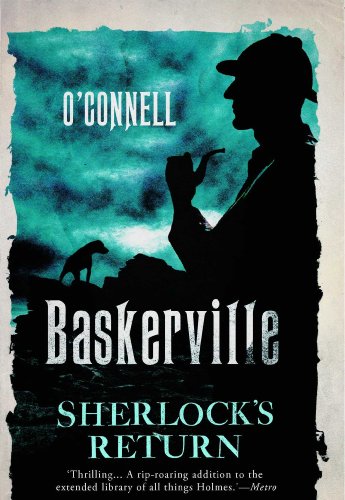
Inhaltsangabe
Based on true events in the life of Sir Arthur Conan Doyle, this darkly thrilling tale of friendship, rivalry, and ambition tells the backstory of how one of the world’s most celebrated mysteries came to be written.
Dartmoor, 1900. Two friends are roaming the moors: Arthur Conan Doyle – the most famous novelist of his age – who has recently killed off his most popular creation, Sherlock Holmes; and Bertram Fletcher Robinson – Holmes aficionado and editor of the Daily Express.
They are researching a detective novel, a collaboration starring a new hero, set in the eerie stillness of ancient West Country moorland, and featuring a monstrous dog. They already have a title…
London, 1902. The Hound of the Baskervilles is published, featuring Sherlock Holmes back from the dead. Conan Doyle and Fletcher Robinson have not spoken for two years and the book is credited to just one author. It will become one of the most famous stories ever written. But who really wrote it? And what really happened on those moors, to drive the two friends apart?
Die Inhaltsangabe kann sich auf eine andere Ausgabe dieses Titels beziehen.
Über die Autorin bzw. den Autor
John O’Connell worked for several years at Time Out. He now writes, mostly about books, for The Times, The Guardian, New Statesman, and The National. He lives with his family in south London.
Auszug. © Genehmigter Nachdruck. Alle Rechte vorbehalten.
Baskerville
Chapter 1
It is often hard to recall the exact circumstances of a meeting. But I can say for certain that I first met Dr Arthur Conan Doyle on the morning of July 11th, 1900. We were waiting to sail from Cape Town back to Southampton on the SS Briton, the most graceful of the Union mail steamers.
Like every other available vessel, the Briton had been requisitioned as a troop transport. It had done well in the early days of the second South African war, rushing out some 1,500 soldiers in under 15 days. Now she was bringing them back; some of them, at any rate, for our fight against the Boer was far from over.
As I leaned over the deck rail, straining for a better view of the gaunt Tommies waiting to board, a voice close behind startled me so that I almost lost my balance.
‘Of course,’ it said, ‘a good many of them will be afflicted by enteric fever.’
It was a deep, confident voice lent charm by a slight Scottish accent. I turned and was confronted by its owner, a man I recognised immediately from engravings and photographs as the creator of Sherlock Holmes; though as I said, I had not met him before.
He, however, believed differently. ‘We’ve been introduced,’ he said. ‘You are Bertram Fletcher Robinson, journalist and sports writer.’
I agreed that I was. But I also admitted, as I felt I must, that I had no memory of our meeting.
Doyle appeared unconcerned. ‘It was at the Reform Club. You are a Reformer, aren’t you?’
‘I am.’
‘Well then,’ he said, as if that concluded the matter.
Like me, Doyle is a tall man, his build stout and athletic. But he had lost weight in Bloemfontein, where he was working as voluntary supervisor at Langman’s field hospital; so much that his double-breasted linen suit billowed out in a manner it was hard not to find comical.
I had noticed when we shook hands that his skin was clammy. Considering him now, more attentively, it was obvious he was unwell. Every so often a ripple passed across his pale face as if from some palsy. The weather was not yet hot – on the contrary, there was a pleasantly light morning breeze – but fat beads of perspiration glistened on his forehead.
Doyle saw my concern. ‘Please don’t worry,’ he said. ‘I was inoculated with the serum on the way out. Whatever this is, it’s nothing serious.’
‘Can you be sure?’
He smiled weakly. ‘Self-diagnosis is a doctor’s greatest pleasure.’
We stood there for what might have been ten minutes – not talking, just gazing at what we were shortly to leave behind: Cape Town itself, spread out along the margin of the bay; Table Mountain, whose broad, flattened summit I still longed to visit; and the whole noisy scrum of wharf life, so intoxicating when first you encountered it: Malays and Kaffirs in various states of undress, all wanting to carry your luggage to the custom-house or get you a wagon or sell you fruit – great dewy heaps of purple and white grapes, nectarines, figs, melons, apricots, all wonderfully cheap.
It was Doyle who broke the silence. ‘Such a charming place,’ he said. ‘A fine country. Anyone with any energy could make a fortune here in no time.’
‘I’ve plenty of energy,’ I said, ‘but not for mining or entrepreneurialism.’
‘No? For what, then?’
‘I’m to be Managing Editor of the Daily Express. It’s why I’m returning to London.’
At this Doyle insisted on shaking my hand again. ‘My dear fellow, congratulations! They must be pleased with your work out here. Now I remember, there was an Express at the hospital and I read one of your dispatches. What was it called – “Cape Town for Empire”? Do I have it right?’
‘That was my first,’ I pointed out, not without pride.
‘Was it? Well, well. It was very good. Very thoughtful. I’m writing something myself, as it happens. A history of the conflict. I should have it finished soon.’
He stopped suddenly, gripped the deck rail and shuddered, as if a wave of nausea had overtaken him.
I rushed forward and made to grasp his arm. ‘Dr Doyle?’
He put up a hand. ‘Please. It will pass. We must talk another time, over dinner. I won’t want food tonight, but this thing comes and goes.’
‘Perhaps tomorrow evening?’
‘Yes, yes. Come to the first-class saloon for seven o’clock.’
With this Doyle turned and, using the rail for support, edged cautiously along the deck in the direction of his cabin.
Doyle had a cabin to himself on the main deck. My quarters were less salubrious, though still not too badly appointed: those of us with War Office press passes were billeted in what would have been first class.
About a hundred soldiers slept on the lower deck in hammocks strung up in rows. I went there only once, in a spirit of journalistic enquiry. I found the conditions cramped and stifling, rendered more unpleasant still by the want of convenience for washing.
Once the anchor was drawn up we soon lost sight of Cape Town and the Cape of Good Hope. Though the sky remained clear and blue, sailing conditions worsened. A heavy beam swell rolled us around and I came close to adding my own weave to the fetid carpet I had noticed on the deck below.
Evidently Doyle felt wretched as well. He postponed our dinner – first one night, then another.
The monotony of shipboard life gets to everyone and I confess I grew jittery and impatient. Weary, too. Too weary to take pleasure in sights I had relished on the way out, like the shoals of flying fish and even the other passing steamers, identification of which had once been the goal of much clamorous and excited sharing of field glasses.
My attempts to organise races and other athletic activities came mostly to nothing. One afternoon I persuaded several soldiers to join me in a game of deck-quoit. When their enthusiasm waned, too quickly for my liking, I passed the time reading and playing chess with a nonconformist missionary whose foul breath I had to turn my head to evade.
I also wrote at length to Gladys, my fiancée, knowing I could post the letter in Las Palmas when we stopped to take on coal.
I told her of my excitement at meeting Doyle. She would understand, I knew; for like me she had read with awe every Sherlock Holmes story. She shared my frustration at Doyle’s decision seven years before to kill off the great detective in ‘The Final Problem’.
How can I do justice to Gladys?
Perhaps I can’t.
Let me just say that while I was away I carried in my head not merely her image – the golden ringletted hair; the light-grey eyes which seem to communicate the finest gradations of thought; the roundness and smoothness of her cheeks – but a sense-memory of her exuberant vitality. It was palpable, physical, like stray hairs left behind on a brush, or the floral smell of her neck as I stooped to kiss her.
Her letters had sustained me on the front line. I loved them for their combination of domestic detail and political analysis; though I confess their naïve...
„Über diesen Titel“ kann sich auf eine andere Ausgabe dieses Titels beziehen.
Suchergebnisse für Baskerville: The Mysterious Tale of Sherlock's...

Foto des Verkäufers
Baskerville: The Mysterious Tale of Sherlock's Return
Verlag:
Atria Books/Marble Arch Press, 2013
ISBN 10: 1476730237
ISBN 13: 9781476730233
Gebraucht
Softcover
Anbieter: -OnTimeBooks-, Phoenix, AZ, USA
Verkäuferbewertung 5 von 5 Sternen

Zustand: good. A copy that has been read, remains in good condition. All pages are intact, and the cover is intact. The spine and cover show signs of wear. Pages can include notes and highlighting and show signs of wear, and the copy can include "From the library of" labels or previous owner inscriptions. 100% GUARANTEE! Shipped with delivery confirmation, if you're not satisfied with purchase please return item! Ships via media mail. Bestandsnummer des Verkäufers OTV.1476730237.G
Gebraucht kaufen
EUR 6,22
Versand gratis
Versand innerhalb von USA
Versand innerhalb von USA
Anzahl: 1 verfügbar
Beispielbild für diese ISBN
Baskerville : The Mysterious Tale of Sherlock's Return
Anbieter: Better World Books, Mishawaka, IN, USA
Verkäuferbewertung 5 von 5 Sternen
Zustand: Very Good. Original. Former library copy. Pages intact with possible writing/highlighting. Binding strong with minor wear. Dust jackets/supplements may not be included. Includes library markings. Stock photo provided. Product includes identifying sticker. Better World Books: Buy Books. Do Good. Bestandsnummer des Verkäufers 1391046-20
Gebraucht kaufen
EUR 6,50
Versand gratis
Versand innerhalb von USA
Versand innerhalb von USA
Anzahl: 1 verfügbar
Beispielbild für diese ISBN
Baskerville
Verlag:
Atria Books/Marble Arch Press, 2013
ISBN 10: 1476730237
ISBN 13: 9781476730233
Gebraucht
Paperback
Anbieter: Whodunit Bookshop, Winnipeg, MB, Kanada
Verkäuferbewertung 5 von 5 Sternen
Paperback. Zustand: Very Good. Bestandsnummer des Verkäufers 978147673023U
Gebraucht kaufen
EUR 8,43
EUR 46,79 Versand
Versand von Kanada nach USA
Versand von Kanada nach USA
Anzahl: 1 verfügbar