
Verwandte Artikel zu Hard Choices
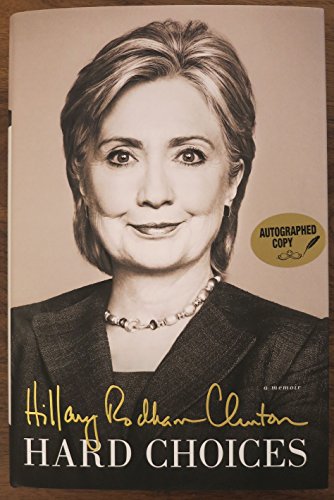
Inhaltsangabe
Hillary Rodham Clinton’s inside account of the crises, choices, and challenges she faced during her four years as America’s 67th Secretary of State, and how those experiences drive her view of the future.
“All of us face hard choices in our lives,” Hillary Rodham Clinton writes at the start of this personal chronicle of years at the center of world events. “Life is about making such choices. Our choices and how we handle them shape the people we become.”
In the aftermath of her 2008 presidential run, she expected to return to representing New York in the United States Senate. To her surprise, her former rival for the Democratic Party nomination, newly elected President Barack Obama, asked her to serve in his administration as Secretary of State. This memoir is the story of the four extraordinary and historic years that followed, and the hard choices that she and her colleagues confronted.
Secretary Clinton and President Obama had to decide how to repair fractured alliances, wind down two wars, and address a global financial crisis. They faced a rising competitor in China, growing threats from Iran and North Korea, and revolutions across the Middle East. Along the way, they grappled with some of the toughest dilemmas of US foreign policy, especially the decision to send Americans into harm’s way, from Afghanistan to Libya to the hunt for Osama bin Laden.
By the end of her tenure, Secretary Clinton had visited 112 countries, traveled nearly one million miles, and gained a truly global perspective on many of the major trends reshaping the landscape of the twenty-first century, from economic inequality to climate change to revolutions in energy, communications, and health. Drawing on conversations with numerous leaders and experts, Secretary Clinton offers her views on what it will take for the United States to compete and thrive in an interdependent world. She makes a passionate case for human rights and the full participation in society of women, youth, and LGBT people. An astute eyewitness to decades of social change, she distinguishes the trendlines from the headlines and describes the progress occurring throughout the world, day after day.
Secretary Clinton’s descriptions of diplomatic conversations at the highest levels offer readers a master class in international relations, as does her analysis of how we can best use “smart power” to deliver security and prosperity in a rapidly changing world—one in which America remains the indispensable nation.
Die Inhaltsangabe kann sich auf eine andere Ausgabe dieses Titels beziehen.
Über die Autorin bzw. den Autor
Hillary Rodham Clinton is the first woman to be nominated for president by a major political party and the winner of the national popular vote. She served as Secretary of State after nearly four decades in public service as an attorney, First Lady, and US Senator. She is married to former US President Bill Clinton and is a mother and grandmother. Visit HillaryClinton.com.
Auszug. © Genehmigter Nachdruck. Alle Rechte vorbehalten.
17
Benghazi: Under Attack
On September 11, 2012, Ambassador Chris Stevens and Information Management Officer Sean Smith were killed in a terrorist attack on our diplomatic compound in Benghazi, Libya. Two CIA officers, Glen Doherty and Tyrone Woods, were killed hours later during an attack on the Agency’s nearby compound.
Sean Smith had joined the State Department after six years in the Air Force and served for a decade at our embassies and consulates in Pretoria, Baghdad, Montreal, and The Hague.
Tyrone Woods was known to his friends in the Navy SEALs and later the CIA as “Rone.” He served multiple tours in Iraq and Afghanistan. In addition to being an experienced combat veteran, he also earned distinction as a registered nurse and certified paramedic. He and his wife, Dorothy, had three sons, including one born just a few months before he died.
Glen Doherty, who went by “Bub,” was a former SEAL as well and an experienced paramedic. He too had deployed to some of the most dangerous places on earth, including Iraq and Afghanistan, always putting his life on the line to safeguard other Americans. Both Tyrone and Glen had committed their skills and experience to protecting CIA personnel in Libya.
Ambassador Chris Stevens, the only one of the four I had the privilege of knowing personally, was a talented diplomat and an engaging and extraordinarily warm human being. When I asked him in the spring of 2011 to undertake the dangerous mission to make contact with the Libyan rebel leadership in Benghazi during the revolution, and later to return to Libya as Ambassador after the fall of Qaddafi, he quickly accepted. Chris understood the risks and recognized how challenging it would be to help pull together a shattered country, but he knew that America had vital national security interests at stake. His long experience in the region and talent for delicate diplomacy made him a natural choice.
Losing these fearless public servants in the line of duty was a crushing blow. As Secretary I was the one ultimately responsible for my people’s safety, and I never felt that responsibility more deeply than I did that day.
Sending those who serve our nation into harm’s way is one of the hardest choices our country and leaders ever have to make. Far and away my greatest regret from those years is that not all of them returned home safely. I often think about the families who lost loved ones serving our country. The gravity of the mission and the gratitude of our nation may provide some solace, but in the end there is nothing any of us can say or do to fill the holes left behind.
The truest way to honor them is to improve our ability to protect those who carry on their work and prevent future losses.
From my first day leading the State Department, I was aware that terrorists could strike any of our more than 270 diplomatic posts around the world. It had happened too many times before, and those hell-bent on attacking America would never stop trying. In 1979, fifty-two American diplomats were taken hostage in Iran and held captive for 444 days. The Hezbollah attacks on our embassy and Marine barracks in Beirut in 1983 killed 258 Americans and more than a hundred others. In 1998, al Qaeda bombed our embassies in Kenya and Tanzania, killing more than two hundred people, including twelve Americans. I vividly remember standing next to Bill at Andrews Air Force Base when the remains of those who had fallen returned home.
All told, terrorists have killed sixty-six American diplomatic personnel since the 1970s and more than a hundred contractors and locally employed staff. Four U.S. Ambassadors were murdered in terrorist attacks between 1973 and 1979 alone. Since 2001 there have been more than one hundred assaults on U.S. diplomatic facilities around the world and nearly two dozen direct attacks on diplomatic personnel. In 2004, gunmen killed nine people, including five locally employed staff in an attack on our consulate in Jeddah, Saudi Arabia. In May 2009, a roadside bomb in Iraq killed Terry Barnich, the Deputy Director of our Transition Assistance Team. In March 2010, Lesley Enriquez, a pregnant twenty-five-year-old consular officer in Juarez, Mexico, was shot to death, along with her husband. In August 2012, USAID officer Ragaei Said Abdelfattah was killed by a suicide bomber in Afghanistan. As of 2014, 244 of America’s diplomats have fallen in our nation’s history while serving overseas.
Diplomacy, by its very nature, must often be practiced in dangerous places where America’s national security hangs in the balance. We have to weigh the imperatives of our national security against the sacrifices required to safeguard it. As Secretary of State I was responsible for nearly seventy thousand employees, and I deeply admired those who volunteered to accept the risks that come with carrying our flag where it is needed most. Every day as they walk into work the men and women of the State Department pass the names of those 244 fallen diplomats inscribed in marble in the lobby of the Harry S Truman Building. It’s a constant reminder of the risks that come with representing the United States around the world. I was heartened—though not surprised—to learn from the Department that after major attacks against the United States, applications to the Foreign Service went up. People want to serve our country, even when it means being in harm’s way. Nothing speaks more to the character and dedication of those who represent our country around the world.
The events of September 2012, and the choices made in the days and weeks before and since, throw into sharp relief some of the toughest dilemmas of American foreign policy—and the heartbreaking human stakes of every decision we make. Our diplomats must balance the necessity of engaging in difficult and dangerous settings with the need to stay safe and secure. As a country, we have to do more to protect them, without preventing them from doing their important jobs. We need to stay open to the world in a time when any provocation can spark anti-American riots across the globe and far-flung terrorist groups continue to plot new attacks. Ultimately these challenges boil down to this: Are we willing to shoulder the burdens of American leadership in a perilous age?
Part of the answer came from the independent investigation into the Benghazi attacks, which noted, “The total elimination of risk is a non-starter for U.S. diplomacy, given the need for the U.S. government to be present in places where stability and security are often most profoundly lacking and host government support is sometimes minimal to non-existent.”
While we can and must work to reduce the danger, the only way to eliminate risk entirely is to retreat entirely and to accept the consequences of the void we leave behind. When America is absent, extremism takes root, our interests suffer, and our security at home is threatened. There are some who believe that is the better choice; I am not one of them. Retreat is not the answer; it won’t make the world a safer place, and it’s just not in our country’s DNA. When faced with setbacks and tragedies, Americans have always worked harder and smarter. We strive to learn from our mistakes and avoid repeating them. And we do not shrink from the challenges ahead. That is what we must continue to do.
The events of that September occurred in what is often called the “fog of war,” with...
„Über diesen Titel“ kann sich auf eine andere Ausgabe dieses Titels beziehen.
Suchergebnisse für Hard Choices

Beispielbild für diese ISBN
Hard Choices
Anbieter: World of Books (was SecondSale), Montgomery, IL, USA
Verkäuferbewertung 5 von 5 Sternen

Zustand: Acceptable. Item in acceptable condition! Textbooks may not include supplemental items i.e. CDs, access codes etc. Bestandsnummer des Verkäufers 00096082469
Gebraucht kaufen
EUR 4,20
Versand gratis
Versand innerhalb von USA
Versand innerhalb von USA
Anzahl: 5 verfügbar
Beispielbild für diese ISBN
Hard Choices
Anbieter: World of Books (was SecondSale), Montgomery, IL, USA
Verkäuferbewertung 5 von 5 Sternen
Zustand: Good. Item in good condition. Textbooks may not include supplemental items i.e. CDs, access codes etc. Bestandsnummer des Verkäufers 00086102116
Gebraucht kaufen
EUR 4,20
Versand gratis
Versand innerhalb von USA
Versand innerhalb von USA
Anzahl: Mehr als 20 verfügbar
Foto des Verkäufers
Hard Choices: A Memoir
Anbieter: Used Book Company, Egg Harbor Township, NJ, USA
Verkäuferbewertung 5 von 5 Sternen
Zustand: Very Good. Shows minimal signs of wear and previous use. Can include minimal notes/highlighting. A portion of your purchase benefits nonprofits! - Note: Edition & format may differ from what is shown in stock photo & item details. May not include supplementary material (toys, access code, dvds, etc). Bestandsnummer des Verkäufers 584UZG000CCH_ns
Gebraucht kaufen
EUR 4,21
Versand gratis
Versand innerhalb von USA
Versand innerhalb von USA
Anzahl: 2 verfügbar
Foto des Verkäufers
Hard Choices: A Memoir
Anbieter: Used Book Company, Egg Harbor Township, NJ, USA
Verkäuferbewertung 5 von 5 Sternen
Zustand: Good. Former library copy. Shows moderate signs of wear and previous use. Can include notes/highlighting. A portion of your purchase benefits nonprofits! - Note: Edition & format may differ from what is shown in stock photo & item details. May not include supplementary material (toys, access code, dvds, etc). Bestandsnummer des Verkäufers 584UZG000EP1_ns
Gebraucht kaufen
EUR 4,21
Versand gratis
Versand innerhalb von USA
Versand innerhalb von USA
Anzahl: 2 verfügbar
Beispielbild für diese ISBN
Hard Choices: A Memoir
Anbieter: Gulf Coast Books, Cypress, TX, USA
Verkäuferbewertung 5 von 5 Sternen
Hardcover. Zustand: Fair. Bestandsnummer des Verkäufers 1476751447-4-22192148
Gebraucht kaufen
EUR 4,30
Versand gratis
Versand innerhalb von USA
Versand innerhalb von USA
Anzahl: 1 verfügbar
Beispielbild für diese ISBN
Hard Choices: A Memoir
Anbieter: Gulf Coast Books, Cypress, TX, USA
Verkäuferbewertung 5 von 5 Sternen
Hardcover. Zustand: Good. Bestandsnummer des Verkäufers 1476751447-3-18538301
Gebraucht kaufen
EUR 4,30
Versand gratis
Versand innerhalb von USA
Versand innerhalb von USA
Anzahl: 1 verfügbar
Beispielbild für diese ISBN
Hard Choices: A Memoir
Anbieter: Orion Tech, Kingwood, TX, USA
Verkäuferbewertung 5 von 5 Sternen
Hardcover. Zustand: Good. Bestandsnummer des Verkäufers 1476751447-3-22012414
Gebraucht kaufen
EUR 4,30
Versand gratis
Versand innerhalb von USA
Versand innerhalb von USA
Anzahl: 2 verfügbar
Foto des Verkäufers
Hard Choices: A Memoir
Anbieter: Zoom Books Company, Lynden, WA, USA
Verkäuferbewertung 5 von 5 Sternen
Zustand: very_good. Book is in very good condition and may include minimal underlining highlighting. The book can also include "From the library of" labels. May not contain miscellaneous items toys, dvds, etc. . We offer 100% money back guarantee and 24 7 customer service. Bestandsnummer des Verkäufers ZBV.1476751447.VG
Gebraucht kaufen
EUR 4,31
Versand gratis
Versand innerhalb von USA
Versand innerhalb von USA
Anzahl: 1 verfügbar
Foto des Verkäufers
Hard Choices: A Memoir
Anbieter: Reliant Bookstore, El Dorado, KS, USA
Verkäuferbewertung 5 von 5 Sternen
Zustand: like_new. This book is in like new condition. Cover image on the book may vary from photo. Ships out quickly in a secure plastic mailer. Bestandsnummer des Verkäufers RDV.1476751447.LN
Gebraucht kaufen
EUR 4,50
Versand gratis
Versand innerhalb von USA
Versand innerhalb von USA
Anzahl: 1 verfügbar
Foto des Verkäufers
Hard Choices: A Memoir
Anbieter: Reliant Bookstore, El Dorado, KS, USA
Verkäuferbewertung 5 von 5 Sternen
Zustand: good. This book is in good condition with very minimal damage. Pages may have minimal notes or highlighting. Cover image on the book may vary from photo. Ships out quickly in a secure plastic mailer. Bestandsnummer des Verkäufers 56JTFK000YEG_ns
Gebraucht kaufen
EUR 4,50
Versand gratis
Versand innerhalb von USA
Versand innerhalb von USA
Anzahl: 3 verfügbar