
Teachable Moments: Using Everyday Encounters with Media and Culture to Instill Conscience, Character, and Faith - Softcover
Inhaltsangabe
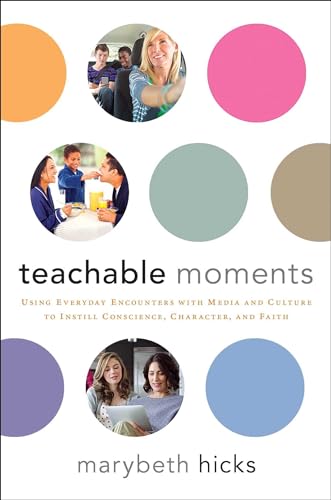
Nationally syndicated columnist and media advisor on parenting, Marybeth Hicks outlines the overarching issues in using daily encounters with the current media-driven culture to impart the values and virtues of Christianity.
Never have Christian families been so challenged by the world around them to instill and instruct their children in the tenets of their faith. In today’s day and age, children and teens are surrounded on all sides by popular culture through incessant streams of social media on their cell phones, televisions, and computers. The constant presence of social media in your child’s daily life can influence and define their attitudes and behaviors. As parents and role models for the millennial generation, how do we overcome the moral relativism that saturates our culture to help our children put their faith into action and live out the values and virtues embodied in Jesus Christ? Marybeth Hicks shows Christian families how through “teachable moments.”
These teachable moments might be as simple as incorporating empathy and compassion in early friendships, or as complex as understanding the subtleties of our culture’s potentially destructive messages about human sexuality. They might present themselves in song lyrics, teacher’s comments, television shows, social media interactions, and current events. Teachable moments can emerge in parenting decisions, family relationships, school situations, and in opportunities for freedom and responsibility as our children engage with the world around them.
Through Teachable Moments Marybeth Hicks has created “a parent’s field guide to navigate a challenging culture” (Dr. Michele Borba). With entertaining and instructive questions and answers, this enriching handbook provides concrete examples of teachable moments that will ring true for you as you maximize opportunities to instill important life lessons into the everyday experiences of your children.
Die Inhaltsangabe kann sich auf eine andere Ausgabe dieses Titels beziehen.
Über die Autorin bzw. den Autor
Marybeth Hicks is a columnist and speaker and the author of three previous books on parenting and culture. Founder and editor of the blog, OntheCulture.com, she also writes a monthly family column for Catholic Digest magazine and is a regular contributor to EWTN radio. Formerly a columnist for The Washington Times, Marybeth is a frequent guest on national television and radio outlets to comment on issues that impact families and communities. She and her husband, Jim, are the parents of four children and make their home in Michigan.
Auszug. © Genehmigter Nachdruck. Alle Rechte vorbehalten.
Teachable Moments
CHAPTER ONE
Parenting in the Moment
YOU ASK YOUR TEN-YEAR-OLD son to get the newspaper from the front porch. When he comes into the kitchen, he’s reading a front-page story about a politician whose claim to fame is his predilection for “sexting” with young women, none of whom is his wife.
On the way to school, you pass a billboard that says EXTREME METH MAKEOVER, featuring before-and-after photos of a methamphetamine addict. Your kids want to know if this is a new reality TV show.
While your older children are at school, you take your four-year-old daughter with you to the grocery store. At the check out, she points to a magazine picture of a scantily clad Miley Cyrus “twerking” on stage and asks, “What is Miley doing?”
After school, you’re the carpool driver. A fellow third grader tells your child all about last night’s episode of Glee, which focused on a gay high school romance. You try to change the subject, so the kids tell you about a boy in their class who is being bullied. They’re sure it’s because he is gay.
At dinner, your eight-year-old hums Daft Punk’s “Get Lucky” while your twelve-year-old mentions that the soccer coach dropped an f-bomb while yelling directions at the team.
It’s just another day of parenthood in America, and another night in which you’ll pray that God will help you to build a hedge of protection around your children before the culture steals their hearts away for good.
There’s no way to avoid the intrusion of popular culture into our homes and families, but we don’t have to let these instances exploit and influence our children. Instead, we can use those unplanned opportunities to instill conscience, character, and faith into the hearts and minds of the children God has entrusted to our care.
Educators use the phrase “teachable moments” to describe unforeseen and unexpected opportunities to veer away from a lesson plan in order to capitalize on something that sparks students’ interest. Teachable moments sometimes arise from the day’s headlines or from something that happens in pop culture. They can suggest themselves from something exciting that happens to an individual student, or from an unpleasant incident on the playground. The lessons these moments present aren’t necessarily obvious, or even directly related to the incident itself. Essentially, teachable moments are springboards for learning—any kind of learning, about anything at all.
Intentional Parenting
Educators also use the term “intentional teacher.” According to researcher and author Dr. Ann Epstein, intentional teachers “act purposefully, with a goal in mind and a plan for accomplishing it. Intentional teaching is not an accident. When an unexpected situation arises, as it always does, intentional teachers recognize a teaching opportunity and are able to take advantage of it.”
Intentionality is crucial in parenting, too, especially if we hope to pass along the truth of the Gospel to our kids.
Years ago, my late mother-in-law, a lifelong educator, made an inadvertent comment that helped me to articulate the concept of intentionality. We were visiting her with our two eldest daughters, then four and two years old, and I disciplined them for some reason (who can remember why?). Grandma Nita came to the girls’ defense and said, “You don’t need to be so strict. Your girls are so good and so well-behaved!”
I smiled at her and said, “That’s not actually dumb luck, you know!”
Lots of folks think having “good kids” is just that—luck. But intentional parenting means thinking ahead about the character traits and moral development that you want for your children.
If, by definition, teachable moments are unplanned and unexpected, intentional parents must be vigilant and prepared to recognize them and use them for good. In that sense, any occurrence throughout a typical day could represent a teachable moment. Some come from the outside world, and some develop naturally in your family’s daily life.
External Moments
External moments are those presented by popular culture and current events. They come to us through the media.
American media—once a conduit to receive a limited menu of information and entertainment—is now a fixture in our daily lives, offering a diet of content that quickly overwhelms our limited capacity. Aside from causing nearly constant sensory overload, this ubiquitous media presence means that the people who control the messages that our children consume have pulled up a seat at the family table. Their ideas, opinions, worldviews, and values now are among those that shape and mold our children’s character and conscience.
But media dissemination is no longer a one-way street; it’s aninteractive component woven into the fabric of our existence. It has changed not only our vocabulary, turning random nouns into verbs (“Facebook me!” “Text me!” “DM me!”), but also the ways we relate to our children and the ways they relate to the world. So as we look for teachable moments, we must not only address media consumption but also discuss the use of technology.
It will help to have some perspective about our kids’ generation. Researchers sometimes refer to our children as “Generation M”—Generation Media. In its study about the media habits of children aged eight to eighteen, the Kaiser Family Foundation found in 2010 that young Americans spend an average of seven hours and thirty-eight minutes per day engaged with media. The study also calculated media multi-tasking (surfing the net while watching TV, for example), which increased the total average media time to ten hours and forty-five minutes per day. And this didn’t even include texting!
Parents should be concerned about the amount of time our children spend with media. Study after study proves that the content of our modern media is influencing and molding our children’s character and values. Behaviors related to sex, violence, substance use, consumerism, body image, and interpersonal relationships are modeled in the media with alarming impact. But just as importantly, our children’s attitudes and opinions are formed based on the manner in which important subjects are portrayed in popular culture, and these ideas often are contrary to the tenets of Christianity. Given the conflicting moral messages with which they are constantly confronted, it’s no wonder children and teens are confused or indifferent about how to live the Gospel values.
Still, it’s important to remember that technology itself is morally neutral. Just as it can be used to compromise or even corrupt their souls, it also can be a tool to teach and promote the lessons our children need to live moral and faithful lives. Media devices can isolate us from one another, but if we use them in a positive way, they can bring us together. The trick is to have mastery over our media consumption, and not let media have mastery over us.
Organic Moments
It’s not just the outside world as experienced through the media that offers teachable moments. Teachable moments also come simply from living our lives. Family relationships and friendships, sports and extracurricular activities, and episodes of growth and maturity create opportunities to teach valuable lessons. The American ethos itself...
„Über diesen Titel“ kann sich auf eine andere Ausgabe dieses Titels beziehen.
Weitere beliebte Ausgaben desselben Titels

Suchergebnisse für Teachable Moments: Using Everyday Encounters with Media...

Beispielbild für diese ISBN
Teachable Moments: Using Everyday Encounters with Media and Culture to Instill Conscience, Character, and Faith
Anbieter: Wonder Book, Frederick, MD, USA
Verkäuferbewertung 5 von 5 Sternen

Zustand: As New. Like New condition. A near perfect copy that may have very minor cosmetic defects. Bestandsnummer des Verkäufers Q09Q-00195
Gebraucht kaufen
EUR 6,75
Versand gratis
Versand innerhalb von USA
Versand innerhalb von USA
Anzahl: 1 verfügbar
Beispielbild für diese ISBN
Teachable Moments: Using Everyday Encounters with Media and Culture to Instill Conscience, Character, and Faith
Anbieter: ThriftBooks-Dallas, Dallas, TX, USA
Verkäuferbewertung 5 von 5 Sternen
Paperback. Zustand: Good. No Jacket. Former library book; Pages can have notes/highlighting. Spine may show signs of wear. ~ ThriftBooks: Read More, Spend Less. Bestandsnummer des Verkäufers G1476757518I3N10
Gebraucht kaufen
EUR 6,91
Versand gratis
Versand innerhalb von USA
Versand innerhalb von USA
Anzahl: 1 verfügbar
Beispielbild für diese ISBN
Teachable Moments: Using Everyday Encounters with Media and Culture to Instill Conscience, Character, and Faith
Anbieter: ThriftBooks-Dallas, Dallas, TX, USA
Verkäuferbewertung 5 von 5 Sternen
Paperback. Zustand: Very Good. No Jacket. May have limited writing in cover pages. Pages are unmarked. ~ ThriftBooks: Read More, Spend Less. Bestandsnummer des Verkäufers G1476757518I4N00
Gebraucht kaufen
EUR 6,91
Versand gratis
Versand innerhalb von USA
Versand innerhalb von USA
Anzahl: 1 verfügbar
Beispielbild für diese ISBN
Teachable Moments: Using Everyday Encounters with Media and Culture to Instill Conscience, Character, and Faith
Anbieter: HPB-Emerald, Dallas, TX, USA
Verkäuferbewertung 5 von 5 Sternen
paperback. Zustand: Very Good. Connecting readers with great books since 1972! Used books may not include companion materials, and may have some shelf wear or limited writing. We ship orders daily and Customer Service is our top priority! Bestandsnummer des Verkäufers S_474940738
Gebraucht kaufen
EUR 6,65
EUR 3,24 Versand
Versand innerhalb von USA
Versand innerhalb von USA
Anzahl: 1 verfügbar
Beispielbild für diese ISBN
Teachable Moments: Using Everyday Encounters with Media and Culture to Instill Conscience, Character, and Faith
Anbieter: HPB Inc., Dallas, TX, USA
Verkäuferbewertung 5 von 5 Sternen
paperback. Zustand: Very Good. Connecting readers with great books since 1972! Used books may not include companion materials, and may have some shelf wear or limited writing. We ship orders daily and Customer Service is our top priority! Bestandsnummer des Verkäufers S_475544732
Gebraucht kaufen
EUR 6,65
EUR 3,24 Versand
Versand innerhalb von USA
Versand innerhalb von USA
Anzahl: 1 verfügbar
Beispielbild für diese ISBN
Teachable Moments: Using Everyday Encounters with Media and Culture to Instill Conscience, Character, and Faith
Anbieter: Lakeside Books, Benton Harbor, MI, USA
Verkäuferbewertung 5 von 5 Sternen
Zustand: New. Brand New! Not Overstocks or Low Quality Book Club Editions! Direct From the Publisher! We're not a giant, faceless warehouse organization! We're a small town bookstore that loves books and loves it's customers! Buy from Lakeside Books! Bestandsnummer des Verkäufers OTF-S-9781476757513
Neu kaufen
EUR 9,15
EUR 3,44 Versand
Versand innerhalb von USA
Versand innerhalb von USA
Anzahl: Mehr als 20 verfügbar
Beispielbild für diese ISBN
Teachable Moments Format: Paperback
Anbieter: INDOO, Avenel, NJ, USA
Verkäuferbewertung 5 von 5 Sternen
Zustand: As New. Unread copy in mint condition. Bestandsnummer des Verkäufers SS9781476757513
Gebraucht kaufen
EUR 13,66
Versand gratis
Versand innerhalb von USA
Versand innerhalb von USA
Anzahl: Mehr als 20 verfügbar
Beispielbild für diese ISBN
Teachable Moments Format: Paperback
Anbieter: INDOO, Avenel, NJ, USA
Verkäuferbewertung 5 von 5 Sternen
Zustand: New. Brand New. Bestandsnummer des Verkäufers 9781476757513
Neu kaufen
EUR 13,75
Versand gratis
Versand innerhalb von USA
Versand innerhalb von USA
Anzahl: Mehr als 20 verfügbar
Beispielbild für diese ISBN
Teachable Moments: Using Everyday Encounters with Media and Culture to Instill Conscience, Character, and Faith
Anbieter: California Books, Miami, FL, USA
Verkäuferbewertung 4 von 5 Sternen

Zustand: New. Bestandsnummer des Verkäufers I-9781476757513
Neu kaufen
EUR 15,11
Versand gratis
Versand innerhalb von USA
Versand innerhalb von USA
Anzahl: Mehr als 20 verfügbar
Beispielbild für diese ISBN
Teachable Moments (Paperback)
Print-on-DemandAnbieter: Grand Eagle Retail, Bensenville, IL, USA
Verkäuferbewertung 5 von 5 Sternen
Paperback. Zustand: new. Paperback. Nationally syndicated columnist and media advisor on parenting, Marybeth Hicks outlines the overarching issues in using daily encounters with the current media-driven culture to impart the values and virtues of Christianity.Never have Christian families been so challenged by the world around them to instill and instruct their children in the tenets of their faith. In today's day and age, children and teens are surrounded on all sides by popular culture through incessant streams of social media on their cell phones, televisions, and computers. The constant presence of social media in your child's daily life can influence and define their attitudes and behaviors. As parents and role models for the millennial generation, how do we overcome the moral relativism that saturates our culture to help our children put their faith into action and live out the values and virtues embodied in Jesus Christ? Marybeth Hicks shows Christian families how through "teachable moments." These teachable moments might be as simple as incorporating empathy and compassion in early friendships, or as complex as understanding the subtleties of our culture's potentially destructive messages about human sexuality. They might present themselves in song lyrics, teacher's comments, television shows, social media interactions, and current events. Teachable moments can emerge in parenting decisions, family relationships, school situations, and in opportunities for freedom and responsibility as our children engage with the world around them. Through Teachable Moments Marybeth Hicks has created "a parent's field guide to navigate a challenging culture" (Dr. Michele Borba). With entertaining and instructive questions and answers, this enriching handbook provides concrete examples of teachable moments that will ring true for you as you maximize opportunities to instill important life lessons into the everyday experiences of your children. This item is printed on demand. Shipping may be from multiple locations in the US or from the UK, depending on stock availability. Bestandsnummer des Verkäufers 9781476757513