
Verwandte Artikel zu Get What's Yours: The Secrets to Maxing Out Your...
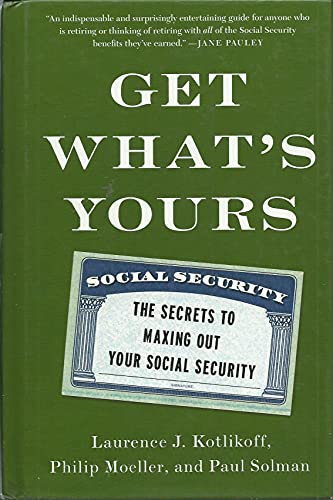
Get What's Yours: The Secrets to Maxing Out Your Social Security (The Get What's Yours Series) - Hardcover
Inhaltsangabe
Social Security law has changed! Key secrets may require action before April 30, 2016. If you or your spouse turns 66 by then, you should read this book, and everyone should read updates on the authors' website, GetWhatsYours.org.
But even with the law changes, the book explains numerous secrets to maximizing your Social Security benefits that you can’t get anywhere else. And above all, Get What's Yours explains the lifetime payoff from waiting as long as possible.
To navigate the forbidding maze of Social Security and emerge with the highest possible benefits, you could try reading all 2,728 rules of the Social Security system (and the thousands of explanations of these rules). But Kotlikoff, Moeller, and Solman do the navigating for you, explaining Social Security benefits in an easy to understand and user-friendly style. What you don’t know can seriously hurt you: wrong decisions about which Social Security benefits to apply for cost some individual retirees thousands in lost income every year.
Get What’s Yours covers the most frequent benefit scenarios faced by married retired couples, by divorced retirees, by widows and widowers, among others. It explains what to do if you’re a retired parent of dependent children, disabled, or an eligible beneficiary who continues to work, and how to plan wisely before retirement. It addresses the tax consequences of your choices, as well as the financial implications for other investments.
Many personal finance books briefly address Social Security, but none offers the thorough, authoritative, yet conversational analysis found here.
Die Inhaltsangabe kann sich auf eine andere Ausgabe dieses Titels beziehen.
Über die Autorin bzw. den Autor
Laurence J. Kotlikoff is a professor of economics at Boston University and president of Economic Security Planning, Inc. His company websites are ESPlanner.com and MaximizeMySocialSecurity.com. To learn more, visit GetWhatsYours.org.
Journalist Philip Moeller writes about retirement for Money and authors the Ask Phil Medicare column for PBS. He also is a Research Fellow at the Center on Aging & Work at Boston College and the founder of Insure.com, a leading site for insurance information.
Paul Solman is the business and economics correspondent for the PBS NewsHour and is a Brady-Johnson Distinguished Practitioner in Grand Strategy at the International Security Studies department at Yale University.
Auszug. © Genehmigter Nachdruck. Alle Rechte vorbehalten.
Get What’s Yours
1
GETTING PAUL NEARLY $50,000 IN EXTRA BENEFITS OVER TENNIS
This book was born of a simple question—How old are Paul and his wife?
Larry and Paul were taking a break from what they call tennis, shooting the breeze, since talking is easier than running after errant shots. Larry launched into a harangue, as he often does; this one was about Social Security’s impossible complexity. Paul was listening, as usual, with his skeptical journalist’s ear. Or, maybe, since it was Larry, just half-listening.
Then Larry asked, How old were Paul and his wife and when were they planning to take their Social Security benefits?
Proudly, Paul told Larry not to worry: he and his wife had it all figured out. They would both wait until 70, when Paul would get something like $40,000 a year instead of the $30,000 or so if he took his benefits at 66, his “full”—but not “maximum”—retirement age, which was coming right up. Paul had been reading and saving those annual green statements from the Social Security Administration for years with their “Estimated Benefits.” He’d been reading his wife’s, too. As the family’s financial planner, he knew just how much they were entitled to.
But how old are you and Jan? Larry asked.
What difference does it make? said Paul. Like I say, we’re both waiting until 70.
It makes a big difference, said Larry.
Okay, Paul’s wife would soon turn 66; he, 65.
Here’s what you do, said Larry, never at a loss when it comes to speaking in the imperative. Jan should apply for her Social Security retirement benefit when she turned 66, but then “suspend” it. That is, she would make herself eligible for the benefit but wouldn’t take it.
Then, said Larry, when you (Paul) turn 66, you apply just for a spousal benefit. When you each hit 70, you do as originally planned—you each take your own retirement benefits, at which point they will start at their highest possible values.
Or, Larry continued, clearly thinking aloud, you apply and suspend at 66 and Jan begins taking the spousal benefit, since you earned more than she did, didn’t you?
Paul can be quite dismissive of what he considers Larry’s flights of fantasy, Larry being the epitome of “often overstated, but never in doubt.” Yet Paul had begun to pay close attention. Having reported on business and economics on public television for decades, Paul understood the intricacies of business, finance, and economics better than most Americans (though admittedly, that may not be saying much). The exceptions, however, were the professional economists he’d befriended in the course of his career. Larry was one of them, and among the most deeply versed in financial planning.
Spousal benefits? Paul had vaguely heard of them. He had, however, never imagined he or his wife were eligible for any, though, had you asked him why not, he couldn’t have told you.
Spousal benefits for four years. That should be almost $50,000, Larry quickly estimated.
An aside is in order here. Larry is a world-famous scold or, he will tell you, a dead-on Cassandra, with respect to Social Security’s insolvency. Advising people like Paul to take extra benefits from the system while himself decrying the system’s funding shortfall was not what Paul expected to hear. (More on that in Chapter 18.) But Larry believes it’s not fair that some beneficiaries get more than others simply because they know the system’s rules. And Paul and Phil agree with him.
Fifty thousand dollars? Explain, Paul said.
Well, if Jan’s Social Security full retirement benefit were, say, $24,000, you’d be eligible to get half that as a spousal benefit: about $12,000 a year. And if you get $12,000 a year from age 66 to age 70, that’s $48,000. If, on the other hand, Jan takes the spousal benefit on your Social Security earnings record, she’ll get more per year but for only three years instead of four, because she’ll be 67 by the time you become eligible, only three years from 70. But still, that would mean . . . etc.
However number-laden the trees, the forest was plain to see: there seemed to be an unambiguous strategy for maximizing benefits that Paul and Jan were eligible to collect, having contributed for decades, but had been entirely unaware of.
If this is true, said Paul, I’m buying you dinner. Anywhere in the world.
Boston will do, said Larry, who also lives there. But there are dozens of really important details like this one. What we should really do (we’re compressing here) is write a book. And we should include Phil Moeller, a retirement expert who’s already spoken with me about such a project. He’s been a financial journalist for years, and has written article after article for U.S. News & World Report and Money about retirees who collectively leave tens of billions of dollars in Social Security benefits on the table by failing to claim everything to which they are entitled. Plus, Phil loves the Red Sox (although not as much as the Baltimore Orioles) and the New England Patriots.
Fast-forward. Paul’s wife came of age (66). She filed and suspended—by phone. The person she talked to couldn’t have been nicer. Paul came of age. He filed for a spousal benefit. The Social Security woman on the phone had never heard of file-and-suspend, checked with her supervisor, and came back on the line to thank him for enlightening her about a strategy she could now share with everyone who called. When they hit 70, both Paul and his wife called again, were again reprocessed—graciously, competently, and within minutes, though his wife was nonplussed when asked if she’d ever been a nun. And Paul has since taken Larry to dinner, and a pretty good dinner at that.
SOCIAL SECURITY VERBATIM
YOU’RE RIGHT THERE (AND WE’RE RIGHT HERE)
“The regulations that require a notice for an initial determination contemplate sending a correct notice. We consider that an initial determination is correct even if we send an incorrect notice.”
ALL QUOTES FROM OFFICIAL SOCIAL SECURITY RULES
GET WHAT’S YOURS—AND YOU DON’T EVEN HAVE TO BUY LARRY A MEAL
We’ve written this book to help people maximize the Social Security benefits they have earned and therefore, we believe, deserve to get. We three authors—Boston University economist Laurence Kotlikoff, journalist and aging expert Phil Moeller, and PBS NewsHour economics correspondent Paul Solman—have spent years studying the system and making it intelligible to the public.
Why have we bothered to write this book?
Because Social Security is, far and away, Americans’ most important retirement asset. And that’s not only true for people of modest means. Middle-income and upper-income households actually have the most to gain, in total amounts, from getting Social Security right. Toting up lifetime benefits, even low-earning couples may be Social Security millionaires. And except for the Bill Gateses and Warren Buffetts of the world—whose percentage of the population was exceedingly modest last we checked—Social Security is a very meaningful income source.
So, this book is for nearly every one of you who’s ever earned a paycheck and wants every Social Security benefit dollar to which you are entitled—entitled because you paid for it. You earned it. It’s yours. It can even be yours...
„Über diesen Titel“ kann sich auf eine andere Ausgabe dieses Titels beziehen.
Suchergebnisse für Get What's Yours: The Secrets to Maxing Out Your...

Beispielbild für diese ISBN
Get What's Yours: The Secrets to Maxing Out Your Social Security
Anbieter: World of Books (was SecondSale), Montgomery, IL, USA
Verkäuferbewertung 5 von 5 Sternen

Hardback. Zustand: Good. Social Security law has changed Key secrets may require action before April 30, 2016. If you or your spouse turns 66 by then, read this book. Learn the secrets to maximizing your Social Security benefits and earn up to thousands of dollars more each year with expert advice that you can t get anywhere else. Want to know how to navigate the forbidding maze of Social Security and emerge with the highest possible benefits? You could try reading all 2,728 rules of the Social Security system (and the thousands of explanations of these rules), but Kotlikoff, Moeller, and Solman explain Social Security benefits in an easy to understand and user-friendly style. What you don t know can seriously hurt you: wrong decisions about which Social Security benefits to apply for cost some individual retirees tens of thousands of dollars in lost income every year. How many retirees or those nearing retirement know about such Social Security options as file and suspend (apply for benefits and then don t take them)? Or start stop start (start benefits, stop them, then re-start them)? Or just as important when and how to use these techniques? Get What s Yours covers the most frequent benefit scenarios faced by married retired couples, by divorced retirees, by widows and widowers, among others. It explains what to do if you re a retired parent of dependent children, disabled, or an eligible beneficiary who continues to work, and how to plan wisely before retirement. It addresses the tax consequences of your choices, as well as the financial implications for other investments. Many personal finance books briefly address Social Security, but none offers the thorough, authoritative, yet conversational analysis found here. You ve paid all your working life for these benefits. Now, get what s yours. Bestandsnummer des Verkäufers 00068165271
Gebraucht kaufen
EUR 3,47
Versand gratis
Versand innerhalb von USA
Versand innerhalb von USA
Anzahl: Mehr als 20 verfügbar
Beispielbild für diese ISBN
Get What's Yours: The Secrets to Maxing Out Your Social Security
Anbieter: World of Books (was SecondSale), Montgomery, IL, USA
Verkäuferbewertung 5 von 5 Sternen
Hardback. Zustand: Very Good. Social Security law has changed Key secrets may require action before April 30, 2016. If you or your spouse turns 66 by then, read this book. Learn the secrets to maximizing your Social Security benefits and earn up to thousands of dollars more each year with expert advice that you can t get anywhere else. Want to know how to navigate the forbidding maze of Social Security and emerge with the highest possible benefits? You could try reading all 2,728 rules of the Social Security system (and the thousands of explanations of these rules), but Kotlikoff, Moeller, and Solman explain Social Security benefits in an easy to understand and user-friendly style. What you don t know can seriously hurt you: wrong decisions about which Social Security benefits to apply for cost some individual retirees tens of thousands of dollars in lost income every year. How many retirees or those nearing retirement know about such Social Security options as file and suspend (apply for benefits and then don t take them)? Or start stop start (start benefits, stop them, then re-start them)? Or just as important when and how to use these techniques? Get What s Yours covers the most frequent benefit scenarios faced by married retired couples, by divorced retirees, by widows and widowers, among others. It explains what to do if you re a retired parent of dependent children, disabled, or an eligible beneficiary who continues to work, and how to plan wisely before retirement. It addresses the tax consequences of your choices, as well as the financial implications for other investments. Many personal finance books briefly address Social Security, but none offers the thorough, authoritative, yet conversational analysis found here. You ve paid all your working life for these benefits. Now, get what s yours. Bestandsnummer des Verkäufers 00106290535
Gebraucht kaufen
EUR 3,47
Versand gratis
Versand innerhalb von USA
Versand innerhalb von USA
Anzahl: 3 verfügbar
Beispielbild für diese ISBN
Get What's Yours: The Secrets to Maxing Out Your Social Security (The Get What's Yours Series)
Anbieter: Your Online Bookstore, Houston, TX, USA
Verkäuferbewertung 5 von 5 Sternen
Hardcover. Zustand: Fair. Bestandsnummer des Verkäufers 1476772290-4-22047638
Gebraucht kaufen
EUR 3,91
Versand gratis
Versand innerhalb von USA
Versand innerhalb von USA
Anzahl: 1 verfügbar
Beispielbild für diese ISBN
Get What's Yours: The Secrets to Maxing Out Your Social Security (The Get What's Yours Series)
Anbieter: Orion Tech, Kingwood, TX, USA
Verkäuferbewertung 5 von 5 Sternen
Hardcover. Zustand: Very Good. Bestandsnummer des Verkäufers 1476772290-2-19661789
Gebraucht kaufen
EUR 3,91
Versand gratis
Versand innerhalb von USA
Versand innerhalb von USA
Anzahl: 2 verfügbar
Beispielbild für diese ISBN
Get What's Yours: The Secrets to Maxing Out Your Social Security (The Get What's Yours Series)
Anbieter: Gulf Coast Books, Cypress, TX, USA
Verkäuferbewertung 5 von 5 Sternen
Hardcover. Zustand: Very Good. Bestandsnummer des Verkäufers 1476772290-2-19008120
Gebraucht kaufen
EUR 3,91
Versand gratis
Versand innerhalb von USA
Versand innerhalb von USA
Anzahl: 5 verfügbar
Beispielbild für diese ISBN
Get What's Yours: The Secrets to Maxing Out Your Social Security (The Get What's Yours Series)
Anbieter: Orion Tech, Kingwood, TX, USA
Verkäuferbewertung 5 von 5 Sternen
Hardcover. Zustand: Fair. Bestandsnummer des Verkäufers 1476772290-4-24832089
Gebraucht kaufen
EUR 3,91
Versand gratis
Versand innerhalb von USA
Versand innerhalb von USA
Anzahl: 1 verfügbar
Beispielbild für diese ISBN
Get What's Yours: The Secrets to Maxing Out Your Social Security (The Get What's Yours Series)
Anbieter: Gulf Coast Books, Cypress, TX, USA
Verkäuferbewertung 5 von 5 Sternen
Hardcover. Zustand: Good. Bestandsnummer des Verkäufers 1476772290-3-18454673
Gebraucht kaufen
EUR 3,91
Versand gratis
Versand innerhalb von USA
Versand innerhalb von USA
Anzahl: 1 verfügbar
Beispielbild für diese ISBN
Get What's Yours: The Secrets to Maxing Out Your Social Security (The Get What's Yours Series)
Anbieter: Your Online Bookstore, Houston, TX, USA
Verkäuferbewertung 5 von 5 Sternen
Hardcover. Zustand: Very Good. Bestandsnummer des Verkäufers 1476772290-2-19142941
Gebraucht kaufen
EUR 3,91
Versand gratis
Versand innerhalb von USA
Versand innerhalb von USA
Anzahl: 4 verfügbar
Foto des Verkäufers
Get What's Yours: The Secrets to Maxing Out Your Social Security
Anbieter: 3Brothers Bookstore, Egg harbor township, NJ, USA
Verkäuferbewertung 5 von 5 Sternen
Zustand: very_good. Cover may have light wear, pages in very good condition and binding is sturdy; may have other light shelf wear or creases. May have notes or highlighting. Bestandsnummer des Verkäufers EVV.1476772290.VG
Gebraucht kaufen
EUR 3,92
Versand gratis
Versand innerhalb von USA
Versand innerhalb von USA
Anzahl: 2 verfügbar
Foto des Verkäufers
Get What's Yours: The Secrets to Maxing Out Your Social Security (The Get What's Yours Series)
Anbieter: Zoom Books East, Glendale Heights, IL, USA
Verkäuferbewertung 5 von 5 Sternen
Zustand: acceptable. Book is in acceptable condition and shows signs of wear. Book may also include underlining highlighting. The book can also include "From the library of" labels. May not contain miscellaneous items toys, dvds, etc. . We offer 100% money back guarantee and 24 7 customer service. Bestandsnummer des Verkäufers ZEV.1476772290.A
Gebraucht kaufen
EUR 4,06
Versand gratis
Versand innerhalb von USA
Versand innerhalb von USA
Anzahl: 1 verfügbar