
Verwandte Artikel zu The Invisible Bridge: The Fall of Nixon and the Rise...
Inhaltsangabe
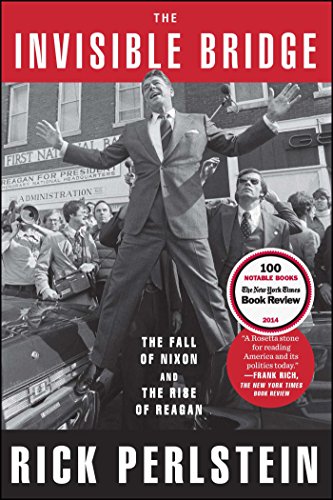
The New York Times bestselling portrait of America on the verge of a nervous breakdown in the tumultuous political and economic times of the 1970s is “a Rosetta stone for reading America and its politics today” (Frank Rich, The New York Times Book Review).
In January of 1973 Richard Nixon announced the end of the Vietnam War and prepared for a triumphant second term—until televised Watergate hearings revealed his White House as little better than a mafia den. The next president declared upon Nixon’s resignation “our long national nightmare is over”—but then congressional investigators exposed the CIA for assassinating foreign leaders. The collapse of the South Vietnamese government rendered moot the sacrifice of some 58,000 American lives. The economy was in tatters. And as Americans began thinking about their nation in a new way—as one more nation among nations, no more providential than any other—the pundits declared that from now on successful politicians would be the ones who honored this chastened new national mood.
Ronald Reagan never got the message. Which was why, when he announced his intention to challenge President Ford for the 1976 Republican nomination, those same pundits dismissed him—until, amazingly, it started to look like he just might win. He was inventing the new conservative political culture we know now, in which a vision of patriotism rooted in a sense of American limits was derailed in America’s Bicentennial year by the rise of the smiling politician from Hollywood. Against a backdrop of melodramas from the Arab oil embargo to Patty Hearst to the near-bankruptcy of America’s greatest city, The Invisible Bridge asks the question: what does it mean to believe in America? To wave a flag—or to reject the glibness of the flag wavers?
Die Inhaltsangabe kann sich auf eine andere Ausgabe dieses Titels beziehen.
Über die Autorin bzw. den Autor
Rick Perlstein is the author of the New York Times bestseller The Invisible Bridge: The Fall of Nixon and the Rise of Reagan; Nixonland: The Rise of a President and the Fracturing of America, a New York Times bestseller picked as one of the best nonfiction books of 2007 by over a dozen publications; and Before the Storm: Barry Goldwater and the Unmaking of the American Consensus, which won the 2001 Los Angeles Times Book Award for history and appeared on the best books of the year lists of The New York Times, The Washington Post, and the Chicago Tribune. His essays and book reviews have been published in The New Yorker, The New York Times, The Washington Post, The Nation, The Village Voice, and Slate, among others. A contributing editor and board member of In These Times magazine, he lives in Chicago.
Von der hinteren Coverseite
A dazzling portrait of America on the verge of a nervous breakdown in the tumultuous political and economic times of the 1970s.
Auszug. © Genehmigter Nachdruck. Alle Rechte vorbehalten.
The Invisible Bridge CHAPTER ONE “Small and Suspicious Circles”
ONCE UPON A TIME WE had a Civil War. More than six hundred thousand Americans were slaughtered or wounded. Soon afterward, the two sides began carrying out sentimental rituals of reconciliation. Confederate soldiers paraded through the streets of Boston to the cheers of welcoming Yankee throngs, and John Quincy Adams II, orating from the podium, said, “You are come so that once more we may pledge ourselves to a new union, not a union merely of law, or simply of the lips: not . . . of the sword, but gentlemen, the only true union, the union of hearts.” Dissenters from the new postbellum comity—like the abolitionist William Lloyd Garrison, who argued that the new system of agricultural labor taking root in the South and enforced by Ku Klux Klan terror hardly differed from slavery—were shouted down. “Does he really imagine,” the New York Times indignantly asked, “that outside of small and suspicious circles any real interest attaches to the old forms of the Southern question?”
America the Innocent, always searching for totems of a unity it can never quite achieve—even, or especially, when its crises of disunity are most pressing: it is one of the structuring stories of our nation. The “return to normalcy” enjoined by Warren Harding after the Great War; the cult of suburban home and hearth after World War II; the union of hearts declaimed by Adams on Boston’s Bunker Hill parade ground after the War Between the States.
And in 1973, after ten or so years of war in Vietnam, America tried to do it again.
On January 23, four days into his second term, which he had won with the most commanding landslide in U.S. history, President Richard Nixon went on TV to announce, “We have concluded an agreement to end the war and bring peace with honor in Vietnam and South Asia.” The Vietnam War was over—“peace with honor,” in the phrase the president repeated six more times.
But “it wasn’t like 1945, when the end of the war brought a million people downtown to cheer,” Mike Royko, the Chicago Daily News’ regular-guy columnist, wrote. “Now the president comes on TV, reads his speech, and without a sound the country sets the clock and goes to bed.” He was grateful for it. “There is nothing to cheer about this time. Except that it is over. . . . Mr. Nixon’s efforts to inject glory into our involvement were hollow. All he had to say was that it is finally over.”
Royko continued, “It is hard to see the honor. . . . Why kid ourselves? They didn’t die for anyone’s freedom. They died because we made a mistake. And we can’t justify it with slogans and phrases from other times.
“It was a war that made the sixties the most terrible decade our history. . . . If we insist on looking for something of value in this war then maybe it is this:
“Maybe we finally have the painful knowledge that we can never again believe everything our leaders tell us.”
Others, though, longed for the old patriotic rituals of reconciliation. And their vehicle became the prisoners of war held in Hanoi by our Communist enemies. “The returning POWs,” Secretary of Defense Elliot Richardson told the president, “have dramatically launched what DOD is trying to do to restore the military to its proper position.” The president, pleased, agreed: “We now have an invaluable opportunity to revise the history of this war.”
It began twenty days after the president’s speech, at the airport in Hanoi. What the Pentagon dubbed “Operation Homecoming” turned the network news into a nightly patriotic spectacle. Battered camouflage buses conveyed the first sixty men to the planes that would take them to Clark Air Base in the Philippines; a Navy captain named Galand Kramer unfurled a homemade sign out the window, scrawled on a scrap of cloth: GOD BLESS AMERICA & NIXON. The buses emptied; officers shouted out commands in loud American voices to free American men, who marched forth in smart formation, slowing to accommodate comrades on crutches. On the planes, and on TV, they kissed nurses, smoked too many American cigarettes, circulated news magazines with their wives and children on the cover, and drank a pasty white nutrient shake whose taste they didn’t mind, a newsman explained, because it was the first cold drink some of them had had in eight years. On one of the three planes they passed a wriggling puppy from lap to lap. “He was a Communist dog,” explained the Navy commander who smuggled him to freedom in his flight bag, “but not anymore!”
At Clark, the tarmac was thronged by kids in baseball and Boy Scout uniforms, women in lawn chairs with babes in arms, airmen with movie cameras, all jostling one another for a better view of a red carpet that had been borrowed at the last minute from Manila’s InterContinental Hotel because the one Clark used for the usual round of VIPs wasn’t sumptuous enough. In a crisp brocaded dress uniform with captain stripes newly affixed, Navy flier Jeremiah Denton, the first to descend, stood erect before the microphone and pronounced in a slowly swelling voice:
“We are honored to have the opportunity to serve our country—”
(A stately echo: “country–country—country . . .”)
“We are profoundly grateful to our Commander in Chief and our nation for this day.”
(“Day—day—day . . .”)
“God—”
(“God—God—God . . .”)
“Bless—”
(“Bless—bless—bless . . .”)
“America!”
(“America—America—America . . .”)
In days to come cameras lingered on cafeteria trays laden with strawberry pie, steak, corn on the cob, Cornish game hens, ice cream, and eggs. (“Beautiful!” sighed a man in a hospital gown on TV to a fry cook whipping up eggs.) When the men were in Hawaii for refueling on Valentine’s Day, the cameras luxuriated over the nurses who defied orders and broke through the security line to bestow leis on their heroes. Then the cameras followed the men to the base exchange, where a boom mike overheard Captain Kramer gingerly trying on a pair of bell-bottomed pants: “I must say, they’re a little different from what I would normally wear!”
The next stop was Travis Air Force Base in California, where for twelve long years the flag-draped coffins had come home. Now it was the setting for Times Square 1945 images: wives leaping into husbands’ arms; teenagers unabashedly knocking daddies off their feet; seven-year-olds bringing up the rear, sheepish, shuffling—they had never met their fathers before. From there the men shipped out to service hospitals around the country, especially prepared for their return with color TVs and bright yellow bedspreads to mask the metallic hospital tone; once more words like “God—God—God” and “duty—duty—duty” and “honor—honor—honor” and “country—country—country” echoed across airport tarmacs. The first men to touch ground had been given expedited discharge to comfort terminally ill relatives. Press accounts credited at least one mother with a miraculous recovery. Miracles, according to the press, were thick on the ground.
“The first thing she did when she raced to embrace her husband . . . was slip his wedding ring on his finger. The ring, she told reporters, had been sent to her, along with her...
„Über diesen Titel“ kann sich auf eine andere Ausgabe dieses Titels beziehen.
Suchergebnisse für The Invisible Bridge: The Fall of Nixon and the Rise...

Foto des Verkäufers
The Invisible Bridge: The Fall of Nixon and the Rise of Reagan
Anbieter: Zoom Books East, Glendale Heights, IL, USA
Verkäuferbewertung 5 von 5 Sternen

Zustand: very_good. Book is in very good condition and may include minimal underlining highlighting. The book can also include "From the library of" labels. May not contain miscellaneous items toys, dvds, etc. . We offer 100% money back guarantee and 24 7 customer service. Bestandsnummer des Verkäufers ZEV.1476782423.VG
Gebraucht kaufen
EUR 6,32
Versand gratis
Versand innerhalb von USA
Versand innerhalb von USA
Anzahl: 1 verfügbar
Foto des Verkäufers
The Invisible Bridge: The Fall of Nixon and the Rise of Reagan
Anbieter: Dream Books Co., Denver, CO, USA
Verkäuferbewertung 5 von 5 Sternen
Zustand: acceptable. This copy has clearly been enjoyedâ"expect noticeable shelf wear and some minor creases to the cover. Binding is strong, and all pages are legible. May contain previous library markings or stamps. Bestandsnummer des Verkäufers DBV.1476782423.A
Gebraucht kaufen
EUR 6,61
Versand gratis
Versand innerhalb von USA
Versand innerhalb von USA
Anzahl: 1 verfügbar
Foto des Verkäufers
The Invisible Bridge: The Fall of Nixon and the Rise of Reagan
Anbieter: Greenworld Books, Arlington, TX, USA
Verkäuferbewertung 5 von 5 Sternen
Zustand: good. Fast Free Shipping â" Good condition. It may show normal signs of use, such as light writing, highlighting, or library markings, but all pages are intact and the book is fully readable. A solid, complete copy that's ready to enjoy. Bestandsnummer des Verkäufers GWV.1476782423.G
Gebraucht kaufen
EUR 7,57
Versand gratis
Versand innerhalb von USA
Versand innerhalb von USA
Anzahl: 1 verfügbar
Beispielbild für diese ISBN
The Invisible Bridge: The Fall of Nixon and the Rise of Reagan
Anbieter: HPB-Ruby, Dallas, TX, USA
Verkäuferbewertung 5 von 5 Sternen
Paperback. Zustand: Very Good. Connecting readers with great books since 1972! Used books may not include companion materials, and may have some shelf wear or limited writing. We ship orders daily and Customer Service is our top priority! Bestandsnummer des Verkäufers S_476729861
Gebraucht kaufen
EUR 4,59
EUR 3,35 Versand
Versand innerhalb von USA
Versand innerhalb von USA
Anzahl: 1 verfügbar
Beispielbild für diese ISBN
The Invisible Bridge: The Fall of Nixon and the Rise of Reagan
Anbieter: Half Price Books Inc., Dallas, TX, USA
Verkäuferbewertung 5 von 5 Sternen
Paperback. Zustand: Very Good. Connecting readers with great books since 1972! Used books may not include companion materials, and may have some shelf wear or limited writing. We ship orders daily and Customer Service is our top priority! Bestandsnummer des Verkäufers S_464485668
Gebraucht kaufen
EUR 4,59
EUR 3,35 Versand
Versand innerhalb von USA
Versand innerhalb von USA
Anzahl: 1 verfügbar
Beispielbild für diese ISBN
The Invisible Bridge: The Fall of Nixon and the Rise of Reagan
Anbieter: HPB-Diamond, Dallas, TX, USA
Verkäuferbewertung 5 von 5 Sternen
Paperback. Zustand: Very Good. Connecting readers with great books since 1972! Used books may not include companion materials, and may have some shelf wear or limited writing. We ship orders daily and Customer Service is our top priority! Bestandsnummer des Verkäufers S_475195854
Gebraucht kaufen
EUR 4,59
EUR 3,35 Versand
Versand innerhalb von USA
Versand innerhalb von USA
Anzahl: 1 verfügbar
Foto des Verkäufers
The Invisible Bridge: The Fall of Nixon and the Rise of Reagan
Anbieter: Goodwill Books, Hillsboro, OR, USA
Verkäuferbewertung 5 von 5 Sternen
Zustand: acceptable. Fairly worn, but readable and intact. If applicable: Dust jacket, disc or access code may not be included. Bestandsnummer des Verkäufers GICWV.1476782423.A
Gebraucht kaufen
EUR 4,60
EUR 3,56 Versand
Versand innerhalb von USA
Versand innerhalb von USA
Anzahl: 2 verfügbar
Beispielbild für diese ISBN
The Invisible Bridge: The Fall of Nixon and the Rise of Reagan
Anbieter: ThriftBooks-Phoenix, Phoenix, AZ, USA
Verkäuferbewertung 5 von 5 Sternen
Paperback. Zustand: Fair. No Jacket. Readable copy. Pages may have considerable notes/highlighting. ~ ThriftBooks: Read More, Spend Less. Bestandsnummer des Verkäufers G1476782423I5N00
Gebraucht kaufen
EUR 8,25
Versand gratis
Versand innerhalb von USA
Versand innerhalb von USA
Anzahl: 1 verfügbar
Beispielbild für diese ISBN
The Invisible Bridge: The Fall of Nixon and the Rise of Reagan
Anbieter: ThriftBooks-Dallas, Dallas, TX, USA
Verkäuferbewertung 5 von 5 Sternen
Paperback. Zustand: Good. No Jacket. Pages can have notes/highlighting. Spine may show signs of wear. ~ ThriftBooks: Read More, Spend Less. Bestandsnummer des Verkäufers G1476782423I3N00
Gebraucht kaufen
EUR 8,25
Versand gratis
Versand innerhalb von USA
Versand innerhalb von USA
Anzahl: 1 verfügbar
Beispielbild für diese ISBN
The Invisible Bridge: The Fall of Nixon and the Rise of Reagan
Anbieter: ThriftBooks-Reno, Reno, NV, USA
Verkäuferbewertung 5 von 5 Sternen
Paperback. Zustand: Fair. No Jacket. Readable copy. Pages may have considerable notes/highlighting. ~ ThriftBooks: Read More, Spend Less. Bestandsnummer des Verkäufers G1476782423I5N00
Gebraucht kaufen
EUR 8,25
Versand gratis
Versand innerhalb von USA
Versand innerhalb von USA
Anzahl: 1 verfügbar