
Verwandte Artikel zu Phenomenological Hermeneutics and the Study of Literature...
Inhaltsangabe
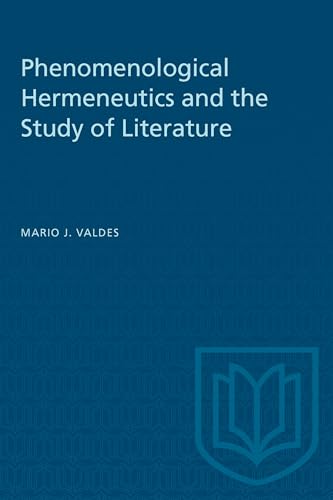
In the intensity of current theoretical debates, critics and students of literature are sometimes in danger of losing sight of the most basic principles and presuppositions of their discipline, of the underlying connections between attitudes to truth and the study of literature. Aware of this danger, Mario Valdés has taken up the challenge of retracing the historical and philosophical background of his own approach to literature, the application of phenomenological philosophy to the interpretation of texts.
Phenomenological hermeneutics, Valdés reminds us, participates in a long-standing tradition of textual commentary that originates in the Renaissance and achieves full force in the work of Giambattista Vico by the middle of the eighteenth century. Valdés characterizes this tradition as the embodiment of a relational rather than an absolutist epistemology: its practitioners do not seek fixed and exclusive meanings in texts but regard the literary work of art as an experience that is shared within a community of readers and commentators, and enriched by the historical continuity of that community.
Valdés demonstrates the vigour of the tradition and community he has inherited in a brief survey of such relational commentators as Vico, Juan Luis Vives, Wilhelm von Humboldt, Unamuno, Croce, and Collingwood. He elaborates the contemporary contribution of phenomenological hermeneutics to the tradition, referring particularly to the work of Paul Ricoeur. In arguing for a living and evolving community of criticism, he contests both the historicist imposition of closure on texts and the radical scepticism of the deconstructionists. And in reading of works by Octavio Paz and Jorge Luis Borges, he offers a model for the continuing celebration of the living literary text.
Die Inhaltsangabe kann sich auf eine andere Ausgabe dieses Titels beziehen.
Über die Autorin bzw. den Autor
Mario J. Valdés, FRSC is a professor emeritus in the Centre for Comparative Literature and the Department of Spanish and Portuguese at the University of Toronto.
„Über diesen Titel“ kann sich auf eine andere Ausgabe dieses Titels beziehen.
Suchergebnisse für Phenomenological Hermeneutics and the Study of Literature...

Foto des Verkäufers
Phenomenological Hermeneutics and the Study of Literature
Verlag:
University of Toronto Press, 1987
ISBN 10: 1487581351
ISBN 13: 9781487581350
Gebraucht
Softcover
Anbieter: GreatBookPrices, Columbia, MD, USA
Verkäuferbewertung 5 von 5 Sternen

Zustand: As New. Unread book in perfect condition. Bestandsnummer des Verkäufers 37649605
Gebraucht kaufen
EUR 24,61
EUR 2,28 Versand
Versand innerhalb von USA
Versand innerhalb von USA
Anzahl: Mehr als 20 verfügbar
Beispielbild für diese ISBN
Phenomenological Hermeneutics and the Study of Literature
Anbieter: PBShop.store UK, Fairford, GLOS, Vereinigtes Königreich
Verkäuferbewertung 5 von 5 Sternen
PAP. Zustand: New. New Book. Shipped from UK. Established seller since 2000. Bestandsnummer des Verkäufers FW-9781487581350
Neu kaufen
EUR 22,82
EUR 4,85 Versand
Versand von Vereinigtes Königreich nach USA
Versand von Vereinigtes Königreich nach USA
Anzahl: 15 verfügbar
Foto des Verkäufers
Phenomenological Hermeneutics and the Study of Literature
Anbieter: GreatBookPrices, Columbia, MD, USA
Verkäuferbewertung 5 von 5 Sternen
Zustand: New. Bestandsnummer des Verkäufers 37649605-n
Neu kaufen
EUR 26,15
EUR 2,28 Versand
Versand innerhalb von USA
Versand innerhalb von USA
Anzahl: Mehr als 20 verfügbar
Beispielbild für diese ISBN
Phenomenological Hermeneutics and the Study of Literature (eng)
Anbieter: Brook Bookstore On Demand, Napoli, NA, Italien
Verkäuferbewertung 5 von 5 Sternen
Zustand: new. Bestandsnummer des Verkäufers DYP0D8WUER
Neu kaufen
EUR 26,86
EUR 4,00 Versand
Versand von Italien nach USA
Versand von Italien nach USA
Anzahl: Mehr als 20 verfügbar
Foto des Verkäufers
Phenomenological Hermeneutics and the Study of Literature
Verlag:
University of Toronto Press, CA, 1987
ISBN 10: 1487581351
ISBN 13: 9781487581350
Neu
Paperback
Anbieter: Rarewaves.com USA, London, LONDO, Vereinigtes Königreich
Verkäuferbewertung 5 von 5 Sternen
Paperback. Zustand: New. In the intensity of current theoretical debates, critics and students of literature are sometimes in danger of losing sight of the most basic principles and presuppositions of their discipline, of the underlying connections between attitudes to truth and the study of literature. Aware of this danger, Mario Valdés has taken up the challenge of retracing the historical and philosophical background of his own approach to literature, the application of phenomenological philosophy to the interpretation of texts. Phenomenological hermeneutics, Valdés reminds us, participates in a long-standing tradition of textual commentary that originates in the Renaissance and achieves full force in the work of Giambattista Vico by the middle of the eighteenth century. Valdés characterizes this tradition as the embodiment of a relational rather than an absolutist epistemology: its practitioners do not seek fixed and exclusive meanings in texts but regard the literary work of art as an experience that is shared within a community of readers and commentators, and enriched by the historical continuity of that community. Valdés demonstrates the vigour of the tradition and community he has inherited in a brief survey of such relational commentators as Vico, Juan Luis Vives, Wilhelm von Humboldt, Unamuno, Croce, and Collingwood. He elaborates the contemporary contribution of phenomenological hermeneutics to the tradition, referring particularly to the work of Paul Ricoeur. In arguing for a living and evolving community of criticism, he contests both the historicist imposition of closure on texts and the radical scepticism of the deconstructionists. And in reading of works by Octavio Paz and Jorge Luis Borges, he offers a model for the continuing celebration of the living literary text. Bestandsnummer des Verkäufers LU-9781487581350
Neu kaufen
EUR 33,81
Versand gratis
Versand von Vereinigtes Königreich nach USA
Versand von Vereinigtes Königreich nach USA
Anzahl: Mehr als 20 verfügbar
Beispielbild für diese ISBN
Phenomenological Hermeneutics and the Study of Literature (Heritage)
Anbieter: Majestic Books, Hounslow, Vereinigtes Königreich
Verkäuferbewertung 4 von 5 Sternen

Zustand: New. pp. 158. Bestandsnummer des Verkäufers 369883563
Neu kaufen
EUR 28,61
EUR 7,58 Versand
Versand von Vereinigtes Königreich nach USA
Versand von Vereinigtes Königreich nach USA
Anzahl: 3 verfügbar
Beispielbild für diese ISBN
Phenomenological Hermeneutics and the Study of Literature (Heritage)
Anbieter: Kennys Bookshop and Art Galleries Ltd., Galway, GY, Irland
Verkäuferbewertung 5 von 5 Sternen
Zustand: New. 1987. paperback. . . . . . Bestandsnummer des Verkäufers V9781487581350
Neu kaufen
EUR 27,75
EUR 9,50 Versand
Versand von Irland nach USA
Versand von Irland nach USA
Anzahl: Mehr als 20 verfügbar
Beispielbild für diese ISBN
Phenomenological Hermeneutics and the Study of Literature
Verlag:
University of Toronto Press, 1987
ISBN 10: 1487581351
ISBN 13: 9781487581350
Neu
Paperback / softback
Anbieter: THE SAINT BOOKSTORE, Southport, Vereinigtes Königreich
Verkäuferbewertung 5 von 5 Sternen
Paperback / softback. Zustand: New. New copy - Usually dispatched within 4 working days. Bestandsnummer des Verkäufers B9781487581350
Neu kaufen
EUR 22,82
EUR 14,69 Versand
Versand von Vereinigtes Königreich nach USA
Versand von Vereinigtes Königreich nach USA
Anzahl: Mehr als 20 verfügbar
Beispielbild für diese ISBN
Phenomenological Hermeneutics and the Study of Literature (Heritage)
Anbieter: Books Puddle, New York, NY, USA
Verkäuferbewertung 4 von 5 Sternen
Zustand: New. pp. 158. Bestandsnummer des Verkäufers 26377243252
Neu kaufen
EUR 38,50
EUR 3,44 Versand
Versand innerhalb von USA
Versand innerhalb von USA
Anzahl: 3 verfügbar
Beispielbild für diese ISBN
Phenomenological Hermeneutics and the Study of Literature (Heritage)
Anbieter: Kennys Bookstore, Olney, MD, USA
Verkäuferbewertung 5 von 5 Sternen
Zustand: New. 1987. paperback. . . . . . Books ship from the US and Ireland. Bestandsnummer des Verkäufers V9781487581350
Neu kaufen
EUR 33,17
EUR 9,05 Versand
Versand innerhalb von USA
Versand innerhalb von USA
Anzahl: Mehr als 20 verfügbar