
Verwandte Artikel zu Telecom Expense Management for Large Organizations:...
Inhaltsangabe
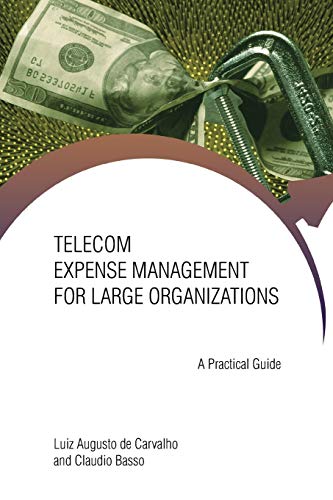
Managing telecom expenses is not easy; what's more, the larger the organization is, the more complicated that management gets. In Telecom Expense Management for Large Organizations, authors Luiz Augusto de Carvalho and Claudio Basso, who have each worked for more than a decade in the telecommunications industry, share their wealth of knowledge so you can slash expenses and manage business properly. This practical guide is divided into five sections: managerial issues, managerial processes, bill processing, traffic analysis and specific aspects. Each section builds upon the previous one, helping you contract and negotiate with telecom service providers; design a wellcontrolled telecom structure; oversee the inventory of assets and services; manage contracts, processes, and challenges; and process invoices and navigate auditing processes. This book discusses several techniques which will help you to organize the telecom cost/expenses management in your organization. Take control of your organization's future and plot a path that can help you enhance the quality of your telecom expenses management.
Die Inhaltsangabe kann sich auf eine andere Ausgabe dieses Titels beziehen.
Auszug. © Genehmigter Nachdruck. Alle Rechte vorbehalten.
Telecom Expense Management for Large Organizations
A Practical Guide
By Luiz Augusto de Carvalho, Claudio BassoiUniverse LLC
Copyright © 2014 Luiz Augusto de Carvalho and Claudio Basso
All rights reserved.
ISBN: 978-1-4917-2002-8All rights reserved.
Contents
Preface, i,
Chapter 1: Organizing the Telecom Area Administratively, 1,
Chapter 2: Sourcing and Procurement, 10,
Chapter 3: Policies and Governance, 32,
Chapter 4: Cost Benefits of Expense Management Methods, 49,
Chapter 5: Asset and Service Inventory Management, 53,
Chapter 6: Service Ordering and Change Control, 69,
Chapter 7: Contract Management, 79,
Chapter 8: Help Desk Management, 83,
Chapter 9: Invoice Processing, 86,
Chapter 10: Auditing, 96,
Chapter 11: Billing Systems, 101,
Chapter 12: Traffic Analysis and Optimization, 111,
Chapter 13: Mobile Device and Mobile Applications Management, 142,
Chapter 14: Risk Management, 153,
Chapter 15: Reports and Analysis, 162,
Chapter 16: Closing Words, 186,
Bibliography, 187,
CHAPTER 1
Organizing the Telecom Area Administratively
Initially, we would like to focus on four administrative strategies that are usually associated with the effectiveness of a telecom area:
• voice and data controlled together
• telecom as part of the organization's information technology structure
• controlling telecom in a centralized way
• deployment of control systems and consequent processes
Of course, these are general guidelines, and specific contexts may impose different strategies; however, these four points usually are the way to go. Subsequent sections will discuss the reasons.
1.1 Voice and Data Controlled Together
Although this strategy may seem obvious, some organizations do not control voice and data in a unified way. In today's technological environment, it is very advisable to have a control structure wherein the same area within the organization manages both voice and data contracts. There are four main reasons for this:
1) There is a technological trend to unify voice and data services over the same equipment and protocols.
2) The providers of both services are usually the same.
3) The billing control processes are similar.
4) The technical and administrative skills required from the people involved in the control of both services are very similar.
These elements are at the root of the trend to unify the control of telecom resources (voice and data) under one area of an organization. That is by itself a very important administrative decision, which tends to improve the quality of resource management. Very often, by just unifying the control of voice and data resources, overall costs can be reduced.
Some organizations control mobile resources and devices separately; our view is that these devices should be controlled by the same group within the organization responsible for controlling data and voice resources.
1.2 Telecom as Part of the Organization's Information Technology Structure
The structure and responsibilities of managing telecom within a large organization have changed over time as shifts in technology took place. Generally, the objective has been to bring telecommunications into the IT sphere of influence, unifying voice and data disciplines in a telecommunications/network area.
The migration of the telecom area from general services to IT is an administrative trend that follows the technological trend of integrating voice and data over the same network.
In addition, managing a telecom infrastructure in today's large organization requires skills more often found in people working in the IT department than anywhere within the organization.
1.3 Controlling Telecom in a Centralized Way
Telecom management is one area where centralized control tends to generate better results. Of course it isn't an absolute truth; multinational companies must balance the benefits of centralized management against the difficulties of managing infrastructures in different countries with different languages, currencies, and cultures.
It is our experience that policies and standards should be defined globally as far as possible. This creates an environment where teamwork and cross-regional support are possible, greatly enhancing the efficiency of the human capital deployed across the organization.
Here we emphasize the need to have unified inventory databases, processes, and technological standards. Sometimes, several arms of a large organization spread around the world do not understand the benefits of unified policies and standards. Usually, the telecommunications team in each country tends to believe that its own ways are the best, but anyone who has managed a multinational telecommunications area knows that having standards is better, even if they are not going to be optimal in every environment. When telecom management is centralized, it leads to the following benefits:
• better prices (usually due to global negotiation, where the full weight of the organization is brought to the table, yielding better discounts)
• better control (when only one group is responsible for telecom resources, it usually reduces problems such as overcharges, overlaps, and having unidentified resources or resources that are not used)
• lower operational costs (when headcounts are reduced, there is a consequent reduction in personnel costs)
Centralizing control usually enables the organization to identify its telecom expenses. That fact alone is usually enough to justify centralization, because it shows how much telecom represents within the IT/infrastructure budget and keeps the subject on management's radar.
In more general terms, we have to keep in mind that telecom is a logistic system, and as such, the whole may be more than the sum of the parts.
It would be interesting to insert a caveat into the argument here that centralized management doesn't necessarily mean a centralized operation. If you have the right tools, you may be able to control and contract in a centralized way and yet keep the operation distributed, enabling different telecom teams to operate in different countries, for example.
This is feasible, as long as you manage to make all teams use the same management tools, under a defined hierarchical framework. That means that the local telecom teams may have some autonomy to contract telecom resources (the ones not covered for the worldwide contract, for example), but they have to include each contract and resource in a corporate telecom management tool in such a way that headquarters can see all the telecom expenditures and all resources contracted in all countries. The local teams will see only their own expenditures and resources.
Therefore, we may divide the term "centralization" into two types: financial and technical. Even if operational aspects force technical decentralization, financial centralization remains crucial. The centralized telecom management has to keep track of what is contracted and how much it is costing.
Financial centralization refers to the following:
• centralized resource inventory (including data, voice, and mobile resources)
• centralized contract inventory (including voice, data, mobile services, and maintenance)
• centralized telecom bills (even if received in different countries, all bills would be included in a common tool in a standardized framework,...
„Über diesen Titel“ kann sich auf eine andere Ausgabe dieses Titels beziehen.
Suchergebnisse für Telecom Expense Management for Large Organizations:...

Foto des Verkäufers
Telecom Expense Management for Large Organizations : A Practical Guide
Anbieter: GreatBookPrices, Columbia, MD, USA
Verkäuferbewertung 5 von 5 Sternen

Zustand: New. Bestandsnummer des Verkäufers 20895495-n
Neu kaufen
EUR 12,15
EUR 2,30 Versand
Versand innerhalb von USA
Versand innerhalb von USA
Anzahl: Mehr als 20 verfügbar
Foto des Verkäufers
Telecom Expense Management for Large Organizations: A Practical Guide (Paperback or Softback)
Verlag:
iUniverse 1/24/2014, 2014
ISBN 10: 1491720026
ISBN 13: 9781491720028
Neu
Paperback or Softback
Anbieter: BargainBookStores, Grand Rapids, MI, USA
Verkäuferbewertung 5 von 5 Sternen
Paperback or Softback. Zustand: New. Telecom Expense Management for Large Organizations: A Practical Guide. Book. Bestandsnummer des Verkäufers BBS-9781491720028
Foto des Verkäufers
Telecom Expense Management for Large Organizations : A Practical Guide
Anbieter: GreatBookPrices, Columbia, MD, USA
Verkäuferbewertung 5 von 5 Sternen
Zustand: As New. Unread book in perfect condition. Bestandsnummer des Verkäufers 20895495
Gebraucht kaufen
EUR 13,08
EUR 2,30 Versand
Versand innerhalb von USA
Versand innerhalb von USA
Anzahl: Mehr als 20 verfügbar
Beispielbild für diese ISBN
Telecom Expense Management for Large Organizations: A Practical Guide
Anbieter: California Books, Miami, FL, USA
Verkäuferbewertung 4 von 5 Sternen

Zustand: New. Bestandsnummer des Verkäufers I-9781491720028
Neu kaufen
EUR 17,04
Versand gratis
Versand innerhalb von USA
Versand innerhalb von USA
Anzahl: Mehr als 20 verfügbar
Beispielbild für diese ISBN
Telecom Expense Management for Large Organizations A Practical Guide
Print-on-DemandAnbieter: PBShop.store UK, Fairford, GLOS, Vereinigtes Königreich
Verkäuferbewertung 5 von 5 Sternen
PAP. Zustand: New. New Book. Delivered from our UK warehouse in 4 to 14 business days. THIS BOOK IS PRINTED ON DEMAND. Established seller since 2000. Bestandsnummer des Verkäufers IQ-9781491720028
Neu kaufen
EUR 19,64
EUR 4,85 Versand
Versand von Vereinigtes Königreich nach USA
Versand von Vereinigtes Königreich nach USA
Anzahl: 15 verfügbar
Beispielbild für diese ISBN
Telecom Expense Management for Large Organizations
Print-on-DemandAnbieter: Majestic Books, Hounslow, Vereinigtes Königreich
Verkäuferbewertung 4 von 5 Sternen
Zustand: New. Print on Demand pp. 200 23:B&W 6 x 9 in or 229 x 152 mm Perfect Bound on White w/Gloss Lam. Bestandsnummer des Verkäufers 132850768
Neu kaufen
EUR 17,47
EUR 7,58 Versand
Versand von Vereinigtes Königreich nach USA
Versand von Vereinigtes Königreich nach USA
Anzahl: 4 verfügbar
Beispielbild für diese ISBN
Telecom Expense Management for Large Organizations
Print-on-DemandAnbieter: Books Puddle, New York, NY, USA
Verkäuferbewertung 4 von 5 Sternen
Zustand: New. Print on Demand pp. 200. Bestandsnummer des Verkäufers 26127703951
Neu kaufen
EUR 23,49
EUR 3,47 Versand
Versand innerhalb von USA
Versand innerhalb von USA
Anzahl: 4 verfügbar
Beispielbild für diese ISBN
Telecom Expense Management for Large Organizations
Print-on-DemandAnbieter: Biblios, Frankfurt am main, HESSE, Deutschland
Verkäuferbewertung 4 von 5 Sternen
Zustand: New. PRINT ON DEMAND pp. 200. Bestandsnummer des Verkäufers 18127703941
Neu kaufen
EUR 18,00
EUR 9,95 Versand
Versand von Deutschland nach USA
Versand von Deutschland nach USA
Anzahl: 4 verfügbar
Beispielbild für diese ISBN
Telecom Expense Management for Large Organizations: A Practical Guide
Anbieter: Ria Christie Collections, Uxbridge, Vereinigtes Königreich
Verkäuferbewertung 5 von 5 Sternen
Zustand: New. In English. Bestandsnummer des Verkäufers ria9781491720028_new
Neu kaufen
EUR 20,38
EUR 10,93 Versand
Versand von Vereinigtes Königreich nach USA
Versand von Vereinigtes Königreich nach USA
Anzahl: Mehr als 20 verfügbar
Beispielbild für diese ISBN
Telecom Expense Management for Large Organizations: A Practical Guide
Print-on-DemandAnbieter: THE SAINT BOOKSTORE, Southport, Vereinigtes Königreich
Verkäuferbewertung 5 von 5 Sternen
Paperback / softback. Zustand: New. This item is printed on demand. New copy - Usually dispatched within 5-9 working days 272. Bestandsnummer des Verkäufers C9781491720028
Neu kaufen
EUR 18,06
EUR 15,71 Versand
Versand von Vereinigtes Königreich nach USA
Versand von Vereinigtes Königreich nach USA
Anzahl: Mehr als 20 verfügbar