
Verwandte Artikel zu The Internet in Brazil: Origins, Strategy, Development,...
Inhaltsangabe
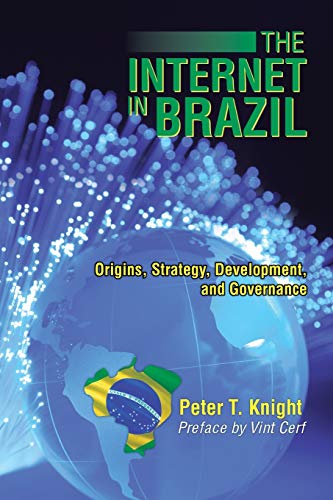
How was the Internet born in Brazil? Who were its pioneers? How did they interact with the Internet?s fathers in the United States and Europe? What strategies guided the development of Brazil?s Internet? How has it developed in terms of coverage, usage, speed, pricing, and quality of service? What needs to be done to better realize its potential for accelerating economic, social and political development? What is the Brazilian model of Internet governance and how is it evolving? These are the major questions addressed in this book.
The author has been an observer and participant in the development and use of the Internet in Africa, Asia, Russia and the United States, but above all in Brazil. He has interacted with many Internet pioneers around the world who have inspired his work.
This book, completed immediately after the Global Stakeholder Meeting on the Future of Internet Governance (NETmundial) in São Paulo, seeks to provide background that will be useful to participants in that important gathering and to Internet enthusiasts in Brazil and around the world.
Die Inhaltsangabe kann sich auf eine andere Ausgabe dieses Titels beziehen.
Über die Autorin bzw. den Autor
Peter T. Knight is an economist specialized in the use of information and communication technologies for accelerating economic, social, and political development. A resident of Rio de Janeiro since 2000, he is a founding member, researcher, and member of the Board of Directors of the Fernand Braudel Institute of World Economics in São Paulo and has worked as a consultant since 1997.
In a career of over 20 years with the World Bank, his last three positions were Lead Economist for the Brazil Department, Chief of the National Economic Management Division of the Bank?s external training arm, and Chief of the Electronic Media Center. Previously he held positions at Cornell University, the Ford Foundation and the Brookings Institution.
Peter holds a PhD from Stanford University and degrees in Government from Dartmouth College and Politics, Philosophy and Economics from Oxford University. He has published ten other books, six of them dealing with the use of the Internet for development.
Auszug. © Genehmigter Nachdruck. Alle Rechte vorbehalten.
The Internet in Brazil
Origins, Strategy, Development, and Governance
By Peter T. KnightAuthorHouse LLC
Copyright © 2014 Peter T. Knight
All rights reserved.
ISBN: 978-1-4918-7248-2All rights reserved.
Contents
List of Figures and Tables, ix,
Figures, ix,
Tables, ix,
Glossary of Acronyms, xi,
Preface, xv,
Foreword, xix,
Chapter 1: The Strategic Importance of the Internet for Brazil's Development, 1,
Chapter 2: The Origins and Institutions of the Internet in Brazil, 16,
Chapter 3: Development of the Internet in Brazil, 39,
Chapter 4: Speed, Cost, and Quality, 63,
Chapter 5: What Is Being Done to Improve Internet Connectivity?, 72,
Chapter 6: The Dark Side of the Internet, 95,
Chapter 7: The Brazilian Model of Internet Governance, 102,
Chapter 8: The Future of the Internet in Brazil, 129,
References, 135,
About the Author, 149,
Index, 151,
CHAPTER 1
The Strategic Importance of the Internet for Brazil's Development
Both Brazilians and international observers are prone to contradictory views of Brazil's future. An Austrian immigrant, Stefan Zweig, coined the expression "Brazil, a Country of the Future" the title of an insightful book published in 1941. On a more pessimistic note, Brazilians often say that Brazil is the country of the future, and always will be. During the military dictatorship (1964-1985), propaganda boasted that "Brazil was the country of the future, but now the future has arrived", an optimistic expression repeated by United States President Barak Obama during a visit to Rio de Janeiro in 2011.
At the beginning of 2014 the mood is more somber. Economic growth has been anemic over the past three years, inflation is on the rise, and the Brazilians' evaluation of their own politicians had reached a new low. In June 2013, millions of demonstrators, largely mobilized over the Internet, took to the streets in cities around the country to protest corruption, impunity, and poor public services. Many expect that mass protests of this kind will be repeated during the World Cup soccer matches to take place in June and July 2014.
In April, before the World Cup, another, less publicized international event was hosted in Brazil, the Global Multistakeholder Meeting on the Future of Internet Governance, also dubbed NETmundial. Brazil has been a leader in developing and implementing multistakeholder governance of the Internet, where government, private sector, academia, civil society organizations and Internet professionals perform this function. Brazil's model of Internet governance, embodied in the Brazilian Internet Steering Committee (Comitê Gestor da Internet no Brasil – CGI.br), was held up as a possible model for other countries and for international Internet governance during NETmundial.
In 2009, Brazilians began preparing legislation, called the Civil Rights Framework for the Internet (Marco Civil da Internet) that establishes principles, guarantees, rights and obligations for the use of the Internet in Brazil. This legislation was closely studied by participants in NETmundial. But the process by which this legislation has been developed may also be seen as a model for other countries and indeed for the international institutions involved in Internet governance. This process has been thorough, highly participatory, democratic, and has made ample use of the Internet (websites, wikis, blogs, social networks, etc.). It may herald a new, more modern mode of policy making – something of which Brazilians can be proud.
This book examines how the Internet came to Brazil, how it has developed, how it is governed, and why its future development is strategic for achieving national goals. This chapter deals with the last of these issues, presenting arguments for putting the Internet at the center of Brazil's strategy for achieving better future.
Background: Brazil in a nutshell
Brazil is the largest and arguably the most important country in Latin America. With an estimated population of 202 million in February 2014, it is also the most populous. In 2012 Brazil's economy was the seventh largest in the world according to four separate estimates by the United Nations, the IMF, the World Bank, and the CIA, ranging from US$ 2.3 to 2.4 trillion. Per capita income was US$11,354 in 2012, or 60th highest in the world according to the IMF, well above China's US$6071, but half of South Korea's.
Brazil also has well-known weaknesses. Though income inequality as measured by the Gini coefficient (running from zero for perfect equality to 1 for absolute inequality) has fallen from .57 in 1997 to .50 in 2012 according to the official Brazilian statistical agency, it is still a serious problem. Of the BRICS countries, only South Africa has a higher degree of income concentration, according to both the United Nations and CIA estimates for the latest years available. Other broad indicators put Brazil way down in the rankings. For example, the World Economic Forum's (WEF) competitiveness ranking for Brazil in its 2013-2014 report was 56 out of 148 countries, though it was the best of the BRICS countries except for China, ranked 29th. South Korea ranked 25th. The WEF competitiveness index includes a very wide range of sub-indicators covering national policies, institutions, and factors affecting productivity (e.g. education, health, innovation, and infrastructure).
The Internet and the information and communications revolution
The Internet is a great invention of the 20th Century that is changing the civilization of the 21st Century. Its power grows with the fiber optic cables that are now the nerves of the world economy. No other technology permits greater speed of transmission nor generates greater economies of scale at such a low cost as fiber optic cables. Thanks to this worldwide system of storing, organizing and sharing information, 90% of the data that exists in the world today was created over the past two years. In 2012, every day 2.5 quintillion bytes (exabytes – that is 1 followed by 18 zeros) of data were created. Meanwhile, in June 2013, the number of Internet users reached 2.4 billion, 34% of the world's population, an increase of 566% since the year 2000.8
This enormous flood of data is expected to double every two years through 2020, propelled by the increase in Internet users and their increasing consumption and production of video, among other factors.
The Internet has become the world's most important means of processing information, comparable to the invention of the printing press with moveable type by Johannes Gutenberg, that has expanded access to the printed word and the horizons of human knowledge since the 15th century. In that time paper and ink were fundamental. Today the physical means of communication are fiber optic cables, supplemented by satellites and terrestrial wireless technologies. Extending over land, under oceans or in space, together they are creating the essential infrastructure of the 21st century.
Fiber optic cables and the rapidly expanding processing power of computers are reshaping economies worldwide. Packets of information, data, text, voice and image are sent over these cables, reduced to zeros and ones transmitted over the Internet using TCP/IP (Transport Control Protocol/Internet Protocol). Combined with other information and communication technologies (ICT), the Internet is a tool with multiple uses that strengthens economic and social development as well as political participation. More and...
„Über diesen Titel“ kann sich auf eine andere Ausgabe dieses Titels beziehen.
Suchergebnisse für The Internet in Brazil: Origins, Strategy, Development,...

Foto des Verkäufers
Internet in Brazil : Origins, Strategy, Development, and Governance
Anbieter: GreatBookPrices, Columbia, MD, USA
Verkäuferbewertung 5 von 5 Sternen

Zustand: As New. Unread book in perfect condition. Bestandsnummer des Verkäufers 21099966
Gebraucht kaufen
EUR 16,96
EUR 2,31 Versand
Versand innerhalb von USA
Versand innerhalb von USA
Anzahl: Mehr als 20 verfügbar
Foto des Verkäufers
Internet in Brazil : Origins, Strategy, Development, and Governance
Anbieter: GreatBookPrices, Columbia, MD, USA
Verkäuferbewertung 5 von 5 Sternen
Zustand: New. Bestandsnummer des Verkäufers 21099966-n
Neu kaufen
EUR 17,07
EUR 2,31 Versand
Versand innerhalb von USA
Versand innerhalb von USA
Anzahl: Mehr als 20 verfügbar
Foto des Verkäufers
The Internet in Brazil
Anbieter: Rarewaves.com USA, London, LONDO, Vereinigtes Königreich
Verkäuferbewertung 5 von 5 Sternen
Paperback. Zustand: New. Bestandsnummer des Verkäufers LU-9781491872482
Neu kaufen
EUR 19,45
Versand gratis
Versand von Vereinigtes Königreich nach USA
Versand von Vereinigtes Königreich nach USA
Anzahl: Mehr als 20 verfügbar
Foto des Verkäufers
The Internet in Brazil: Origins, Strategy, Development, and Governance (Paperback or Softback)
Verlag:
Authorhouse 3/24/2014, 2014
ISBN 10: 1491872489
ISBN 13: 9781491872482
Neu
Paperback or Softback
Anbieter: BargainBookStores, Grand Rapids, MI, USA
Verkäuferbewertung 5 von 5 Sternen
Paperback or Softback. Zustand: New. The Internet in Brazil: Origins, Strategy, Development, and Governance. Book. Bestandsnummer des Verkäufers BBS-9781491872482
Beispielbild für diese ISBN
The Internet in Brazil
Print-on-DemandAnbieter: PBShop.store US, Wood Dale, IL, USA
Verkäuferbewertung 5 von 5 Sternen
PAP. Zustand: New. New Book. Shipped from UK. THIS BOOK IS PRINTED ON DEMAND. Established seller since 2000. Bestandsnummer des Verkäufers L0-9781491872482
Neu kaufen
EUR 20,97
Versand gratis
Versand innerhalb von USA
Versand innerhalb von USA
Anzahl: Mehr als 20 verfügbar
Beispielbild für diese ISBN
The Internet in Brazil
Print-on-DemandAnbieter: PBShop.store UK, Fairford, GLOS, Vereinigtes Königreich
Verkäuferbewertung 5 von 5 Sternen
PAP. Zustand: New. New Book. Delivered from our UK warehouse in 4 to 14 business days. THIS BOOK IS PRINTED ON DEMAND. Established seller since 2000. Bestandsnummer des Verkäufers L0-9781491872482
Neu kaufen
EUR 19,19
EUR 4,85 Versand
Versand von Vereinigtes Königreich nach USA
Versand von Vereinigtes Königreich nach USA
Anzahl: Mehr als 20 verfügbar
Beispielbild für diese ISBN
The Internet in Brazil: Origins, Strategy, Development, and Governance
Anbieter: Ria Christie Collections, Uxbridge, Vereinigtes Königreich
Verkäuferbewertung 5 von 5 Sternen
Zustand: New. In English. Bestandsnummer des Verkäufers ria9781491872482_new
Neu kaufen
EUR 21,28
EUR 10,92 Versand
Versand von Vereinigtes Königreich nach USA
Versand von Vereinigtes Königreich nach USA
Anzahl: Mehr als 20 verfügbar
Beispielbild für diese ISBN
The Internet in Brazil: Origins, Strategy, Development, and Governance
Anbieter: Chiron Media, Wallingford, Vereinigtes Königreich
Verkäuferbewertung 5 von 5 Sternen
PF. Zustand: New. Bestandsnummer des Verkäufers 6666-IUK-9781491872482
Neu kaufen
EUR 14,71
EUR 18,06 Versand
Versand von Vereinigtes Königreich nach USA
Versand von Vereinigtes Königreich nach USA
Anzahl: 10 verfügbar
Beispielbild für diese ISBN
The Internet in Brazil
Print-on-DemandAnbieter: Majestic Books, Hounslow, Vereinigtes Königreich
Verkäuferbewertung 4 von 5 Sternen

Zustand: New. Print on Demand pp. 182 2:B&W 6 x 9 in or 229 x 152 mm Perfect Bound on Creme w/Gloss Lam. Bestandsnummer des Verkäufers 132769793
Neu kaufen
EUR 25,31
EUR 7,58 Versand
Versand von Vereinigtes Königreich nach USA
Versand von Vereinigtes Königreich nach USA
Anzahl: 4 verfügbar
Foto des Verkäufers
Internet in Brazil : Origins, Strategy, Development, and Governance
Anbieter: GreatBookPricesUK, Woodford Green, Vereinigtes Königreich
Verkäuferbewertung 5 von 5 Sternen
Zustand: New. Bestandsnummer des Verkäufers 21099966-n
Neu kaufen
EUR 17,36
EUR 17,48 Versand
Versand von Vereinigtes Königreich nach USA
Versand von Vereinigtes Königreich nach USA
Anzahl: Mehr als 20 verfügbar