
Verwandte Artikel zu Materials and Reliability Handbook for Semiconductor...
Inhaltsangabe
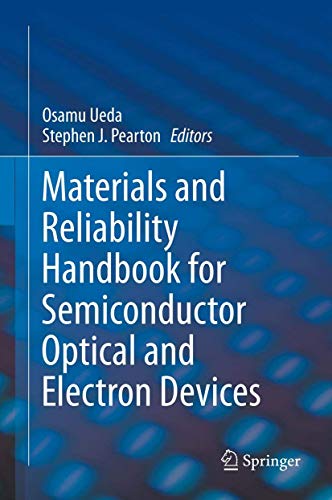
Materials and Reliability Handbook for Semiconductor Optical and Electron Devices provides comprehensive coverage of reliability procedures and approaches for electron and photonic devices. These include lasers and high speed electronics used in cell phones, satellites, data transmission systems and displays. Lifetime predictions for compound semiconductor devices are notoriously inaccurate due to the absence of standard protocols. Manufacturers have relied on extrapolation back to room temperature of accelerated testing at elevated temperature. This technique fails for scaled, high current density devices. Device failure is driven by electric field or current mechanisms or low activation energy processes that are masked by other mechanisms at high temperature.
The Handbook addresses reliability engineering for III-V devices, including materials and electrical characterization, reliability testing, and electronic characterization. These are used to develop new simulation technologies for device operation and reliability, which allow accurate prediction of reliability as well as the design specifically for improved reliability. The Handbook emphasizes physical mechanisms rather than an electrical definition of reliability. Accelerated aging is useful only if the failure mechanism is known. The Handbook also focuses on voltage and current acceleration stress mechanisms.
Die Inhaltsangabe kann sich auf eine andere Ausgabe dieses Titels beziehen.
Über die Autorin bzw. den Autor
Materials and Reliability Handbook for Semiconductor Optical and Electron Devices provides comprehensive coverage of reliability procedures and approaches for modern electron and photonic devices. These devices include lasers and high speed electronics used in all aspects of our lives, from cell phones to satellites, data transmission systems and displays. Lifetime prediction for compound semiconductor device operation is notoriously inaccurate due to the fragmented efforts in reliability and the absence of standard protocols. Manufacturers have usually relied on accelerated testing at elevated temperature and then extrapolated back to room temperature operation. This technique frequently fails for scaled, high current density devices. Device failure is driven by electric field or current mechanisms or low activation energy processes that are masked by other mechanisms at high temperature. Device degradation can be driven by failure in either active structures or passivation layers.
The Handbook addresses reliability engineering for III-V device structures, including materials and electrical characterization, reliability testing, and electronic characterization. These last techniques are used to develop new simulation technologies for device operation and reliability, which in turn allow accurate prediction of reliability as well as the design of structures specifically for improved reliability of operation. Given that a relatively small percentage of devices will actually show failure, it is critical to both enhance the failure rate through accelerated testing and to treat the resulting reliability data correctly. For this reason, the Handbook emphasizes physical mechanisms rather than an electrical definition of reliability. In other words, accelerated aging is useful only if we know the failure mechanism. Also covered are standard Si reliability approaches to determine the instantaneous failure rate and mean time to failure and therefore the distribution functions of greatest relevance to the specific device technology. Furthermore, the Handbook focuses attention on voltage and current acceleration stress mechanisms.
Von der hinteren Coverseite
Materials and Reliability Handbook for Semiconductor Optical and Electron Devices provides comprehensive coverage of reliability procedures and approaches for electron and photonic devices. These include lasers and high speed electronics used in cell phones, satellites, data transmission systems and displays. Lifetime predictions for compound semiconductor devices are notoriously inaccurate due to the absence of standard protocols. Manufacturers have relied on extrapolation back to room temperature of accelerated testing at elevated temperature. This technique fails for scaled, high current density devices. Device failure is driven by electric field or current mechanisms or low activation energy processes that are masked by other mechanisms at high temperature.
The Handbook addresses reliability engineering for III-V devices, including materials and electrical characterization, reliability testing, and electronic characterization. These are used to develop new simulation technologies for device operation and reliability, which allow accurate prediction of reliability as well as the design specifically for improved reliability. The Handbook emphasizes physical mechanisms rather than an electrical definition of reliability. Accelerated aging is useful only if the failure mechanism is known. The Handbook also focuses on voltage and current acceleration stress mechanisms.
Provides the first handbook to cover all aspects of compound semiconductor device reliability
Systematically describes research results on reliability and materials issues of both optical and electron devices developed since 2000
Covers characterization techniques needed to understand failure mechanisms in compound semiconductor devices
Includes experimental approaches in reliability studies
Presents case studies of laser degradation and HEMT degradation
„Über diesen Titel“ kann sich auf eine andere Ausgabe dieses Titels beziehen.
Suchergebnisse für Materials and Reliability Handbook for Semiconductor...

Foto des Verkäufers
Materials and Reliability Handbook for Semiconductor Optical and Electron Devices
Print-on-DemandAnbieter: BuchWeltWeit Ludwig Meier e.K., Bergisch Gladbach, Deutschland
Verkäuferbewertung 5 von 5 Sternen

Taschenbuch. Zustand: Neu. This item is printed on demand - it takes 3-4 days longer - Neuware -Materials and Reliability Handbook for Semiconductor Optical and Electron Devices provides comprehensive coverage of reliability procedures and approaches for electron and photonic devices. These include lasers and high speed electronics used in cell phones, satellites, data transmission systems and displays. Lifetime predictions for compound semiconductor devices are notoriously inaccurate due to the absence of standard protocols. Manufacturers have relied on extrapolation back to room temperature of accelerated testing at elevated temperature. This technique fails for scaled, high current density devices. Device failure is driven by electric field or current mechanisms or low activation energy processes that are masked by other mechanisms at high temperature. The Handbook addresses reliability engineering for III-V devices, including materials and electrical characterization, reliability testing, and electronic characterization. These are used to develop new simulation technologies for device operation and reliability, which allow accurate prediction of reliability as well as the design specifically for improved reliability. The Handbook emphasizes physical mechanisms rather than an electrical definition of reliability. Accelerated aging is useful only if the failure mechanism is known. The Handbook also focuses on voltage and current acceleration stress mechanisms. 632 pp. Englisch. Bestandsnummer des Verkäufers 9781493901197
Neu kaufen
EUR 181,85
EUR 23,00 Versand
Versand von Deutschland nach USA
Versand von Deutschland nach USA
Anzahl: 2 verfügbar
Beispielbild für diese ISBN
Materials and Reliability Handbook for Semiconductor Optical and Electron Devices (eng)
Print-on-DemandAnbieter: Brook Bookstore On Demand, Napoli, NA, Italien
Verkäuferbewertung 5 von 5 Sternen
Zustand: new. Questo è un articolo print on demand. Bestandsnummer des Verkäufers c573b259f83dd6b4fa9c61037b5cc4e8
Neu kaufen
EUR 246,33
EUR 8,00 Versand
Versand von Italien nach USA
Versand von Italien nach USA
Anzahl: Mehr als 20 verfügbar
Foto des Verkäufers
Materials and Reliability Handbook for Semiconductor Optical and Electron Devices
Anbieter: preigu, Osnabrück, Deutschland
Verkäuferbewertung 5 von 5 Sternen
Taschenbuch. Zustand: Neu. Materials and Reliability Handbook for Semiconductor Optical and Electron Devices | Osamu Ueda (u. a.) | Taschenbuch | xvi | Englisch | 2014 | Springer | EAN 9781493901197 | Verantwortliche Person für die EU: Springer Verlag GmbH, Tiergartenstr. 17, 69121 Heidelberg, juergen[dot]hartmann[at]springer[dot]com | Anbieter: preigu. Bestandsnummer des Verkäufers 105057468
Neu kaufen
EUR 274,65
EUR 70,00 Versand
Versand von Deutschland nach USA
Versand von Deutschland nach USA
Anzahl: 5 verfügbar
Beispielbild für diese ISBN
Materials and Reliability Handbook for Semiconductor Optical and Electron Devices
Anbieter: GreatBookPrices, Columbia, MD, USA
Verkäuferbewertung 5 von 5 Sternen
Zustand: New. Bestandsnummer des Verkäufers 22055645-n
Neu kaufen
EUR 361,45
EUR 2,35 Versand
Versand innerhalb von USA
Versand innerhalb von USA
Anzahl: 15 verfügbar
Beispielbild für diese ISBN
Materials and Reliability Handbook for Semiconductor Optical and Electron Devices
Anbieter: Ria Christie Collections, Uxbridge, Vereinigtes Königreich
Verkäuferbewertung 5 von 5 Sternen
Zustand: New. In English. Bestandsnummer des Verkäufers ria9781493901197_new
Neu kaufen
EUR 351,09
EUR 13,40 Versand
Versand von Vereinigtes Königreich nach USA
Versand von Vereinigtes Königreich nach USA
Anzahl: Mehr als 20 verfügbar
Foto des Verkäufers
Materials and Reliability Handbook for Semiconductor Optical and Electron Devices
Anbieter: GreatBookPrices, Columbia, MD, USA
Verkäuferbewertung 5 von 5 Sternen
Zustand: As New. Unread book in perfect condition. Bestandsnummer des Verkäufers 22055645
Gebraucht kaufen
EUR 371,58
EUR 2,35 Versand
Versand innerhalb von USA
Versand innerhalb von USA
Anzahl: 15 verfügbar
Foto des Verkäufers
Materials and Reliability Handbook for Semiconductor Optical and Electron Devices
Verlag:
Springer New York, Springer US Okt 2014, 2014
ISBN 10: 1493901192
ISBN 13: 9781493901197
Neu
Taschenbuch
Anbieter: buchversandmimpf2000, Emtmannsberg, BAYE, Deutschland
Verkäuferbewertung 5 von 5 Sternen
Taschenbuch. Zustand: Neu. This item is printed on demand - Print on Demand Titel. Neuware -Materials and Reliability Handbook for Semiconductor Optical and Electron Devices provides comprehensive coverage of reliability procedures and approaches for electron and photonic devices. These include lasers and high speed electronics used in cell phones, satellites, data transmission systems and displays. Lifetime predictions for compound semiconductor devices are notoriously inaccurate due to the absence of standard protocols. Manufacturers have relied on extrapolation back to room temperature of accelerated testing at elevated temperature. This technique fails for scaled, high current density devices. Device failure is driven by electric field or current mechanisms or low activation energy processes that are masked by other mechanisms at high temperature.The Handbook addresses reliability engineering for III-V devices, including materials and electrical characterization, reliability testing, and electronic characterization. These are used to develop new simulation technologies for device operation and reliability, which allow accurate prediction of reliability as well as the design specifically for improved reliability. The Handbook emphasizes physical mechanisms rather than an electrical definition of reliability. Accelerated aging is useful only if the failure mechanism is known. The Handbook also focuses on voltage and current acceleration stress mechanisms.Springer Verlag GmbH, Tiergartenstr. 17, 69121 Heidelberg 632 pp. Englisch. Bestandsnummer des Verkäufers 9781493901197
Neu kaufen
EUR 320,99
EUR 60,00 Versand
Versand von Deutschland nach USA
Versand von Deutschland nach USA
Anzahl: 1 verfügbar
Foto des Verkäufers
Materials and Reliability Handbook for Semiconductor Optical and Electron Devices
Anbieter: AHA-BUCH GmbH, Einbeck, Deutschland
Verkäuferbewertung 5 von 5 Sternen
Taschenbuch. Zustand: Neu. Druck auf Anfrage Neuware - Printed after ordering - Materials and Reliability Handbook for Semiconductor Optical and Electron Devices provides comprehensive coverage of reliability procedures and approaches for electron and photonic devices. These include lasers and high speed electronics used in cell phones, satellites, data transmission systems and displays. Lifetime predictions for compound semiconductor devices are notoriously inaccurate due to the absence of standard protocols. Manufacturers have relied on extrapolation back to room temperature of accelerated testing at elevated temperature. This technique fails for scaled, high current density devices. Device failure is driven by electric field or current mechanisms or low activation energy processes that are masked by other mechanisms at high temperature. The Handbook addresses reliability engineering for III-V devices, including materials and electrical characterization, reliability testing, and electronic characterization. These are used to develop new simulation technologies for device operation and reliability, which allow accurate prediction of reliability as well as the design specifically for improved reliability. The Handbook emphasizes physical mechanisms rather than an electrical definition of reliability. Accelerated aging is useful only if the failure mechanism is known. The Handbook also focuses on voltage and current acceleration stress mechanisms. Bestandsnummer des Verkäufers 9781493901197
Neu kaufen
EUR 358,67
EUR 35,00 Versand
Versand von Deutschland nach USA
Versand von Deutschland nach USA
Anzahl: 1 verfügbar
Beispielbild für diese ISBN
Materials and Reliability Handbook for Semiconductor Optical and Electron Devices
Anbieter: Revaluation Books, Exeter, Vereinigtes Königreich
Verkäuferbewertung 5 von 5 Sternen
Paperback. Zustand: Brand New. 632 pages. 9.25x6.10x1.42 inches. In Stock. Bestandsnummer des Verkäufers x-1493901192
Neu kaufen
EUR 467,39
EUR 14,84 Versand
Versand von Vereinigtes Königreich nach USA
Versand von Vereinigtes Königreich nach USA
Anzahl: 2 verfügbar