
Verwandte Artikel zu Mathematical Physiology: II: Systems Physiology (Interdiscip...
Mathematical Physiology: II: Systems Physiology (Interdisciplinary Applied Mathematics) - Softcover
Buch 20 von 53: Interdisciplinary Applied Mathematics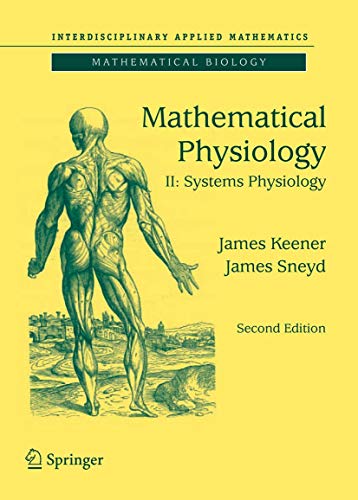
Inhaltsangabe
There has been a long history of interaction between mathematics and physiology. This book looks in detail at a wide selection of mathematical models in physiology, showing how physiological problems can be formulated and studied mathematically, and how such models give rise to interesting and challenging mathematical questions. With its coverage of many recent models it gives an overview of the field, while many older models are also discussed, to put the modern work in context.
In this second edition the coverage of basic principles has been expanded to include such topics as stochastic differential equations, Markov models and Gibbs free energy, and the selection of models has also been expanded to include some of the basic models of fluid transport, respiration/perfusion, blood diseases, molecular motors, smooth muscle, neuroendrocine cells, the baroreceptor loop, turboglomerular oscillations, blood clotting and the retina.
Owing to this extensive coverage, the seond edition is published in two volumes. This first volume deals with the fundamental principles of cell physiology and the second with the physiology of systems.
The book includes detailed illustrations and numerous excercises with selected solutions. The emphasis throughout is on the applications; because of this interdisciplinary approach, this book will be of interest to students and researchers, not only in mathematics, but also in bioengineering, physics, chemistry, biology, statistics and medicine.
James Keener is a Distinguished Professor of Mathematics at the University of Utah.
James Sneyd is the Professor of Applied Mathematics at the University of Auckland, New Zealand. He is best known for his work on the dynamics of intracellular calcium.
Reviews of the first edition:
...probably the best book ever written on the interdisciplinary field of mathematical physiology. Mathematical Reviews, 2000
In addition to being good reading, excellent pedagogy, and appealing science, the exposition is lucid and clear, and there are many good problem sets to choose from... Highly recommended. Mathematical Biosciences, 1999
Both authors are seasoned experts in the field of mathematical physiology and particularly in the field of excitability, calcium dynamics and spiral waves. It directs students to become not merely skilled technicians in biological research but masters of the science. SIAM, 2004
The first edition was the winner of the prize for The Best Mathematics book of 1998 from the American Association of Publishers.
Die Inhaltsangabe kann sich auf eine andere Ausgabe dieses Titels beziehen.
Von der hinteren Coverseite
There has been a long history of interaction between mathematics and physiology. This book looks in detail at a wide selection of mathematical models in physiology, showing how physiological problems can be formulated and studied mathematically, and how such models give rise to interesting and challenging mathematical questions. With its coverage of many recent models it gives an overview of the field, while many older models are also discussed, to put the modern work in context.
In this second edition the coverage of basic principles has been expanded to include such topics as stochastic differential equations, Markov models and Gibbs free energy, and the selection of models has also been expanded to include some of the basic models of fluid transport, respiration/perfusion, blood diseases, molecular motors, smooth muscle, neuroendrocine cells, the baroreceptor loop, turboglomerular oscillations, blood clotting and the retina.
Owing to this extensive coverage, the second edition is published in two volumes. This second volume deals with the physiology of systems and the first volume with the fundamental principles of cell physiology.
The book includes detailed illustrations and numerous excercises with selected solutions. The emphasis throughout is on the applications; because of this interdisciplinary approach, this book will be of interest to students and researchers, not only in mathematics, but also in bioengineering, physics, chemistry, biology, statistics and medicine.
James Keener is a Distinguished Professor of Mathematics at the University of Utah. He and his wife live in Salt Lake City, but don't be surprised if he moves to the mountains.
James Sneyd is the Professor of Applied Mathematics at the University of Auckland in New Zealand, where he has worked for the past six years. He lives with his wife and three children beside a beach, and wouldrather be swimming.
Reviews of the first edition:
...probably the best book ever written on the interdisciplinary field of mathematical physiology. Mathematical Reviews, 2000
In addition to being good reading, excellent pedagogy, and appealing science, the exposition is lucid and clear, and there are many good problem sets to choose from... Highly recommended. Mathematical Biosciences, 1999
Both authors are seasoned experts in the field of mathematical physiology and particularly in the field of excitability, calcium dynamics and spiral waves. It directs students to become not merely skilled technicians in biological research but masters of the science. SIAM, 2004
The first edition was the winner of the 1998 Association of American Publishers "Best New Title in Mathematics."
„Über diesen Titel“ kann sich auf eine andere Ausgabe dieses Titels beziehen.
Suchergebnisse für Mathematical Physiology: II: Systems Physiology (Interdiscip...

Foto des Verkäufers
Mathematical Physiology
Print-on-DemandAnbieter: BuchWeltWeit Ludwig Meier e.K., Bergisch Gladbach, Deutschland
Verkäuferbewertung 5 von 5 Sternen

Taschenbuch. Zustand: Neu. This item is printed on demand - it takes 3-4 days longer - Neuware -There has been a longhistory of interaction between mathematics and physiology. This book looks in detail at a wide selection of mathematical models in physiology, showing how physiological problems can be formulated and studied mathematically, and how such models give rise to interesting and challenging mathematical questions. With its coverage of many recent models it gives an overview of the field, while many older models are also discussed, to put the modern work in context.In this second edition the coverage of basic principles has been expanded to include such topics as stochastic differential equations, Markov models and Gibbs free energy, and the selection of models has also been expanded to include some of the basic models of fluid transport, respiration/perfusion, blood diseases, molecular motors, smooth muscle, neuroendrocine cells, the baroreceptor loop, turboglomerular oscillations, blood clotting and the retina.Owing to this extensive coverage, the seond edition is published in two volumes. This first volume deals with the fundamental principles of cell physiology and the second with the physiology of systems.The book includes detailed illustrations and numerous excercises with selected solutions. The emphasis throughout is on the applications; because of this interdisciplinary approach, this book will be of interest to students and researchers, not only in mathematics, but also in bioengineering, physics, chemistry, biology, statistics and medicine.James Keener is a Distinguished Professor of Mathematics at the University of Utah. James Sneyd is the Professor of Applied Mathematics at the University of Auckland, New Zealand.He is best known for his work on the dynamics of intracellular calcium.Reviews of thefirst edition:.probably the best book ever written on the interdisciplinary field of mathematical physiology. Mathematical Reviews, 2000In addition to being good reading, excellent pedagogy, and appealing science, the exposition is lucid and clear, and there are many good problem sets to choose from. Highly recommended. Mathematical Biosciences, 1999Both authors are seasoned experts in the field of mathematical physiology and particularly in the field of excitability, calcium dynamics and spiral waves. It directs students to become not merely skilled technicians in biological research but masters of the science. SIAM, 2004The first edition was thewinner of the prize for The Best Mathematics book of 1998 from the American Association of Publishers. 608 pp. Englisch. Bestandsnummer des Verkäufers 9781493937097
Neu kaufen
EUR 96,29
EUR 23,00 Versand
Versand von Deutschland nach USA
Versand von Deutschland nach USA
Anzahl: 2 verfügbar
Foto des Verkäufers
Mathematical Physiology
Print-on-DemandAnbieter: moluna, Greven, Deutschland
Verkäuferbewertung 5 von 5 Sternen
Zustand: New. Dieser Artikel ist ein Print on Demand Artikel und wird nach Ihrer Bestellung fuer Sie gedruckt. Contains a variety of physiological problems and the current and new mathematical techniques used in this areaNumerous exercises and models are includedOf interest both to applied mathematicians and quantitative physiologistsWinner o. Bestandsnummer des Verkäufers 447955326
Neu kaufen
EUR 81,44
EUR 48,99 Versand
Versand von Deutschland nach USA
Versand von Deutschland nach USA
Anzahl: Mehr als 20 verfügbar
Foto des Verkäufers
Mathematical Physiology : II: Systems Physiology
Anbieter: AHA-BUCH GmbH, Einbeck, Deutschland
Verkäuferbewertung 5 von 5 Sternen
Taschenbuch. Zustand: Neu. Druck auf Anfrage Neuware - Printed after ordering - There has been a longhistory of interaction between mathematics and physiology. This book looks in detail at a wide selection of mathematical models in physiology, showing how physiological problems can be formulated and studied mathematically, and how such models give rise to interesting and challenging mathematical questions. With its coverage of many recent models it gives an overview of the field, while many older models are also discussed, to put the modern work in context.In this second edition the coverage of basic principles has been expanded to include such topics as stochastic differential equations, Markov models and Gibbs free energy, and the selection of models has also been expanded to include some of the basic models of fluid transport, respiration/perfusion, blood diseases, molecular motors, smooth muscle, neuroendrocine cells, the baroreceptor loop, turboglomerular oscillations, blood clotting and the retina.Owing to this extensive coverage, the seond edition is published in two volumes. This first volume deals with the fundamental principles of cell physiology and the second with the physiology of systems.The book includes detailed illustrations and numerous excercises with selected solutions. The emphasis throughout is on the applications; because of this interdisciplinary approach, this book will be of interest to students and researchers, not only in mathematics, but also in bioengineering, physics, chemistry, biology, statistics and medicine.James Keener is a Distinguished Professor of Mathematics at the University of Utah. James Sneyd is the Professor of Applied Mathematics at the University of Auckland, New Zealand.He is best known for his work on the dynamics of intracellular calcium.Reviews of thefirst edition:.probably the best book ever written on the interdisciplinary field of mathematical physiology. Mathematical Reviews, 2000In addition to being good reading, excellent pedagogy, and appealing science, the exposition is lucid and clear, and there are many good problem sets to choose from. Highly recommended. Mathematical Biosciences, 1999Both authors are seasoned experts in the field of mathematical physiology and particularly in the field of excitability, calcium dynamics and spiral waves. It directs students to become not merely skilled technicians in biological research but masters of the science. SIAM, 2004The first edition was thewinner of the prize for The Best Mathematics book of 1998 from the American Association of Publishers. Bestandsnummer des Verkäufers 9781493937097
Neu kaufen
EUR 110,42
EUR 35,00 Versand
Versand von Deutschland nach USA
Versand von Deutschland nach USA
Anzahl: 1 verfügbar
Foto des Verkäufers
Mathematical Physiology
Print-on-DemandAnbieter: buchversandmimpf2000, Emtmannsberg, BAYE, Deutschland
Verkäuferbewertung 5 von 5 Sternen
Taschenbuch. Zustand: Neu. This item is printed on demand - Print on Demand Titel. Neuware -There has been a long history of interaction between mathematics and physiology. This book looks in detail at a wide selection of mathematical models in physiology, showing how physiological problems can be formulated and studied mathematically, and how such models give rise to interesting and challenging mathematical questions. With its coverage of many recent models it gives an overview of the field, while many older models are also discussed, to put the modern work in context.In this second edition the coverage of basic principles has been expanded to include such topics as stochastic differential equations, Markov models and Gibbs free energy, and the selection of models has also been expanded to include some of the basic models of fluid transport, respiration/perfusion, blood diseases, molecular motors, smooth muscle, neuroendrocine cells, the baroreceptor loop, turboglomerular oscillations, blood clotting and the retina.Owing to this extensive coverage, the seond edition is published in two volumes. This first volume deals with the fundamental principles of cell physiology and the second with the physiology of systems.The book includes detailed illustrations and numerous excercises with selected solutions. The emphasis throughout is on the applications; because of this interdisciplinary approach, this book will be of interest to students and researchers, not only in mathematics, but also in bioengineering, physics, chemistry, biology, statistics and medicine.James Keener is a Distinguished Professor of Mathematics at the University of Utah.James Sneyd is the Professor of Applied Mathematics at the University of Auckland, New Zealand. He is best known for his work on the dynamics of intracellular calcium.Reviews of the first edition:.probably the best book ever written on the interdisciplinary field of mathematical physiology. Mathematical Reviews, 2000In addition to being good reading, excellent pedagogy, and appealing science, the exposition is lucid and clear, and there are many good problem sets to choose from. Highly recommended. Mathematical Biosciences, 1999Both authors are seasoned experts in the field of mathematical physiology and particularly in the field of excitability, calcium dynamics and spiral waves. It directs students to become not merely skilled technicians in biological research but masters of the science. SIAM, 2004The first edition was the winner of the prize for The Best Mathematics book of 1998 from the American Association of Publishers.Springer-Verlag KG, Sachsenplatz 4-6, 1201 Wien 608 pp. Englisch. Bestandsnummer des Verkäufers 9781493937097
Neu kaufen
EUR 96,29
EUR 60,00 Versand
Versand von Deutschland nach USA
Versand von Deutschland nach USA
Anzahl: 1 verfügbar
Foto des Verkäufers
Mathematical Physiology | II: Systems Physiology
Anbieter: preigu, Osnabrück, Deutschland
Verkäuferbewertung 5 von 5 Sternen
Taschenbuch. Zustand: Neu. Mathematical Physiology | II: Systems Physiology | James Keener (u. a.) | Taschenbuch | Interdisciplinary Applied Mathematics | xxv | Englisch | 2008 | Humana | EAN 9781493937097 | Verantwortliche Person für die EU: Springer Verlag GmbH, Tiergartenstr. 17, 69121 Heidelberg, juergen[dot]hartmann[at]springer[dot]com | Anbieter: preigu. Bestandsnummer des Verkäufers 108925313
Neu kaufen
EUR 86,30
EUR 70,00 Versand
Versand von Deutschland nach USA
Versand von Deutschland nach USA
Anzahl: 5 verfügbar
Beispielbild für diese ISBN
Mathematical Physiology: II: Systems Physiology (Interdisciplinary Applied Mathematics (8/2))
Anbieter: Books Puddle, Woodside, NY, USA
Verkäuferbewertung 4 von 5 Sternen

Zustand: New. pp. 574. Bestandsnummer des Verkäufers 26378360125
Neu kaufen
EUR 157,28
EUR 3,57 Versand
Versand innerhalb von USA
Versand innerhalb von USA
Anzahl: 4 verfügbar
Beispielbild für diese ISBN
Mathematical Physiology: II: Systems Physiology (Interdisciplinary Applied Mathematics)
Anbieter: Revaluation Books, Exeter, Vereinigtes Königreich
Verkäuferbewertung 5 von 5 Sternen
Paperback. Zustand: Brand New. 2nd edition. 574 pages. 9.25x6.10x1.30 inches. In Stock. Bestandsnummer des Verkäufers zk149393709X
Neu kaufen
EUR 147,72
EUR 17,91 Versand
Versand von Vereinigtes Königreich nach USA
Versand von Vereinigtes Königreich nach USA
Anzahl: 1 verfügbar
Beispielbild für diese ISBN
Mathematical Physiology: II: Systems Physiology (Interdisciplinary Applied Mathematics (8/2))
Print-on-DemandAnbieter: Majestic Books, Hounslow, Vereinigtes Königreich
Verkäuferbewertung 4 von 5 Sternen
Zustand: New. Print on Demand pp. 574. Bestandsnummer des Verkäufers 385543906
Neu kaufen
EUR 161,35
EUR 7,76 Versand
Versand von Vereinigtes Königreich nach USA
Versand von Vereinigtes Königreich nach USA
Anzahl: 4 verfügbar
Beispielbild für diese ISBN
Mathematical Physiology: II: Systems Physiology (Interdisciplinary Applied Mathematics (8/2))
Print-on-DemandAnbieter: Biblios, Frankfurt am main, HESSE, Deutschland
Verkäuferbewertung 4 von 5 Sternen
Zustand: New. PRINT ON DEMAND pp. 574. Bestandsnummer des Verkäufers 18378360119
Neu kaufen
EUR 162,98
EUR 9,95 Versand
Versand von Deutschland nach USA
Versand von Deutschland nach USA
Anzahl: 4 verfügbar
Beispielbild für diese ISBN
Mathematical Physiology: II: Systems Physiology (Interdisciplinary Applied Mathematics, 8/2)
Anbieter: Mispah books, Redhill, SURRE, Vereinigtes Königreich
Verkäuferbewertung 4 von 5 Sternen
Paperback. Zustand: Like New. LIKE NEW. SHIPS FROM MULTIPLE LOCATIONS. book. Bestandsnummer des Verkäufers ERICA800149393709X6
Gebraucht kaufen
EUR 204,20
EUR 29,86 Versand
Versand von Vereinigtes Königreich nach USA
Versand von Vereinigtes Königreich nach USA
Anzahl: 1 verfügbar