
Verwandte Artikel zu The Organization of Critical Care: An Evidence-Based...
The Organization of Critical Care: An Evidence-Based Approach to Improving Quality (Respiratory Medicine) - Softcover
Buch 21 von 61: Respiratory Medicine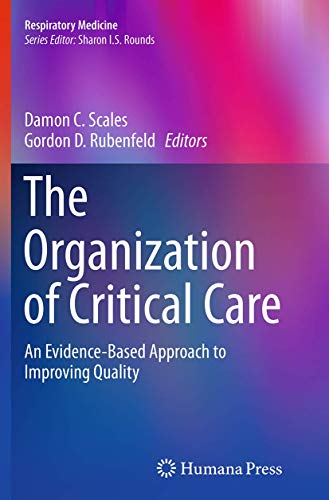
Inhaltsangabe
The origin of modern intensive care units (ICUs) has frequently been attributed to the widespread provision of mechanical ventilation within dedicated hospital areas during the 1952 Copenhagen polio epidemic. However, modern ICUs have developed to treat or monitor patients who have any severe, life-threatening disease or injury. These patients receive specialized care and vital organ assistance such as mechanical ventilation, cardiovascular support, or hemodialysis. ICU patients now typically occupy approximately 10% of inpatient acute care beds, yet the structure and organization of these ICUs can be quite different across hospitals. In The Organization of Critical Care: An Evidence-Based Approach to Improving Quality, leaders provide a concise, evidence-based review of ICU organizational factors that have been associated with improved patient (or other) outcomes. The topics covered are grouped according to four broad domains: (1) the organization, structure, and staffing of an ICU; (2) organizational approaches to improving quality of care in an ICU; (3) integrating ICU care with other healthcare provided within the hospital and across the broader healthcare system; and (4) international perspectives on critical care delivery. Each chapter summarizes a different aspect of ICU organization and targets individual clinicians and healthcare decision makers. A long overdue contribution to the field, The Organization of Critical Care: An Evidence-Based Approach to Improving Quality is an indispensable guide for all clinicians and health administrators concerned with achieving state-of-the-art outcomes for intensive care.
Die Inhaltsangabe kann sich auf eine andere Ausgabe dieses Titels beziehen.
Von der hinteren Coverseite
The origin of modern intensive care units (ICUs) has frequently been attributed to the widespread provision of mechanical ventilation within dedicated hospital areas during the 1952 Copenhagen polio epidemic. However, modern ICUs have developed to treat or monitor patients who have any severe, life-threatening disease or injury. These patients receive specialized care and vital organ assistance such as mechanical ventilation, cardiovascular support, or hemodialysis. ICU patients now typically occupy approximately 10% of inpatient acute care beds, yet the structure and organization of these ICUs can be quite different across hospitals. In The Organization of Critical Care: An Evidence-Based Approach to Improving Quality, leaders provide a concise, evidence-based review of ICU organizational factors that have been associated with improved patient (or other) outcomes. The topics covered are grouped according to four broad domains: (1) the organization, structure, and staffing of an ICU; (2) organizational approaches to improving quality of care in an ICU; (3) integrating ICU care with other healthcare provided within the hospital and across the broader healthcare system; and (4) international perspectives on critical care delivery. Each chapter summarizes a different aspect of ICU organization and targets individual clinicians and healthcare decision makers. A long overdue contribution to the field, The Organization of Critical Care: An Evidence-Based Approach to Improving Quality is an indispensable guide for all clinicians and health administrators concerned with achieving state-of-the-art outcomes for intensive care.
„Über diesen Titel“ kann sich auf eine andere Ausgabe dieses Titels beziehen.
Suchergebnisse für The Organization of Critical Care: An Evidence-Based...

Beispielbild für diese ISBN
The Organization of Critical Care (eng)
Print-on-DemandAnbieter: Brook Bookstore On Demand, Napoli, NA, Italien
Verkäuferbewertung 5 von 5 Sternen

Zustand: new. Questo è un articolo print on demand. Bestandsnummer des Verkäufers 786a13f8ce2e5fda1274a84dd185ccc4
Neu kaufen
EUR 94,25
EUR 30,00 Versand
Versand von Italien nach USA
Versand von Italien nach USA
Anzahl: Mehr als 20 verfügbar
Beispielbild für diese ISBN
Organization of Critical Care : An Evidence-based Approach to Improving Quality
Anbieter: GreatBookPrices, Columbia, MD, USA
Verkäuferbewertung 5 von 5 Sternen
Zustand: New. Bestandsnummer des Verkäufers 27023963-n
Neu kaufen
EUR 128,52
EUR 2,36 Versand
Versand innerhalb von USA
Versand innerhalb von USA
Anzahl: 15 verfügbar
Foto des Verkäufers
The Organization of Critical Care
Print-on-DemandAnbieter: BuchWeltWeit Ludwig Meier e.K., Bergisch Gladbach, Deutschland
Verkäuferbewertung 5 von 5 Sternen
Taschenbuch. Zustand: Neu. This item is printed on demand - it takes 3-4 days longer - Neuware -The origin of modern intensive care units (ICUs) has frequently been attributed to the widespread provision of mechanical ventilation within dedicated hospital areas during the 1952 Copenhagen polio epidemic. However, modern ICUs have developed to treat or monitor patients who have any severe, life-threatening disease or injury. These patients receive specialized care and vital organ assistance such as mechanical ventilation, cardiovascular support, or hemodialysis. ICU patients now typically occupy approximately 10% of inpatient acute care beds, yet the structure and organization of these ICUs can be quite different across hospitals. In The Organization of Critical Care: An Evidence-Based Approach to Improving Quality, leaders provide a concise, evidence-based review of ICU organizational factors that have been associated with improved patient (or other) outcomes. The topics covered are grouped according to four broad domains: (1) the organization, structure, and staffing of an ICU; (2) organizational approaches to improving quality of care in an ICU; (3) integrating ICU care with other healthcare provided within the hospital and across the broader healthcare system; and (4) international perspectives on critical care delivery. Each chapter summarizes a different aspect of ICU organization and targets individual clinicians and healthcare decision makers. A long overdue contribution to the field, The Organization of Critical Care: An Evidence-Based Approach to Improving Quality is an indispensable guide for all clinicians and health administrators concerned with achieving state-of-the-art outcomes for intensive care. 296 pp. Englisch. Bestandsnummer des Verkäufers 9781493951635
Neu kaufen
EUR 117,69
EUR 23,00 Versand
Versand von Deutschland nach USA
Versand von Deutschland nach USA
Anzahl: 2 verfügbar
Foto des Verkäufers
The Organization of Critical Care
Print-on-DemandAnbieter: moluna, Greven, Deutschland
Verkäuferbewertung 5 von 5 Sternen
Zustand: New. Dieser Artikel ist ein Print on Demand Artikel und wird nach Ihrer Bestellung fuer Sie gedruckt. Evidence-based and comprehensive survey of the organization and function of intensive care unitsSuggests a range of improvements to consider in the physical layout and design of intensive care unitsIncludes techniques for integrating subspe. Bestandsnummer des Verkäufers 447956270
Neu kaufen
EUR 98,54
EUR 48,99 Versand
Versand von Deutschland nach USA
Versand von Deutschland nach USA
Anzahl: Mehr als 20 verfügbar
Beispielbild für diese ISBN
The Organization of Critical Care. An Evidence-Based Approach to Improving Quality.
Anbieter: Kennys Bookshop and Art Galleries Ltd., Galway, GY, Irland
Verkäuferbewertung 5 von 5 Sternen
Zustand: New. Editor(s): Scales, Damon C.; Rubenfeld, Gordon D. Series: Respiratory Medicine. Num Pages: 293 pages, 11 black & white illustrations, 23 colour illustrations, 17 black & white tables, biograp. BIC Classification: MMKL. Category: (P) Professional & Vocational. Dimension: 235 x 155 x 16. Weight in Grams: 456. . 2016. Softcover reprint of the original 1st ed. 2014. Paperback. . . . . Bestandsnummer des Verkäufers V9781493951635
Neu kaufen
EUR 140,67
EUR 9,50 Versand
Versand von Irland nach USA
Versand von Irland nach USA
Anzahl: 15 verfügbar
Beispielbild für diese ISBN
The Organization of Critical Care: An Evidence-Based Approach to Improving Quality (Respiratory Medicine)
Anbieter: Ria Christie Collections, Uxbridge, Vereinigtes Königreich
Verkäuferbewertung 5 von 5 Sternen
Zustand: New. In English. Bestandsnummer des Verkäufers ria9781493951635_new
Neu kaufen
EUR 143,62
EUR 13,34 Versand
Versand von Vereinigtes Königreich nach USA
Versand von Vereinigtes Königreich nach USA
Anzahl: Mehr als 20 verfügbar
Foto des Verkäufers
The Organization of Critical Care : An Evidence-Based Approach to Improving Quality
Print-on-DemandAnbieter: AHA-BUCH GmbH, Einbeck, Deutschland
Verkäuferbewertung 5 von 5 Sternen
Taschenbuch. Zustand: Neu. nach der Bestellung gedruckt Neuware - Printed after ordering - The origin of modern intensive care units (ICUs) has frequently been attributed to the widespread provision of mechanical ventilation within dedicated hospital areas during the 1952 Copenhagen polio epidemic. However, modern ICUs have developed to treat or monitor patients who have any severe, life-threatening disease or injury. These patients receive specialized care and vital organ assistance such as mechanical ventilation, cardiovascular support, or hemodialysis. ICU patients now typically occupy approximately 10% of inpatient acute care beds, yet the structure and organization of these ICUs can be quite different across hospitals. In The Organization of Critical Care: An Evidence-Based Approach to Improving Quality, leaders provide a concise, evidence-based review of ICU organizational factors that have been associated with improved patient (or other) outcomes. The topics covered are grouped according to four broad domains: (1) the organization, structure, and staffing of an ICU; (2) organizational approaches to improving quality of care in an ICU; (3) integrating ICU care with other healthcare provided within the hospital and across the broader healthcare system; and (4) international perspectives on critical care delivery. Each chapter summarizes a different aspect of ICU organization and targets individual clinicians and healthcare decision makers. A long overdue contribution to the field, The Organization of Critical Care: An Evidence-Based Approach to Improving Quality is an indispensable guide for all clinicians and health administrators concerned with achieving state-of-the-art outcomes for intensive care. Bestandsnummer des Verkäufers 9781493951635
Neu kaufen
EUR 133,20
EUR 35,00 Versand
Versand von Deutschland nach USA
Versand von Deutschland nach USA
Anzahl: 1 verfügbar
Foto des Verkäufers
The Organization of Critical Care | An Evidence-Based Approach to Improving Quality
Anbieter: preigu, Osnabrück, Deutschland
Verkäuferbewertung 5 von 5 Sternen
Taschenbuch. Zustand: Neu. The Organization of Critical Care | An Evidence-Based Approach to Improving Quality | Damon C. Scales (u. a.) | Taschenbuch | Respiratory Medicine | ix | Englisch | 2016 | Springer | EAN 9781493951635 | Verantwortliche Person für die EU: Humana Press in Springer Science + Business Media, Heidelberger Platz 3, 14197 Berlin, juergen[dot]hartmann[at]springer[dot]com | Anbieter: preigu. Bestandsnummer des Verkäufers 103542632
Neu kaufen
EUR 104,25
EUR 70,00 Versand
Versand von Deutschland nach USA
Versand von Deutschland nach USA
Anzahl: 5 verfügbar
Foto des Verkäufers
The Organization of Critical Care
Print-on-DemandAnbieter: buchversandmimpf2000, Emtmannsberg, BAYE, Deutschland
Verkäuferbewertung 5 von 5 Sternen
Taschenbuch. Zustand: Neu. This item is printed on demand - Print on Demand Titel. Neuware -The origin of modern intensive care units (ICUs) has frequently been attributed to the widespread provision of mechanical ventilation within dedicated hospital areas during the 1952 Copenhagen polio epidemic. However, modern ICUs have developed to treat or monitor patients who have any severe, life-threatening disease or injury. These patients receive specialized care and vital organ assistance such as mechanical ventilation, cardiovascular support, or hemodialysis. ICU patients now typically occupy approximately 10% of inpatient acute care beds, yet the structure and organization of these ICUs can be quite different across hospitals. In The Organization of Critical Care: An Evidence-Based Approach to Improving Quality, leaders provide a concise, evidence-based review of ICU organizational factors that have been associated with improved patient (or other) outcomes. The topics covered are grouped according to four broad domains: (1) the organization, structure, and staffing of an ICU; (2) organizational approaches to improving quality of care in an ICU; (3) integrating ICU care with other healthcare provided within the hospital and across the broader healthcare system; and (4) international perspectives on critical care delivery. Each chapter summarizes a different aspect of ICU organization and targets individual clinicians and healthcare decision makers. A long overdue contribution to the field, The Organization of Critical Care: An Evidence-Based Approach to Improving Quality is an indispensable guide for all clinicians and health administrators concerned with achieving state-of-the-art outcomes for intensive care.Libri GmbH, Europaallee 1, 36244 Bad Hersfeld 296 pp. Englisch. Bestandsnummer des Verkäufers 9781493951635
Neu kaufen
EUR 117,69
EUR 60,00 Versand
Versand von Deutschland nach USA
Versand von Deutschland nach USA
Anzahl: 1 verfügbar
Beispielbild für diese ISBN
The Organization of Critical Care: An Evidence-based Approach to Improving Quality
Anbieter: Revaluation Books, Exeter, Vereinigtes Königreich
Verkäuferbewertung 5 von 5 Sternen
Paperback. Zustand: Brand New. reprint edition. 293 pages. 9.25x6.10x0.70 inches. In Stock. Bestandsnummer des Verkäufers x-1493951637
Neu kaufen
EUR 172,88
EUR 11,82 Versand
Versand von Vereinigtes Königreich nach USA
Versand von Vereinigtes Königreich nach USA
Anzahl: 2 verfügbar