
Verwandte Artikel zu The Left's War Against the Poor: Rethinking the...
Inhaltsangabe
Leftists have been waging a war against the poor since the 1960s. During that decade, the left began turning its attention to other causes and in doing so began a war against the poor. This war is not an intentional war, but it is a war nevertheless. It manifests itself in a number of ways: by environmentalists who never think about the impact that their policies have on the poor; by well-meaning people who destroyed the public schools; and by people who support criminals over their victims, who are almost always poor people. Why did this war happen? It happened because the left, despite its focus on the poor, has almost always been controlled by the rich. When the left adopted new issues several decades ago, these rich people refused to listen to those among the poor who protested. But while the left's war against the poor goes back only a few decades, the fact that the left has been controlled by the rich ever since the left began means that the left has never really been wholly committed to helping the poor. Instead, the analyses and policies formulated by rich leftists have helped rich leftists (who get to keep their wealth and to control the government) more than the poor. This book argues that a leftism by and for the poor will be strikingly different from leftism as it now exists. While Rich People's Leftism blames capitalism for exploiting the workers and wants a redistribution of wealth, Poor People's Lefism wants job creation. The more jobs there are for the poor, the less they are exploited. It is job creation more than anything else that will help the poor escape from poverty.
Die Inhaltsangabe kann sich auf eine andere Ausgabe dieses Titels beziehen.
Auszug. © Genehmigter Nachdruck. Alle Rechte vorbehalten.
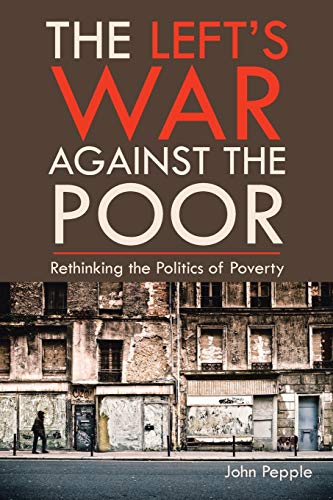
The Left's War Against the Poor
Rethinking the Politics of Poverty
By John PeppleAuthorHouse
Copyright © 2015 John Frederick Pepple
All rights reserved.
ISBN: 978-1-4969-6031-3All rights reserved.
Contents
Acknowledgments, 7,
Introduction, 9,
Part I: The Left's Recent War Against The Poor, 17,
Chapter 1: The Five Income Taxes, 19,
Chapter 2: The Environment or the Poor: Which Has Greater Priority for Leftists?, 25,
Chapter 3: Being Soft on Crime, 46,
Chapter 4: Pushing for the Decline of Our Schools, 62,
Chapter 5: Making College Unaffordable, 73,
Chapter 6: A Miscellany of Smaller Complaints, 80,
Chapter 7: Conclusions Concerning the Left's War Against the Poor, 90,
Part II: Capitalism Is Not the Problem, 97,
Chapter 8: The Evils of Capitalism Can Arise Even When Capitalism Is Absent, 99,
Chapter 9: Eliminating Capitalism Doesn't Necessarily Help the Poor, 118,
Chapter 10: Eliminating Capitalism Causes Its Own Problems, 122,
Chapter 11: The Real Problems of the Industrial Revolution, 127,
Chapter 12: How the United States Overcame Those Problems, 132,
Part III: A Leftism by, for, and of the Poor, 139,
Chapter 13: The Left Is Run by Rich People, 141,
Chapter 14: Against Redistributions, 162,
Chapter 15: Listening to the Poor as They Vote with their Feet, 186,
Chapter 16: Jobs, Jobs, Jobs: What Poor People Need and What Rich People's Leftism Doesn't Give Them, 191,
Chapter 17: Some Differences Between Rich People's Leftism and Poor People's Leftism, 211,
Chapter 18: A Closer Look at Some of These Differences, 220,
Chapter 19: A New Role for the Rich Leftist, 239,
Chapter 20: How to Do a Redistribution If It Is Needed, 242,
Chapter 21: Dispelling Some Myths about Capitalism, 245,
Chapter 22: How Is Poor People's Leftism Different from Conservatism or Libertarianism?, 267,
Chapter 23: A Whole New Leftism, 278,
Notes, 287,
Index, 297,
CHAPTER 1
The Five Income Taxes
Before I give evidence that the left has been waging a war against the poor, I want to make an analogy. Imagine that there was not one, but five separate income taxes. Of these, one was the original income tax from the early part of the twentieth century, while the other four were new ones instituted in the 1960s by the Democrats. Imagine also that the following policies were in place. With respect to the original income tax, the Democrats demanded that it be high but also that it be progressive. In other words, they believed that the poor—and here I am including everyone in the bottom half as poor—should pay a smaller percentage of their income than the rich. However, with respect to the other four income taxes, the Democrats were indifferent. If those taxes happened to be regressive rather than progressive, they were not troubled.
The Republicans had a different policy. With respect to the original income tax, they weren't interested in whether it was progressive or not. They simply wanted the rates reduced. As for the other four income taxes, they wanted them eliminated.
Now, whose policies do you think the poor would prefer? Any Democrat who thinks that the poor would prefer their policies over those of the Republicans has blinders on. The poor don't like those extra four taxes, especially because those taxes tend to be regressive. The Democrats heartlessly say, "Well, you just have to pay them. They're needed." Meanwhile, the Republicans are saying, "We don't like those taxes either, and we want them eliminated."
Even worse, the Democrats' policy of having the original tax be high, the idea being that the money will be redistributed back to the poor, doesn't sit well with many poor people because (1) whatever they receive from a redistribution is gobbled up by paying the other four taxes, and (2) they believe that much of that money goes to people other than themselves anyway. Accordingly, they are stuck with high, mostly regressive taxes, and they don't like them at all. The Republicans swoop in and say, "We want to cut your tax rates." And many poor people love it.
From the late 1960s down to today, this has been the situation that Democrats have faced, and most of them have not understood it. This has had severe electoral consequences for the Democrats since at one time they regularly won presidential elections, whereas since the 1970s, their record has been much less impressive.
Since the 2008 election, what I am saying may not seem very important. There was a lot of talk after that election of a realignment in American politics, in which the Democrats would gain a lot of power and the Republicans would lose. I didn't believe this because I live in a lower-middle-class neighborhood, and I could see nothing there that would suggest any such realignment. It didn't surprise me at all when the Republicans came roaring back in 2010. Confidence returned to the Democrats with the 2012 election, but it may be a little misplaced. President Obama won re-election with fewer votes than he received in 2008, which isn't suggestive of a realignment. Anyway, the election of 2014 was another big win for the Republicans, a win that gave them control of the Senate and many state legislatures and governorships. Accordingly, I'm going to assume that any realignment is something that might happen twenty or thirty years from now, but is not happening right now, and so the Democrats are back to figuring out how to get more poor voters on their side.
Let me consider some other reasons leftists might be inclined to dismiss what I am saying. Many Democrats imagine the poor will always favor their policies. This is an article of faith among the Democrats to such a degree that perhaps not even using the analogy of the five income taxes will get through to them. In the minds of such ideologues, the left is the poor person's natural ally. That was carved in stone ages ago and can never be overthrown, nor can any amount of empirical evidence ever show them that some poor people now have different attitudes. But I say that poor people will generally go to whichever party or group they think will help them more. If they are desperate—and poor people often are—they will follow (whether knowingly or unknowingly) the adage, "Any port in a storm." Their attitude will be, "So what if I've been voting for the Democrats for half a century? I need help now, and while the Democrats are not willing to provide it, the Republicans are." Any Democrat who clings to the idea that the poor will always see the Democrats as their ally will never understand the election of various Republicans over the last half century, and they might as well save time and stop reading this book now.
A slightly less deluded Democrat may, when considering the extra taxes I am talking about, dismiss them as unimportant. He or she may say, "The Republicans hurt the poor so much through their other policies that these regressive taxes you talk about don't mean anything." But that isn't the way the poor see it. Their attitude is, "You should not be hurting us at all." The fact that they perceive the Democrats as hurting them makes them feel betrayed. When everything is toted up, it might be true that Republicans hurt the poor more than Democrats did, but I wouldn't bet on it. I believe that poor people, especially the working poor, have sound instincts and that they know better than Democratic theorists what their situation is and who is helping them more. But let's say they are wrong. It is nevertheless...
„Über diesen Titel“ kann sich auf eine andere Ausgabe dieses Titels beziehen.
Suchergebnisse für The Left's War Against the Poor: Rethinking the...

Foto des Verkäufers
Left's War Against the Poor : Rethinking the Politics of Poverty
Anbieter: GreatBookPrices, Columbia, MD, USA
Verkäuferbewertung 5 von 5 Sternen

Zustand: As New. Unread book in perfect condition. Bestandsnummer des Verkäufers 23272669
Gebraucht kaufen
EUR 19,86
EUR 2,27 Versand
Versand innerhalb von USA
Versand innerhalb von USA
Anzahl: Mehr als 20 verfügbar
Foto des Verkäufers
Left's War Against the Poor : Rethinking the Politics of Poverty
Anbieter: GreatBookPrices, Columbia, MD, USA
Verkäuferbewertung 5 von 5 Sternen
Zustand: New. Bestandsnummer des Verkäufers 23272669-n
Neu kaufen
EUR 21,59
EUR 2,27 Versand
Versand innerhalb von USA
Versand innerhalb von USA
Anzahl: Mehr als 20 verfügbar
Beispielbild für diese ISBN
The Left's War Against the Poor: Rethinking the Politics of Poverty
Anbieter: California Books, Miami, FL, USA
Verkäuferbewertung 5 von 5 Sternen
Zustand: New. Bestandsnummer des Verkäufers I-9781496960313
Neu kaufen
EUR 23,95
Versand gratis
Versand innerhalb von USA
Versand innerhalb von USA
Anzahl: Mehr als 20 verfügbar
Beispielbild für diese ISBN
The Left's War Against the Poor
Print-on-DemandAnbieter: PBShop.store US, Wood Dale, IL, USA
Verkäuferbewertung 5 von 5 Sternen
PAP. Zustand: New. New Book. Shipped from UK. THIS BOOK IS PRINTED ON DEMAND. Established seller since 2000. Bestandsnummer des Verkäufers L0-9781496960313
Neu kaufen
EUR 24,61
Versand gratis
Versand innerhalb von USA
Versand innerhalb von USA
Anzahl: Mehr als 20 verfügbar
Foto des Verkäufers
The Left's War Against the Poor: Rethinking the Politics of Poverty (Paperback or Softback)
Anbieter: BargainBookStores, Grand Rapids, MI, USA
Verkäuferbewertung 5 von 5 Sternen
Zustand: New. The Left's War Against the Poor: Rethinking the Politics of Poverty (Paperback or Softback). Bestandsnummer des Verkäufers BBS-9781496960313
Beispielbild für diese ISBN
The Left's War Against the Poor
Print-on-DemandAnbieter: PBShop.store UK, Fairford, GLOS, Vereinigtes Königreich
Verkäuferbewertung 5 von 5 Sternen
PAP. Zustand: New. New Book. Delivered from our UK warehouse in 4 to 14 business days. THIS BOOK IS PRINTED ON DEMAND. Established seller since 2000. Bestandsnummer des Verkäufers L0-9781496960313
Neu kaufen
EUR 21,61
EUR 5,84 Versand
Versand von Vereinigtes Königreich nach USA
Versand von Vereinigtes Königreich nach USA
Anzahl: Mehr als 20 verfügbar
Beispielbild für diese ISBN
The Left's War Against the Poor: Rethinking the Politics of Poverty
Anbieter: Ria Christie Collections, Uxbridge, Vereinigtes Königreich
Verkäuferbewertung 5 von 5 Sternen
Zustand: New. In. Bestandsnummer des Verkäufers ria9781496960313_new
Neu kaufen
EUR 21,72
EUR 13,94 Versand
Versand von Vereinigtes Königreich nach USA
Versand von Vereinigtes Königreich nach USA
Anzahl: Mehr als 20 verfügbar
Beispielbild für diese ISBN
Left's War Against the Poor : Rethinking the Politics of Poverty
Anbieter: GreatBookPricesUK, Woodford Green, Vereinigtes Königreich
Verkäuferbewertung 5 von 5 Sternen
Zustand: New. Bestandsnummer des Verkäufers 23272669-n
Neu kaufen
EUR 21,60
EUR 17,46 Versand
Versand von Vereinigtes Königreich nach USA
Versand von Vereinigtes Königreich nach USA
Anzahl: Mehr als 20 verfügbar
Foto des Verkäufers
Left's War Against the Poor : Rethinking the Politics of Poverty
Anbieter: GreatBookPricesUK, Woodford Green, Vereinigtes Königreich
Verkäuferbewertung 5 von 5 Sternen
Zustand: As New. Unread book in perfect condition. Bestandsnummer des Verkäufers 23272669
Gebraucht kaufen
EUR 22,73
EUR 17,46 Versand
Versand von Vereinigtes Königreich nach USA
Versand von Vereinigtes Königreich nach USA
Anzahl: Mehr als 20 verfügbar
Beispielbild für diese ISBN
The Left's War Against the Poor: Rethinking the Politics of Poverty
Print-on-DemandAnbieter: THE SAINT BOOKSTORE, Southport, Vereinigtes Königreich
Verkäuferbewertung 5 von 5 Sternen
Paperback. Zustand: New. This item is printed on demand. New copy - Usually dispatched within 5-9 working days. Bestandsnummer des Verkäufers C9781496960313
Neu kaufen
EUR 23,31
EUR 17,21 Versand
Versand von Vereinigtes Königreich nach USA
Versand von Vereinigtes Königreich nach USA
Anzahl: Mehr als 20 verfügbar