
Verwandte Artikel zu Dream Again: A Story of Faith, Courage, and the Tenacity...
Inhaltsangabe
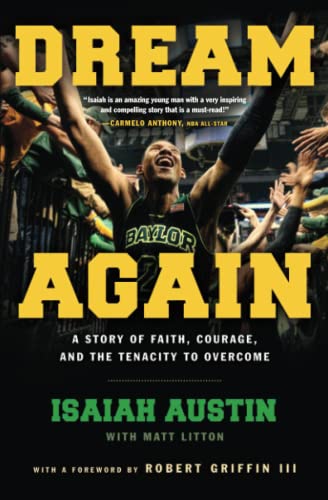
The inspiring story of Isaiah Austin, the man who captured our hearts when he was made the honorary NBA draft pick after a shocking diagnosis ended his professional basketball career before he could even step onto the court.
“There are two choices in life: you make it your excuse or you make it your story.” Isaiah Austin’s mother shared these words of wisdom with him as a child as he came to terms with a torn retina taking away the ability to see with his right eye. Faced with adversity at a young age, Isaiah had to choose—let his disability define him or overcome the challenge and shine.
Overcoming that challenge is exactly what Isaiah did as he made a name for himself on Baylor University’s NCAA Division 1 basketball team. Everyone expected Isaiah to have a successful career in the NBA after college, but on June 21, 2014—just five days before the NBA draft—Austin was diagnosed with Marfan syndrome, a genetic disorder that affects the body’s connective tissue, putting him at risk of rupturing his heart if he continued to play basketball. In seconds, Austin’s hopes for a career in the NBA became impossible.
After hearing about Isaiah’s diagnosis, NBA commissioner Adam Silver invited Austin to attend the 2014 draft as his personal guest. The League recognized Isaiah’s courage, resilience, and determination in a bittersweet moment when he was made an Honorary Draft Pick.
Rather than letting another challenge destroy his faith, Austin has once again strived to overcome adversity by becoming a spokesperson for The Marfan Foundation, raising awareness and understanding for the disease. He has also founded his own non-profit organization, The Isaiah Austin Foundation, to provide support and research for Marfan syndrome and those affected by it. Despite the many heartbreaking challenges he has faced, Isaiah’s story is inspirational and full of hope as he encourages everyone to tower in the face of adversity and keep living out their dreams, no matter what life throws their way.
The book includes a foreword from Robert Griffin III—the Heisman Trophy winner and NFL quarterback.
Die Inhaltsangabe kann sich auf eine andere Ausgabe dieses Titels beziehen.
Über die Autorinnen und Autoren
Isaiah Austin completed his very successful college career for the Baylor Bears in 2014. He had been considered a first-round prospect until he was diagnosed with Marfan syndrome just days prior to the NBA Draft. On June 26, 2014, between the fifteenth and sixteenth picks of the 2014 Draft, NBA Commissioner Adam Silver made Austin a ceremonial pick, which fulfilled his dream of getting drafted. The crowd gave him a standing ovation as he walked up to the podium.
Robert Griffin III played college football at Baylor University, where he won the 2011 Heisman Trophy. Griffin won the 2012 NFL Offensive Rookie of the Year award, leading Washington to the top of their division and their first playoff appearance in five seasons. He currently serves as NFL and College Football analyst for ESPN. You can follow Robert on Twitter and Instagram @RGIII.
Auszug. © Genehmigter Nachdruck. Alle Rechte vorbehalten.
Dream Again
CHAPTER 1
BLINDSIDED
I am seven feet tall, so I stand out everywhere I go. Each time I shop at the mall, every time I get out of my car at a gas station, anytime I walk across campus at school, people notice me. Standing out or being different is something I’ve just had to deal with my whole life. But it’s not my height that really makes me different from everyone else in the world; it’s my vision.
Let me explain. I take great pride in how well I see the game of basketball, especially when I am out there competing on the court. I can see a teammate coming open off a cut before he’s actually open. I’ll beat you to the ball because I can see on which side of the paint a rebound is going to fall before the shot is missed. I can tell if a double team is coming to trap me in the post before it actually gets to me. I’ve worked hard all my life to see these things better than other players.
But there are a lot of guys out there who work hard to have that kind of vision on the court. So when I talk about “the way I see,” I am also talking about something much bigger. I strive to have a life vision. Life vision is similar to vision on the court, but instead of being all about the game, it’s all about how well you can visualize your dreams. My whole life I’ve tried to look toward the positive, even in the worst circumstances, and I see my dreams coming true.
From the time I was five years old living in California, I had a vision of playing in the NBA. I know a lot of other kids might say that kind of thing, but this was different. Even when I was a child, I could see myself on the stage at Radio City Music Hall on draft night. I could visualize every part—I could see myself dressed in a crisp suit, sitting at a table with my family, hugging my mom and dad when my name was called, walking up those stairs to shake hands with the commissioner, taking the franchise hat, smiling for the cameras, and letting my personality shine while I did the post-draft interviews. For as long as I can remember, I could see all of those details clearly when I laid my head down on the pillow at night, when I woke up in the morning, every time I took the court, and each time I stood on my driveway to practice the game I love so much. That vision drove me to where I am today; it made me the person I am right now. Although I’ve had a difficult time seeing the details in my everyday life that most people take for granted, I could still always see my dream.
A big part of my story is about dreams and what it takes to make them come true. That kind of vision comes from hard work, grinding it out every day, especially on the days when I didn’t feel like working. It comes from the support of family, learning to overcome adversity, and staying positive, even when everything in the world around me was negative. I think that’s one of the reasons why I’ve always liked the Bible character Joseph. Every time my preacher would talk about Joseph, he’d talk about dreams. I could identify with Joseph because even when things were tough for him, when he was in trouble, separated from his family, and no one else believed in him, he still held on to his vision; he still kept his dreams in sight.
Since God gave Joseph his dreams, Joseph knew that meant they would come true. And just the same for me, I believed God had given me this dream of playing in the NBA and it was destined to be true.
FIVE DAYS BEFORE the 2014 NBA draft, I woke up early with my heart beating fast. Leading up to this big day, I had traveled to NBA franchises all over the country and competed as hard as I could through eleven different workouts. I checked my phone when I got out of bed that morning to reread the messages from my agent, Dwon Clifton, who had received great news from one of my last workouts with the Los Angeles Clippers.
After a great sophomore season at Baylor, which included a Sweet 16 appearance in the NCAA tournament, I made the difficult decision to leave college at the end of season and enter my name into the draft. My head coach, Scott Drew, along with the rest of the Baylor coaching staff, helped me make the best possible decision and then supported and encouraged me once my choice was final. Still, a lot of people doubted my decision to come out of college early. The experts said I wasn’t ready. Early on in the process I attended the NBA combine and was flagged to do some testing on my heart, so several of the scouts had me going late in the second round and a lot of people even had me projected as going undrafted. But I knew it was my time. I can’t explain it any better than that. I didn’t necessarily want to leave the campus I loved so much, but I had this gut feeling that it was my moment to go.
Throughout the whole pre-draft process, I only had one terrible performance, and that was mainly because I had been sick with some type of flu. My energy was low for the workout, and I know it had a huge effect on how I played that afternoon. There were a few moments where things didn’t look good, but I stayed positive and kept hanging on to my vision. The truth is that the more I played and interviewed for teams, the better news my agent seemed to be getting. There were several teams who were interested in taking me with their first-round pick.
In addition to wanting to see my dream fulfilled, I also felt I had something to prove about myself and my ability. I had a pretty big chip on my shoulder because of the lack of respect I got as a player all season—even when my numbers and performances were consistently better than some of the guys who were projected to be solid first-round draft picks. I knew when all the talk was done, when we were in the gym going at it, I was going to rise to the top. I never let the doubters get me down, though—in fact, they drove me to work even harder. I stayed focused, and sure enough, my name continued to climb higher on the draft board, even ahead of players who had gotten a lot more hype than me during the college season.
When my agent called that Friday morning with great news from the Clippers, I was so excited. They told him that I shot the ball better than a lot of guards they had already tried out. They liked how energetic I was around the basket, how versatile I was for a seven-foot player, and how good my passing and dribbling were for a guy my size. They said I was very skilled and that they thought they could help me put some weight on and that I might be a great fit in their program. The NBA is big business and there are no guarantees, but the Clippers had a late first-round pick. They were a veteran team, and my agent believed it would be a great place for me to develop my game and learn from the best. We had gotten this kind of feedback from a couple of other teams, and I started to believe I had a legitimate shot at the first round. I ate breakfast thinking about those texts, the Clippers, playing on the same team with guys like Chris Paul and Blake Griffin, being coached by a future Hall of Fame guy like Doc Rivers . . . I imagined playing in front of thousands of fans and even Hollywood movie stars sitting courtside to watch every game. I was thinking about what it meant to be a first-rounder after I had spent my whole college career with people on the outside, criticizing and doubting my ability. It was hard not to be too excited. But I had to stay focused. I was about to head to Chicago, another solid team with a great coach and a lot of veterans, for my final workout the next morning. That’s right, the Bulls, the...
„Über diesen Titel“ kann sich auf eine andere Ausgabe dieses Titels beziehen.
Suchergebnisse für Dream Again: A Story of Faith, Courage, and the Tenacity...

Beispielbild für diese ISBN
Dream Again: A Story of Faith, Courage, and the Tenacity to Overcome
Anbieter: Bookmonger.Ltd, HILLSIDE, NJ, USA
Verkäuferbewertung 5 von 5 Sternen

paperback. Zustand: Good. Marks on edge * Crease on cover and a few pages*. Bestandsnummer des Verkäufers mon0000717179
Gebraucht kaufen
EUR 1,38
EUR 3,55 Versand
Versand innerhalb von USA
Versand innerhalb von USA
Anzahl: 1 verfügbar
Beispielbild für diese ISBN
Dream Again: A Story of Faith, Courage, and the Tenacity to Overcome
Anbieter: World of Books (was SecondSale), Montgomery, IL, USA
Verkäuferbewertung 5 von 5 Sternen
Zustand: Good. Item in good condition and has highlighting/writing on text. Used texts may not contain supplemental items such as CDs, info-trac etc. Bestandsnummer des Verkäufers 00106968875
Gebraucht kaufen
EUR 5,48
Versand gratis
Versand innerhalb von USA
Versand innerhalb von USA
Anzahl: 1 verfügbar
Beispielbild für diese ISBN
Dream Again: A Story of Faith, Courage, and the Tenacity to Overcome
Anbieter: ThriftBooks-Atlanta, AUSTELL, GA, USA
Verkäuferbewertung 5 von 5 Sternen
Paperback. Zustand: Good. No Jacket. Pages can have notes/highlighting. Spine may show signs of wear. ~ ThriftBooks: Read More, Spend Less. Bestandsnummer des Verkäufers G1501123068I3N00
Gebraucht kaufen
EUR 5,99
Versand gratis
Versand innerhalb von USA
Versand innerhalb von USA
Anzahl: 1 verfügbar
Beispielbild für diese ISBN
Dream Again: A Story of Faith, Courage, and the Tenacity to Overcome
Anbieter: ThriftBooks-Atlanta, AUSTELL, GA, USA
Verkäuferbewertung 5 von 5 Sternen
Paperback. Zustand: As New. No Jacket. Pages are clean and are not marred by notes or folds of any kind. ~ ThriftBooks: Read More, Spend Less. Bestandsnummer des Verkäufers G1501123068I2N00
Gebraucht kaufen
EUR 5,99
Versand gratis
Versand innerhalb von USA
Versand innerhalb von USA
Anzahl: 1 verfügbar
Foto des Verkäufers
Dream Again: A Story of Faith, Courage, and the Tenacity to Overcome
Anbieter: Blue Vase Books, Interlochen, MI, USA
Verkäuferbewertung 5 von 5 Sternen
Zustand: acceptable. The item is very worn but is perfectly usable. Signs of wear can include aesthetic issues such as scratches, dents, worn and creased covers, folded page corners and minor liquid stains. All pages and the cover are intact, but the dust cover may be missing. Pages may include moderate to heavy amount of notes and highlighting, but the text is not obscured or unreadable. Page edges may have foxing age related spots and browning . May NOT include discs, access code or other supplemental materials. Bestandsnummer des Verkäufers BVV.1501123068.A
Gebraucht kaufen
EUR 6,00
Versand gratis
Versand innerhalb von USA
Versand innerhalb von USA
Anzahl: 1 verfügbar
Beispielbild für diese ISBN
Dream Again: A Story of Faith, Courage, and the Tenacity to Overcome [Paperback] Austin, Isaiah
Anbieter: Lakeside Books, Benton Harbor, MI, USA
Verkäuferbewertung 5 von 5 Sternen
Zustand: New. Brand New! Not Overstocks or Low Quality Book Club Editions! Direct From the Publisher! We're not a giant, faceless warehouse organization! We're a small town bookstore that loves books and loves it's customers! Buy from Lakeside Books! Bestandsnummer des Verkäufers OTF-S-9781501123061
Neu kaufen
EUR 9,92
EUR 3,55 Versand
Versand innerhalb von USA
Versand innerhalb von USA
Anzahl: Mehr als 20 verfügbar
Foto des Verkäufers
Dream Again : A Story of Faith, Courage, and the Tenacity to Overcome
Anbieter: GreatBookPrices, Columbia, MD, USA
Verkäuferbewertung 5 von 5 Sternen
Zustand: New. Bestandsnummer des Verkäufers 24797213-n
Neu kaufen
EUR 11,15
EUR 2,35 Versand
Versand innerhalb von USA
Versand innerhalb von USA
Anzahl: 15 verfügbar
Foto des Verkäufers
Dream Again : A Story of Faith, Courage, and the Tenacity to Overcome
Anbieter: GreatBookPrices, Columbia, MD, USA
Verkäuferbewertung 5 von 5 Sternen
Zustand: As New. Unread book in perfect condition. Bestandsnummer des Verkäufers 24797213
Gebraucht kaufen
EUR 12,19
EUR 2,35 Versand
Versand innerhalb von USA
Versand innerhalb von USA
Anzahl: 15 verfügbar
Beispielbild für diese ISBN
Dream Again Format: Paperback
Anbieter: INDOO, Avenel, NJ, USA
Verkäuferbewertung 5 von 5 Sternen
Zustand: As New. Unread copy in mint condition. Bestandsnummer des Verkäufers SS9781501123061
Gebraucht kaufen
EUR 14,62
Versand gratis
Versand innerhalb von USA
Versand innerhalb von USA
Anzahl: Mehr als 20 verfügbar
Beispielbild für diese ISBN
Dream Again Format: Paperback
Anbieter: INDOO, Avenel, NJ, USA
Verkäuferbewertung 5 von 5 Sternen
Zustand: New. Brand New. Bestandsnummer des Verkäufers 9781501123061
Neu kaufen
EUR 14,71
Versand gratis
Versand innerhalb von USA
Versand innerhalb von USA
Anzahl: Mehr als 20 verfügbar