
Verwandte Artikel zu The Year of Dangerous Days: Riots, Refugees, and Cocaine...
The Year of Dangerous Days: Riots, Refugees, and Cocaine in Miami 1980 (A Wild Year in Miami's History) - Softcover
Inhaltsangabe
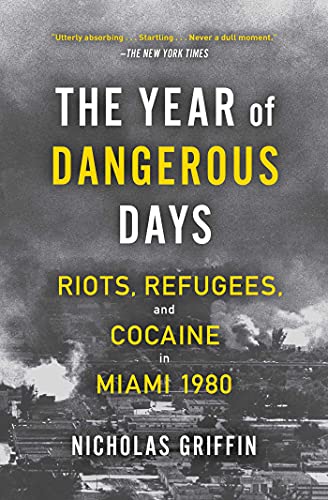
In the tradition of The Wire, the “utterly absorbing” (The New York Times) story of the cinematic transformation of Miami, one of America’s bustling cities—rife with a drug epidemic, a burgeoning refugee crisis, and police brutality—from journalist and award-winning author Nicholas Griffin.
Miami, Florida, famed for its blue skies and sandy beaches, is one of the world’s most popular vacation destinations, with nearly twenty-three million tourists visiting annually. But few people have any idea how this unofficial capital of Latin America came to be.
The Year of Dangerous Days is “an engrossing, peek-between-your-fingers history of an American city on the edge” (Kirkus Reviews). With a cast that includes iconic characters such as Jimmy Carter, Fidel Castro, and Janet Reno, this slice of history is brought to life through intertwining personal stories. At the core, there’s Edna Buchanan, a reporter for the Miami Herald who breaks the story on the wrongful murder of a black man and the shocking police cover-up; Captain Marshall Frank, the hardboiled homicide detective tasked with investigating the murder; and Mayor Maurice Ferré, the charismatic politician who watches the case, and the city, fall apart.
On a roller coaster of national politics and international diplomacy, these three figures cross paths as their city explores one of the worst race riots in American history as more than 120,000 Cuban refugees land south of Miami, and as drug cartels flood the city with cocaine and infiltrate all levels of law enforcement. In a battle of wills, Buchanan has to keep up with the 150 percent murder rate increase; Captain Frank has to scrub and rebuild his homicide bureau; and Mayor Ferré must find a way to reconstruct his smoldering city. Against all odds, they persevere, and a stronger, more vibrant, Miami begins to emerge. But the foundation of this new Miami—partially built on corruption and drug money—will have severe ramifications for the rest of the country.
Deeply researched, “well-written” (New York Journal of Books), and covering many timely issues including police brutality, immigration, and the drug crisis, The Year of Dangerous Days is both a clarion call and a dramatic rebirth story of one of America’s most iconic cities.
Die Inhaltsangabe kann sich auf eine andere Ausgabe dieses Titels beziehen.
Über die Autorin bzw. den Autor
Nicholas Griffin is a journalist and author of four novels and three works of nonfiction. His writing has appeared in The Times (London), the Financial Times, and Foreign Policy, among other publications. His book Ping-Pong Diplomacy was shortlisted for the PEN/ESPN Award for Literary Sports Writing. He lives in Miami with his wife and two children.
Auszug. © Genehmigter Nachdruck. Alle Rechte vorbehalten.
Chapter 1 CHAPTER 1
DECEMBER 1979
By 1979, there were several Miamis that barely lapped against one another, let alone integrated. The county itself was a strange beast, twenty-seven different municipalities with their own mayor, many with their own police departments. But Miami wasn’t divided by municipalities; it was separated into tribes.
There was Anglo Miami, which the city’s boosters were still hawking to white America: beaches, real estate, hotels, and entertainment. Tourists dominated the region. Dade had 1.6 million residents but 2.1 million international visitors a year. Anglo Miami was far from monolithic. There were southerners, migrants, and a large Jewish population that ran some of the most important businesses and institutions in Miami Beach.
Across the causeway in Little Havana and up the coast in Hialeah sat Latin Miami, created by the Cubans who’d fled Fidel Castro’s revolution twenty years before. Whenever there was violence south of the border, Latin America coughed up a new pocket of immigrants. Most recently that meant that the Cuban population in Dade was being watered down by Nicaraguans, Salvadorans, and Colombians.
Then there was black Miami. It, too, had more divisions than cohesion. There was a strong Bahamian presence, plenty of Jamaicans. Both felt distinct from the African Americans who had moved south from Georgia, and those who were born and bred in Miami. The latest immigrants were only beginning to spill in: a large number of unwelcome Haitians. Arriving on rickety boats, fleeing both political persecution and economic despair, they were docking at a time when not one of Miami’s communities was in the mood to reach out and welcome them.
For all the nuances, if you were black, white, or Latin, you tended to know so little about the other tribes that you regarded them as rigid blocs. Who knew a Jamaican turned his nose up at a Georgia-born black, or that a Puerto Rican couldn’t stand another word from a Cuban, or that a Jew couldn’t walk through the door at the all-white country club at La Gorce? There was enough inequality to go around, but in this one thing, the black community got the most generous helping.
In 1979, if you were black in Dade County, you most likely lived in one of three neighborhoods: Overtown, the Black Grove, or Liberty City. Liberty City was the youngest of the three, dating back to 1937, when President Franklin Roosevelt authorized the first large public housing project in the South. It was Roosevelt’s response to local campaigns for better sanitation. In the ’30s, Liberty City had what most houses in Overtown and the Black Grove did not: running water, modern kitchens, electricity. Overtown remained the center of black life in Miami until the arrival of I-95, the vast stretch of American highway that ran from Maine down the East Coast all the way to Miami. It stomped right through the middle of Miami’s most prominent black neighborhood in 1965, a ravenous millipede with a thousand concrete legs.
Had the 3,000-kilometer highway been halted just 5 kilometers to the north, black Miami might have had a different history. Instead the highway, touted as “slum clearance,” bulldozed through black Miami’s main drags. Gone was much of Overtown’s commercial heart, with its three movie theaters, its public pool, grocery store, and businesses. Goodbye to clubs that had hosted Ella Fitzgerald, to the Sir John Hotel, which had offered their finest suites to black entertainers banned from staying in whites-only Miami Beach. But more important, goodbye to a neighborhood where parents knew which house every child belonged to. Goodbye to the nighttime games of Moonlight Baby, where kids would use the bottle caps of Cola Nibs to mark the edge of their bodies on the pavement. Goodbye to unarmed black patrolmen walking black streets.
Overtown had its own all-black police station, with strict rules. Black officers couldn’t carry a weapon home, since “no one wanted to see a black man with a gun.” They could stop whites in Overtown but had no power of arrest over them. The closest affordable housing for Overtown’s displaced was in and around the Liberty City projects. Block by block it began to turn from white to black, until neighboring white homeowners built a wall to separate themselves from ever-blacker Liberty City. White housewives in colorful plaids and horn-rimmed glasses carried protest signs: “We want this Nigger moved” and “Nigger go to Washington.” Someone detonated a stick of dynamite in an empty apartment leased to blacks. Nothing worked, and by the end of the 1960s the first proud black owners inside Liberty City were joined by many of Overtown’s twenty thousand displaced. As white flight accelerated, house prices declined, local businesses faltered, and unemployment and crime began to rise. By 1968, Liberty City had assumed a new reputation. The CND—the Central-North District—had earned the nickname “Central Negro District” from both the city and the county police departments.
There was still beauty in Liberty City, still sunrises where the light would smart off the sides of pastel-painted houses, and the dew on the grass would glisten, and churches would fill, and the jitney buses would chug patiently, waiting for the elderly to board. Still schoolchildren in white shirts tightening backpacks to their shoulders and catching as much shade as possible on the way to the school gates. There was still beauty, but you had to squint to see it.
Eighty percent of South Florida homes had air-conditioning in 1980, but in stifling hot Liberty City, only one in five homes could afford it. It was a neighborhood without a center, few jobs to offer, seventy-two churches but just six banks, not one of which was black-owned. There were plenty of places to pray for a positive future but few institutions willing to risk investment in one. The fact that a teenager called Arthur McDuffie got out at all was unusual. The fact that he came back, found a good job, earned steadily, and raised a family was rarer still.
Frederica Jones had been Arthur McDuffie’s high school sweetheart at Booker T. Washington, one of Miami’s three segregated schools. They’d met while Frederica was walking home from the local store, where she’d bought a can of peas for her mother. She’d swung her groceries at her side, and McDuffie, who’d been watching her from across the street, fell into step beside her.
After a few moments of banter, McDuffie made a simple declaration. “I like you.” Then he asked for Frederica’s number. That night McDuffie called, and the two talked for an hour. At the end of the conversation McDuffie, two years Frederica’s senior, asked, “Would you go with me?”
“Yes!” she said.
They became inseparable. They were in the Booker T. Washington band together. McDuffie was the baritone horn and Frederica a majorette. She watched McDuffie win the local swim meets. When McDuffie graduated, he joined the Marine Corps, and for the next three years, they communicated through letters. Then, within two months of his honorable discharge, they married. Two children quickly followed. After which came problems, separation, and, in 1978, divorce. McDuffie had always had a reputation as a ladies’ man, and now he had a child with another woman to prove it.
Yet toward the end of 1979, the thirty-three-year-old McDuffie was back visiting the house he’d once shared with Frederica. He mowed the lawn, fixed the air conditioners, and trimmed the hedges of their neighbor, the last white family on the block. The warmth in the failed marriage seemed to be returning. The...
„Über diesen Titel“ kann sich auf eine andere Ausgabe dieses Titels beziehen.
Suchergebnisse für The Year of Dangerous Days: Riots, Refugees, and Cocaine...

Beispielbild für diese ISBN
The Year of Dangerous Days: Riots, Refugees, and Cocaine in Miami 1980 (A Wild Year in Miami's History)
Anbieter: HPB-Diamond, Dallas, TX, USA
Verkäuferbewertung 5 von 5 Sternen

paperback. Zustand: Very Good. Connecting readers with great books since 1972! Used books may not include companion materials, and may have some shelf wear or limited writing. We ship orders daily and Customer Service is our top priority! Bestandsnummer des Verkäufers S_478741396
Gebraucht kaufen
EUR 6,47
EUR 3,25 Versand
Versand innerhalb von USA
Versand innerhalb von USA
Anzahl: 1 verfügbar
Beispielbild für diese ISBN
The Year of Dangerous Days: Riots, Refugees, and Cocaine in Miami 1980
Anbieter: World of Books (was SecondSale), Montgomery, IL, USA
Verkäuferbewertung 5 von 5 Sternen
Zustand: Good. Item in good condition. Textbooks may not include supplemental items i.e. CDs, access codes etc. Bestandsnummer des Verkäufers 00109728909
Gebraucht kaufen
EUR 9,80
Versand gratis
Versand innerhalb von USA
Versand innerhalb von USA
Anzahl: 1 verfügbar
Foto des Verkäufers
The Year of Dangerous Days: Riots, Refugees, and Cocaine in Miami 1980 (A Wild Year in Miami's History)
Anbieter: Zoom Books East, Glendale Heights, IL, USA
Verkäuferbewertung 5 von 5 Sternen
Zustand: very_good. Book is in very good condition and may include minimal underlining highlighting. The book can also include "From the library of" labels. May not contain miscellaneous items toys, dvds, etc. . We offer 100% money back guarantee and 24 7 customer service. Bestandsnummer des Verkäufers ZEV.1501191039.VG
Gebraucht kaufen
EUR 9,81
Versand gratis
Versand innerhalb von USA
Versand innerhalb von USA
Anzahl: 1 verfügbar
Foto des Verkäufers
The Year of Dangerous Days: Riots, Refugees, and Cocaine in Miami 1980 (A Wild Year in Miami's History)
Anbieter: clickgoodwillbooks, Indianapolis, IN, USA
Verkäuferbewertung 4 von 5 Sternen

Zustand: acceptable. Used - Acceptable: All pages and the cover are intact, but shrink wrap, dust covers, or boxed set case may be missing. Pages may include limited notes, highlighting, or minor water damage but the text is readable. Item may be missing bundled media. Bestandsnummer des Verkäufers 3O6QYV003JLF_ns
Gebraucht kaufen
EUR 6,48
EUR 3,46 Versand
Versand innerhalb von USA
Versand innerhalb von USA
Anzahl: 1 verfügbar
Foto des Verkäufers
The Year of Dangerous Days: Riots, Refugees, and Cocaine in Miami 1980 (A Wild Year in Miami's History)
Anbieter: Goodwill of Central and Coastal Virginia, Richmond, VA, USA
Verkäuferbewertung 4 von 5 Sternen
Zustand: acceptable. Bestandsnummer des Verkäufers CCVV.1501191039.A
Gebraucht kaufen
EUR 6,21
EUR 4,97 Versand
Versand innerhalb von USA
Versand innerhalb von USA
Anzahl: 1 verfügbar
Beispielbild für diese ISBN
Year of Dangerous Days : Riots, Refugees, and Cocaine in Miami 1980
Anbieter: GreatBookPrices, Columbia, MD, USA
Verkäuferbewertung 5 von 5 Sternen
Zustand: good. May show signs of wear, highlighting, writing, and previous use. This item may be a former library book with typical markings. No guarantee on products that contain supplements Your satisfaction is 100% guaranteed. Twenty-five year bookseller with shipments to over fifty million happy customers. Bestandsnummer des Verkäufers 42618436-5
Gebraucht kaufen
EUR 9,22
EUR 2,29 Versand
Versand innerhalb von USA
Versand innerhalb von USA
Anzahl: 4 verfügbar
Beispielbild für diese ISBN
The Year of Dangerous Days: Riots, Refugees, and Cocaine in Miami 1980
Anbieter: World of Books Inc, Montgomery, IL, USA
Verkäuferbewertung 2 von 5 Sternen

Paperback. Zustand: Good. In the tradition of The Wire, the ?utterly absorbing? (The New York Times) story of the cinematic transformation of Miami, one of America?s bustling cities?rife with a drug epidemic, a burgeoning refugee crisis, and police brutality?from journalist and award-winning author Nicholas Griffin.Miami, Florida, famed for its blue skies and sandy beaches, is one of the world?s most popular vacation destinations, with nearly twenty-three million tourists visiting annually. But few people have any idea how this unofficial capital of Latin America came to be. The Year of Dangerous Days is ?an engrossing, peek-between-your-fingers history of an American city on the edge? (Kirkus Reviews). With a cast that includes iconic characters such as Jimmy Carter, Fidel Castro, and Janet Reno, this slice of history is brought to life through intertwining personal stories. At the core, there?s Edna Buchanan, a reporter for the Miami Herald who breaks the story on the wrongful murder of a black man and the shocking police cover-up; Captain Marshall Frank, the hardboiled homicide detective tasked with investigating the murder; and Mayor Maurice Ferré, the charismatic politician who watches the case, and the city, fall apart. On a roller coaster of national politics and international diplomacy, these three figures cross paths as their city explores one of the worst race riots in American history as more than 120,000 Cuban refugees land south of Miami, and as drug cartels flood the city with cocaine and infiltrate all levels of law enforcement. In a battle of wills, Buchanan has to keep up with the 150 percent murder rate increase; Captain Frank has to scrub and rebuild his homicide bureau; and Mayor Ferré must find a way to reconstruct his smoldering city. Against all odds, they persevere, and a stronger, more vibrant, Miami begins to emerge. But the foundation of this new Miami?partially built on corruption and drug money?will have severe ramifications for the rest of the country. Deeply researched, ?well-written? (New York Journal of Books), and covering many timely issues including police brutality, immigration, and the drug crisis, The Year of Dangerous Days is both a clarion call and a dramatic rebirth story of one of America?s most iconic cities. Bestandsnummer des Verkäufers CIN1501191039G
Gebraucht kaufen
EUR 11,59
Versand gratis
Versand innerhalb von USA
Versand innerhalb von USA
Anzahl: 1 verfügbar
Foto des Verkäufers
Year of Dangerous Days : Riots, Refugees, and Cocaine in Miami 1980
Anbieter: GreatBookPrices, Columbia, MD, USA
Verkäuferbewertung 5 von 5 Sternen
Zustand: New. Bestandsnummer des Verkäufers 42618436-n
Neu kaufen
EUR 13,60
EUR 2,29 Versand
Versand innerhalb von USA
Versand innerhalb von USA
Anzahl: Mehr als 20 verfügbar
Beispielbild für diese ISBN
The Year of Dangerous Days Format: Paperback
Anbieter: INDOO, Avenel, NJ, USA
Verkäuferbewertung 5 von 5 Sternen
Zustand: New. Bestandsnummer des Verkäufers 9781501191039
Neu kaufen
EUR 15,96
Versand gratis
Versand innerhalb von USA
Versand innerhalb von USA
Anzahl: Mehr als 20 verfügbar
Foto des Verkäufers
The Year of Dangerous Days
Anbieter: Rarewaves USA, HEBRON, KY, USA
Verkäuferbewertung 5 von 5 Sternen
Paperback. Zustand: New. In the tradition of The Wire, the "utterly absorbing" (The New York Times) story of the cinematic transformation of Miami, one of America's bustling cities-rife with a drug epidemic, a burgeoning refugee crisis, and police brutality-from journalist and award-winning author Nicholas Griffin.Miami, Florida, famed for its blue skies and sandy beaches, is one of the world's most popular vacation destinations, with nearly twenty-three million tourists visiting annually. But few people have any idea how this unofficial capital of Latin America came to be. The Year of Dangerous Days is "an engrossing, peek-between-your-fingers history of an American city on the edge" (Kirkus Reviews). With a cast that includes iconic characters such as Jimmy Carter, Fidel Castro, and Janet Reno, this slice of history is brought to life through intertwining personal stories. At the core, there's Edna Buchanan, a reporter for the Miami Herald who breaks the story on the wrongful murder of a black man and the shocking police cover-up; Captain Marshall Frank, the hardboiled homicide detective tasked with investigating the murder; and Mayor Maurice Ferré, the charismatic politician who watches the case, and the city, fall apart. On a roller coaster of national politics and international diplomacy, these three figures cross paths as their city explores one of the worst race riots in American history as more than 120,000 Cuban refugees land south of Miami, and as drug cartels flood the city with cocaine and infiltrate all levels of law enforcement. In a battle of wills, Buchanan has to keep up with the 150 percent murder rate increase; Captain Frank has to scrub and rebuild his homicide bureau; and Mayor Ferré must find a way to reconstruct his smoldering city. Against all odds, they persevere, and a stronger, more vibrant, Miami begins to emerge. But the foundation of this new Miami-partially built on corruption and drug money-will have severe ramifications for the rest of the country. Deeply researched, "well-written" (New York Journal of Books), and covering many timely issues including police brutality, immigration, and the drug crisis, The Year of Dangerous Days is both a clarion call and a dramatic rebirth story of one of America's most iconic cities. Bestandsnummer des Verkäufers LU-9781501191039
Neu kaufen
EUR 16,10
Versand gratis
Versand innerhalb von USA
Versand innerhalb von USA
Anzahl: Mehr als 20 verfügbar