
Verwandte Artikel zu High Heel: Object Lessons
Inhaltsangabe
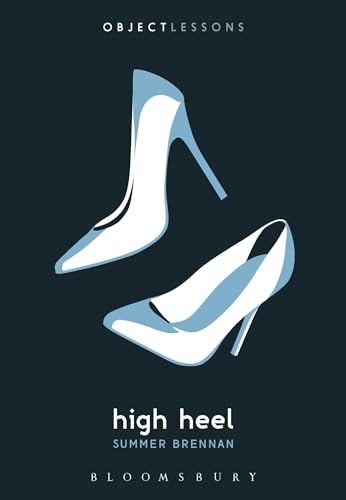
High Heel is a dive into the labyrinthine nature of modern womanhood and sexual politics, with the world's most provocative fashion accessory as its point of entry.
Die Inhaltsangabe kann sich auf eine andere Ausgabe dieses Titels beziehen.
Über die Autorin bzw. den Autor
Summer Brennan is a journalist and author. She received the 2016 Matthew Power Literary Reporting Award and was a visiting scholar at the Arthur L. Carter Journalism Institute at New York University. Her first book, The Oyster War: The True Story of a Small Farm, Big Politics, and the Future of Wilderness in America (2015) was a finalist for the 2016 Orion Book Award. A longtime consultant for the United Nations, her writing has appeared in New York Magazine, Scientific American, McSweeney's, the San Francisco Chronicle, and elsewhere. She lives in Brooklyn and New Mexico.
Von der hinteren Coverseite
Object Lessons is a series of short, beautifully designed books about the hidden lives of ordinary things. Fetishized, demonized, celebrated and outlawed, the high heel is central to the iconography of modern womanhood. But are high heels good? Are they feminist? What does it mean for a woman (or, for that matter, a man) to choose to wear them? Meditating on the labyrinthine nature of sexual identity and the performance of gender, High Heel moves from film to fairytale, from foot binding to feminism, and from the golden ratio to glam rock. It considers this most provocative of fashion accessories as a nexus of desire and struggle, sex and society, setting out to understand what it means to be a woman by walking a few hundred years in her shoes.
Auszug. © Genehmigter Nachdruck. Alle Rechte vorbehalten.
High Heel
By Summer BrennanBloomsbury Publishing Plc
Copyright © 2019 Summer Brennan
All rights reserved.
ISBN: 978-1-5013-2599-1All rights reserved.
Contents
1 The garden of forking paths, 1,
2 Daphne in Flight, Daphne in Flower, 29,
3 Ashes, sea-foam, glass, gold, 67,
4 The Minotaur, 103,
5 A goddess at the end of the world, 133,
Acknowledgments, 155,
Selected bibliography, 157,
Index, 160,
CHAPTER 1
THE GARDEN OF FORKING PATHS
"Then it seemed like falling into a labyrinth: we thought we were at the finish but our way bent round and we found ourselves as it were back at the beginning ..."
— SOCRATES, PLATO'S EUTHEDEMUS
1
A woman runs through a forest, chased by a god.
Another attends a ball.
A third stands over a subway grate in white chiffon.
A fourth chains herself to the gates of a palace.
A fifth is carried away.
A sixth is going home now, click click click.
(Another, not counted here, disappears in the darkness.)
A seventh approaches the guillotine.
An eighth dances backward, into cliché.
A ninth wants to stop and can't.
A tenth is furred and feathered and becomes the jungle.
An eleventh emerges from the sea.
A twelfth erases the border between countries, rides a stallion, and does the laundry, like
a goddess, in a cocktail dress and black high heels.
These, my dancing princesses, of a different sort altogether.
2
I started writing this in Paris, birthplace of the stiletto, in summer. The daytime streets were crowded with women in flats, sandals, casual sneakers, and fashionable running shoes; few wore high heels. With the locals fled to the countryside or vacations in the south, the city's annual flush of tourists was given right-of-way.
To be sure to see a woman in high heels out in the open, one had to catch her in the morning on her way to work, or else wait until the evening hours when she emerged again, doe-like, crepuscular, red lipstick refreshed. Old, young, tall, short, black, white, and everything in between, the chic Parisiennes filled metro cars and twilit sidewalks; they traversed the smoky cobblestones or the chalky ground of manicured parks en route to dinners or parties, their arches lifted as if on tiptoe, moving to the street-muffled sounds of clack clack clack clack and tap tap tap tap.
3
Enter the labyrinth. Take a turn, and another turn, and another. You won't have too much time. The stopwatch is ticking, and evening is closing in. Just keep walking. Yes, like that.
4
Our shoes pin us to the world, like Peter Pan to his shadow. More than simply facilitating our movement out-of-doors, they mediate between the wearer and the ground. Perhaps it is less the world they pin us to, but our place in it — that shadow of society that follows wherever we go.
5
In 1962, the writer and poet Sylvia Plath drew a picture of a pair of black patent leather high-heel shoes. That these were her own personal shoes is not confirmed, but I believe they were. In the drawing, done in ink, the left shoe points east while the right shoe points north by northwest, as if turned overly inward into a position that no real feet could find tenable. Above these, in pencil, Plath wrote "The Bell Jar."
6
A pair of worn shoes is a portrait of its wearer. Not just the scuffed toes and heels ground down by months or years of pavement, or the narratives told by damage and repair, but the form and function of them, their type. They are a part of our costume in both the quotidian and theatrical sense. And because the stories that shoes tell are invariably about public life, they must also be about status, and power, or the lack of it.
7
A friend of mine, a former colleague, is one of the most consistently feminine-presenting women that I know — always tastefully perfumed, always in heels. She emigrated from the Soviet Union with her family in 1989 when she was just a child. Sometime during that first year in America, her father took her to a supermarket in Queens, and snapped a photo of her in front of the overstocked juice aisle. It is a picture that radiates astonishment. One might expect a look of joy to accompany that much abundance, but instead there is something closer to shock and fear in her big brown eyes. Entitlement is a learned skill.
8
Western women are often told that we're now living in a time of unprecedented choice and the ability to form our own destiny. That the world is our overstocked supermarket. You go girl! the advertising copy says — or seems to say. The popular narrative is that we can choose to be whatever we want to be, to work or be a "housewife," a stay-at-home mom, to have a child or not. We're told that we can choose how we want to look, to wear makeup or not wear makeup, to grow our hair long or to buzz it off, and that we can choose whatever we want to wear on our feet. Modern shoe consumerism, especially, is often presented within the politically feminized language of choice. A woman's right to choose becomes "a woman's right to shoes." By this logic, it matters not so much what we choose, but that it is chosen. The very presence of different paths, visible but untaken, seems to indicate that choice was possible; that the path we end up on was selected as a result of our desires or, at the very least, by our personal limitations, and that this is empowerment, or even feminism. That empowerment — the taking on of power — is a matter of personal intent and actualization, rather than one of structural change. That the course we chart through the labyrinth is individual, and intentional.
Some buy it, some don't.
9
The high heels that Plath drew under the words "The Bell Jar" were meant to be an illustration for her novel of the same name. Understood to be an autobiographical roman à clef, it concerns a troubled young woman named Esther Greenwood at the dawn of her adult life. She is struggling to find her place in the world, beginning with an internship in New York City, and these same heels appear throughout the book as a sort of leitmotif. She is frequently aware of them, and what they are supposed to mean, the role they assign to her. The heels follow her like a shadowy familiar. We hear their origin story, bought one lunch hour at Bloomingdales "with a black patent leather belt and black patent leather pocket-book to match." At one key point in the book when she is ready to abandon her life, to unpin herself from the world, she first abandons the shoes — only to return, the stitching between self and society momentarily restored. She knows they should be a source of envy, that thousands of other college girls probably wished they could be standing in them: inside the high heels themselves, but also inside the life she has found herself in — selected for a prestigious scholarship, receiving fancy clothes, getting dressed up to attend formal luncheons and parties and to be photographed.
They are a pair of shoes she is supposed to be happy in but isn't.
10
There was a time in my own life in New York City when I wore high heels almost every day. I myself did not have much power, but I worked at the United Nations, in a place where powerful people congregate. It is a place of suits and ties, skirts and silk blouses; of long speeches and aggressive air conditioning; of Your...
„Über diesen Titel“ kann sich auf eine andere Ausgabe dieses Titels beziehen.
Suchergebnisse für High Heel: Object Lessons

Beispielbild für diese ISBN
High Heel (Object Lessons)
Anbieter: World of Books (was SecondSale), Montgomery, IL, USA
Verkäuferbewertung 5 von 5 Sternen

Zustand: Good. Good condition ex-library book with usual library markings and stickers. Bestandsnummer des Verkäufers 00101356779
Gebraucht kaufen
EUR 6,53
Versand gratis
Versand innerhalb von USA
Versand innerhalb von USA
Anzahl: 1 verfügbar
Beispielbild für diese ISBN
High Heel
Verlag:
Bloomsbury Academic & Professional, 2019
ISBN 10: 150132599X
ISBN 13: 9781501325991
Gebraucht
Softcover
Anbieter: Better World Books, Mishawaka, IN, USA
Verkäuferbewertung 5 von 5 Sternen
Zustand: Very Good. Pages intact with possible writing/highlighting. Binding strong with minor wear. Dust jackets/supplements may not be included. Stock photo provided. Product includes identifying sticker. Better World Books: Buy Books. Do Good. Bestandsnummer des Verkäufers 17242927-6
Gebraucht kaufen
EUR 6,54
Versand gratis
Versand innerhalb von USA
Versand innerhalb von USA
Anzahl: 2 verfügbar
Foto des Verkäufers
High Heel (Object Lessons)
Anbieter: WeBuyBooks, Rossendale, LANCS, Vereinigtes Königreich
Verkäuferbewertung 5 von 5 Sternen
paperback. Zustand: Good. Most items will be dispatched the same or the next working day. A copy that has been read but remains in clean condition. All of the pages are intact and the cover is intact and the spine may show signs of wear. The book may have minor markings which are not specifically mentioned. Bestandsnummer des Verkäufers rev4816820479
Gebraucht kaufen
EUR 1,61
EUR 5,47 Versand
Versand von Vereinigtes Königreich nach USA
Versand von Vereinigtes Königreich nach USA
Anzahl: 1 verfügbar
Beispielbild für diese ISBN
High Heel
Verlag:
Bloomsbury Publishing Plc, 2019
ISBN 10: 150132599X
ISBN 13: 9781501325991
Gebraucht
Paperback
Anbieter: World of Books Inc, Montgomery, IL, USA
Verkäuferbewertung 4 von 5 Sternen

Paperback. Zustand: Good. Best Fifteen Books of March 2019, Refinery29Best Nonfiction Books of 2019, Paste MagazineObject Lessons is a series of short, beautifully designed books about the hidden lives of ordinary things. Fetishized, demonized, celebrated, and outlawed, the high heel is central to the iconography of modern womanhood. But are high heels good? Are they feminist? What does it mean for a woman (or, for that matter, a man) to choose to wear them?Meditating on the labyrinthine nature of sexual identity and the performance of gender, High Heel moves from film to fairytale, from foot binding to feminism, and from the golden ratio to glam rock. Summer Brennan considers this most provocative of fashion accessories as a nexus of desire and struggle, sex and society, violence and self expression, setting out to understand what it means to be a woman by walking a few hundred years in her shoes.Object Lessons is published in partnership with an essay series in The Atlantic. Bestandsnummer des Verkäufers CIN150132599XG
Gebraucht kaufen
EUR 8,36
Versand gratis
Versand innerhalb von USA
Versand innerhalb von USA
Anzahl: 1 verfügbar
Beispielbild für diese ISBN
High Heel
Anbieter: ThriftBooks-Atlanta, AUSTELL, GA, USA
Verkäuferbewertung 5 von 5 Sternen
Paperback. Zustand: Very Good. No Jacket. Former library book; May have limited writing in cover pages. Pages are unmarked. ~ ThriftBooks: Read More, Spend Less. Bestandsnummer des Verkäufers G150132599XI4N10
Gebraucht kaufen
EUR 8,60
Versand gratis
Versand innerhalb von USA
Versand innerhalb von USA
Anzahl: 1 verfügbar
Beispielbild für diese ISBN
High Heel
Anbieter: ThriftBooks-Atlanta, AUSTELL, GA, USA
Verkäuferbewertung 5 von 5 Sternen
Paperback. Zustand: Very Good. No Jacket. May have limited writing in cover pages. Pages are unmarked. ~ ThriftBooks: Read More, Spend Less. Bestandsnummer des Verkäufers G150132599XI4N00
Gebraucht kaufen
EUR 8,60
Versand gratis
Versand innerhalb von USA
Versand innerhalb von USA
Anzahl: 1 verfügbar
Beispielbild für diese ISBN
High Heel (Object Lessons)
Anbieter: HPB-Emerald, Dallas, TX, USA
Verkäuferbewertung 5 von 5 Sternen
Paperback. Zustand: Very Good. Connecting readers with great books since 1972! Used books may not include companion materials, and may have some shelf wear or limited writing. We ship orders daily and Customer Service is our top priority! Bestandsnummer des Verkäufers S_481307536
Gebraucht kaufen
EUR 6,85
EUR 3,33 Versand
Versand innerhalb von USA
Versand innerhalb von USA
Anzahl: 1 verfügbar
Foto des Verkäufers
High Heel
Anbieter: GreatBookPrices, Columbia, MD, USA
Verkäuferbewertung 5 von 5 Sternen
Zustand: New. Bestandsnummer des Verkäufers 28705747-n
Neu kaufen
EUR 11,67
EUR 2,35 Versand
Versand innerhalb von USA
Versand innerhalb von USA
Anzahl: 15 verfügbar
Beispielbild für diese ISBN
High Heel (Object Lessons)
Anbieter: INDOO, Avenel, NJ, USA
Verkäuferbewertung 5 von 5 Sternen
Zustand: New. Bestandsnummer des Verkäufers 9781501325991
Foto des Verkäufers
High Heel
Verlag:
Bloomsbury Publishing Plc, US, 2019
ISBN 10: 150132599X
ISBN 13: 9781501325991
Neu
Paperback
Anbieter: Rarewaves USA, HEBRON, KY, USA
Verkäuferbewertung 5 von 5 Sternen
Paperback. Zustand: New. Best Fifteen Books of March 2019, Refinery29Best Nonfiction Books of 2019, Paste MagazineObject Lessons is a series of short, beautifully designed books about the hidden lives of ordinary things. Fetishized, demonized, celebrated, and outlawed, the high heel is central to the iconography of modern womanhood. But are high heels good? Are they feminist? What does it mean for a woman (or, for that matter, a man) to choose to wear them?Meditating on the labyrinthine nature of sexual identity and the performance of gender, High Heel moves from film to fairytale, from foot binding to feminism, and from the golden ratio to glam rock. Summer Brennan considers this most provocative of fashion accessories as a nexus of desire and struggle, sex and society, violence and self expression, setting out to understand what it means to be a woman by walking a few hundred years in her shoes.Object Lessons is published in partnership with an essay series in The Atlantic. Bestandsnummer des Verkäufers LU-9781501325991