
Verwandte Artikel zu The Last Card: Inside George W. Bush's Decision...
Inhaltsangabe
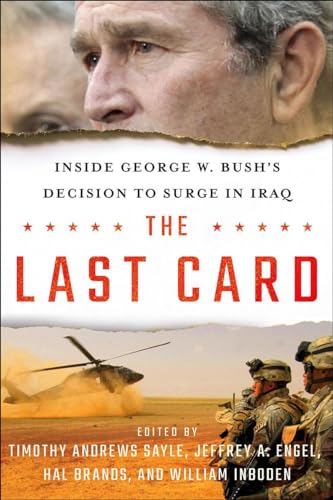
This is the real story of how George W. Bush came to double-down on Iraq in the highest stakes gamble of his entire presidency. Drawing on extensive interviews with nearly thirty senior officials, including President Bush himself, The Last Card offers an unprecedented look into the process by which Bush overruled much of the military leadership and many of his trusted advisors, and authorized the deployment of roughly 30,000 additional troops to the warzone in a bid to save Iraq from collapse in 2007.
The adoption of a new counterinsurgency strategy and surge of new troops into Iraq altered the American posture in the Middle East for a decade to come. In The Last Card we have access to the deliberations among the decision-makers on Bush's national security team as they embarked on that course. In their own words, President George W. Bush, Vice President Dick Cheney, National Security Advisor Stephen Hadley, Secretary of State Condoleezza Rice, White House Chief of Staff Joshua Bolten, Secretary of Defense Robert Gates, and others, recount the debates and disputes that informed the process as President Bush weighed the historical lessons of Vietnam against the perceived strategic imperatives in the Middle East. For a president who had earlier vowed never to dictate military strategy to generals, the deliberations in the Oval Office and Situation Room in 2006 constituted a trying and fateful moment.
Even a president at war is bound by rules of consensus and limited by the risk of constitutional crisis. What is to be achieved in the warzone must also be possible in Washington, D.C. Bush risked losing public esteem and courted political ruin by refusing to disengage from the costly war in Iraq. The Last Card is a portrait of leadership—firm and daring if flawed—in the Bush White House.
The personal perspectives from men and women who served at the White House, Foggy Bottom, the Pentagon, and in Baghdad, are complemented by critical assessments written by leading scholars in the field of international security. Taken together, the candid interviews and probing essays are a first draft of the history of the surge and new chapter in the history of the American presidency.
Die Inhaltsangabe kann sich auf eine andere Ausgabe dieses Titels beziehen.
Über die Autorin bzw. den Autor
Timothy Andrews Sayle is Assistant Professor in the Department of History at the University of Toronto.
Jeffrey A. Engel is Director of the Center for Presidential History at Southern Methodist University.
Hal Brands is the Henry A. Kissinger Distinguished Professor of Global Affairs at the Johns Hopkins School of Advanced International Studies and a scholar at the American Enterprise Institute. He is the author of What Good is Grand Strategy?
William Inboden is Executive Director and William Powers, Jr., Chair of the Clements Center for National Security at the University of Texas at Austin.
Auszug. © Genehmigter Nachdruck. Alle Rechte vorbehalten.
The Last Card
Inside George W. Bush's Decision to Surge in Iraq
By Timothy A. Sayle, Jeffrey A. Engel, Hal Brands, William InbodenCornell University Press
Copyright © 2019 Cornell University
All rights reserved.
ISBN: 978-1-5017-1518-1All rights reserved.
Contents
Editorial Note, vii,
Introduction: The American Occupation of Iraq by 2006 and the Search for a New Strategy Timothy Andrews Sayle and Hal Brands, 1,
Part 1,
1. America's War in Iraq: 2003–2005, 25,
2. This Strategy Is Not Working: January–June 2006, 46,
3. Together Forward? June–August 2006, 74,
4. Silos and Stovepipes: September–October 2006, 89,
5. Setting the Stage: Early November 2006, 113,
6. A Sweeping Internal Review: Mid–Late November 2006, 130,
7. Choosing to Surge: December 2006, 153,
8. What Kind of Surge? Late December 2006–January 2007, 182,
Part 2,
9. How the "Surge" Came to Be Stephen Hadley, Meghan O'Sullivan, and Peter Feaver, 207,
10. Iraq, Vietnam, and the Meaning of Victory Andrew Preston, 239,
11. Decisions and Politics Robert Jervis, 260,
12. Blood, Treasure, and Time: Strategy-Making for the Surge Richard K. Betts, 277,
13. Strategy and the Surge Joshua Rovner, 296,
14. Civil-Military Relations and the 2006 Iraq Surge Kori Schake, 314,
15. The Bush Administration's Decision to Surge in Iraq: A Long and Winding Road Richard H. Immerman, 328,
16. The President as Policy Entrepreneur: George W. Bush and the 2006 Iraq Strategy Review Colin Dueck, 344,
Appendix A. Cast of Characters, 361,
Appendix B. Time Line, 363,
Notes, 367,
Contributors, 395,
Index, 397,
CHAPTER 1
America's War in Iraq
2003–2005
Two years after he stood before a banner that read "mission accomplished," George W. Bush's war in Iraq dragged on. Military officials and intelligence analysts warned of a growing insurgency as early as late 2003. Others hoped political developments would slowly, but surely, overtake opposition, bringing peace and stability to the country.
Mixed signals abounded for any who sought to predict Iraq's future. Sectarian violence spiked anew by the summer of 2005, especially in Baghdad, and with particular barbarity. Political milestones also dotted the landscape, including November's "National Strategy for Victory in Iraq," the White House's effort to shore up bipartisan support for the war through a clearer explanation of US policy in Iraq. We plan to "clear, hold, and build," Secretary of State Condoleezza Rice told Congress. Nationwide elections in December suggesting improved governance in Iraq might yet, she and other administration officials hoped, drain momentum from the current wave of violence.
American commanders in Iraq, and Defense Department officials in Washington, disagreed with Rice's optimistic characterization, revealing that American strategy was anything but agreed upon in Washington.
The Insurgency Emerges
Lieutenant General Douglas Lute, US Army, director of operations, Joint Staff: [The insurgency] was unanticipated. We didn't expect it. So from the summer of '03 to sort of the summer or fall of '05, the American forces, the multinational forces, were going through a major transition internally, from what we thought we were going to be doing in Iraq to what we were actually doing. This was not a counterinsurgency army; we didn't have a counterinsurgency army. We developed one on the fly, under fire, between the summer of '03 and the summer of '05, and that's not pretty, and there were a lot of mistakes made, and the transition was not smooth.
General John Abizaid, US Army, commander, US Central Command: I was a deputy commander during the invasion of Iraq, and after the invasion of Iraq I became the CENTCOM [United States Central Command] commander, and this was about three months afterward, and we were in the process of pulling forces out on the orders of the secretary of defense. We were going to leave a very small, residual force behind, and it was clear that that was not going to work, so we had to reorganize the force.
John Hannah, assistant to the vice president: In my own view, you know I distinctly recall in late 2003, certainly after the UN bombings in August of 2003, after the bombing of the head of the Supreme Council [for the Islamic Revolution in Iraq, Ayatollah Mohammed Baqir al-Hakim], his assassination by car-bombing in Najaf, around that same time in 2003. One has a sense that things are not going well, that something is emerging here in terms of the insurgency that looks like it could be a strategic threat to the American effort in Iraq, if and only if, because by that time already, it seemed to me at least, that you had a steady drip, drip, drip, of American casualties, virtually every single day or every other day; one, two, three Americans being killed, and that just seemed to be that over time, would be entirely corrosive of the effort. It wasn't what the American people had been prepared for, and I didn't think you would be able to sustain that over time in terms of achieving our objectives in Iraq. I think that only sort of escalates, and that feeling of unease continues throughout 2004, 2005. There's always a hope in that period, that the political progress that we are seeing being made, in terms of handing over sovereignty back to the Iraqis in 2004, in terms of the series of elections we held through the end of 2005, that that political process is going to be the thing that kind of stanches the insurgency and allows us to begin building that vision of a more representative, inclusive Iraq that is going to be an ally of the United States in the broader region and the broader war on terror. And yet, I think there's a lot of unease in the government, that as each of those milestones passes and the insurgency only appears to worsen, that that in fact is not the case, that there is a fundamental problem of first order, in getting on top of the security situation in Iraq and understanding what the insurgency is and how it might be defeated. And until you can provide Iraqis, at least the vast majority of the population, that fundamental sense of security, our ability to marginalize the insurgency and really proceed forward to develop that model of a representative Iraq is not going to get very far.
Richard Cheney, vice president: [There were] arguments being made that ... there was an inconsistency between what you needed to create a democracy and the role of the military, having a strong military. From the perspective of that view, that the [Iraqi] military was a negative, the military was a force not for good, but something you had to make certain didn't interfere with the political process domestically, inside Iraq. Some of the early debates, as we look back on them, began to take place around that subject. We ended up with the belief, for example, as I recall, in the interior ministry, and if we just go through and get rid of the bad guys at the top, the Baathists, the Saddam Hussein lovers, pull them aside, then you'd have a bureaucracy there and you could get good people in charge, and that unit would begin to function the way it should in the government. It turned out that wasn't valid. So there was an inherent conflict to some extent, and when we got into this debate of what comes first, the military or the civilian, and then if you go back to the original arguments, I think some of those occurred in that first year, and in the immediate aftermath of that, with...
„Über diesen Titel“ kann sich auf eine andere Ausgabe dieses Titels beziehen.
Suchergebnisse für The Last Card: Inside George W. Bush's Decision...

Beispielbild für diese ISBN
The Last Card: Inside George W. Bush's Decision to?Surge?in?Iraq
Verlag:
Cornell University Press, 2019
ISBN 10: 1501715186
ISBN 13: 9781501715181
Gebraucht
Hardcover
Anbieter: World of Books (was SecondSale), Montgomery, IL, USA
Verkäuferbewertung 5 von 5 Sternen

Zustand: Acceptable. Item in acceptable condition! Textbooks may not include supplemental items i.e. CDs, access codes etc. Bestandsnummer des Verkäufers 00103927702
Gebraucht kaufen
EUR 4,85
Versand gratis
Versand innerhalb von USA
Versand innerhalb von USA
Anzahl: 1 verfügbar
Beispielbild für diese ISBN
The Last Card: Inside George W. Bush's Decision to Surge in Iraq
Verlag:
Cornell University Press, 2019
ISBN 10: 1501715186
ISBN 13: 9781501715181
Gebraucht
Hardcover
Anbieter: World of Books Inc, Montgomery, IL, USA
Verkäuferbewertung 2 von 5 Sternen

Hardback. Zustand: Fair. This is the real story of how George W. Bush came to double-down on Iraq in the highest stakes gamble of his entire presidency. Drawing on extensive interviews with nearly thirty senior officials, including President Bush himself. The Last Card offers an unprecedented look into the process by which President Bush overruled much of the military. Bestandsnummer des Verkäufers CIN1501715186A
Gebraucht kaufen
EUR 6,64
Versand gratis
Versand innerhalb von USA
Versand innerhalb von USA
Anzahl: 1 verfügbar
Beispielbild für diese ISBN
The Last Card: Inside George W. Bush's Decision toÂSurgeÂinÂIraq
Verlag:
Cornell University Press, 2019
ISBN 10: 1501715186
ISBN 13: 9781501715181
Gebraucht
Hardcover
Anbieter: Midtown Scholar Bookstore, Harrisburg, PA, USA
Verkäuferbewertung 5 von 5 Sternen
Hardcover. Zustand: Very Good. Very Good - Crisp, clean, unread book with some shelfwear/edgewear, may have a remainder mark - NICE Standard-sized. Bestandsnummer des Verkäufers M1501715186Z2
Gebraucht kaufen
EUR 2,68
EUR 5,20 Versand
Versand innerhalb von USA
Versand innerhalb von USA
Anzahl: 5 verfügbar
Beispielbild für diese ISBN
The Last Card : Inside George W. Bush's Decision to Surge in Iraq
Verlag:
Cornell University Press, 2019
ISBN 10: 1501715186
ISBN 13: 9781501715181
Gebraucht
Hardcover
Anbieter: Better World Books, Mishawaka, IN, USA
Verkäuferbewertung 5 von 5 Sternen
Zustand: Very Good. Pages intact with possible writing/highlighting. Binding strong with minor wear. Dust jackets/supplements may not be included. Stock photo provided. Product includes identifying sticker. Better World Books: Buy Books. Do Good. Bestandsnummer des Verkäufers 39944992-6
Gebraucht kaufen
EUR 8,54
Versand gratis
Versand innerhalb von USA
Versand innerhalb von USA
Anzahl: 1 verfügbar
Beispielbild für diese ISBN
The Last Card: Inside George W. Bush's Decision toÂSurgeÂinÂIraq
Verlag:
Cornell University Press, 2019
ISBN 10: 1501715186
ISBN 13: 9781501715181
Gebraucht
Hardcover
Anbieter: Midtown Scholar Bookstore, Harrisburg, PA, USA
Verkäuferbewertung 5 von 5 Sternen
Hardcover. Zustand: Good. Good - Bumped and creased book with tears to the extremities, but not affecting the text block, may have remainder mark or previous owner's name - GOOD Standard-sized. Bestandsnummer des Verkäufers M1501715186Z3
Gebraucht kaufen
EUR 3,50
EUR 5,20 Versand
Versand innerhalb von USA
Versand innerhalb von USA
Anzahl: 3 verfügbar
Beispielbild für diese ISBN
The Last Card: Inside George W. Bush's Decision toÂSurgeÂinÂIraq
Verlag:
Cornell University Press, 2019
ISBN 10: 1501715186
ISBN 13: 9781501715181
Gebraucht
Hardcover
Anbieter: Midtown Scholar Bookstore, Harrisburg, PA, USA
Verkäuferbewertung 5 von 5 Sternen
Hardcover. Zustand: Acceptable. HARDCOVER Acceptable - This is a significantly damaged book. It should be considered a reading copy only. Please order this book only if you are interested in the content and not the condition. May be ex-library. Standard-sized. Bestandsnummer des Verkäufers M1501715186Z4
Gebraucht kaufen
EUR 3,52
EUR 5,20 Versand
Versand innerhalb von USA
Versand innerhalb von USA
Anzahl: 1 verfügbar
Beispielbild für diese ISBN
The Last Card: Inside George W. Bush's Decision to Surge in Iraq
Verlag:
Cornell University Press, 2019
ISBN 10: 1501715186
ISBN 13: 9781501715181
Gebraucht
Hardcover
Anbieter: HPB-Ruby, Dallas, TX, USA
Verkäuferbewertung 5 von 5 Sternen
hardcover. Zustand: Very Good. Connecting readers with great books since 1972! Used books may not include companion materials, and may have some shelf wear or limited writing. We ship orders daily and Customer Service is our top priority! Bestandsnummer des Verkäufers S_419525886
Gebraucht kaufen
EUR 7,80
EUR 3,25 Versand
Versand innerhalb von USA
Versand innerhalb von USA
Anzahl: 1 verfügbar
Beispielbild für diese ISBN
The Last Card: Inside George W. Bush's Decision to Surge in Iraq
Verlag:
Cornell University Press, 2019
ISBN 10: 1501715186
ISBN 13: 9781501715181
Gebraucht
Hardcover
Anbieter: Textbooks_Source, Columbia, MO, USA
Verkäuferbewertung 5 von 5 Sternen
hardcover. Zustand: Good. Illustrated. Ships in a BOX from Central Missouri! May not include working access code. Will not include dust jacket. Has used sticker(s) and some writing or highlighting. UPS shipping for most packages, (Priority Mail for AK/HI/APO/PO Boxes). Bestandsnummer des Verkäufers 002323266U
Gebraucht kaufen
EUR 12,11
EUR 3,46 Versand
Versand innerhalb von USA
Versand innerhalb von USA
Anzahl: 1 verfügbar
Beispielbild für diese ISBN
The Last Card: Inside George W. Bush's Decision to Surge in Iraq
Anbieter: Textbooks_Source, Columbia, MO, USA
Verkäuferbewertung 5 von 5 Sternen
hardcover. Zustand: New. Illustrated. Ships in a BOX from Central Missouri! UPS shipping for most packages, (Priority Mail for AK/HI/APO/PO Boxes). Bestandsnummer des Verkäufers 002323266N
Neu kaufen
EUR 16,89
EUR 3,46 Versand
Versand innerhalb von USA
Versand innerhalb von USA
Anzahl: 3 verfügbar
Beispielbild für diese ISBN
The Last Card: Inside George W. Bush's Decision to Surge in Iraq
Anbieter: Orion Tech, Kingwood, TX, USA
Verkäuferbewertung 5 von 5 Sternen
hardcover. Zustand: New. Bestandsnummer des Verkäufers 1501715186-11-37593145