
Verwandte Artikel zu Ask Leader Guide: Faith Questions in a Skeptical Age
Inhaltsangabe
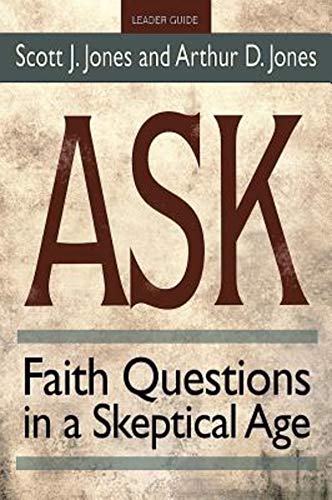
We live in a skeptical age. People—especially young people—expressdoubts about Christian faith. In this thoughtful eight week studyBishop Scott J. Jones, author of The Wesleyan Way, partnerswith his son Rev. Arthur Jones, to address hard questions that all of usface when considering faith, religion, and the church.This Leader Guide includes everything a group leader needs to planand facilitate the eight sessions, helping participants to explore whatthey have read, to view a video, and to discuss the reading and videowith the group. The guide walks leaders through the study format andprovides options for tailoring sessions to the time-frame and style ofeach group.
Die Inhaltsangabe kann sich auf eine andere Ausgabe dieses Titels beziehen.
Über die Autorin bzw. den Autor
Scott J. Jones is the Resident Bishop of the Texas Conference of the United Methodist Church and served as Bishop of the Great Plains area of The United Methodist Church. He was formerly the McCreless Associate Professor of Evangelism at Perkins School of Theology, where he taught courses in evangelism and Wesley studies. Previous books include The Wesleyan Way, The Evangelistic Love of God & Neighbor, Staying at the Table, and Wesley and the Quadrilateral, all published by Abingdon Press. of the United Methodist Church and served as Bishop of the Great Plains area of The United Methodist Church.
Auszug. © Genehmigter Nachdruck. Alle Rechte vorbehalten.
Ask
Faith Questions in a Skeptical Age Leader Guide
By Scott J. Jones, Arthur D. Jones, Barbara DickAbingdon Press
Copyright © 2015 Abingdon Press
All rights reserved.
ISBN: 978-1-5018-0335-2All rights reserved.
Contents
To the Leader,
1. Can Only One Religion Be True?,
2. Why Is There Suffering and Evil?,
3. How Can I Believe in Science and Creation?,
4. How Can I Believe in a God I Can't Prove?,
5. Can I Trust the Old Testament?,
6. Are Marriage, Sex, and Family Life Religious Issues?,
7. Was Jesus' Resurrection Real?,
8. Why Do Christians Disagree About So Many Things?,
CHAPTER 1
Can Only One Religion Be True?
Planning the Session
Session Goals
Through the conversations and activities connected with this session, group members should begin to:
• Reflect on biblical passages that are related to the nature of faith and religion;
• Assess their personal faith stories in relation to Christianity;
• Explore teachings and experiences on the nature and function of religion.
• Prepare your own answer to this week's question: Can one religion be true?
Biblical Foundation
Ask, and you will receive. (Matthew 7:7)
You are one body and one spirit, just as God also called you in one hope. There is one Lord, one faith, one baptism, one God and Father of all, who is over all, through all, and in all. (Ephesians 4:4-6)
Dear friends, let's love each other, because love is from God, and everyone who loves is born of God and knows God. The person who doesn't love does not know God, because God is love. (1 John 4:7-8)
Special Preparation
• If group members are not familiar with one another, make nametags available.
• If possible, in advance of the first session, ask participants to bring either a journal or an electronic means of journaling, such as a tablet. Provide writing paper and pens for those who may need them. Also have a variety of Bible versions available for those who do not bring one.
• Make sure all participants have a copy of the study book, Ask. Invite them to read the introduction and chapter 1 in advance of the first session. You also should read this material.
• On a large sheet of paper or a board, print "Religion is ..." and "Spirituality is ..." as the heads of two columns.
• Have available easel pads or whiteboard, blank paper or construction paper, and markers or crayons.
• In the box, have available a variety of index cards and pictures that echo the items used in the session video, such as: picture of a member of ISIS and a victim; text of 1 Corinthians 13:12; the word Evangelism; the question "Why am I a Christian?"
Remember that there are more activities than most groups will have time to complete. As leader, you'll want to go over the session in advance and select or adapt the activities you think will work best for your group in the time allotted. Consider your own responses to questions you will pose to the group.
Getting Started
Welcome
As participants arrive, welcome them to the study and invite them to make use of the available Bibles, if they did not bring one.
Opening Prayer
Gracious and loving God, as we begin this study, open us to your presence and fill us — our time, our conversations, our reflections, our doubts, and our fears — with the joy of exploration and the wisdom of your love. We gather in Jesus' name. Amen.
Opening Activity
When all participants have arrived, invite them to introduce themselves by name and to complete verbally one of the posted prompts: "Religion is ..." or "Spirituality is ..." Do not take notes during the introductions.
When everyone has responded to the prompts, post responses on the sheet (or whiteboard). Participants may repeat their original responses or add to them. Defining these two terms provides a foundation and starting place for the study.
Learning Together
Bible Study
Here are the Scriptures for this session:
• Ephesians 4:4-6 ("One Lord, one faith, one baptism")
• 1 John 4:7-8 ("God is love")
• 1 Corinthians 13:12 ("Now we see a reflection; then we will see face- to-face;" try to include the NRSV or KJV)
Use the following process to study these Scriptures:
Ask for volunteers who are willing to read aloud from a variety of Bible versions.
As each passage is read, invite the participants to engage in "active listening." Instruct them to
• Sit comfortably (with uncrossed legs, if possible);
• Breathe slowly and deeply (expanding the diaphragm, not raising the shoulders);
• Focus on the words in one of these ways: close eyes; focus on a candle, a cross, or another object; look directly at the person reading the passage;
• Pay attention to any words that strike a chord, either negative or positive.
If the passage is read more than once or from more than one translation, instruct the active listeners to shift their focus for the second reading. The second time the passage is read, they might consider doing the following:
• Note emotional responses to the passage;
• Imagine the sensory environment of the first hearers: What would the first hearers taste, smell, see, or feel as they listened? What would they be wearing?
• Note what the passage is asking. When we allow ourselves to be encountered by the biblical text, we may hear a call to action or prayer.
After each passage has been read and heard in this way, invite participants to share words that "jumped out at them," insights that were gained, information that was learned, and any call to action or prayer that was received.
Video Study and Discussion
After viewing the video, form groups of 3–4 and ask the groups to give reactions to these comments from the video:
• "It's not me trying to be right. It's me trying to be faithful."
• "Does this mean that my Jewish friend or Muslim friend is going to hell?"
• "This doesn't mean that Jesus isn't right ... what it means is that God is outside of whatever box we put him in."
• "While there are competing claims ... I would argue that there's much more that [religions] actually share in common."
• "Every religion has a piece of truth, because God has been working through everybody."
When the small groups have had some time to share, bring the entire group together and invite someone from each group to share highlights of the conversation.
Book Study and Discussion
What Is Religion?
In Chapter 1, the authors invite us to explore the fundamental nature and function of religion. Ask participants to review their responses to the opening questions you posted: "Religion is ..." and "Spirituality is ..." and to share with the group which of the definitions seems most correct or helpful and why.
What Is Religion For?
The section of the book called "The Functions of Religion" offers a variety of responses to the question of religion's purpose in our lives, including providing answers to fundamental questions, building common culture, and giving an account of ultimate reality. List these functions on newsprint, and invite participants to share other functions of religion in their lives.
Four...
„Über diesen Titel“ kann sich auf eine andere Ausgabe dieses Titels beziehen.
Suchergebnisse für Ask Leader Guide: Faith Questions in a Skeptical Age

Beispielbild für diese ISBN
Ask Leader Guide: Faith Questions in a Skeptical Age
Anbieter: Once Upon A Time Books, Siloam Springs, AR, USA
Verkäuferbewertung 4 von 5 Sternen

Paperback. Zustand: Good. This is a used book in good condition and may show some signs of use or wear . This is a used book in good condition and may show some signs of use or wear . Bestandsnummer des Verkäufers mon0000762381
Gebraucht kaufen
EUR 2,08
EUR 3,53 Versand
Versand innerhalb von USA
Versand innerhalb von USA
Anzahl: 1 verfügbar
Beispielbild für diese ISBN
Ask Leader Guide: Faith Questions in a Skeptical Age
Anbieter: Half Price Books Inc., Dallas, TX, USA
Verkäuferbewertung 5 von 5 Sternen

paperback. Zustand: Very Good. Connecting readers with great books since 1972! Used books may not include companion materials, and may have some shelf wear or limited writing. We ship orders daily and Customer Service is our top priority! Bestandsnummer des Verkäufers S_463554164
Gebraucht kaufen
EUR 3,44
EUR 3,35 Versand
Versand innerhalb von USA
Versand innerhalb von USA
Anzahl: 1 verfügbar
Beispielbild für diese ISBN
Ask Leader Guide: Faith Questions in a Skeptical Age
Anbieter: HPB-Movies, Dallas, TX, USA
Verkäuferbewertung 5 von 5 Sternen
paperback. Zustand: Very Good. Connecting readers with great books since 1972! Used books may not include companion materials, and may have some shelf wear or limited writing. We ship orders daily and Customer Service is our top priority! Bestandsnummer des Verkäufers S_476124143
Gebraucht kaufen
EUR 4,48
EUR 3,35 Versand
Versand innerhalb von USA
Versand innerhalb von USA
Anzahl: 1 verfügbar
Beispielbild für diese ISBN
Ask Leader Guide: Faith Questions in a Skeptical Age
Anbieter: Lakeside Books, Benton Harbor, MI, USA
Verkäuferbewertung 5 von 5 Sternen
Zustand: New. Brand New! Not Overstocks or Low Quality Book Club Editions! Direct From the Publisher! We're not a giant, faceless warehouse organization! We're a small town bookstore that loves books and loves it's customers! Buy from Lakeside Books! Bestandsnummer des Verkäufers OTF-9781501803352
Neu kaufen
EUR 9,36
EUR 3,56 Versand
Versand innerhalb von USA
Versand innerhalb von USA
Anzahl: Mehr als 20 verfügbar
Foto des Verkäufers
Ask Leader Guide: Faith Questions in a Skeptical Age (Paperback or Softback)
Verlag:
Abingdon Press 9/1/2015, 2015
ISBN 10: 1501803352
ISBN 13: 9781501803352
Neu
Paperback or Softback
Anbieter: BargainBookStores, Grand Rapids, MI, USA
Verkäuferbewertung 5 von 5 Sternen
Paperback or Softback. Zustand: New. Ask Leader Guide: Faith Questions in a Skeptical Age. Book. Bestandsnummer des Verkäufers BBS-9781501803352
Beispielbild für diese ISBN
Ask - Leader Guide
Print-on-DemandAnbieter: PBShop.store US, Wood Dale, IL, USA
Verkäuferbewertung 5 von 5 Sternen
PAP. Zustand: New. New Book. Shipped from UK. THIS BOOK IS PRINTED ON DEMAND. Established seller since 2000. Bestandsnummer des Verkäufers L0-9781501803352
Neu kaufen
EUR 16,59
Versand gratis
Versand innerhalb von USA
Versand innerhalb von USA
Anzahl: Mehr als 20 verfügbar
Foto des Verkäufers
Ask - Leader Guide
Anbieter: Rarewaves.com USA, London, LONDO, Vereinigtes Königreich
Verkäuferbewertung 5 von 5 Sternen
Paperback. Zustand: New. Bestandsnummer des Verkäufers LU-9781501803352
Neu kaufen
EUR 16,65
Versand gratis
Versand von Vereinigtes Königreich nach USA
Versand von Vereinigtes Königreich nach USA
Anzahl: Mehr als 20 verfügbar
Beispielbild für diese ISBN
Ask - Leader Guide
Print-on-DemandAnbieter: PBShop.store UK, Fairford, GLOS, Vereinigtes Königreich
Verkäuferbewertung 5 von 5 Sternen
PAP. Zustand: New. New Book. Delivered from our UK warehouse in 4 to 14 business days. THIS BOOK IS PRINTED ON DEMAND. Established seller since 2000. Bestandsnummer des Verkäufers L0-9781501803352
Neu kaufen
EUR 16,17
EUR 3,89 Versand
Versand von Vereinigtes Königreich nach USA
Versand von Vereinigtes Königreich nach USA
Anzahl: Mehr als 20 verfügbar
Beispielbild für diese ISBN
Ask
Print-on-DemandAnbieter: Majestic Books, Hounslow, Vereinigtes Königreich
Verkäuferbewertung 4 von 5 Sternen
Zustand: New. Print on Demand pp. 64. Bestandsnummer des Verkäufers 375218773
Neu kaufen
EUR 13,49
EUR 7,68 Versand
Versand von Vereinigtes Königreich nach USA
Versand von Vereinigtes Königreich nach USA
Anzahl: 4 verfügbar
Beispielbild für diese ISBN
Ask
Print-on-DemandAnbieter: Books Puddle, Woodside, NY, USA
Verkäuferbewertung 4 von 5 Sternen
Zustand: New. Print on Demand pp. 64. Bestandsnummer des Verkäufers 26371907978
Neu kaufen
EUR 19,17
EUR 3,56 Versand
Versand innerhalb von USA
Versand innerhalb von USA
Anzahl: 4 verfügbar