
Verwandte Artikel zu Who Is My Neighbor? Teacher Manual: Learning Spanish...
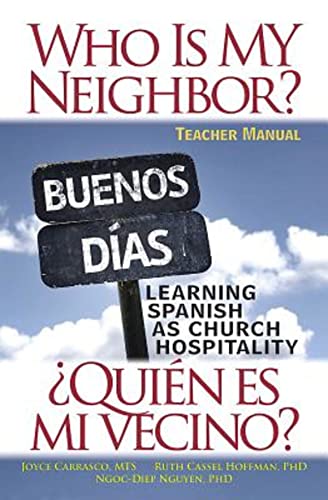
Who Is My Neighbor? Teacher Manual: Learning Spanish as Church Hospitality: Learning Spanish As Church Hospitality: A Worship-Centered Curriculum - Softcover
Inhaltsangabe
Who Is My Neighbor? is a field-tested resource through whichEnglish speakers of any church and congregation can learn basicSpanish-speaking skills to be able to communicate and provide awelcoming atmosphere to the Hispanic communities surrounding them. Thesix-session resource developed by the Northern Illinois Conferencecovers basic conversational Spanish, and simple and easy to followSpanish-language worship material. The program encourages opennesstoward Spanish-speaking neighbors, understanding of different cultures,and compassion for those who struggle to learn English.This resource is easily implemented by congregations of any size,and it results in a program of hospitality that will help includeHispanic communities in your church congregation.
Die Inhaltsangabe kann sich auf eine andere Ausgabe dieses Titels beziehen.
Über die Autorin bzw. den Autor
Ruth Cassel Hoffman, PhD, has been a lover of languages since childhood. She first experienced the power of speaking another s language as hospitality on a UMC youth mission trip to Vieques, PR. She earned her doctorate in Romance Languages from the University of Chicago and taught French at St. Mary s College in Notre Dame, IN. Ruth founded Language Resources Ltd. in 1983, providing corporate foreign language training, translation, and interpretation, and has developed active curricula in French and Spanish for students from preschoolers to adults. She is an active member and a former Lay Leader of Kingswood United Methodist Church in Buffalo Grove, IL. She lives in Lake Zurich, Illinois with her husband Miles and their dog Isabella.
Auszug. © Genehmigter Nachdruck. Alle Rechte vorbehalten.
¿Quién es mi vecino? Who Is My Neighbor?
Learning Spanish as Church Hospitality: A Worship-Centered Curriculum
By Joyce Carrasco, Ruth Cassel Hoffman, Ngoc-Diep NguyenAbingdon Press
Copyright © 2015 Abingdon Press
All rights reserved.
ISBN: 978-1-5018-0367-3All rights reserved.
Contents
Foreword,
Starting Your Program: Directions and Forms for the Hosting Church,
• Host Site Commitment,
• Job Description: Spanish Teacher,
• Memorandum of Understanding,
• Teacher Toolkit,
• Host Site: Local Church Ambassador Checklist,
Teacher's Manual,
How Do People Learn a Language?,
Lesson 1,
• Theme: La familia (Family),
• Song: Yo tengo gozo, gozo ... (I Have a Joy, Joy ...),
• Content: Naming Family Members in Spanish,
• Culture: Self-Identity,
Lesson 2,
• Theme: Mi vecino es ... (My Neighbor Is ...),
• Song: Cristo me ama (Jesus Loves Me),
• Content: Describing People in Spanish,
• Culture: Names,
Lesson 3,
• Theme: Me gusta, no me gusta, ¡qué pena! (I Like, I Don't Like, What a Shame!),
• Song: De colores,
• Content: Colors, Expressing Likes, Dislikes, and Empathy,
• Culture: Personal Space and Touch,
Lesson 4,
• Theme: El buen samaritano (The Good Samaritan) y el gran mandamiento (The Great Commandment),
• Content/Focus Story: Understanding the Good Samaritan Story and the Great Commandment in Spanish,
• Culture: The Sense of Time,
Lesson 5,
• Theme: El Padrenuestro (The Lord's Prayer),
• Content/Focus Story: Understanding and Learning to Say (Read) the Lord's Prayer in Spanish,
• Culture: Fiestas patrias (Independence Days),
Lesson 6,
• Theme: Esto es mi cuerpo (This Is My Body),
• Content/Focus Story: Participating in the Lord's Supper in Spanish,
• Culture: Where in the World Is VIM?,
• Worship: Holy Communion in Spanish, With Clergy Person Participating,
• Fellowship: Second Hour Devoted to Potluck,
Cultural Insights: Guide for Teachers,
Cultural Tidbits and Maps,
Cultural Insights,
FAQ: Spanish as a Second Language Classes,
CHAPTER 1
Lesson 1
La familia
Linguistic objectives: Become familiar with the sounds of Spanish. Begin to understand a few words. Build students' confidence in their own ability to learn, understand, and speak Spanish. Introduce the following vocabulary: hola, me llamo/se llama, pase, siéntese, es/son, mamá, papá, hermano/a, esposo/a, hijo/a, abuelo/a, tengo/tiene, numbers 1-12, vecino/a, sí, no, ¿y usted?, amor, paz, corazón.
Cultural objectives: What is "Hispanic" or "Latino" culture? How do Spanish-speakers in the US prefer to identify themselves? Where is Spanish spoken throughout the world?
Materials needed:
whiteboard, markers
pictures of family (photos, clip art, pictures cut out from magazines, etc.)
roll of masking tape
blank paper
drawing materials (crayons, colored pencils, or markers)
large flash cards of numbers 1-12
(optional) dowel, walking stick, cane, or yardstick
two flyswatters
words for Yo tengo gozo, gozo and
for Enviado soy de Dios (ask your SSL
Local Church Ambassador to make copies for the class)
• (7 minutes) Open with prayer. Explain that in this series of classes, they will learn to understand and say about 100 words, and will be able to recognize more words than that. Tell them that the theme of the class is "Who Is My Neighbor?" and that you will be helping them learn how to be good neighbors to their Spanish-speaking coworkers, neighbors, and people they meet. Tell them that the last class will include a Communion service in Spanish and a potluck meal, both of which will be an integral part of the learning experience.
• (5 minutes) Greetings and introductions:
* Hola.
* Me llamo ____, ¿y usted?
* Don't make the students reply in Spanish, just say their own name.
• (6 minutes) First commands: Take students into the hallway or outside the room, and have them knock on the door one by one or in small groups, varying the commands as needed. Use gestures to illustrate the following commands:
* ¡Hola! ¡Pase(n)! Siénte(n)se aquí! [ADAPTATION FOR OTHER-ABLED PARTICIPANTS: Have them use the "twofinger person" on the palm of their hand or a tabletop to imitate actions such as standing, sitting, or walking.]
• (15 minutes) Use large photos, clip art, or flash cards of individual family members and tape them to a surface, or draw the heads one by one on the whiteboard as you introduce them. Use "family tree" format to help them visualize the relationships.
* Es mi mamá. Ella se llama _____.
* Es mi papá. Él se llama _____.
* Es mi esposo/a. Él/Ella se llama _____.
* Es mi hijo. Él se llama _____.
* Es mi hija. Ella se llama _____.
* Son mis abuelos. Ellos se llaman _____ y _____.
* Son mis hermanos, ____ y _____.
* Es mi hermana _____.
• (15 minutes) Give paper and crayons to students. Invite students to draw their own family. Invite them to respond to your questions. Ask 2-3 questions of each student, and hold up papers so everyone can see where you are pointing.
* ¿Es su mamá, ¿sí? ¿Cómo se llama ella? etc.
* Allow one-word answers: mamá, sí, no.
• (10 minutes) Introduce numbers 1-12, using large flashcards. Set out flashcards in a large circle on the floor, making a clock. Don't say "This is how we tell time" or "This is a clock" or "This is how we count"; just let them see what you are doing and interpret it on their own. Invite students to make a circle around the flashcards on the floor, so all can see well. If you wish, use a yardstick, dowel, walking cane, or other stick to point to each card. Dangle your watch or show a clock to the class, then walk around the clock and point to each number in order:
* Es la una. Son las dos, etc.
* Then have students point to numbers as you say the time. Don't make them say the time, just have them point. Any students who already know the numbers can say them as a group.
* Emphasize dos/diez/doce , so students can hear the difference. They all sound alike to a beginner. Same for cinco/seis/siete and for uno/once. If you are a native speaker, this statement may seem ridiculous, but it is true. To teach your native language effectively, you must think like a beginner.
• (10 minutes) Play SWAT: Divide group into two teams. (The teams do not have to be even in number.) Have each team line up behind each other facing the whiteboard. Give the first person on each team a flyswatter.
* Using the pictures of family members that are already on the whiteboard and numbers 1-12 that you have scattered among the pictures, call out a word (hermano, abuela, tres, etc.).
* The holder of the flyswatter must run to the board and swat the appropriate picture on the board. [ADAPTATION FOR OTHER-ABLED PARTICIPANTS: Station the swatter-holders close to the whiteboard so they don't have to run. Or assign partners within teams, to work together.]
* Tell participants to hold their flyswatter in place after...
„Über diesen Titel“ kann sich auf eine andere Ausgabe dieses Titels beziehen.
Suchergebnisse für Who Is My Neighbor? Teacher Manual: Learning Spanish...

Beispielbild für diese ISBN
Who Is My Neighbor? Teacher Manual: Learning Spanish as Church Hospitality
Anbieter: ThriftBooks-Atlanta, AUSTELL, GA, USA
Verkäuferbewertung 5 von 5 Sternen

Paperback. Zustand: Very Good. No Jacket. May have limited writing in cover pages. Pages are unmarked. ~ ThriftBooks: Read More, Spend Less. Bestandsnummer des Verkäufers G1501803670I4N00
Gebraucht kaufen
EUR 10,29
Versand gratis
Versand innerhalb von USA
Versand innerhalb von USA
Anzahl: 1 verfügbar
Beispielbild für diese ISBN
Who Is My Neighbor? Teacher Manual: Learning Spanish as Church Hospitality
Anbieter: Lakeside Books, Benton Harbor, MI, USA
Verkäuferbewertung 5 von 5 Sternen
Zustand: New. Brand New! Not Overstocks or Low Quality Book Club Editions! Direct From the Publisher! We're not a giant, faceless warehouse organization! We're a small town bookstore that loves books and loves it's customers! Buy from Lakeside Books! Bestandsnummer des Verkäufers OTF-Y-9781501803673
Neu kaufen
EUR 9,27
EUR 3,55 Versand
Versand innerhalb von USA
Versand innerhalb von USA
Anzahl: Mehr als 20 verfügbar
Foto des Verkäufers
Who Is My Neighbor? / Quien es mi vecino? : Learning Spanish As Church Hospitality: A Worship-Centered Curriculum
Anbieter: GreatBookPrices, Columbia, MD, USA
Verkäuferbewertung 5 von 5 Sternen
Zustand: New. Bestandsnummer des Verkäufers 23771517-n
Neu kaufen
EUR 10,50
EUR 2,35 Versand
Versand innerhalb von USA
Versand innerhalb von USA
Anzahl: Mehr als 20 verfügbar
Foto des Verkäufers
Who Is My Neighbor? Teacher Manual: Learning Spanish as Church Hospitality (Paperback or Softback)
Verlag:
Abingdon Press 4/21/2015, 2015
ISBN 10: 1501803670
ISBN 13: 9781501803673
Neu
Paperback or Softback
Anbieter: BargainBookStores, Grand Rapids, MI, USA
Verkäuferbewertung 5 von 5 Sternen
Paperback or Softback. Zustand: New. Who Is My Neighbor? Teacher Manual: Learning Spanish as Church Hospitality. Book. Bestandsnummer des Verkäufers BBS-9781501803673
Foto des Verkäufers
Who Is My Neighbor? / Quien es mi vecino? : Learning Spanish As Church Hospitality: A Worship-Centered Curriculum
Anbieter: GreatBookPrices, Columbia, MD, USA
Verkäuferbewertung 5 von 5 Sternen
Zustand: As New. Unread book in perfect condition. Bestandsnummer des Verkäufers 23771517
Gebraucht kaufen
EUR 11,98
EUR 2,35 Versand
Versand innerhalb von USA
Versand innerhalb von USA
Anzahl: Mehr als 20 verfügbar
Beispielbild für diese ISBN
Who Is My Neighbor? Teacher Manual: Learning Spanish as Church Hospitality
Anbieter: California Books, Miami, FL, USA
Verkäuferbewertung 5 von 5 Sternen
Zustand: New. Bestandsnummer des Verkäufers I-9781501803673
Neu kaufen
EUR 16,51
Versand gratis
Versand innerhalb von USA
Versand innerhalb von USA
Anzahl: Mehr als 20 verfügbar
Foto des Verkäufers
Who is My Neighbor? Teacher Manual
Anbieter: Rarewaves.com USA, London, LONDO, Vereinigtes Königreich
Verkäuferbewertung 5 von 5 Sternen
Paperback. Zustand: New. Who Is My Neighbor? Teacher Manual ed. Bestandsnummer des Verkäufers LU-9781501803673
Neu kaufen
EUR 16,61
Versand gratis
Versand von Vereinigtes Königreich nach USA
Versand von Vereinigtes Königreich nach USA
Anzahl: Mehr als 20 verfügbar
Beispielbild für diese ISBN
Who Is My Neighbor? Teacher Manual
Print-on-DemandAnbieter: PBShop.store US, Wood Dale, IL, USA
Verkäuferbewertung 5 von 5 Sternen
PAP. Zustand: New. New Book. Shipped from UK. THIS BOOK IS PRINTED ON DEMAND. Established seller since 2000. Bestandsnummer des Verkäufers L0-9781501803673
Neu kaufen
EUR 17,33
Versand gratis
Versand innerhalb von USA
Versand innerhalb von USA
Anzahl: Mehr als 20 verfügbar
Beispielbild für diese ISBN
Who Is My Neighbor? Teacher Manual
Print-on-DemandAnbieter: Chiron Media, Wallingford, Vereinigtes Königreich
Verkäuferbewertung 5 von 5 Sternen
PF. Zustand: New. This item is printed on demand. Brand new book, sourced directly from publisher. Dispatch time is 6-7 days from our warehouse. Book will be sent in robust, secure packaging to ensure it reaches you securely. Bestandsnummer des Verkäufers 6666-IUK-9781501803673
Neu kaufen
EUR 12,29
EUR 5,33 Versand
Versand von Vereinigtes Königreich nach USA
Versand von Vereinigtes Königreich nach USA
Anzahl: 20 verfügbar
Beispielbild für diese ISBN
Who Is My Neighbor? Teacher Manual
Print-on-DemandAnbieter: PBShop.store UK, Fairford, GLOS, Vereinigtes Königreich
Verkäuferbewertung 5 von 5 Sternen
PAP. Zustand: New. New Book. Delivered from our UK warehouse in 4 to 14 business days. THIS BOOK IS PRINTED ON DEMAND. Established seller since 2000. Bestandsnummer des Verkäufers L0-9781501803673
Neu kaufen
EUR 16,26
EUR 4,94 Versand
Versand von Vereinigtes Königreich nach USA
Versand von Vereinigtes Königreich nach USA
Anzahl: Mehr als 20 verfügbar