
Verwandte Artikel zu The Mystery of the Exploding Teeth: And Other Curiosities...
Inhaltsangabe
"Delightfully horrifying."--Popular Science
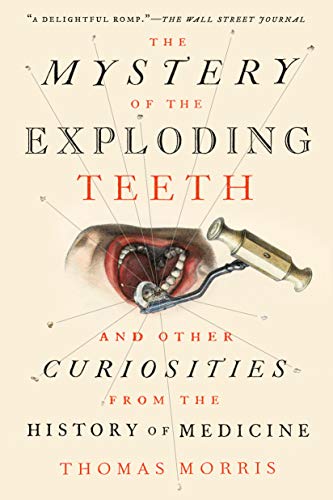
This wryly humorous collection of stories about bizarre medical treatments and cases offers a unique portrait of a bygone era in all its jaw-dropping weirdness.
A puzzling series of dental explosions beginning in the nineteenth century is just one of many strange tales that have long lain undiscovered in the pages of old medical journals. Award-winning medical historian Thomas Morris delivers one of the most remarkable, cringe-inducing collections of stories ever assembled. Witness Mysterious Illnesses (such as the Rhode Island woman who peed through her nose), Horrifying Operations (1781: A French soldier in India operates on his own bladder stone), Tall Tales (like the "amphibious infant" of Chicago, a baby that could apparently swim underwater for half an hour), Unfortunate Predicaments (such as that of the boy who honked like a goose after inhaling a bird's larynx), and a plethora of other marvels.
Beyond a series of anecdotes, these painfully amusing stories reveal a great deal about the evolution of modern medicine. Some show the medical profession hopeless in the face of ailments that today would be quickly banished by modern drugs; but others are heartening tales of recovery against the odds, patients saved from death by the devotion or ingenuity of a conscientious doctor.
However embarrassing the ailment or ludicrous the treatment, every case in The Mystery of the Exploding Teeth tells us something about the knowledge (and ignorance) of an earlier age, along with the sheer resilience of human life.
Die Inhaltsangabe kann sich auf eine andere Ausgabe dieses Titels beziehen.
Über die Autorin bzw. den Autor
Thomas Morris is a writer and medical historian. His first book, The Matter of the Heart, a history of heart surgery, was a winner of a Royal Society of Literature Jerwood Award. He lives in London.
Auszug. © Genehmigter Nachdruck. Alle Rechte vorbehalten.
Unfortunate predicaments
A regular feature of any hospital emergency department is the patient who turns up with an embarrassing and entirely self-inflicted complaint. When questioned about the nature of their ailment and how it came about, they may fall silent or offer a less than plausible explanation. In 1953, a man was admitted to a hospital in Barnsley with severe abdominal pain that he said had been plaguing him for almost a fortnight. Surgeons discovered severe tearing in the wall of his rectum, evidently inflicted just a few hours earlier, which they were able to repair. Asked how he had sustained this injury, the patient claimed that he was standing too near a firework "while in a stooping position," and it had gone off unexpectedly. Pressed for the truth, he admitted that he had become frustrated in his personal life and had "decided to explode a firework up his seat." That's one way of dealing with it, I suppose.
The medical literature is brimming with misguided individuals, the forebears of this proctological pyrotechnician, who inserted strange objects in places where they weren't meant to go. One of the earliest stories concerns a monk who tried to ease his colic by coaxing a bottle of perfume inside his gut; another relates how a surgeon rescued the dignity of a farmer who had somehow ended up with a goblet wedged inside his rectum. But these are prosaic achievements compared with some of the bravura feats recorded in the following pages. What is so impressive about many of these tales of mishap is the sheer ingenuity that had gone into creating a highly regrettable situation-often matched by the imaginative manner in which a physician or surgeon went about treating the unfortunate patient.
Medicine has improved almost beyond recognition in the past few centuries, but some things never change. The human capacity for mischief, misadventure and downright idiocy is apparently a trait that progress cannot eradicate.
A fork up the anus
Modern medical journals aren't exactly famous for their snappy headlines. The professional terminology doesn't help: It's not easy to write a zinger of a heading if the subject of your article has a name like bestrophinopathy, idiopathic thrombocytopenic purpura or necrotizing fasciitis.
But recent years have seen a fightback against such sterile jargon, with a few researchers trying to grab their readers' attention by means of literary allusions, pop culture references and bad puns. One recent article in The New England Journal of Medicine made a desperate pitch to George R. R. Martin fans with the headline "Game of TOR: The Target of Rapamycin Rules Four Kingdoms." Another, about foreign bodies in the bladder, was headed "From Urethra with Shove." And for sheer chutzpah, it's difficult to beat "Super-mesenteric-vein-expia-thrombosis, the Clinical Sequelae Can Be Quite Atrocious"-the improbable title of an article about a serious complication of appendicitis.
But my favorite medical headline of all was written almost three hundred years ago. In 1724, the Philosophical Transactions, the journal of the Royal Society, published a letter from Mr. Robert Payne, a surgeon from Lowestoft in Suffolk. The title is unimprovable:
James Bishop, an apprentice to a ship-carpenter in Great Yarmouth, about nineteen years of age, had violent pains in the lower part of the abdomen for six or seven months. It did not appear to be any species of the colic; he sometimes made bloody urine, which induced Mr P. to believe it might be a stone in the bladder. He was very little relieved by physic; at length a hard tumour appeared in the left buttock, on or near the glutaeus maximus, two or three inches from the verge of the anus, a little sloping upwards. A short time after, he voided purulent matter by the anus, every day for some time.
This is the old sense of the word tumor: not necessarily indicating abnormal tissue growth, but a swelling of any description. This example was, as it turned out, some sort of cyst, and eventually its surface broke. The surgeon suspected it was an anal fistula-an anomalous channel between the end of the bowel and the skin. But events soon proved him wrong:
Shortly after the prongs of a fork appeared through the orifice of the sore, above half an inch beyond the skin. As soon as the prongs appeared, his violent pains ceased; I divided the flesh between the prongs, according to the best of my judgment; and after that made a circular incision about the prongs and so with a strong pair of pincers extracted it, not without great difficulty, handle and all entire. The end of the handle was besmeared with the excrement, when drawn out.
Naturally. This was a surprisingly large item of cutlery:
It is six inches and a half long, a large pocket-fork; the handle is ivory, but is dyed of a very dark brown colour; the iron part is very black and smooth, but not rusty.
The young man was reluctant to explain how he had managed to get himself in this predicament; at least, not until he was threatened with the withdrawal of his allowance.
A relation of his, a Gentleman in this neighbourhood, who sent him to be under my care, the Reverend Mr Gregory Clark, Rector of Blundeston, on whom, in a great measure, his dependence is, threatened never to look upon him more, unless he would give him an account how it came; and he told him, that, being costive, he put the fork up his fundament, thinking by that means to help himself, but unfortunately it slipped up so far, that he could not recover it again.
Mr. Payne adds a postscript:
PS: He says he had no trouble or pain till a month, or more, after it was put up.
A fact that does not alter the moral of this cautionary tale: If you're constipated, it's better not to stick a fork up your fundament.
Swallowing knives is bad for you
Compulsive swallowers have always featured heavily in medical literature. There are numerous cases in nineteenth-century journals-but most of the individuals concerned were obviously suffering from some kind of mental illness. This, from the Medico-Chirurgical Transactions for 1823, is the first I've come across in which the patient was swallowing knives for a laugh.
In the month of June 1799, John Cummings, an American sailor, about twenty-three years of age, being with his ship on the coast of France, and having gone on shore with some of his shipmates about two miles from the town of Havre de Grace, he and his party directed their course towards a tent which they saw in a field, with a crowd of people round it. Being told that a play was acting there, they entered, and found in the tent a mountebank, who was entertaining the audience by pretending to swallow clasp-knives. Having returned on board, and one of the party having related to the ship's company the story of the knives, Cummings, after drinking freely, boasted that he could swallow knives as well as the Frenchman.
Not a particularly wise boast, and his comrades lost no time in challenging him to prove it. Eager not to disappoint them, he put his penknife in his mouth and swallowed it, washing it down with yet more booze.
The spectators, however, were not satisfied with one experiment, and asked the operator "whether he could swallow more?"; his answer was, "all the knives on board the ship", upon which three knives were immediately produced, which were swallowed in the same way as the former; and "by this bold attempt of a drunken man", (to use his own expressions) "the company was well entertained for that night."
Actions have consequences, as every sailor should know, and when foreign objects are ingested, the "consequences" usually come within twelve hours. And lo, it came to pass.
The next morning he had a motion, which presented nothing extraordinary; and in the afternoon he had another, with which he passed one knife, which however was not the one that he had swallowed the first. The next day he passed two knives at once, one of which was the first, which he had missed the day before. The fourth never came away, to his knowledge, and he never felt any inconvenience from it.
So no problem, right?
After this great performance, he thought no more of swallowing knives for the space of six years. In the month of March 1805, being then at Boston, in America, he was one day tempted, while drinking with a party of sailors, to boast of his former exploits, adding that he was the same man still, and ready to repeat his performance; upon which a small knife was produced, which he instantly swallowed. In the course of that evening he swallowed five more. The next morning crowds of visitors came to see him; and in the course of that day he was induced to swallow eight knives more, making in all fourteen.
It seems safe to assume at this point that Mr. Cummings was not-ahem-the sharpest knife in the drawer.
This time, however, he paid dearly for his frolic; for he was seized the next morning with constant vomiting and pain at his stomach, which made it necessary to carry him to Charleston hospital, where, as he expresses it, "betwixt that period and the 28th of the following month, he was safely delivered of his cargo."
No doubt this was a common naval euphemism of the time rather than an original bon mot; but it made me laugh. Having "emptied the hold," Cummings boarded a vessel traveling to France. But on the return journey, his ship was intercepted by HMS Isis, and he was press-ganged into service with the Royal Navy.
One day while at Spithead, where the ship lay some time, having got drunk and, as usual, renewed the topic of his former follies, he was once more challenged to repeat the experiment, and again complied, "disdaining," as he says, "to be worse than his word."
An honorable person may keep their word, but a sensible one does not consume five knives, as the misguided American did that night. And he still wasn't finished; far from it.
On the next morning the ship's company having expressed a great desire to see him repeat the performance, he complied with his usual readiness, and "by the encouragement of the people, and the assistance of good grog", he swallowed that day, as he distinctly recollects, nine clasp-knives, some of which were very large; and he was afterwards assured by the spectators that he had swallowed four more, which, however, he declares he knew nothing about, being, no doubt, at this period of the business, too much intoxicated to have any recollection of what was passing.
Dear oh dear. Will he never learn?
This, however, is the last performance we have to record; it made a total of at least thirty-five knives, swallowed at different times, and we shall see that it was this last attempt which ultimately put an end to his existence.
Feeling like death, and probably more than a little foolish, Cummings applied to the ship's surgeon for laxatives, but the drugs he was given had no effect.
At last, about three months afterwards, having taken a quantity of oil, he felt the knives (as he expressed it) "dropping down his bowels", after which, though he does not mention their being actually discharged, he became easier, and continued so till the 4th of June following (1806), when he vomited one side of the handle of a knife, which was recognized by one of the crew to whom it had belonged.
And who presumably was not eager to reclaim it.
In the month of November of the same year, he passed several fragments of knives, and some more in February 1807. In June of the same year, he was discharged from his ship as incurable; immediately after which, he came to London, where he became a patient of Dr Babington, in Guy's Hospital.
The doctors did not believe his story and discharged him. His health improved, and it was not until September 1808 that he reappeared:
He now became a patient of Dr Curry, under whose care he remained, gradually and miserably sinking under his sufferings, till March 1809, when he died in a state of extreme emaciation.
Even during this final illness, the doctors treating him refused to believe that he had swallowed more than thirty knives, until . . .
Dr Babington having one day examined him, conjointly with Sir Astley Cooper, these gentlemen concluded, from a minute inquiry into all the circumstances of the case, and especially from the deep black colour of his alvine evacuations, that there really was an accumulation of ferruginous matter in his organs of digestion. And this was fully confirmed soon afterwards by Mr Lucas, one of the surgeons of the hospital, who, by introducing his finger into the rectum, distinctly felt in it a portion of a knife, which appeared to lie across the intestine, but which he could not extract, on account of the intense pain which the patient expressed on his attempting to grasp it.
The doctors tried to dissolve the knives (or at least blunt their edges) with nitric and sulfuric acids, a measure that must have done more harm than good. Powerless to help their patient, they had to watch as he wasted away and finally died. The physicians dissected his body and found that the inside of the abdomen presented an extraordinary sight: The tissues were stained a dark rusty color. Several blades were found inside the intestines, one of them piercing the colon. This alone would have been enough to kill him. But that wasn't all:
The stomach, viewed externally, bore evident marks of altered structure. It was not examined internally at this time, but was opened soon afterwards, in the presence of Sir Astley Cooper and Mr Smith, surgeon of the Bristol infirmary, who happened to be present at that moment, when a great many portions of blades, knife-springs, and handles, were found in it. These fragments were between thirty and forty in number, thirteen or fourteen of them being evidently the remains of blades; some of which were remarkably corroded, and prodigiously reduced in size, while others were comparatively in a state of tolerable preservation.
A close examination of the abdominal organs also cleared up one question that had puzzled the doctors: Why was it that some knives had traveled through the gut virtually unaltered, while others had been partly digested?
When the stomach was able to expel them quickly, they passed through the intestines, enclosed within their handles, and therefore comparatively harmless; while at a later period, the knives were detained in the stomach till the handles, which were mostly of horn, had been dissolved, or at least too much reduced to afford any protection against the metallic part.
„Über diesen Titel“ kann sich auf eine andere Ausgabe dieses Titels beziehen.
Suchergebnisse für The Mystery of the Exploding Teeth: And Other Curiosities...

Beispielbild für diese ISBN
The Mystery of the Exploding Teeth: And Other Curiosities from the History of Medicine
Anbieter: World of Books (was SecondSale), Montgomery, IL, USA
Verkäuferbewertung 5 von 5 Sternen

Paperback. Zustand: Very Good. "Delightfully horrifying."--Popular Science This wryly humorous collection of stories about bizarre medical treatments and cases offers a unique portrait of a bygone era in all its jaw-dropping weirdness. A puzzling series of dental explosions beginning in the nineteenth century is just one of many strange tales that have long lain undiscovered in the pages of old medical journals. Award-winning medical historian Thomas Morris delivers one of the most remarkable, cringe-inducing collections of stories ever assembled. Witness Mysterious Illnesses (such as the Rhode Island woman who peed through her nose), Horrifying Operations (1781: A French soldier in India operates on his own bladder stone), Tall Tales (like the "amphibious infant" of Chicago, a baby that could apparently swim underwater for half an hour), Unfortunate Predicaments (such as that of the boy who honked like a goose after inhaling a bird's larynx), and a plethora of other marvels. Beyond a series of anecdotes, these painfully amusing stories reveal a great deal about the evolution of modern medicine. Some show the medical profession hopeless in the face of ailments that today would be quickly banished by modern drugs; but others are heartening tales of recovery against the odds, patients saved from death by the devotion or ingenuity of a conscientious doctor. However embarrassing the ailment or ludicrous the treatment, every case in The Mystery of the Exploding Teeth tells us something about the knowledge (and ignorance) of an earlier age, along with the sheer resilience of human life. Bestandsnummer des Verkäufers 00109626997
Gebraucht kaufen
EUR 3,85
Versand gratis
Versand innerhalb von USA
Versand innerhalb von USA
Anzahl: 2 verfügbar
Beispielbild für diese ISBN
The Mystery of the Exploding Teeth: And Other Curiosities from the History of Medicine
Anbieter: World of Books (was SecondSale), Montgomery, IL, USA
Verkäuferbewertung 5 von 5 Sternen
Paperback. Zustand: Fair. "Delightfully horrifying."--Popular Science This wryly humorous collection of stories about bizarre medical treatments and cases offers a unique portrait of a bygone era in all its jaw-dropping weirdness. A puzzling series of dental explosions beginning in the nineteenth century is just one of many strange tales that have long lain undiscovered in the pages of old medical journals. Award-winning medical historian Thomas Morris delivers one of the most remarkable, cringe-inducing collections of stories ever assembled. Witness Mysterious Illnesses (such as the Rhode Island woman who peed through her nose), Horrifying Operations (1781: A French soldier in India operates on his own bladder stone), Tall Tales (like the "amphibious infant" of Chicago, a baby that could apparently swim underwater for half an hour), Unfortunate Predicaments (such as that of the boy who honked like a goose after inhaling a bird's larynx), and a plethora of other marvels. Beyond a series of anecdotes, these painfully amusing stories reveal a great deal about the evolution of modern medicine. Some show the medical profession hopeless in the face of ailments that today would be quickly banished by modern drugs; but others are heartening tales of recovery against the odds, patients saved from death by the devotion or ingenuity of a conscientious doctor. However embarrassing the ailment or ludicrous the treatment, every case in The Mystery of the Exploding Teeth tells us something about the knowledge (and ignorance) of an earlier age, along with the sheer resilience of human life. Bestandsnummer des Verkäufers 00107838355
Gebraucht kaufen
EUR 3,85
Versand gratis
Versand innerhalb von USA
Versand innerhalb von USA
Anzahl: 1 verfügbar
Beispielbild für diese ISBN
The Mystery of the Exploding Teeth: And Other Curiosities from the History of Medicine
Anbieter: World of Books (was SecondSale), Montgomery, IL, USA
Verkäuferbewertung 5 von 5 Sternen
Paperback. Zustand: Good. "Delightfully horrifying."--Popular Science This wryly humorous collection of stories about bizarre medical treatments and cases offers a unique portrait of a bygone era in all its jaw-dropping weirdness. A puzzling series of dental explosions beginning in the nineteenth century is just one of many strange tales that have long lain undiscovered in the pages of old medical journals. Award-winning medical historian Thomas Morris delivers one of the most remarkable, cringe-inducing collections of stories ever assembled. Witness Mysterious Illnesses (such as the Rhode Island woman who peed through her nose), Horrifying Operations (1781: A French soldier in India operates on his own bladder stone), Tall Tales (like the "amphibious infant" of Chicago, a baby that could apparently swim underwater for half an hour), Unfortunate Predicaments (such as that of the boy who honked like a goose after inhaling a bird's larynx), and a plethora of other marvels. Beyond a series of anecdotes, these painfully amusing stories reveal a great deal about the evolution of modern medicine. Some show the medical profession hopeless in the face of ailments that today would be quickly banished by modern drugs; but others are heartening tales of recovery against the odds, patients saved from death by the devotion or ingenuity of a conscientious doctor. However embarrassing the ailment or ludicrous the treatment, every case in The Mystery of the Exploding Teeth tells us something about the knowledge (and ignorance) of an earlier age, along with the sheer resilience of human life. Bestandsnummer des Verkäufers 00106631029
Gebraucht kaufen
EUR 3,85
Versand gratis
Versand innerhalb von USA
Versand innerhalb von USA
Anzahl: 3 verfügbar
Foto des Verkäufers
The Mystery of the Exploding Teeth: And Other Curiosities from the History of Medicine
Anbieter: Greenworld Books, Arlington, TX, USA
Verkäuferbewertung 5 von 5 Sternen
Zustand: good. Fast Free Shipping â" Good condition. It may show normal signs of use, such as light writing, highlighting, or library markings, but all pages are intact and the book is fully readable. A solid, complete copy that's ready to enjoy. Bestandsnummer des Verkäufers GWV.1524743704.G
Gebraucht kaufen
EUR 5,16
Versand gratis
Versand innerhalb von USA
Versand innerhalb von USA
Anzahl: 1 verfügbar
Beispielbild für diese ISBN
The Mystery of the Exploding Teeth: And Other Curiosities from the History of Medicine
Anbieter: World of Books Inc, Montgomery, IL, USA
Verkäuferbewertung 4 von 5 Sternen

Paperback. Zustand: Very Good. "Delightfully horrifying."--Popular Science This wryly humorous collection of stories about bizarre medical treatments and cases offers a unique portrait of a bygone era in all its jaw-dropping weirdness. A puzzling series of dental explosions beginning in the nineteenth century is just one of many strange tales that have long lain undiscovered in the pages of old medical journals. Award-winning medical historian Thomas Morris delivers one of the most remarkable, cringe-inducing collections of stories ever assembled. Witness Mysterious Illnesses (such as the Rhode Island woman who peed through her nose), Horrifying Operations (1781: A French soldier in India operates on his own bladder stone), Tall Tales (like the "amphibious infant" of Chicago, a baby that could apparently swim underwater for half an hour), Unfortunate Predicaments (such as that of the boy who honked like a goose after inhaling a bird's larynx), and a plethora of other marvels. Beyond a series of anecdotes, these painfully amusing stories reveal a great deal about the evolution of modern medicine. Some show the medical profession hopeless in the face of ailments that today would be quickly banished by modern drugs; but others are heartening tales of recovery against the odds, patients saved from death by the devotion or ingenuity of a conscientious doctor. However embarrassing the ailment or ludicrous the treatment, every case in The Mystery of the Exploding Teeth tells us something about the knowledge (and ignorance) of an earlier age, along with the sheer resilience of human life. Bestandsnummer des Verkäufers CIN1524743704VG
Gebraucht kaufen
EUR 5,69
Versand gratis
Versand innerhalb von USA
Versand innerhalb von USA
Anzahl: 2 verfügbar
Beispielbild für diese ISBN
The Mystery of the Exploding Teeth: And Other Curiosities from the History of Medicine
Anbieter: World of Books Inc, Montgomery, IL, USA
Verkäuferbewertung 4 von 5 Sternen
Paperback. Zustand: Good. "Delightfully horrifying."--Popular Science This wryly humorous collection of stories about bizarre medical treatments and cases offers a unique portrait of a bygone era in all its jaw-dropping weirdness. A puzzling series of dental explosions beginning in the nineteenth century is just one of many strange tales that have long lain undiscovered in the pages of old medical journals. Award-winning medical historian Thomas Morris delivers one of the most remarkable, cringe-inducing collections of stories ever assembled. Witness Mysterious Illnesses (such as the Rhode Island woman who peed through her nose), Horrifying Operations (1781: A French soldier in India operates on his own bladder stone), Tall Tales (like the "amphibious infant" of Chicago, a baby that could apparently swim underwater for half an hour), Unfortunate Predicaments (such as that of the boy who honked like a goose after inhaling a bird's larynx), and a plethora of other marvels. Beyond a series of anecdotes, these painfully amusing stories reveal a great deal about the evolution of modern medicine. Some show the medical profession hopeless in the face of ailments that today would be quickly banished by modern drugs; but others are heartening tales of recovery against the odds, patients saved from death by the devotion or ingenuity of a conscientious doctor. However embarrassing the ailment or ludicrous the treatment, every case in The Mystery of the Exploding Teeth tells us something about the knowledge (and ignorance) of an earlier age, along with the sheer resilience of human life. Bestandsnummer des Verkäufers CIN1524743704G
Gebraucht kaufen
EUR 5,69
Versand gratis
Versand innerhalb von USA
Versand innerhalb von USA
Anzahl: 3 verfügbar
Beispielbild für diese ISBN
The Mystery of the Exploding Teeth: And Other Curiosities from the History of Medicine
Anbieter: World of Books Inc, Montgomery, IL, USA
Verkäuferbewertung 4 von 5 Sternen
Paperback. Zustand: Fair. "Delightfully horrifying."--Popular Science This wryly humorous collection of stories about bizarre medical treatments and cases offers a unique portrait of a bygone era in all its jaw-dropping weirdness. A puzzling series of dental explosions beginning in the nineteenth century is just one of many strange tales that have long lain undiscovered in the pages of old medical journals. Award-winning medical historian Thomas Morris delivers one of the most remarkable, cringe-inducing collections of stories ever assembled. Witness Mysterious Illnesses (such as the Rhode Island woman who peed through her nose), Horrifying Operations (1781: A French soldier in India operates on his own bladder stone), Tall Tales (like the "amphibious infant" of Chicago, a baby that could apparently swim underwater for half an hour), Unfortunate Predicaments (such as that of the boy who honked like a goose after inhaling a bird's larynx), and a plethora of other marvels. Beyond a series of anecdotes, these painfully amusing stories reveal a great deal about the evolution of modern medicine. Some show the medical profession hopeless in the face of ailments that today would be quickly banished by modern drugs; but others are heartening tales of recovery against the odds, patients saved from death by the devotion or ingenuity of a conscientious doctor. However embarrassing the ailment or ludicrous the treatment, every case in The Mystery of the Exploding Teeth tells us something about the knowledge (and ignorance) of an earlier age, along with the sheer resilience of human life. Bestandsnummer des Verkäufers CIN1524743704A
Gebraucht kaufen
EUR 5,69
Versand gratis
Versand innerhalb von USA
Versand innerhalb von USA
Anzahl: 1 verfügbar
Foto des Verkäufers
The Mystery of the Exploding Teeth: And Other Curiosities from the History of Medicine
Anbieter: Greenworld Books, Arlington, TX, USA
Verkäuferbewertung 5 von 5 Sternen
Zustand: very_good. Fast Free Shipping â" Very Good condition book with a firm cover and clean pages. Shows normal use and some light wear or limited notes markings. A solid, nice copy to enjoy. Bestandsnummer des Verkäufers GWV.1524743704.VG
Gebraucht kaufen
EUR 5,86
Versand gratis
Versand innerhalb von USA
Versand innerhalb von USA
Anzahl: 1 verfügbar
Beispielbild für diese ISBN
The Mystery of the Exploding Teeth: And Other Curiosities from the History of Medicine
Anbieter: Evergreen Goodwill, Seattle, WA, USA
Verkäuferbewertung 5 von 5 Sternen
paperback. Zustand: Good. Bestandsnummer des Verkäufers mon0000389553
Gebraucht kaufen
EUR 2,45
EUR 3,56 Versand
Versand innerhalb von USA
Versand innerhalb von USA
Anzahl: 1 verfügbar
Foto des Verkäufers
The Mystery of the Exploding Teeth: And Other Curiosities from the History of Medicine
Anbieter: clickgoodwillbooks, Indianapolis, IN, USA
Verkäuferbewertung 4 von 5 Sternen
Zustand: good. Used - Good: A book that has been read but is in good condition. Very minimal damage to the cover including scuff marks, but no holes or tears. The dust jacket for hard covers may not be included. Binding has minimal wear. The majority of pages are undamaged with minimal creasing or tearing, minimal pencil underlining of text, no highlighting of text, no writing in margins. No missing pages. Bestandsnummer des Verkäufers 3O6QYV003KBC_ns
Gebraucht kaufen
EUR 3,29
EUR 3,56 Versand
Versand innerhalb von USA
Versand innerhalb von USA
Anzahl: 1 verfügbar