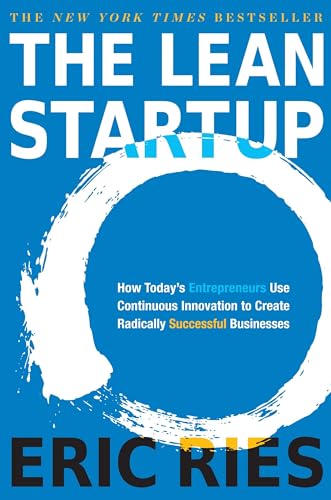
The Lean Startup: How Today's Entrepreneurs Use Continuous Innovation to Create Radically Successful Businesses - Softcover
Inhaltsangabe
Most startups fail. But many of those failures are preventable. The Lean Startup is a new approach being adopted across the globe, changing the way companies are built and new products are launched.
Eric Ries defines a startup as an organization dedicated to creating something new under conditions of extreme uncertainty. This is just as true for one person in a garage or a group of seasoned professionals in a Fortune 500 boardroom. What they have in common is a mission to penetrate that fog of uncertainty to discover a successful path to a sustainable business.
The Lean Startup approach fosters companies that are both more capital efficient and that leverage human creativity more effectively. Inspired by lessons from lean manufacturing, it relies on “validated learning,” rapid scientific experimentation, as well as a number of counter-intuitive practices that shorten product development cycles, measure actual progress without resorting to vanity metrics, and learn what customers really want. It enables a company to shift directions with agility, altering plans inch by inch, minute by minute.
Rather than wasting time creating elaborate business plans, The Lean Startup offers entrepreneurs—in companies of all sizes—a way to test their vision continuously, to adapt and adjust before it’s too late. Ries provides a scientific approach to creating and managing successful startups in a age when companies need to innovate more than ever.
Die Inhaltsangabe kann sich auf eine andere Ausgabe dieses Titels beziehen.
Über die Autorin bzw. den Autor
Eric Ries is an entrepreneur and author of the popular blog Startup Lessons Learned. He co-founded and served as CTO of IMVU, his third startup, and has had plenty of startup failures along the way. He is a frequent speaker at business events, has advised a number of startups, large companies, and venture capital firms on business and product strategy, and is an Entrepreneur-in-Residence at Harvard Business School. His Lean Startup methodology has been written about in the New York Times, the Wall Street Journal, the Harvard Business Review, the Huffington Post, and many blogs. He lives in San Francisco.
Von der hinteren Coverseite
Most startups fail. But many of those failures are preventable. The Lean Startup is a new approach being adopted across the globe, changing the way companies are built and new products are launched.
Eric Ries defines a startup as an organization dedicated to creating something new under conditions of extreme uncertainty. This is just as true for one person in a garage or a group of seasoned professionals in a Fortune 500 boardroom. What they have in common is a mission to penetrate that fog of uncertainty to discover a successful path to a sustainable business.
The Lean Startup approach fosters companies that are both more capital efficient and that leverage human creativity more effectively. Inspired by lessons from lean manufacturing, it relies on "validated learning," rapid scientific experimentation, as well as a number of counter-intuitive practices that shorten product development cycles, measure actual progress without resorting to vanity metrics, and learn what customers really want. It enables a company to shift directions with agility, altering plans inch by inch, minute by minute.
Rather than wasting time creating elaborate business plans, The Lean Startup offers entrepreneurs-in companies of all sizes-a way to test their vision continuously, to adapt and adjust before it's too late. Ries provides a scientific approach to creating and managing successful startups in a age when companies need to innovate more than ever.
Auszug. © Genehmigter Nachdruck. Alle Rechte vorbehalten.
Part One
VISION
1 START
ENTREPRENEURIAL MANAGEMENT
Building a startup is an exercise in institution building; thus, it necessarily involves management. This often comes as a surprise to aspiring entrepreneurs, because their associations with these two words are so diametrically opposed. Entrepreneurs are rightly wary of implementing traditional management practices early on in a startup, afraid that they will invite bureaucracy or stifle creativity.
Entrepreneurs have been trying to fit the square peg of their unique problems into the round hole of general management for decades. Asa result, many entrepreneurs take a "just do it" attitude, avoiding all forms of management, process, and discipline. Unfortunately, this approach leads to chaos more often than it does to success. I should know: my first startup failures were all of this kind (as we saw in the Introduction).
The tremendous success of general management over the last century has provided unprecedented material abundance, but those management principles are ill suited to handle the chaos and uncertainty that startups must face.
+ + +
I believe that entrepreneurship requires a managerial discipline to harness the tremendous entrepreneurial opportunity we have been given.
There are more entrepreneurs operating today than at any previous time in history. This has been made possible by dramatic changes inthe global economy. To site but one example, one often hears commentators lament the loss of manufacturing jobs in the United States over the previous two decades, but one rarely hears about a corresponding loss of manufacturing capability. That's because total manufacturing output in the United States is increasing (by 15 percent in the last decade) even as jobs continue to be lost (see the charts below). In effect, the huge productivity increases made possible by modern management and technology have created more productive capacity than firms know what to do with.1
We are living through an unprecedented worldwide entrepreneurial renaissance, but this opportunity is laced with peril. Because we lack a coherent management paradigm for new innovative ventures, we're throwing our excess capacity around with wild abandon. Despite this lack of rigor, we are finding some ways to make money, but for every success there are far too many failures: products pulled from shelves mere weeks after being launched, high-profile startups lauded in the press and forgotten a few months later, and new products that wind up being used by nobody. What makes these failures particularly painful is not just the economic damage done to individual employees, companies, and investors; they are also a colossal waste of our civilization's most precious resource: the time, passion, and skill of its people. The Lean Startup movement is dedicated to preventing these failures.
THE ROOTS OF THE LEAN STARTUP
The Lean Startup takes its name from the lean manufacturing revolution that Taiichi Ohno and Shigeo Shingo are credited with developing at Toyota. Lean thinking is radically altering the way supply chains and production systems are run. Among its tenets are drawing on the knowledge and creations of individual workers, the shrinking of batch sizes, just-in-time production and inventory control, and an acceleration of cycle times. It taught the world the difference between value-creating activities and waste and showed how to build quality into products from the inside out.
The Lean Startup adapts these ideas to the context of entrepreneurship, proposing that entrepreneurs judge their progress differently from the way other kinds of ventures do. Progress in manufacturing is measured by the production of high-quality physical goods. As we'll see in Chapter 3, the Lean Startup uses a different unit of progress, called validated learning. With scientific learning as our yardstick, we can discover and eliminate the tremendous waste that is plaguing entrepreneurship.
A comprehensive theory of entrepreneurship should address all the functions of an early-stage venture: vision and concept, product development, marketing and sales, scaling up, partnerships and distribution, and structure and organizational design. It has to provide startup ventures with a method for measuring progress in the context of extreme uncertainty. It can give entrepreneurs clear guidance on how to make the many trade-off decisions they face: whether and when to invest in process; formulating, planning, and creating infrastructure; when to go it alone and when to partner; when to respond to feedback and when to stick with vision; and how and when to invest in scaling the business. Most of all, it must allow entrepreneurs to make testable predictions.
For example, consider the recommendation that you build cross-functional teams and hold them accountable to what we call learning milestones instead of organizing your company into strict functional departments (marketing, sales, information technology, human resources, etc.) that hold people accountable for performing well in their specialized areas (see Chapter 7). Perhaps you agree with this recommendation, or perhaps you are skeptical. Either way, if you decide to implement it, I predict that you pretty quickly will get feedback from your teams that the new process is reducing their productivity. They will ask to go back to the old way of working, in which they had the opportunity to "stay efficient" by working in larger batches and passing work between departments.
It's safe to predict this result, and not just because I have seen it many times in the companies I work with. It is a straightforward prediction of the Lean Startup theory itself. When people are used to evaluating their productivity locally, they feel that a good day is one in which they did their job well all day. When I worked as a programmer, that meant eight straight hours of programming without interruption. That was a goodday. In contrast, if I was interrupted with questions, process, or—heaven forbid—meetings, I felt bad. What did I really accomplish that day? Code and product features were tangible to me; I could see them, understand them, and show them off. Learning, by contrast, is frustratingly intangible.
The Lean Startup asks people to start measuring their productivity differently. Because startups often accidentally build something nobody wants, it doesn't matter much if they do it on time and on budget. The goal of a startup is to figure out the right thing to build—the thing customers want and will pay for—as quickly as possible. In other words, the Lean Startup is a new way of looking at the development of innovative new products that emphasizes fast iteration and customer insight, a huge vision, and great ambition, all at the same time.
+ + +
Henry Ford is one of the most successful and celebrated entrepreneurs of all time. Since the idea of management has been bound up with the history of the automobile since its first days, I believe it is fitting to use the automobile as a metaphor for a startup.
An internal combustion automobile is powered by twoimportant and very different feedback loops. The first feedback loop is deep inside the engine. Before Henry Ford was a famous CEO, he was an engineer. He spent his days and nights tinkering in his garage with the precise mechanics of getting the engine cylinders to move. Each tiny explosion within the cylinder provides the motive force to turn the wheels but also drives the ignition of the next explosion. Unless the timing of this feedback loop is managed precisely, the engine will sputter and break down.
Startups have a similar engine that I call the engine of...
„Über diesen Titel“ kann sich auf eine andere Ausgabe dieses Titels beziehen.
Weitere beliebte Ausgaben desselben Titels

Suchergebnisse für The Lean Startup: How Today's Entrepreneurs Use...

Foto des Verkäufers
The Lean Startup
Anbieter: Books for Life, LAUREL, MD, USA
Verkäuferbewertung 5 von 5 Sternen

Zustand: acceptable. Book is in acceptable condition. May have shelf wear, edge wear, and spine wear, but a very readable copy. May not come with supplemental materials if applicable. Does not include original dustcover jacket. Possibly Ex Library Copy. Bestandsnummer des Verkäufers LFM.7KEF
Gebraucht kaufen
EUR 17,83
Versand gratis
Versand innerhalb von USA
Versand innerhalb von USA
Anzahl: 1 verfügbar
Beispielbild für diese ISBN
The Lean Startup
Anbieter: ThriftBooks-Dallas, Dallas, TX, USA
Verkäuferbewertung 5 von 5 Sternen
Paperback. Zustand: Good. No Jacket. Missing dust jacket; Pages can have notes/highlighting. Spine may show signs of wear. ~ ThriftBooks: Read More, Spend Less. Bestandsnummer des Verkäufers G1524762407I3N01
Gebraucht kaufen
EUR 18,96
Versand gratis
Versand innerhalb von USA
Versand innerhalb von USA
Anzahl: 1 verfügbar
Beispielbild für diese ISBN
The Lean Startup
Anbieter: Mooney's bookstore, Den Helder, Niederlande
Verkäuferbewertung 4 von 5 Sternen

Zustand: New. Bestandsnummer des Verkäufers E-9781524762407-5567-0
Neu kaufen
EUR 15,99
EUR 14,95 Versand
Versand von Niederlande nach USA
Versand von Niederlande nach USA
Anzahl: 1 verfügbar
Beispielbild für diese ISBN
The Lean Startup: How Today's Entrepreneurs Use Continuous Innovation to Create Radically Successful Businesses
Anbieter: Revaluation Books, Exeter, Vereinigtes Königreich
Verkäuferbewertung 5 von 5 Sternen
Paperback. Zustand: Brand New. 336 pages. 8.23x5.47x0.75 inches. In Stock. Bestandsnummer des Verkäufers __1524762407
Neu kaufen
EUR 19,55
EUR 11,53 Versand
Versand von Vereinigtes Königreich nach USA
Versand von Vereinigtes Königreich nach USA
Anzahl: 2 verfügbar
Beispielbild für diese ISBN
The Lean Startup: How Today's Entrepreneurs Use Continuous Innovation to Create Radically Successful Businesses
Anbieter: THE SAINT BOOKSTORE, Southport, Vereinigtes Königreich
Verkäuferbewertung 5 von 5 Sternen
Paperback / softback. Zustand: New. New copy - Usually dispatched within 4 working days. Bestandsnummer des Verkäufers B9781524762407
Neu kaufen
EUR 16,08
EUR 15,85 Versand
Versand von Vereinigtes Königreich nach USA
Versand von Vereinigtes Königreich nach USA
Anzahl: Mehr als 20 verfügbar
Foto des Verkäufers
Lean Startup : How Today's Entrepreneurs Use Continuous Innovation to Create Radically Successful Businesses
Anbieter: GreatBookPrices, Columbia, MD, USA
Verkäuferbewertung 5 von 5 Sternen
Zustand: New. Bestandsnummer des Verkäufers 30356494-n
Neu kaufen
EUR 29,68
EUR 2,27 Versand
Versand innerhalb von USA
Versand innerhalb von USA
Anzahl: Mehr als 20 verfügbar
Beispielbild für diese ISBN
The Lean Startup
Anbieter: Majestic Books, Hounslow, Vereinigtes Königreich
Verkäuferbewertung 4 von 5 Sternen
Zustand: New. Bestandsnummer des Verkäufers 401893572
Neu kaufen
EUR 24,49
EUR 7,49 Versand
Versand von Vereinigtes Königreich nach USA
Versand von Vereinigtes Königreich nach USA
Anzahl: 1 verfügbar
Foto des Verkäufers
Lean Startup : How Today's Entrepreneurs Use Continuous Innovation to Create Radically Successful Businesses
Anbieter: GreatBookPricesUK, Woodford Green, Vereinigtes Königreich
Verkäuferbewertung 5 von 5 Sternen
Zustand: New. Bestandsnummer des Verkäufers 30356494-n
Neu kaufen
EUR 15,69
EUR 17,29 Versand
Versand von Vereinigtes Königreich nach USA
Versand von Vereinigtes Königreich nach USA
Anzahl: Mehr als 20 verfügbar
Beispielbild für diese ISBN
The Lean Startup: How Today?s Entrepreneurs Use Continuous Innovation to Create Radically Successful Businesses
Anbieter: Kennys Bookshop and Art Galleries Ltd., Galway, GY, Irland
Verkäuferbewertung 5 von 5 Sternen
Zustand: New. 2017. Paperback. . . . . . Bestandsnummer des Verkäufers V9781524762407
Neu kaufen
EUR 22,70
EUR 10,50 Versand
Versand von Irland nach USA
Versand von Irland nach USA
Anzahl: 5 verfügbar
Beispielbild für diese ISBN
Lean Startup: How Today's Entrepreneurs Use Continuous Innovation to Create Radically Successful Businesses
Anbieter: WorldofBooks, Goring-By-Sea, WS, Vereinigtes Königreich
Verkäuferbewertung 5 von 5 Sternen
Paperback. Zustand: Good. The book has been read but remains in clean condition. All pages are intact and the cover is intact. Some minor wear to the spine. Bestandsnummer des Verkäufers GOR011517084
Gebraucht kaufen
EUR 27,38
EUR 6,46 Versand
Versand von Vereinigtes Königreich nach USA
Versand von Vereinigtes Königreich nach USA
Anzahl: 1 verfügbar