
Verwandte Artikel zu K9 Search and Rescue: A Manual for Training the Natural...
K9 Search and Rescue: A Manual for Training the Natural Way (K9 Professional Training) - Softcover
Buch 2 von 15: K9 Professional Training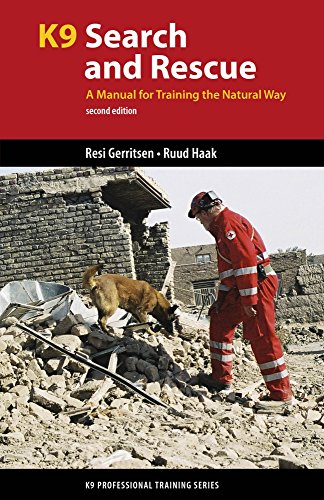
Inhaltsangabe
Training that works by harnessing your dog’s instincts.
Learn how to:
- Stimulate your dog’s natural hunting drive for effective SAR training.
- Start your dog’s training program with an easy, three-step process.
- Develop skills in a variety of search operations, including wilderness, avalanche and disaster scenarios.
Dr. Resi Gerritsen and Ruud Haak have trained search and rescue dogs for more than 30 years and have taken part in rescue operations around the world. They serve as training directors and international judges for the International Red Cross Federation, the United Nations, the International Rescue Dog Organization and the F?d?ration Cynologique Internationale (FCI). Based on their decades of study and experience, their innovative SAR training method is rooted in a firm, scientific understanding of K9 instincts.
Step-by-step instructions, dozens of illustrations and photographs from the field establish a professional K9 SAR program to benefit both beginners and experts.
Die Inhaltsangabe kann sich auf eine andere Ausgabe dieses Titels beziehen.
Über die Autorin bzw. den Autor
Dr. Resi Gerritsen and Ruud Haak are world-renowned specialists in the field of dog work and the authors of more than 30 titles on dog training. They serve as training directors and international judges for the International Red Cross Federation, the United Nations, the International Rescue Dog Organization and the F?d?ration Cynologique Internationale (FCI).
Auszug. © Genehmigter Nachdruck. Alle Rechte vorbehalten.
Introduction
The idea of dogs rescuing people from danger speaks to the imagination. The stories of rescues by Saint Bernards high in the Alps at the borders of Switzerland and Italy are classics. And the famous painting Saved shows a Newfoundland dog on a wharf wall with a girl rescued from the sea lying at its feet.
Such stories and paintings are surrounded with the romance of the past. Modern pictures in the news of actual explosions or earthquakes leave less room for romance—they reproduce the chilling reality of completely destroyed buildings and of people, often injured, who have lost all their property.
Buried Deep Under Debris
In these news photos there is another group of people we do not see. They are the victims who are sometimes buried deep under the debris. Many of them died at the moment of violence, but others are still alive. They may be trapped under the rubble, hardly able to move, or they may be locked in a cellar with tons of debris blocking the door.
These victims can do only one thing in their perilous position, and that is to wait—and to hope that rescuers are coming. If they can make noise, they hope they can be heard above ground. In truth, however, their knocking and yelling hardly ever penetrate to the outside world. They will not likely be heard by anybody, and before long their hands hurt from knocking and their voices are hoarse. With some rainwater and anything they can find to eat, they try to keep themselves alive as long as possible.
After the first reports of such disasters, money, blankets, food, medicines, and tents are sent in from many foreign countries. These supplies help with the primary needs of the survivors who have lost everything, but victims who are lying under the rubble waiting for their rescue do not need money or blankets. For them it is vital that rescue workers come as soon as possible to dig them out.
But first, rescuers have to find the trapped victims. For all our ingenuity, humans can’t find a buried person in an emergency. Only well-trained search and rescue dogs are able to locate people under the rubble. The dog teams must be brought to the disaster area first.
Deployment
Our searches for missing people in hard-to-reach areas, as well as for victims under rubble and avalanches, are our most important tasks. We’re happy to say we’re successful in a lot of cases. Many people owe their lives to the well-trained search and rescue dogs of our group. However, success with these dogs was not achieved in one day. Intensive work with a goal-setting training method is the key to the success of our dogs. Regular training in constantly changing circumstances keeps our dogs at that high level of performance.
After an avalanche or earthquake disaster, time is the enemy in trying to save people who are still alive. The better our dogs are trained and the longer they can work, the greater the chance of finding people alive. That means operational search and rescue dogs always have to be in perfect search condition, mental and physical.
All over the world it is said that search dogs can last no longer than fifteen to twenty minutes in an intensive, continuous search. But we have proven repeatedly that the search and rescue dogs of our group can search and locate for hours. For that we thank our directed training method and the fact that our dogs work without pressure. A dog tires more quickly because of the pressure or compulsion a handler puts on it. The mental stress created when the dog has to work because the handler wants it to, or when it has to be corrected or encouraged constantly, is very wearing on the dog.
Of course, search work is mentally and physically hard. But when a dog works because it likes the task, it can work for hours. Our method is oriented toward letting the dog feel happy and encouraging enjoyment in the search. During consecutive training sessions, the dog encounters gradually more difficult exercises to solve. This way, it learns to develop itself further. Because the dog likes its work, it is able to extend its boundaries of knowledge and stamina.
Team Building
Keep in mind that we have to discover the dog’s potential and take this potential into account in our training method. We have one training method for search and rescue dogs, but every breed, or even every dog, requires an individual approach to train it to the highest possible level.
Our training method is directly connected to abilities and drives of dogs that are rooted in their biology. We do not see the dog as a mechanical behavior machine, but rather as a creature with special skills for search and rescue work already present in its genes.
Handlers are expected to have a special understanding of their dog. They have to accept their dog as their partner: the dog searches; the handler supports it and tries to recognize and read the dog’s body language and expressions. Handlers don’t teach the dog to search on command; instead, handlers stimulate the dog’s internal drive to search. The dog always has to be given—both figuratively and literally—the room to conduct its search. The handler and dog have to be a team.
This book is about search and rescue dog teams and a unique new method for training them in a natural way. Here we focus on the realities of search and rescue dog work, which is the most beautiful application of the dog’s phenomenal ability to detect scent.
Throughout this book we present several case studies to demonstrate the kinds of difficulties and problems that need to be solved during the deployment of search and rescue dogs. The first case study, which follows, is based on excerpts from our team diary after the earth vibrated for about one minute in southern Italy in November 1980.
Case Study: Avellino Earthquake, Italy, November 1980
Sunday, November 23, 1980. An earthquake hits the Avellino region in southern Italy at 6:43 p.m. It has a magnitude of 6.8 to 7.0 on the Richter scale and a focal depth of almost twelve and a half miles (20 km). There is death, injury, homelessness, and desperation everywhere. Blankets and medicines have been sent already. Our unit with search and rescue dogs follows on its own initiative.
Wednesday. Finally, we solve all travel problems and arrive in the region. We work in the town of Calabritto in the middle of the earthquake area. Our dogs are searching and locating: first a woman under a staircase and then a five-year-old girl. Both alive! A big digging machine, however, had already been at work where our dogs indicate a victim. Desperately, a father watches the salvage of his lifeless child.
Friday. Inhabitants indicate that they hear knocking in a house. Our dogs search what they can, but do not find anything. In the afternoon, our food tastes like the disinfectant on our hands. The search will continue after a short break. But where do we start? The village is full of dead bodies, often buried yards deep under the rubble. The volunteer fi re department leaves the village, saying, “Molto pericolosa” (too dangerous).
Saturday. We are crawling through a collapsed porch and see one of our dogs standing near a naked foot. We are lucky. The victim is lying in the upper part of the rubble and a young officer brings rescue workers right away. A bit farther on we find the body of a woman under a door. The usual follows: salvage and disinfect.
Again our dogs indicate a place. But the rescue workers can’t get in to move anything more. From our position under the porch we hear them repeat,“Domani, domani” (tomorrow). We dig by ourselves with a piece of wood and our hands. We rescue three men from the rubble. We are happy that...
„Über diesen Titel“ kann sich auf eine andere Ausgabe dieses Titels beziehen.
Suchergebnisse für K9 Search and Rescue: A Manual for Training the Natural...

Beispielbild für diese ISBN
K9 Search and Rescue: A Manual for Training the Natural Way (K9 Professional Training Series)
Verlag:
Dog Training Press (edition 2), 2014
ISBN 10: 1550594478
ISBN 13: 9781550594478
Gebraucht
Paperback
Anbieter: BooksRun, Philadelphia, PA, USA
Verkäuferbewertung 5 von 5 Sternen

Paperback. Zustand: Very Good. 2. It's a well-cared-for item that has seen limited use. The item may show minor signs of wear. All the text is legible, with all pages included. It may have slight markings and/or highlighting. Bestandsnummer des Verkäufers 1550594478-8-1
Gebraucht kaufen
EUR 28,75
Versand gratis
Versand innerhalb von USA
Versand innerhalb von USA
Anzahl: 1 verfügbar
Beispielbild für diese ISBN
K9 Search and Rescue
Anbieter: PBShop.store UK, Fairford, GLOS, Vereinigtes Königreich
Verkäuferbewertung 5 von 5 Sternen
PAP. Zustand: New. New Book. Shipped from UK. Established seller since 2000. Bestandsnummer des Verkäufers GB-9781550594478
Neu kaufen
EUR 27,48
EUR 4,84 Versand
Versand von Vereinigtes Königreich nach USA
Versand von Vereinigtes Königreich nach USA
Anzahl: 3 verfügbar
Foto des Verkäufers
K9 Search and Rescue : A Manual for Training the Natural Way
Anbieter: GreatBookPrices, Columbia, MD, USA
Verkäuferbewertung 5 von 5 Sternen
Zustand: New. Bestandsnummer des Verkäufers 20072843-n
Neu kaufen
EUR 30,88
EUR 2,32 Versand
Versand innerhalb von USA
Versand innerhalb von USA
Anzahl: Mehr als 20 verfügbar
Foto des Verkäufers
K9 Search and Rescue : A Manual for Training the Natural Way
Anbieter: GreatBookPrices, Columbia, MD, USA
Verkäuferbewertung 5 von 5 Sternen
Zustand: As New. Unread book in perfect condition. Bestandsnummer des Verkäufers 20072843
Gebraucht kaufen
EUR 34,07
EUR 2,32 Versand
Versand innerhalb von USA
Versand innerhalb von USA
Anzahl: Mehr als 20 verfügbar
Beispielbild für diese ISBN
K9 Search and Rescue: A Manual for Training the Natural Way
Anbieter: Kennys Bookshop and Art Galleries Ltd., Galway, GY, Irland
Verkäuferbewertung 5 von 5 Sternen
Zustand: New. . 2014. 2nd Edition. Flexibound. . . . . Bestandsnummer des Verkäufers V9781550594478
Neu kaufen
EUR 30,95
EUR 9,50 Versand
Versand von Irland nach USA
Versand von Irland nach USA
Anzahl: 3 verfügbar
Beispielbild für diese ISBN
K9 Search and Rescue
Verlag:
Detselig Enterprises, Limited, 2014
ISBN 10: 1550594478
ISBN 13: 9781550594478
Neu
Softcover
Anbieter: Majestic Books, Hounslow, Vereinigtes Königreich
Verkäuferbewertung 4 von 5 Sternen

Zustand: New. pp. 176. Bestandsnummer des Verkäufers 96254912
Neu kaufen
EUR 33,02
EUR 7,56 Versand
Versand von Vereinigtes Königreich nach USA
Versand von Vereinigtes Königreich nach USA
Anzahl: 3 verfügbar
Foto des Verkäufers
K9 Search and Rescue: A Manual for Training the Natural Way (Paperback or Softback)
Verlag:
Dog Training Press 9/4/2014, 2014
ISBN 10: 1550594478
ISBN 13: 9781550594478
Neu
Paperback or Softback
Anbieter: BargainBookStores, Grand Rapids, MI, USA
Verkäuferbewertung 5 von 5 Sternen
Paperback or Softback. Zustand: New. K9 Search and Rescue: A Manual for Training the Natural Way. Book. Bestandsnummer des Verkäufers BBS-9781550594478
Beispielbild für diese ISBN
K9 Search and Rescue : A Manual for Training the Natural Way
Anbieter: GreatBookPricesUK, Woodford Green, Vereinigtes Königreich
Verkäuferbewertung 5 von 5 Sternen
Zustand: New. Bestandsnummer des Verkäufers 20072843-n
Neu kaufen
EUR 24,51
EUR 17,44 Versand
Versand von Vereinigtes Königreich nach USA
Versand von Vereinigtes Königreich nach USA
Anzahl: 1 verfügbar
Beispielbild für diese ISBN
K9 Search and Rescue: A Manual for Training the Natural Way (K9 Professional Training)
Anbieter: Chiron Media, Wallingford, Vereinigtes Königreich
Verkäuferbewertung 5 von 5 Sternen
paperback. Zustand: New. Bestandsnummer des Verkäufers 6666-GRD-9781550594478
Neu kaufen
EUR 24,82
EUR 18,01 Versand
Versand von Vereinigtes Königreich nach USA
Versand von Vereinigtes Königreich nach USA
Anzahl: 3 verfügbar
Beispielbild für diese ISBN
K9 Search and Rescue: A Manual for Training the Natural Way
Anbieter: Revaluation Books, Exeter, Vereinigtes Königreich
Verkäuferbewertung 5 von 5 Sternen
Flexibound. Zustand: Brand New. 2nd edition. 176 pages. 8.25x5.50x0.75 inches. In Stock. Bestandsnummer des Verkäufers __1550594478
Neu kaufen
EUR 31,79
EUR 11,63 Versand
Versand von Vereinigtes Königreich nach USA
Versand von Vereinigtes Königreich nach USA
Anzahl: 2 verfügbar