
Inhaltsangabe
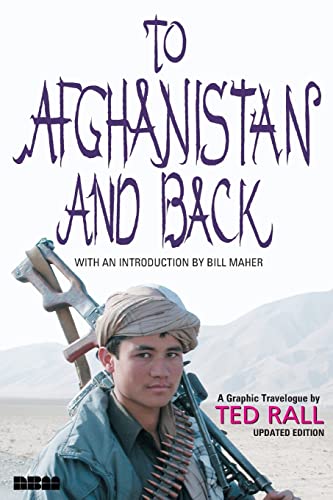
Introduction by Bill Maher. When U.S. bombs started raining on the Taliban, Rall jumped on a plane straight to the war zone to get the real story for himself. Featuring his Village Voice articles and a graphic novel.
Die Inhaltsangabe kann sich auf eine andere Ausgabe dieses Titels beziehen.
Über die Autorin bzw. den Autor
Twice winner of the Robert F. Kennedy Journalism Award and a Pulitzer Prize finalist, Ted Rall is a syndicated editorial cartoonist and columnist for Universal Press Syndicate. His previous books include To Afghanistan and Back, Revenge of the Latchkey Kids and 2024.
Von der hinteren Coverseite
"On the occasion of his second book on Afghanistan - After We Kill You, We Will Welcome You Back as Honored Guests - don't miss Rall's first on the subject. When U.S. bombs started raining on the Taliban, Rall didn't just watch it on TV
Auszug. © Genehmigter Nachdruck. Alle Rechte vorbehalten.
To Afghanistan and Back
By Ted RallNantier Beall Minoustchine Publishing
Copyright © 2003 Ted RallAll right reserved.
ISBN: 9781561633593
Chapter One
Giving War A Chance
NEW YORK, October 24
So we're going to war against Afghanistan. Big deal. We've been at war withAfghanistan for years.
This New War is merely an escalation of genocide by trade sanction, this time witha few old-fashioned bombs and covert commando raids thrown in for popular effect.And while the explosions will look cool on cable TV news and the vague rumors ofAmerican death squads trekking through the mountains will sound dashing in a RudyardKipling-cum-Rambo kind of way, it will accomplish exactly nothing.
On the other hand, this brand of ham-fisted foreign policy ensures that America willnever run out of enemies.
On September 24th, Secretary of State Colin Powell promised that the BushAdministration would finally cough up definitive proof of Saudi dissident Osama binLaden's involvement in the suicide plane bombings of the Pentagon and World TradeCenter: "I think in the near future, we will be able to put out a paper, a document, thatwill describe quite clearly the evidence that we have linking him to this attack."
For the sake of argument, let's assume that Powell is telling the truth: that binLaden, and by extension his Taliban hosts in Afghanistan, financed, ordered or otherwisedirectly participated in the murder of 3,000 Americans.
Clearly, then, bin Laden ought to be hunted down and captured "dead or alive," inthe John Wayne-informed lexicon of our appointed acting president. The Taliban shouldlikewise suffer political capital punishment-being deposed by an overwhelming invasionforce. Under military occupation, bin Laden's Al Qaeda network would be roundedup and shut down. Ditto for the training camps that educate terrorist wannabes for jihadagainst Western democracies. Within a year, cybercafes catering to backpacking collegekids would spring up across Kabul.
Unfortunately, it won't make any difference. Most of the training camps for suchradical guerrilla outfits as the Islamic Movement of Uzbekistan, which made a name foritself a few years back with its annual raids on southern Kyrgyzstan, are in Pakistan,Tajikistan and southern Kyrgyzstan. The Tajik and Kyrgyz governments are far tooimpoverished, politically weak and poorly armed to eject these insurgents, but both valuetheir ten-year-old independence from the Soviet Union too much to allow foreign troopsinto their territory to do the job. Madrassas (religious schools) in the Baluchistan andNorthwest Frontier Provinces of Pakistan continue to serve up Jihad 101, but the fragilemilitary government of General Pervez Musharraf, ethnically aligned and beholden tothe Taliban for battling the Indians in disputed Kashmir province, will never risk thewrath of Muslim extremists in their own country by shutting them down. Bottom line:bombing, destroying and militarily-occupying Afghanistan only shuts down a small fractionof the terrorist training facilities.
Now, let's escalate from the madness of an Afghan invasion (remember how well thesame idea worked out for Britain and the USSR?) to full-fledged mayhem on a monumentalscale. Assuming that we get the approval-and still better, military backing-ofRussia's Vladimir Putin, U.S. troops could fan out across Central Asia. Tajikistan wouldcome easy. Kyrgyzstan wouldn't require much effort. Pakistan is a nuclear state nowadays;perhaps we could pay them to close the madrassas.
It still wouldn't make much difference.
Tens of thousands of Arab fundamentalist militants have already graduated fromthose Taliban-affiliated training facilities. They're in Egypt, Saudi Arabia, Libya, theUnited Arab Emirates, Qatar, Syria ... and Florida. They belong to dozens of distinctorganizations, each enjoying individual sources of financing and adhering to separategoals and ideologies. Putting their alma maters out of business won't prevent them fromcarrying out future attacks on the U.S.
Nonetheless, it's always possible to carry a hypothetical war on terrorism to its logicalextreme: somehow, perhaps using satellite surveillance and pixie dust, the U.S. andits allies successfully hunt down every single member of every militant Islamic organizationin the world and either jail or kill them. Who knows how? Anyway-
It still wouldn't matter. Those dead and jailed militants have mothers, fathers, sistersand brothers. They have friends. And countless ordinary Muslim people wouldwatch, driven to vengeance by the extraordinary ruthlessness of such a massive assaultby America on individuals whose only proven sins are their beliefs. A new army ofjihadists would rise from the ashes of Bush's 21st century crusade.
Nonetheless, America must have its vengeance. We're not the kind of people to sitaround and mourn a few thousand dead office workers when there's some serious ass tokick. So we'll bomb or invade or something. It won't matter, but that doesn't matter. It'swhat we do.
Chapter Two
The NewGreat Game
NEW YORK, October 9
Nursultan Nazarbayev has a terrible problem. He's the president and formerCommunist Party boss of Kazakhstan, the second-largest republic of the formerSoviet Union. A few years ago, the giant country struck oil in the eastern portion ofthe Caspian Sea. Geologists estimate that sitting beneath the wind-blown steppes ofKazakhstan are 50 billion barrels of off-by far the biggest untapped reserves in theworld. (Saudi Arabia, currently the world's largest oil producer, is believed to have about30 billion barrels remaining. Kazakhstan, meanwhile, may have unconfirmed reserves ofup to 260 billion barrels.)
Kazakhstan's Soviet-subsidized economy collapsed immediately after independencein 1991. When I visited the then-capital of Almaty in 1997. I was struck by its utterabsence of elderly people. One after another, Kazakhs confided that their parents haddied of malnutrition during the brutal winters of 1993 and 1994. Middle-class residentsof a superpower had been reduced to abject poverty virtually overnight; thirtysomethingwomen who appeared sixtysomething hocked their wedding silver in underpasses next toreps for the Kazakh state art museum trying to move enough socialist realist paintingsfor a dollar each to keep the lights on. The average Kazakh earned $20 a month; thoseunwilling or unable to steal died of gangrene adjacent to long-winded tales of woe writtenon cardboard.
Autocrats tend to die badly during periods of downward mobility. Nazarbayev, therefore,has spent most of the last decade trying to get his land-locked oil out to sea. Once theoil starts flowing, it won't take long before Kazakhstan replaces Kuwait as the land of Benzesand ugly gold jewelry. But the longer the pipeline, the more expensive and vulnerable to sabotageit is. The shortest route runs through Iran but Kazakhstan is too closely aligned withthe U.S. to offend it by cutting a deal with Teheran. Russia has helpfully offered to build aline connecting Kazakh oil rigs to the Black Sea, but neighboring Turkmenistan has experiencedtrouble with the Russians-they tend to divert the oil for their own uses without botheringto pay for it. There's even a plan to run crude out to the Pacific through China, butthe proposed 5,300-mile line would be far too long to prove profitable.
The logical alternative, then, is Unocal's plan, which is to extend Turkmenistan'sexisting system west to the Kazakh field on the Caspian and southeast to the...
„Über diesen Titel“ kann sich auf eine andere Ausgabe dieses Titels beziehen.
Weitere beliebte Ausgaben desselben Titels

Suchergebnisse für To Afghanistan and Back: A Graphic Travelogue

Beispielbild für diese ISBN
To Afghanistan and Back
Anbieter: World of Books (was SecondSale), Montgomery, IL, USA
Verkäuferbewertung 5 von 5 Sternen

Zustand: Good. Item in good condition. Textbooks may not include supplemental items i.e. CDs, access codes etc. Bestandsnummer des Verkäufers 00102545234
Gebraucht kaufen
EUR 4,35
Versand gratis
Versand innerhalb von USA
Versand innerhalb von USA
Anzahl: 2 verfügbar
Beispielbild für diese ISBN
To Afghanistan and Back
Verlag:
Nantier Beall Minoustchine Publishing, 2003
ISBN 10: 1561633593
ISBN 13: 9781561633593
Gebraucht
Paperback
Anbieter: ThriftBooks-Atlanta, AUSTELL, GA, USA
Verkäuferbewertung 5 von 5 Sternen
Paperback. Zustand: Good. No Jacket. Pages can have notes/highlighting. Spine may show signs of wear. ~ ThriftBooks: Read More, Spend Less. Bestandsnummer des Verkäufers G1561633593I3N00
Gebraucht kaufen
EUR 7,86
Versand gratis
Versand innerhalb von USA
Versand innerhalb von USA
Anzahl: 1 verfügbar
Foto des Verkäufers
To Afghanistan and Back: A Graphic Travelogue
Anbieter: Gadzooks! Books!, Lompoc, CA, USA
Verkäuferbewertung 4 von 5 Sternen

Softcover. Zustand: As New. 2002 trade-sized softcover. UNREAD COPY. Bright, unmarked pages and firm binding. Glossy Jacket is bright and clean with sharp edges and corners. Nice copy. Bestandsnummer des Verkäufers 5027ff
Gebraucht kaufen
EUR 8,81
EUR 3,41 Versand
Versand innerhalb von USA
Versand innerhalb von USA
Anzahl: 1 verfügbar
Foto des Verkäufers
To Afghanistan and Back : A Graphic Travelogue
Anbieter: GreatBookPrices, Columbia, MD, USA
Verkäuferbewertung 5 von 5 Sternen
Zustand: As New. Unread book in perfect condition. Bestandsnummer des Verkäufers 1758808
Gebraucht kaufen
EUR 10,00
EUR 2,26 Versand
Versand innerhalb von USA
Versand innerhalb von USA
Anzahl: Mehr als 20 verfügbar
Foto des Verkäufers
To Afghanistan and Back : A Graphic Travelogue
Anbieter: GreatBookPrices, Columbia, MD, USA
Verkäuferbewertung 5 von 5 Sternen
Zustand: New. Bestandsnummer des Verkäufers 1758808-n
Neu kaufen
EUR 10,32
EUR 2,26 Versand
Versand innerhalb von USA
Versand innerhalb von USA
Anzahl: Mehr als 20 verfügbar
Foto des Verkäufers
To Afghanistan and Back (Paperback or Softback)
Verlag:
Nantier Beall Minoustchine Publishing 9/1/2003, 2003
ISBN 10: 1561633593
ISBN 13: 9781561633593
Neu
Paperback or Softback
Anbieter: BargainBookStores, Grand Rapids, MI, USA
Verkäuferbewertung 5 von 5 Sternen
Paperback or Softback. Zustand: New. To Afghanistan and Back. Book. Bestandsnummer des Verkäufers BBS-9781561633593
Beispielbild für diese ISBN
To Afghanistan and Back: A Graphic Travelogue
Anbieter: Arbor Scout, Ann Arbor, MI, USA
Verkäuferbewertung 4 von 5 Sternen
Zustand: Used: Like New. Near fine. Bestandsnummer des Verkäufers 6DM-TXK-CWQ
Gebraucht kaufen
EUR 8,35
EUR 5,13 Versand
Versand innerhalb von USA
Versand innerhalb von USA
Anzahl: 1 verfügbar
Beispielbild für diese ISBN
To Afghanistan and Back: A Graphic Travelogue
Anbieter: California Books, Miami, FL, USA
Verkäuferbewertung 4 von 5 Sternen
Zustand: New. Bestandsnummer des Verkäufers I-9781561633593
Neu kaufen
EUR 14,10
Versand gratis
Versand innerhalb von USA
Versand innerhalb von USA
Anzahl: Mehr als 20 verfügbar
Beispielbild für diese ISBN
To Afghanistan And Back - Updated Ed.: A Graphic Travelogue
Anbieter: WorldofBooks, Goring-By-Sea, WS, Vereinigtes Königreich
Verkäuferbewertung 5 von 5 Sternen
Paperback. Zustand: Very Good. The book has been read, but is in excellent condition. Pages are intact and not marred by notes or highlighting. The spine remains undamaged. Bestandsnummer des Verkäufers GOR002292406
Gebraucht kaufen
EUR 8,70
EUR 6,70 Versand
Versand von Vereinigtes Königreich nach USA
Versand von Vereinigtes Königreich nach USA
Anzahl: 1 verfügbar
Beispielbild für diese ISBN
To Afghanistan and Back: A Graphic Travelogue
Anbieter: Books Puddle, New York, NY, USA
Verkäuferbewertung 4 von 5 Sternen
Zustand: New. Bestandsnummer des Verkäufers 261182874
Neu kaufen
EUR 26,73
EUR 3,41 Versand
Versand innerhalb von USA
Versand innerhalb von USA
Anzahl: 4 verfügbar