
Verwandte Artikel zu The Way Kitchens Work: The Science Behind the Microwave,...
The Way Kitchens Work: The Science Behind the Microwave, Teflon Pan, Garbage Disposal, and More - Softcover
Inhaltsangabe
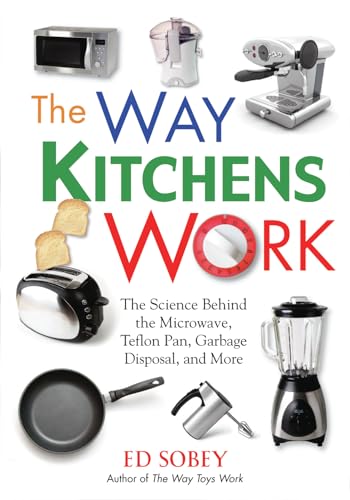
If you’ve ever wondered how a microwave heats food, or why aluminum foil is shiny on one side and dull on the other, or whether it is better to use cold or hot water in a garbage disposal, you should read The Way Kitchens Work. Modern kitchens are hi-tech marvels, with more machinery than any other room in the house. Each of the 50+ entries includes its history, interesting trivia, and a discussion of the technology involved.
Readers will also enjoy reviewing the utensils’ and appliances’ original patent blueprints, as well as photos of the “guts” of these culinary tools. The author even includes odd side stories, such as how the waffle iron played a role in the founding of Nike, how you can reset a turkey timer, and why socialite Josephine Cochran really invented the dishwasher in 1886--it wasn’t because she wanted to ease the burden of her servants, but because she wanted a device that would avoid the unsightly chips associated with hand washing.
And finally, for those whose stovetop skills are still in development, Sobey provides information on the invention and use of the smoke detector and hand-held fire extinguisher.
Die Inhaltsangabe kann sich auf eine andere Ausgabe dieses Titels beziehen.
Über die Autorinnen und Autoren
Ed Sobey is the author of A Field Guide to Household Technology and The Way Toys Work.
Ed Sobey is the author of A Field Guide to Household Technology and The Way Toys Work.
Auszug. © Genehmigter Nachdruck. Alle Rechte vorbehalten.
The Way Kitchens Work
The Science Behind the Microwave, Teflon Pan, Garbage Disposal, and More
By Ed SobeyChicago Review Press Incorporated
Copyright © 2010 Ed Sobey
All rights reserved.
ISBN: 978-1-56976-281-3All rights reserved.
Contents
Title Page,
Copyright Page,
Dedication,
ACKNOWLEDGMENTS,
INTRODUCTION,
ALUMINUM FOIL,
BAG SEALER,
BLENDER,
BREAD MACHINE,
CAN OPENER,
COFFEE GRINDER,
COFFEE MAKER,
COFFEE ROASTER,
COFFEE URN,
CORK REMOVER,
CROCK — POT,
DEEP FAT FRYER,
DISHWASHER,
DUSTBUSTER,
ELECTRIC GRILL,
ELECTRIC KNIFE,
ELECTRIC TEAPOT,
ESPRESSO MAKER,
FAUCET,
FIRE EXTINGUISHER,
FOOD PROCESSOR,
GARBAGE DISPOSAL,
GARLIC CHOPPER,
GROUND FAULT CIRCUIT INTERRUPTER (GFCI) SWITCH,
HOT PLATE,
ICE MAKER,
JUICER,
KITCHEN TORCH,
KNIFE,
MICROWAVE OVEN,
MIXER,
OVEN (ELECTRIC),
OVEN (GAS),
PEPPER MILL,
POPCORN POPPER,
PRESSURE COOKER,
RANGE HOOD,
REFRIGERATOR,
REFRIGERATOR MAGNET,
SALAD SHOOTER,
SALAD SPINNER,
SARAN WRAP,
SMOKE DETECTOR,
STEAMER,
STOVE,
TEFLON-COATED FRYING PAN,
TIMER,
TOASTER,
TOASTER OVEN,
TRASH COMPACTOR,
TURKEY TIMER,
WAFFLE IRON,
WATER FILTER,
WATERCOOLER,
WINE SAVER,
BIBLIOGRAPHY,
ALSO FROM CHICAGO REVIEW PRESS,
CHAPTER 1
ALUMINUM FOIL
History of Aluminum Foil
Alfred Gautschi of Switzerland invented aluminum foil and was awarded a U.S. patent in 1909 (patent number 917,285). His patent claims the utility of aluminum foil for "packing chocolates and other eatables" and outlines a process for making sheets of aluminum foil that are thinner than /10 of a millimeter. The first use of aluminum foil in the United States was to protect candy, such as Life Savers. It replaced the thicker and more expensive tin foil in American kitchens in 1913.
How Aluminum Foil Works
Aluminum is a metal, and as such it is malleable — you can bend it without damaging it. It also doesn't corrode easily. Unlike iron that rusts in the presence of oxygen, aluminum is slow to react with oxygen, and when it does, it forms a surface barrier of aluminum oxide that protects the aluminum atoms below it. Kitchen aluminum foil, which is manufactured to a thickness of about 2/10 of a millimeter, protects food by keeping out oxygen, light, bacteria, and water. Other favorable properties of aluminum are its material strength and low weight, and its high heat conductivity — which means that heat passes easily through the foil. Don't wrap your body in aluminum foil before going skiing!
You will notice that one surface of aluminum foil is shiny and the other is dull. This is the result of the manufacturing process. Two sheets of foil are squeezed between rollers and later separated. The inside surfaces of both sheets are dull, but the sides that were facing the rollers are shiny.
CHAPTER 2BAG SEALER
History of the Bag Sealer
The plastics revolution brought us, among other things, thermoplastics. This family of plastics melt with the application of heat and then refreeze when they cool, making them wonderful materials for creating permanent seals.
Robert Hubbard invented a plastic bag sealer intended for kitchen use. His 1974 patent (patent number 3,847,712) mentions sealing plastic bags for "sandwiches and other food items." His patent was assigned to Dazey Products, the company that made the model that is disassembled in this chapter.
Earlier inventors had discovered a variety of ways to seal thermoplastic bags; one of the earliest is U.S. patent number 3,214,317. However, Hubbard's design appears to be the first intended specifically for home use.
How Bag Sealers Work
The model depicted in this chapter switches on when you lift the lid, but it takes a couple of minutes for the heater to warm up. Then you lay the end of the bag full of leftovers on the sealer's metal edge and close the lid. This compresses the two sides of the mouth of the bag together.
With the lid open, current flows through the heating element, a high resistance wire wrapped in a white insulator, which is under the metal edge. (For more information on how heating elements work, see the introduction, p. xiii.) When you shut the lid, a lever depresses a switch that opens the circuit, cutting power to the heating element. But by this point the edge has grown warm enough to melt the plastic on both sides of the bag, welding them together.
Some more recent models withdraw air from inside the bag to form a vacuum seal. Removing the air from a bag also removes most of the airborne spores and microbes that can spoil food. If you don't have one of these newer models, it's a good idea to squeeze the bag to rid it of air before sealing.
Inside the Bag Sealer
A safety device is wired in series with the heating element under the lid. This small device acts as a thermal fuse. If the temperature rises to an unsafe level, the fuse will open the circuit and stop the flow of electricity. The fuse contains two strips of metal that are joined together with a material that melts above 300° F. Unfortunately, the fuse cannot be reset; if it breaks, you must have it replaced.
CHAPTER 3BLENDER
History of the Blender
Stephen J. Poplawski invented the electric mixer in 1922 (patent number 1,480,915) to make malted milk shakes. The Hamilton Beach Company later purchased Poplawski's patents and started making his milk shake blender.
The first blender designed for home use was invented by Fred Osius in 1937 (patent number D104,289). He recruited musician Fred Waring to provide financing and marketing. The product was sold as the Waring Blendor. In 1940, Stephen Poplawski developed his own home mixer (patent number D123,509) and sold it to the John Oster Manufacturing Company. It marketed the new device as the Osterizer starting in 1946.
How Blenders Work
Electricity is supplied to the base of a blender through a switch that allows you to choose the speed of blending. The switch usually consists of mutually exclusive buttons that you depress to mix, blend, liquefy, etc. You push them and the blender makes a racket as its blades spin. As you push buttons farther to the right, the blades spin increasingly faster. Pushing different buttons changes the flow of electricity to the motor inside; the higher the voltage, the faster the motor spins.
As the motor spins, the blades hurl the contents — let's say, yogurt — toward the outside of the container walls. They force more and more yogurt outward, where it is trapped. The only way it can move is upward, so up the sides of the container the yogurt goes. Along with it go many molecules of air that are drawn into the stirring blades and pushed into the yogurt. The spinning blades pull yogurt in from above and press it out to the sides; this whirling flow of fluid is called a vortex. (Vortexes play important roles not just in blenders but also in sci-fi movies and in your bathtub.)
The powerful motor is the heart of the blender. However, equally important to its operation are the two seals that keep liquids in and out. One seal has to keep liquids in the mixing container on top. Without a reliable seal, you'd have to deal with a puddle under the container. The second seal must keep liquids out of...
„Über diesen Titel“ kann sich auf eine andere Ausgabe dieses Titels beziehen.
Suchergebnisse für The Way Kitchens Work: The Science Behind the Microwave,...

Beispielbild für diese ISBN
The Way Kitchens Work: The Science Behind the Microwave, Teflon Pan, Garbage Disposal, and More
Anbieter: World of Books (was SecondSale), Montgomery, IL, USA
Verkäuferbewertung 5 von 5 Sternen

Paperback. Zustand: Very Good. If you've ever wondered how a microwave heats food, or why aluminum foil is shiny on one side and dull on the other, or whether it is better to use cold or hot water in a garbage disposal, you should read The Way Kitchens Work. Modern kitchens are hi-tech marvels, with more machinery than any other room in the house. Each of the 50+ entries includes its history, interesting trivia, and a discussion of the technology involved. Readers will also enjoy reviewing the utensils' and appliances' original patent blueprints, as well as photos of the guts of these culinary tools. The author even includes odd side stories, such as how the waffle iron played a role in the founding of Nike, how you can reset a turkey timer, and why socialite Josephine Cochran really invented the dishwasher in 1886--it wasn't because she wanted to ease the burden of her servants, but because she wanted a device that would avoid the unsightly chips associated with hand washing. And finally, for those whose stovetop skills are still in development, Sobey provides information on the invention and use of the smoke detector and hand-held fire extinguisher. Bestandsnummer des Verkäufers 00103772149
Gebraucht kaufen
EUR 4,91
Versand gratis
Versand innerhalb von USA
Versand innerhalb von USA
Anzahl: 1 verfügbar
Foto des Verkäufers
The Way Kitchens Work: The Science Behind the Microwave, Teflon Pan, Garbage Disposal, and More
Anbieter: Greenworld Books, Arlington, TX, USA
Verkäuferbewertung 5 von 5 Sternen
Zustand: very_good. Fast Free Shipping â" Very Good condition book with a firm cover and clean pages. Shows normal use and some light wear or limited notes markings. A solid, nice copy to enjoy. Bestandsnummer des Verkäufers GWV.1569762813.VG
Gebraucht kaufen
EUR 4,91
Versand gratis
Versand innerhalb von USA
Versand innerhalb von USA
Anzahl: 1 verfügbar
Beispielbild für diese ISBN
The Way Kitchens Work: The Science Behind the Microwave, Teflon Pan, Garbage Disposal, and More
Anbieter: World of Books Inc, Montgomery, IL, USA
Verkäuferbewertung 4 von 5 Sternen

Paperback. Zustand: Very Good. If you've ever wondered how a microwave heats food, or why aluminum foil is shiny on one side and dull on the other, or whether it is better to use cold or hot water in a garbage disposal, you should read The Way Kitchens Work. Modern kitchens are hi-tech marvels, with more machinery than any other room in the house. Each of the 50+ entries includes its history, interesting trivia, and a discussion of the technology involved. Readers will also enjoy reviewing the utensils' and appliances' original patent blueprints, as well as photos of the guts of these culinary tools. The author even includes odd side stories, such as how the waffle iron played a role in the founding of Nike, how you can reset a turkey timer, and why socialite Josephine Cochran really invented the dishwasher in 1886--it wasn't because she wanted to ease the burden of her servants, but because she wanted a device that would avoid the unsightly chips associated with hand washing. And finally, for those whose stovetop skills are still in development, Sobey provides information on the invention and use of the smoke detector and hand-held fire extinguisher. Bestandsnummer des Verkäufers CIN1569762813VG
Gebraucht kaufen
EUR 6,74
Versand gratis
Versand innerhalb von USA
Versand innerhalb von USA
Anzahl: 1 verfügbar
Beispielbild für diese ISBN
The Way Kitchens Work: The Science Behind the Microwave, Teflon Pan, Garbage Disposal, and More
Anbieter: ThriftBooks-Dallas, Dallas, TX, USA
Verkäuferbewertung 5 von 5 Sternen
Paperback. Zustand: As New. No Jacket. Pages are clean and are not marred by notes or folds of any kind. ~ ThriftBooks: Read More, Spend Less. Bestandsnummer des Verkäufers G1569762813I2N00
Gebraucht kaufen
EUR 8,15
Versand gratis
Versand innerhalb von USA
Versand innerhalb von USA
Anzahl: 1 verfügbar
Beispielbild für diese ISBN
The Way Kitchens Work : The Science Behind the Microwave, Teflon Pan, Garbage Disposal, and More
Verlag:
Chicago Review Press, Incorporated, 2010
ISBN 10: 1569762813
ISBN 13: 9781569762813
Gebraucht
Softcover
Anbieter: Better World Books, Mishawaka, IN, USA
Verkäuferbewertung 5 von 5 Sternen
Zustand: Good. Former library copy. Pages intact with minimal writing/highlighting. The binding may be loose and creased. Dust jackets/supplements are not included. Includes library markings. Stock photo provided. Product includes identifying sticker. Better World Books: Buy Books. Do Good. Bestandsnummer des Verkäufers 3749193-75
Gebraucht kaufen
EUR 10,07
Versand gratis
Versand innerhalb von USA
Versand innerhalb von USA
Anzahl: 1 verfügbar
Beispielbild für diese ISBN
The Way Kitchens Work: The Science Behind the Microwave, Teflon Pan, Garbage Disposal, and More
Anbieter: BookHolders, Towson, MD, USA
Verkäuferbewertung 5 von 5 Sternen
Zustand: Good. [ No Hassle 30 Day Returns ][ Ships Daily ] [ Underlining/Highlighting: NONE ] [ Writing: NONE ] [ Edition: first ] Publisher: Chicago Review Press Pub Date: 4/27/2010 Binding: Paperback Pages: 192 first edition. Bestandsnummer des Verkäufers 6687179
Gebraucht kaufen
EUR 13,76
Versand gratis
Versand innerhalb von USA
Versand innerhalb von USA
Anzahl: 1 verfügbar
Foto des Verkäufers
The Way Kitchens Work: The Science Behind the Microwave, Teflon Pan, Garbage Disposal, and More
Anbieter: Solr Books, Lincolnwood, IL, USA
Verkäuferbewertung 5 von 5 Sternen
Zustand: good. This book is in Good condition. There may be some notes and highligting but otherwise the book is in overall good condition. Bestandsnummer des Verkäufers BCV.1569762813.G
Gebraucht kaufen
EUR 11,45
EUR 7,09 Versand
Versand innerhalb von USA
Versand innerhalb von USA
Anzahl: 1 verfügbar
Beispielbild für diese ISBN
The Way Kitchens Work: The Science Behind the Microwave, Teflon Pan, Garbage Disposal, and More
Anbieter: GoldBooks, Denver, CO, USA
Verkäuferbewertung 5 von 5 Sternen
Paperback. Zustand: new. New Copy. Customer Service Guaranteed. Bestandsnummer des Verkäufers 34C72_64_1569762813
Neu kaufen
EUR 26,22
EUR 4,89 Versand
Versand innerhalb von USA
Versand innerhalb von USA
Anzahl: 1 verfügbar
Foto des Verkäufers
The Way Kitchens Work
Anbieter: Rarewaves USA, HEBRON, KY, USA
Verkäuferbewertung 5 von 5 Sternen
Paperback. Zustand: New. Bestandsnummer des Verkäufers LU-9781569762813
Beispielbild für diese ISBN
The Way Kitchens Work: The Science Behind the Microwave, Teflon Pan, Garbage Disposal, and More [Paperback] Ed Sobey (author)
Anbieter: Hay-on-Wye Booksellers, Hay-on-Wye, HEREF, Vereinigtes Königreich
Verkäuferbewertung 4 von 5 Sternen
Zustand: Fine. Like new condition with a very small stain on the outer edges of the pages. The content is in new condition. Bestandsnummer des Verkäufers HP-67462
Gebraucht kaufen
EUR 4,00
EUR 29,42 Versand
Versand von Vereinigtes Königreich nach USA
Versand von Vereinigtes Königreich nach USA
Anzahl: 1 verfügbar