
Verwandte Artikel zu The Deep Democracy of Open Forums: Practical Steps...
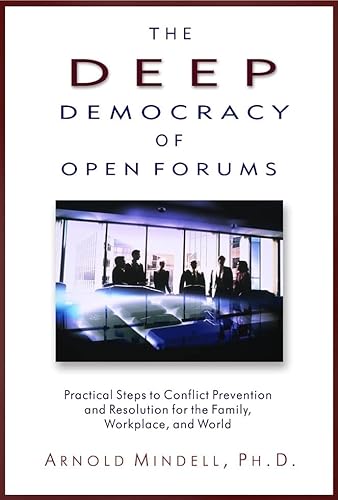
The Deep Democracy of Open Forums: Practical Steps to Conflict Prevention and Resolution for the Family, Workplace, and World - Softcover
Inhaltsangabe
Most of us are terrified of conflict, says Arnold Mindell, PhD, author of fifteen books and internationally recognized for his innovative synthesis of Jungian therapy, dreams, and bodywork. But we needn't be. His burning passion is to create groups and organizations where everyone looks forward to group processes instead of fearing them. He calls this the deep democracy of open forums, where all voices, thoughts, and feelings are aired freely, especially the ones nobody wants to hear.
Since 1992, one of Mindell's prime interests has been the bringing of deeper awareness to group conflicts. Conflict work without reference to altered states of consciousness is like a flu shot for someone in a manic or depressed state of consciousness. Most group and social problems cannot be well facilitated or resolved without access to the dreamlike and mystical atmosphere in the background. The key is becoming aware of it.
Mindell introduces a new paradigm for working in groups, from 3 to 3,000, based on awareness of the flow of signals and events. You can take the subtlest of signals indicating the onset of emotions such as fear, anger, hopelessness, and other altered states, and use them to transform seemingly impossible problems into uplifting community experiences.
As Mindell explains, "I share how everyone--people in schools and organizations, communities and governments--can use inner experiences, dreaming, and mysticism, in conjunction with real methods of conflict management, to produce lively, more sustainable, conscious communities."
Die Inhaltsangabe kann sich auf eine andere Ausgabe dieses Titels beziehen.
Auszug. © Genehmigter Nachdruck. Alle Rechte vorbehalten.
THE DEEP DEMOCRACY OF OPEN FORUMS
Practical Steps to Conflict Prevention and Resolution for the Family, Workplace, and World
By ARNOLD MINDELLHampton Roads Publishing Company, Inc.
Copyright © 2002 Arnold Mindell, Ph.D.
All rights reserved.
ISBN: 978-1-57174-230-8All rights reserved.
Contents
Preface,
Part I. Conducting an Open Forum,
Chapter 1: Beyond the Rules of Order,
Chapter 2: The Open Forum as Outer and Innerwork,
Chapter 3: The Open Forum as Groupwork,
Chapter 4: The Facilitator's Awareness Work,
Chapter 5: Consciousness during Attack,
Chapter 6: Ending with Why You Began,
Part II. A Second Revolution,
Chapter 7: The Psychosocial Activist,
Chapter 8: The Dreaming Background to Community,
Chapter 9: The Media as a Wake-Up Dream,
Chapter 10: The Flu Shot against War,
Chapter 11: The Open Forum as the Elder's Monastery,
Epilogue: Keys to the Open Forum,
Endnotes,
Bibliography,
Index,
About the Author,
CHAPTER 1
Beyond the Rules of Order
"We cannot dismantle one system without having another in its place."
—Mahatma Gandhi (Sharp 1973)
To understand yourself, you need to explore your inner experiences. Likewise, ifmultileveled organizations want to know themselves, they need to explore Open Forumsto understand their various parts. Open Forums in my definition are structured, person-to-personor cyberspace, democratic meetings, in which everyone feels represented.Furthermore, they are facilitated in a deeply democratic manner, which means thedeepest feelings and dreams can also be expressed. In other words, the Open Forum is toa corporation or city as innerwork is to an individual. The analogy between the innerworkof an individual and an organization's Open Forum goes even further. Just as yourpersonal learning depends on how open you are to your various parts, feelings, anddream figures, an organization's self-discovery process depends on openness to thediversity of its individual members, and the diversity of their inner and outer worlds.
Diversity awareness is multileveled: It is a matter of noticing cultures, ages, genders,races, sexual orientations, religions, economic backgrounds, jobs, abilities, andworldviews and dreams. Process-oriented work with organizations is based on awarenessof and bringing forth the richness of our total diversity and complexity.
It is said of Gandhi that "he didn't want to win battles; he wanted to win hearts and minds"(Atlee; Bondurant 1965). The methods of the process-oriented Open Forum aim at doingexactly that. By fostering awareness of the deepest feelings and communication signals ofeveryone in the community, we can create nonviolent yet direct exchanges. The newprocedures presented in the following chapters are adapted to working with organizationsnot as mechanical entities, but as living systems, be they schools, businesses, or cities.
It often seems to me as if the very people we have made responsible for leadership andglobal change are not always the best for the job. Most organizational and world leaders,activists, and politicians have little training in understanding people or helping groups tochange. Yet most of us who are supposed to know most about personal transformation—namely, those in the helping professions—usually avoid organizational tasks and theproblems of social transformation. The lack of conscious leadership is why troubledorganizations turn against their troubles, and conflict with conflict. They assume thatexisting conflict is "wrong."
Process ideas are different. Instead of thinking in terms of the paradigm that condemnswhat's going on in a given conflict situation and implementing programs, methods, andprocedures that implicitly look down on the people involved, process-orientedorganizational work discovers the missing power of transformation in the tension itself andin people's behavior. In the new paradigm, conflict itself is the fastest way to community.Conflict is its own healing.
Democratic methods, rules, and laws alone do not create a sense of community. Rulesand laws may govern mechanical systems, but not people. The new paradigm, which Idescribe in the following chapters, acknowledges that organizations are partiallymechanical beings needing behavior change. However, in the new paradigm,organizations are also living organisms whose lifeblood is composed of feelings, beliefs,and dreams. Ignoring the flow of this "blood", that is, moment-to-moment experiences,disregards emotions and represses what I call "the dreaming background" to the everydaylife of schools, businesses, and cities. Ignoring the dreaming background eventuallydepresses us. When "facts" become more important than feelings and dreams, we getbored, don't vote, won't go to meetings, avoid relationship problems, and becomedisinterested in public life. Disinterested participants erode organizations, precipitatingtheir collapse as if they were empty, paper buildings.
In today's world, "good" ideas don't work without communication awareness. One sidecannot truly win in a battle. In addition, one method alone cannot deal with human issuesfor long. In fact, our organizations are no longer localized in one spot; cyberspacechanged all that! There are no longer simple localities in our second-millennium world. Weare rather a planet of interconnections.
Therefore, creating deep democracy deals with community members not only as separate,local entities but also as sensitive, nonlocal interconnecting spirits of the times, which areconstantly changing. In other words, each of our viewpoints has something global andeternal about it, for even if we are not around, there is always someone else who seemsto fill in for us. In fact, any viewpoint is more like a ghost than a fact. Even when no singleperson represents that viewpoint, it sort of "spooks" us. We have all witnessed at one timeor another how roles such as the "rebel" or the "unconscious leader" hover like spiritsaround groups.
Even in serious situations, process-oriented Open Forums can bring out the spirits in thebackground in a playful manner to reveal the community as a global, dreaming being inthe midst of self-discovery. By taking the group's process as a teacher, everyone becomesa learner and leader, including young children and longtime gang leaders. According toWilliam Ury in his excellent 1999 book, Getting to Peace, "In 10,000 schools in thiscountry, kids as young as six or seven are learning peer mediation." He tells us that in thecities of the United States "gang leaders often become the best mediators, they commandrespect for the transformation they've gone through." The awareness methods of process-orientedOpen Forums work in face-to-face interactions and on the Internet.
Using awareness in groups allows us to discover ourselves, the way we are. Withawareness, we have access not only to our emotions, but also to detachment. Anyonewho uses her awareness to enter the heart of conflict knows from personal experiencethat the emotions that arise are not always predictable. For example, I know from my ownexperience that the feelings involved in tense situations touch me deeply. Sometimespeople scare me; they make me feel sad, or even removed from situations. If I use myawareness, I notice that sometimes my body shakes, as if I were in the presence of ahuge monster, although the person I am facing seems to be acting timidly. Usingawareness connects me to the excitement, the wildness and love in any given moment.Using awareness is a very different...
„Über diesen Titel“ kann sich auf eine andere Ausgabe dieses Titels beziehen.
Suchergebnisse für The Deep Democracy of Open Forums: Practical Steps...

Beispielbild für diese ISBN
The Deep Democracy of Open Forums: Practical Steps to Conflict Prevention and Resolution for the Family, Workplace, and World
Verlag:
Hampton Roads Publishing, 2002
ISBN 10: 1571742301
ISBN 13: 9781571742308
Gebraucht
Softcover
Anbieter: World of Books (was SecondSale), Montgomery, IL, USA
Verkäuferbewertung 5 von 5 Sternen

Zustand: Good. Item in good condition. Textbooks may not include supplemental items i.e. CDs, access codes etc. Bestandsnummer des Verkäufers 00087021541
Gebraucht kaufen
EUR 4,36
Versand gratis
Versand innerhalb von USA
Versand innerhalb von USA
Anzahl: 2 verfügbar
Beispielbild für diese ISBN
The Deep Democracy of Open Forums: Practical Steps to Conflict Prevention and Resolution for the Family, Workplace, and World
Verlag:
Hampton Roads Publishing, 2002
ISBN 10: 1571742301
ISBN 13: 9781571742308
Gebraucht
Softcover
Anbieter: World of Books (was SecondSale), Montgomery, IL, USA
Verkäuferbewertung 5 von 5 Sternen
Zustand: Very Good. Item in very good condition! Textbooks may not include supplemental items i.e. CDs, access codes etc. Bestandsnummer des Verkäufers 00085896806
Gebraucht kaufen
EUR 4,36
Versand gratis
Versand innerhalb von USA
Versand innerhalb von USA
Anzahl: 1 verfügbar
Beispielbild für diese ISBN
The Deep Democracy of Open Forums: Practical Steps to Conflict Prevention and Resolution for the Family, Workplace, and World
Verlag:
Hampton Roads Publishing (edition ), 2002
ISBN 10: 1571742301
ISBN 13: 9781571742308
Gebraucht
Paperback
Anbieter: BooksRun, Philadelphia, PA, USA
Verkäuferbewertung 5 von 5 Sternen
Paperback. Zustand: Very Good. It's a well-cared-for item that has seen limited use. The item may show minor signs of wear. All the text is legible, with all pages included. It may have slight markings and/or highlighting. Bestandsnummer des Verkäufers 1571742301-11-6
Gebraucht kaufen
EUR 4,85
Versand gratis
Versand innerhalb von USA
Versand innerhalb von USA
Anzahl: 1 verfügbar
Beispielbild für diese ISBN
The Deep Democracy of Open Forums : Practical Steps to Conflict Prevention and Resolution for the Family, Workplace, and World
Verlag:
Hampton Roads Publishing Company, Incorporated, 2002
ISBN 10: 1571742301
ISBN 13: 9781571742308
Gebraucht
Softcover
Anbieter: Better World Books, Mishawaka, IN, USA
Verkäuferbewertung 5 von 5 Sternen
Zustand: Good. Pages intact with minimal writing/highlighting. The binding may be loose and creased. Dust jackets/supplements are not included. Stock photo provided. Product includes identifying sticker. Better World Books: Buy Books. Do Good. Bestandsnummer des Verkäufers 5486137-75
Gebraucht kaufen
EUR 6,35
Versand gratis
Versand innerhalb von USA
Versand innerhalb von USA
Anzahl: 2 verfügbar
Beispielbild für diese ISBN
The Deep Democracy of Open Forums: Practical Steps to Conflict Prevention and Resolution for the Family, Workplace, and World
Verlag:
Hampton Roads Publishing Company, 2002
ISBN 10: 1571742301
ISBN 13: 9781571742308
Gebraucht
Paperback
Anbieter: ThriftBooks-Dallas, Dallas, TX, USA
Verkäuferbewertung 5 von 5 Sternen
Paperback. Zustand: As New. No Jacket. Pages are clean and are not marred by notes or folds of any kind. ~ ThriftBooks: Read More, Spend Less. Bestandsnummer des Verkäufers G1571742301I2N00
Gebraucht kaufen
EUR 6,78
Versand gratis
Versand innerhalb von USA
Versand innerhalb von USA
Anzahl: 1 verfügbar
Beispielbild für diese ISBN
The Deep Democracy of Open Forums: Practical Steps to Conflict Prevention and Resolution for the Family, Workplace, and World
Verlag:
Hampton Roads Publishing Company, 2002
ISBN 10: 1571742301
ISBN 13: 9781571742308
Gebraucht
Paperback
Anbieter: ThriftBooks-Atlanta, AUSTELL, GA, USA
Verkäuferbewertung 5 von 5 Sternen
Paperback. Zustand: Very Good. No Jacket. May have limited writing in cover pages. Pages are unmarked. ~ ThriftBooks: Read More, Spend Less. Bestandsnummer des Verkäufers G1571742301I4N00
Gebraucht kaufen
EUR 6,78
Versand gratis
Versand innerhalb von USA
Versand innerhalb von USA
Anzahl: 1 verfügbar
Beispielbild für diese ISBN
The Deep Democracy of Open Forums: Practical Steps to Conflict Prevention and Resolution for the Family, Workplace, and World
Verlag:
Hampton Roads Publishing, 2002
ISBN 10: 1571742301
ISBN 13: 9781571742308
Gebraucht
paperback
Anbieter: Drew, Hutchinson, KS, USA
Verkäuferbewertung 5 von 5 Sternen
paperback. Zustand: Good. Bestandsnummer des Verkäufers 58W000000IIR
Gebraucht kaufen
EUR 7,05
Versand gratis
Versand innerhalb von USA
Versand innerhalb von USA
Anzahl: 1 verfügbar
Beispielbild für diese ISBN
The Deep Democracy of Open Forums: Practical Steps to Conflict Prevention and Resolution for the Family, Workplace, and World
ISBN 10: 1571742301
ISBN 13: 9781571742308
Gebraucht
Paperback
Anbieter: WorldofBooks, Goring-By-Sea, WS, Vereinigtes Königreich
Verkäuferbewertung 5 von 5 Sternen
Paperback. Zustand: Very Good. The book has been read, but is in excellent condition. Pages are intact and not marred by notes or highlighting. The spine remains undamaged. Bestandsnummer des Verkäufers GOR002363823
Gebraucht kaufen
EUR 3,85
EUR 6,53 Versand
Versand von Vereinigtes Königreich nach USA
Versand von Vereinigtes Königreich nach USA
Anzahl: 1 verfügbar
Beispielbild für diese ISBN
The Deep Democracy of Open Forums : Practical Steps to Conflict Prevention and Resolution for the Family, Workplace, and World
Verlag:
Hampton Roads Publishing Company, Incorporated, 2002
ISBN 10: 1571742301
ISBN 13: 9781571742308
Gebraucht
Softcover
Anbieter: Better World Books Ltd, Dunfermline, Vereinigtes Königreich
Verkäuferbewertung 5 von 5 Sternen
Zustand: Very Good. Former library copy. Pages intact with possible writing/highlighting. Binding strong with minor wear. Dust jackets/supplements may not be included. Includes library markings. Stock photo provided. Product includes identifying sticker. Better World Books: Buy Books. Do Good. Bestandsnummer des Verkäufers 4992609-75
Gebraucht kaufen
EUR 5,61
EUR 5,83 Versand
Versand von Vereinigtes Königreich nach USA
Versand von Vereinigtes Königreich nach USA
Anzahl: 1 verfügbar
Foto des Verkäufers
Deep Democracy of Open Forums : Practical Steps to Conflict Prevention and Resolution for the Family, Workplace, and World
Verlag:
Hampton Roads Publishing, 2002
ISBN 10: 1571742301
ISBN 13: 9781571742308
Gebraucht
Softcover
Anbieter: GreatBookPrices, Columbia, MD, USA
Verkäuferbewertung 5 von 5 Sternen
Zustand: As New. Unread book in perfect condition. Bestandsnummer des Verkäufers 864301
Gebraucht kaufen
EUR 15,66
EUR 2,28 Versand
Versand innerhalb von USA
Versand innerhalb von USA
Anzahl: 1 verfügbar