
Verwandte Artikel zu Masonic Temples: Freemasonry, Ritual Architecture,...
Inhaltsangabe
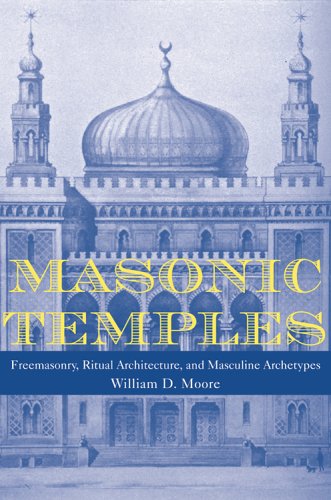
In Masonic Temples, William D. Moore introduces readers to the structures American Freemasons erected over the sixty-year period from 1870 to 1930, when these temples became a ubiquitous feature of the American landscape. As representations of King Solomon’s temple in ancient Jerusalem erected in almost every American town and city, Masonic temples provided specially designed spaces for the enactment of this influential fraternity’s secret rituals. Using New York State as a case study, Moore not only analyzes the design and construction of Masonic structures and provides their historical context, but he also links the temples to American concepts of masculinity during this period of profound economic and social transformation. By examining edifices previously overlooked by architectural and social historians, Moore decodes the design and social function of Masonic architecture and offers compelling new insights into the construction of American masculinity. Four distinct sets of Masonic ritual spaces—the Masonic lodge room, the armory and drill room of the Knights Templar, the Scottish Rite Cathedral, and the Shriners’ mosque – form the central focus of this volume. Moore argues that these spaces and their accompanying ceremonies communicated four alternative masculine archetypes to American Freemasons—the heroic artisan, the holy warrior, the adept or wise man, and the frivolous jester or fool. Although not a Freemason, Moore draws from his experience as director of the Chancellor Robert R Livingston Masonic Library in New York City, where heutilized sources previously inaccessible to scholars. His work should prove valuable to readers with interests in vernacular architecture, material culture, American studies, architectural and social history, Freemasonry, and voluntary associations.
Die Inhaltsangabe kann sich auf eine andere Ausgabe dieses Titels beziehen.
Über die Autorin bzw. den Autor
William D. Moore is assistant professor of history and director of the public history program at the University of North Carolina Wilmington. His work has appeared in CRM: The Journal of Heritage Stewardship, Perspectives in Vernacular Architecture, and Winterthur Portfolio, among other publications.
Auszug. © Genehmigter Nachdruck. Alle Rechte vorbehalten.
New York's Temple Builders
In 1927 the editor of a Masonic magazine published in New York City observed, “It is undoubtedly a marked feature of present-day American Masonry to erect huge and elaborate buildings . . . and to spend on them enormous sums of money.”1 This observation was made near the apex of a sixty-year growth period during which Masonic structures became ubiquitous features of the built American landscape. Although Masonic edifices ranged from simple frame structures to magnificent exotic piles, by 1930 a building of some sort containing Masonic facilities was located in nearly every community in America. While these structures were relevant previously to individuals living in towns and cities across America, their significance largely has been ignored in scholarly discourse. By placing the design and construction of Masonic buildings within their historical context, this study identifies and interprets social forces motivating men of the period to construct complex and arcane temples of masculinity.
The Masonic structures Freemasons erected during the fraternity’s great building era between 1870 and 1930 were designed to hold four distinct sets of ritual spaces in which men were tutored in constructions of masculine identity. Within these ceremonial rooms, men enacted rituals that simultaneously introduced new initiates to the fraternity’s teachings and bolstered the belief systems of those enrolled. The fraternity’s rituals centered upon symbolically transforming men into a series of masculine archetypes. By participating in these ceremonies, individuals were schooled in assuming the roles of the heroic artisan, the righteous warrior, the adept or wise man, and the jester or fool.
Fashioned to imitate the journey undertaken by a man experiencing Freemasonry’s rituals, this volume is divided into six chapters reflecting the initiate’s developing complex Masonic identity. The first two chapters complement the fraternity’s first three degrees, called interchangeably the “Blue Lodge” or Craft Degrees. Chapter 1 explicates the central narrative and symbolic ideals of these ceremonies, while chapter 2 analyzes the lodge room in which these ceremonies took place. Chapter 3 examines the armories and drill halls in which members of the York Rite of Freemasonry transformed themselves into the spiritual heirs of the medieval crusaders and became Knights Templar. The fourth chapter discusses changes in the ritual practices of the Scottish Rite of Freemasonry, an organization that schooled its members in esoteric wisdom, and charts how the organizations’ meeting spaces were transformed as a result of the introduction of scenic backdrops and other new theatrical technologies during this period. The spaces utilized by the Ancient Arabic Order of the Nobles of the Mystic Shrine to assist individuals in playing the fool and thus to embrace a new masculinity based on personality, rather than upon character, are the subject of chapter 5. Finally, the last chapter examines the architectural, financial, and symbolic significances of the structures housing Masonic ritual spaces.
In many ways an ethnographic study, this analysis has been influenced greatly by Clifford Geertz’s charge to scholars to provide “thick descriptions” of cultural activities.2 Moreover, it also has been profoundly influenced by the ongoing efforts of scholars of vernacular architecture who use buildings as tools and sources to explicate consciousness and cognition.3 Instead of simply describing the physical characteristics of the structures that Freemasons erected for themselves, it attempts to untangle the webs of significance that the builders and inhabitants designed into these edifices. By interpreting how these omnipresent American structures shaped social constructions of masculinity in the decades surrounding the start of the twentieth century, this investigation seeks to understand how Freemasons used objects and architecture to anchor themselves within a cognitive framework as they faced the existential crisis of being American men.
New York State
While no one state can claim to be representative of the entire country, for purposes of this study New York State is presented here as a microcosm of the national experience. Because of the state’s geographic and economic diversity, Freemasonry existed within New York in rural, urban, and suburban environments as well as in agricultural and manufacturing economies. The state’s large size, both in square miles and in population, also recommends it for study, providing an adequate statistical sample with its numerous communities of various sizes. Moreover, by 1929 the Grand Lodge of New York was the largest Masonic organization in the world, with a membership representing more than 10 percent of all Freemasons in the United States.4
New York State also recommends itself for the purposes of this study because of the rich collections administered by the Livingston Masonic Library in New York City and in Utica, New York. The Grand Lodge, F. & A.M., of New York began collecting and cataloguing Masonic books, periodicals, ephemera, and other written sources in the 1850s. This collection, incorporated as the Chancellor Robert R Livingston Masonic Library of the Grand Lodge, F. & A.M., of the State of New York in 1987, is one of the nation’s most significant repositories of Masonic materials. Without access to these holdings, this study would have been impossible, since most academic and historical libraries have neglected this subject.
While this study focuses upon New York State, its conclusions are widely applicable to most of the country. By 1870 there were few significant regional differences within Masonic culture. Although some minor details of the Masonic ritual varied from state to state, the larger constellation of cultural ideas, narratives, and values had become homogenized through the growth of the Masonic periodical press, the prosperity of a nationwide Masonic regalia industry following the Civil War, and the constant traveling and intervisitation of Masonic individuals and groups facilitated by improvements in transportation technologies. While the names and dates in this study are specific to New York State, if regional circumstances are taken into account the broader outlines of the argument can be applied judiciously to any of the American Masonic jurisdictions.
The Era of Building
The chronological limits of this study are framed by the dates of June 8, 1870, when Masons laid the cornerstone of New York City’s Masonic Hall, and May 24, 1930, when the membership dedicated Rochester, New York’s great modern Masonic temple (figs. 0.1 and 0.2). Designed by Napoleon LeBrun, the earlier Manhattan building set a standard for all Masonic organizations statewide. Further, it marked the fraternity’s return to prominence following decades of retrenchment after the anti-Masonic movement devastated the organization in the 1820s and 1830s. The Rochester temple was the period’s final great accomplishment and was the last significant Masonic structure completed in the state before the Great Depression transformed American society.
The years between these two landmark events witnessed radical changes in America. During these years the United States went from being a rural, agricultural nation to an urban, industrial society. From isolationist postcolonial roots, the nation assumed a place as a world power involved in global politics and with territories stretching across the western hemisphere from Hawaii to Puerto Rico. Immigration, simultaneously, assured that the nation’s demographics would become increasingly diverse as individuals from other nations sought prosperity in America’s...
„Über diesen Titel“ kann sich auf eine andere Ausgabe dieses Titels beziehen.
Suchergebnisse für Masonic Temples: Freemasonry, Ritual Architecture,...

Beispielbild für diese ISBN
Masonic Temples: Freemasonry, Ritual Architecture, and Masculine Archetypes
Verlag:
Univ Tennessee Press (edition Illustrated), 2006
ISBN 10: 1572334967
ISBN 13: 9781572334960
Gebraucht
Hardcover
Anbieter: BooksRun, Philadelphia, PA, USA
Verkäuferbewertung 5 von 5 Sternen

Hardcover. Zustand: Very Good. Illustrated. With dust jacket. It's a well-cared-for item that has seen limited use. The item may show minor signs of wear. All the text is legible, with all pages included. It may have slight markings and/or highlighting. Bestandsnummer des Verkäufers 1572334967-11-1-29
Gebraucht kaufen
EUR 34,82
Versand gratis
Versand innerhalb von USA
Versand innerhalb von USA
Anzahl: 1 verfügbar
Foto des Verkäufers
Masonic Temples: Freemasonry, Ritual Architecture, and Masculine Archetypes
Anbieter: The Dawn Treader Book Shop, Ann Arbor, MI, USA
Verkäuferbewertung 4 von 5 Sternen

Hardcover. Zustand: Fine. Zustand des Schutzumschlags: Fine. Very light soiling to the page block, otherwise As New. Jacket is wrapped in a clear mylar sleeve. Bestandsnummer des Verkäufers 2033221
Gebraucht kaufen
EUR 41,38
EUR 5,36 Versand
Versand innerhalb von USA
Versand innerhalb von USA
Anzahl: 1 verfügbar
Beispielbild für diese ISBN
Masonic Temples: Freemasonry, Ritual Architecture, and Masculine Archetypes
Verlag:
University of Tennessee Press, Knoxville, TN, 2006
ISBN 10: 1572334967
ISBN 13: 9781572334960
Neu
Hardcover
Erstausgabe
Anbieter: Saucony Book Shop, Kutztown, PA, USA
Verkäuferbewertung 5 von 5 Sternen
Hardcover. Zustand: New. Zustand des Schutzumschlags: New. 1st Edition. Blue cloth, lettered in gold foil. New/as issued, dust jacket now in mylar. 1st ptg. xix,216 pp., illus. Size: 8vo - over 7¾" - 9¾" tall. Book. Bestandsnummer des Verkäufers 066193
Neu kaufen
EUR 41,38
EUR 5,36 Versand
Versand innerhalb von USA
Versand innerhalb von USA
Anzahl: 1 verfügbar
Beispielbild für diese ISBN
Masonic Temples: Freemasonry, Ritual Architecture, And Masculine Archetypes
Verlag:
The University of Tennessee Press, Knoxville, Tennessee, 2006
ISBN 10: 1572334967
ISBN 13: 9781572334960
Gebraucht
Hardcover
Anbieter: Mullen Books, ABAA, Marietta, PA, USA
Verkäuferbewertung 4 von 5 Sternen
Hardcover. blue cloth boards w/ light blue pictorial dustjacket, bold yellow printing. 272 pgs w/ illustrations. Out Of Print from the publisher. "In Masonic Temples, William D. Moore introduces readers to the structures American Freemasons erected over the sixty-year period from 1870 to 1930, when these temples became a ubiquitous feature of the American landscape. As representations of King Solomon's temple in ancient Jerusalem erected in almost every American town and city, Masonic temples provided specially designed spaces for the enactment of this influential fraternity's secret rituals. Using New York State as a case study, Moore not only analyzes the design and construction of Masonic structures and provides their historical context, but he also links the temples to American concepts of masculinity during this period of profound economic and social transformation. By examining edifices previously overlooked by architectural and social historians, Moore decodes the design and social function of Masonic architecture and offers compelling new insights into the construction of American masculinity. Four distinct sets of Masonic ritual spacesthe Masonic lodge room, the armory and drill room of the Knights Templar, the Scottish Rite Cathedral, and the Shriners' mosque form the central focus of this volume. Moore argues that these spaces and their accompanying ceremonies communicated four alternative masculine archetypes to American Freemasonsthe heroic artisan, the holy warrior, the adept or wise man, and the frivolous jester or fool. Although not a Freemason, Moore draws from his experience as director of the Chancellor Robert R Livingston Masonic Library in New York City, where heutilized sources previously inaccessible to scholars. His work should prove valuable to readers with interests in vernacular architecture, material culture, American studies, architectural and social history, Freemasonry, and voluntary associations."--Amazon. New/Sealed (remains in publisher's wrap; may have rubbing, bumping to board edges, corners etc). Bestandsnummer des Verkäufers 196109
Gebraucht kaufen
EUR 64,36
EUR 11,60 Versand
Versand innerhalb von USA
Versand innerhalb von USA
Anzahl: 1 verfügbar
Beispielbild für diese ISBN
Masonic Temples: Freemasonry, Ritual Architecture, and Masculine Archetypes
Verlag:
University of Tennessee Press, 2006
ISBN 10: 1572334967
ISBN 13: 9781572334960
Neu
Hardcover
Anbieter: SHIMEDIA, Brooklyn, NY, USA
Verkäuferbewertung 4 von 5 Sternen
Zustand: New. Satisfaction Guaranteed or your money back. Bestandsnummer des Verkäufers 1572334967