
Verwandte Artikel zu The Wisdom of Life and Counsels and Maxims (Great Books...
Inhaltsangabe
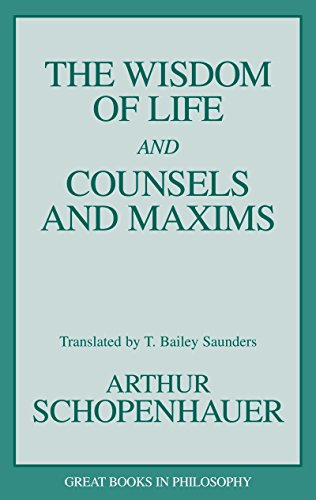
Nineteenth-century German philosopher Arthur Schopenhauer (1788-1860) championed individual strength of will and independent, reasoned deliberation above the irrational impulses that animated most of society. In The Wisdom of Life and Counsels and Maxims, two essays from his last work, Parerga und Paralipomena (1851), he discusses how to order our lives to obtain the greatest amount of pleasure and success; then he offers guidelines for living life to its fullest. But for Schopenhauer a life well lived should always reach beyond itself to a higher plane.
Die Inhaltsangabe kann sich auf eine andere Ausgabe dieses Titels beziehen.
Über die Autorin bzw. den Autor
ARTHUR SCHOPENHAUER, the famous nineteenth-century German pessimist who expanded on the ideas of Plato and Immanuel Kant, wrote accessibly, leading his ideas to resonate with both philosophers and artists alike.
The son of Heinrich Floris Schopenhauer and Johanna Henriette Troisiener, Arthur was born in Danzig on February 22, 1788, just one month after English Romantic poet George Gordon, Lord Byron. A middle-class Dutch family involved in international trade, the Schopenhauers chose "Arthur" as their son's name because the appellation is spelled the same in English, French, and German. Once Prussia annexed Danzig in 1793, the Schopenhauer family moved first to Hamburg, then Arthur spent much of his youth living throughout Europe, learning many languages. Although his father prepared him to inherit the family mercantile business, Arthur Schopenhauer found that the scholarly life suited him perfectly. After Heinrich's 1805 death, Johanna moved her family from Hamburg to Weimar, where Johanna, an author herself, befriended the writer Johann Wolfgang von Goethe.
Arthur Schopenhauer enrolled in the University of Gottingen and received his doctorate from the University of Jena in 1813. His dissertation, The Fourfold Root of the Principle of Sufficient Reason, explored the philosophical assumption that equates reality with rationality. According to Schopenhauer, in order for one to contemplate an explanation for a particular thing, one must assume that there is a subject (oneself) that thinks about the object (thing to be explained). Schopenhauer built his thesis on the work of Kant, who noted that humans cannot transcend themselves and therefore cannot satisfactorily answer metaphysical questions, and G. W. Leibniz, who first defined the principle of sufficient reason, which states that absolutely nothing exists that lacks an adequate reason for its existence.
Schopenhauer's most famous work, the two-volume The World as Will and Representation, sprung from ideas put forth in The Fourfold Root. Schopenhauer's philosophical inquiries led him to embrace a pessimistic worldview--life is a meaningless struggle against the irrational impulses of the will. One could find some solace, however, through aesthetic perception, morality, and asceticism. With regard to the first, Schopenhauer considered artistic endeavors to be the communication of Platonic Ideas, with music as the highest of all art forms because of its instant objectification of the will. Schopenhauer's ideas influenced many literary figures--including Samuel Beckett, Joseph Conrad, Leo Tolstoy, W. B. Yeats, and Emile Zola--as well as musicians such as Johannes Brahms and Richard Wagner.
In the early 1920s, Schopenhauer began lecturing at the University of Berlin, purposely scheduling his classes concurrent with those of G. W. F. Hegel. Schopenhauer strongly disliked Hegel and his philosophy; the former felt that the latter tried to make up for a lack of content in his works by ensnaring the reader in meaningless jargon.
Schopenhauer left Berlin in 1831 to escape the threat of a cholera epidemic, eventually settling in Frankfurt, where he spent the rest of his life. By the mid-1850s, Schopenhauer gained the recognition that he had longed for when a review of his philosophical work appeared in the Westminster Review, which connected some of Schopenhauer's thought with that of Johann Gottlieb Fichte. Schopenhauer's health gradually deteriorated in 1860 until he died of natural causes on September 21 in Frankfurt. New editions of most of Schopenhauer's works began to appear in 1873.
Other works by Schopenhauer include On Vision and Colors (1816), On the Will in Nature (1836), The Two Fundamental Problems of Ethics (1839-40), and Parerga und Paralipomena (1851).
„Über diesen Titel“ kann sich auf eine andere Ausgabe dieses Titels beziehen.
Suchergebnisse für The Wisdom of Life and Counsels and Maxims (Great Books...

Beispielbild für diese ISBN
The Wisdom of Life and Counsels and Maxims
Anbieter: World of Books (was SecondSale), Montgomery, IL, USA
Verkäuferbewertung 5 von 5 Sternen

Paperback. Zustand: Good. Nineteenth-century German philosopher Arthur Schopenhauer (1788-1860) championed individual strength of will and independent, reasoned deliberation above the irrational impulses that animated most of society. In The Wisdom of Life and Counsels and Maxims, two essays from his last work, Parerga und Paralipomena (1851), he discusses how to order our lives to obtain the greatest amount of pleasure and success; then he offers guidelines for living life to its fullest. But for Schopenhauer a life well lived should always reach beyond itself to a higher plane. Bestandsnummer des Verkäufers CIN1573920339G
Gebraucht kaufen
EUR 4,16
Versand gratis
Versand innerhalb von USA
Versand innerhalb von USA
Anzahl: 1 verfügbar
Beispielbild für diese ISBN
The Wisdom of Life and Counsels and Maxims
Anbieter: World of Books Inc, Montgomery, IL, USA
Verkäuferbewertung 4 von 5 Sternen

Paperback. Zustand: Good. Nineteenth-century German philosopher Arthur Schopenhauer (1788-1860) championed individual strength of will and independent, reasoned deliberation above the irrational impulses that animated most of society. In The Wisdom of Life and Counsels and Maxims, two essays from his last work, Parerga und Paralipomena (1851), he discusses how to order our lives to obtain the greatest amount of pleasure and success; then he offers guidelines for living life to its fullest. But for Schopenhauer a life well lived should always reach beyond itself to a higher plane. Bestandsnummer des Verkäufers CIN1573920339G
Gebraucht kaufen
EUR 6,00
Versand gratis
Versand innerhalb von USA
Versand innerhalb von USA
Anzahl: 1 verfügbar
Beispielbild für diese ISBN
Wisdom of Life and Counsels and Maxims (Great Books in Philosophy)
Anbieter: Open Books, Chicago, IL, USA
Verkäuferbewertung 5 von 5 Sternen
Paperback. Zustand: Very Good. Light edge wear. Open Books is a nonprofit social venture that provides literacy experiences for thousands of readers each year through inspiring programs and creative capitalization of books. Bestandsnummer des Verkäufers mon0000854123
Gebraucht kaufen
EUR 4,17
EUR 3,55 Versand
Versand innerhalb von USA
Versand innerhalb von USA
Anzahl: 1 verfügbar
Foto des Verkäufers
Wisdom of Life and Counsels and Maxims
Anbieter: GreatBookPrices, Columbia, MD, USA
Verkäuferbewertung 5 von 5 Sternen
Zustand: New. Bestandsnummer des Verkäufers 538277-n
Neu kaufen
EUR 11,81
EUR 2,35 Versand
Versand innerhalb von USA
Versand innerhalb von USA
Anzahl: Mehr als 20 verfügbar
Beispielbild für diese ISBN
The Wisdom of Life and Counsels and Maxims
Anbieter: INDOO, Avenel, NJ, USA
Verkäuferbewertung 5 von 5 Sternen
Zustand: New. Bestandsnummer des Verkäufers 9781573920339
Foto des Verkäufers
The Wisdom of Life and Counsels and Maxims (Paperback or Softback)
Verlag:
Prometheus Books 11/1/1995, 1995
ISBN 10: 1573920339
ISBN 13: 9781573920339
Neu
Paperback or Softback
Anbieter: BargainBookStores, Grand Rapids, MI, USA
Verkäuferbewertung 5 von 5 Sternen
Paperback or Softback. Zustand: New. The Wisdom of Life and Counsels and Maxims. Book. Bestandsnummer des Verkäufers BBS-9781573920339
Foto des Verkäufers
The Wisdom of Life and Counsels and Maxims
Anbieter: Rarewaves USA, HEBRON, KY, USA
Verkäuferbewertung 5 von 5 Sternen
Paperback. Zustand: New. Nineteenth-century German philosopher Arthur Schopenhauer (1788-1860) championed individual strength of will and independent, reasoned deliberation above the irrational impulses that animated most of society. In The Wisdom of Life and Counsels and Maxims, two essays from his last work, Parerga und Paralipomena (1851), he discusses how to order our lives to obtain the greatest amount of pleasure and success; then he offers guidelines for living life to its fullest. But for Schopenhauer a life well lived should always reach beyond itself to a higher plane. Bestandsnummer des Verkäufers LU-9781573920339
Neu kaufen
EUR 14,28
Versand gratis
Versand innerhalb von USA
Versand innerhalb von USA
Anzahl: Mehr als 20 verfügbar
Foto des Verkäufers
Wisdom of Life and Counsels and Maxims
Anbieter: GreatBookPrices, Columbia, MD, USA
Verkäuferbewertung 5 von 5 Sternen
Zustand: As New. Unread book in perfect condition. Bestandsnummer des Verkäufers 538277
Gebraucht kaufen
EUR 12,69
EUR 2,35 Versand
Versand innerhalb von USA
Versand innerhalb von USA
Anzahl: Mehr als 20 verfügbar
Beispielbild für diese ISBN
The Wisdom of Life and Counsels and Maxims
Anbieter: California Books, Miami, FL, USA
Verkäuferbewertung 5 von 5 Sternen
Zustand: New. Bestandsnummer des Verkäufers I-9781573920339
Neu kaufen
EUR 16,50
Versand gratis
Versand innerhalb von USA
Versand innerhalb von USA
Anzahl: Mehr als 20 verfügbar
Foto des Verkäufers
The Wisdom of Life and Counsels and Maxims (Paperback)
Print-on-DemandAnbieter: Grand Eagle Retail, Bensenville, IL, USA
Verkäuferbewertung 5 von 5 Sternen
Paperback. Zustand: new. Paperback. Nineteenth-century German philosopher Arthur Schopenhauer (1788-1860) championed individual strength of will and independent, reasoned deliberation above the irrational impulses that animated most of society. In "The Wisdom of Life and Counsels and Maxims", two essays from his last work, "Parerga und Paralipomena" (1851), he discusses how to order our lives to obtain the greatest amount of pleasure and success; then he offers guidelines for living life to its fullest. But for Schopenhauer a life well lived should always reach beyond itself to a higher plane. Nineteenth-century German philosopher Arthur Schopenhauer (1788-1860) championed individual strength of will and independent, reasoned deliberation above the irrational impulses that animated most of society. This title includes two essays from his last work wherein he discusses how to order our lives to obtain better amount of success. This item is printed on demand. Shipping may be from multiple locations in the US or from the UK, depending on stock availability. Bestandsnummer des Verkäufers 9781573920339