
Verwandte Artikel zu Accidental Activists: Mark Phariss, Vic Holmes, and...
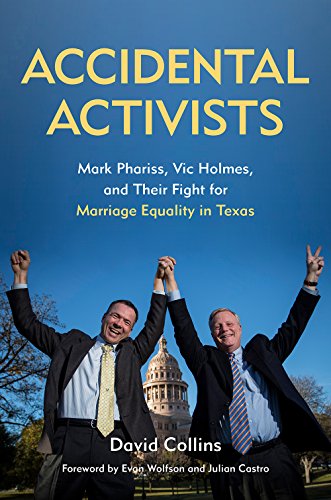
Accidental Activists: Mark Phariss, Vic Holmes, and Their Fight for Marriage Equality in Texas (Mayborn Literary Nonfiction, 8, Band 8) - Hardcover
Inhaltsangabe
Pineville, NC
Die Inhaltsangabe kann sich auf eine andere Ausgabe dieses Titels beziehen.
Über die Autorin bzw. den Autor
DAVID COLLINS taught English for forty years at Westminster College in Missouri. He has had unrestricted access to all materials related to the story of Mark Phariss and Vic Holmes, including legal communications and documents, and conducted extensive interviews with Mark and Vic and others involved in the case. He lives in Pineville, North Carolina.
Auszug. © Genehmigter Nachdruck. Alle Rechte vorbehalten.
Accidental Activists
Mark Phariss, Vic Holmes, and Their Fight for Marriage Equality in Texas
By David CollinsUniversity of North Texas Press
Copyright © 2017 David Collins
All rights reserved.
ISBN: 978-1-57441-692-3All rights reserved.
Contents
Foreword by Evan Wolfson and Julian Castro,
Author's Preface,
Introduction Reluctant Rebels ... but Rebels with a Cause,
Chapter 1 Growing Up Absurd,
Chapter 2 Should We? Or Shouldn't We?,
Chapter 3 The First Blast of the Trumpet,
Chapter 4 The Battle of New Orleans, Part I Opening Salvos: Louisiana and Mississippi,
Chapter 5 The Battle of New Orleans, Part II Texas Engages,
Chapter 6 Crossing the Threshold,
Chapter 7 Justice That Arrives Like a Thunderbolt,
Chapter 8 Backlash in Texas,
Chapter 9 Married at Last, Deep in the Heart of Texas,
Table of Cases,
Endnotes,
Bibliography,
Index,
CHAPTER 1
Growing Up Absurd
Go. There's a journey out there beyond what any of us know, daring and illuminating once taken, for once taken it takes you. Not so much down some path or road as from one chamber of the heart to another, one way of seeing to another, where the old definitions of "productive citizen" and "progress" mean nothing ... these are troubled times, and for some, hard times. But they are not end times. Many great problems and challenges lie ahead. It's not your job to solve them all, but it is your responsibility to be aware, to come together and take problems as best you can, and at the same time enjoy the beauty of this world, celebrate it, restore it, share it, and make it better one day at a time. You don't have to be anything you're not; instead, be everything you are.
— Kim Heacox, Rhythm of the Wild: A Life Inspired by Alaska's Denali National Park
Climbing into his car for the short drive to the home of Chris Hammet and Keith Stanford, Mark Phariss was looking forward to an evening with friends but expecting nothing out of the ordinary. Less than ten blocks, less than two miles, barely time to think two thoughts. No great adventure, just another day in the thus far uneventful spring of 1997 — and that was okay. Chris was a radiologist in the Air Force Reserve, Keith, an ophthalmologist in the Army Reserve. A couple for three years, they were throwing a birthday party for a mutual friend. Mark was pretty sure that, as was so often the case, he'd know everyone there.
As he walked up the short driveway and into the house, Mark had no idea he was minutes from meeting the love of his life, Vic Holmes. One look, one brief conversation and he was smitten, a classic case of love at first sight. The one person Mark didn't know — handsome, beautiful smile, eyes that twinkled when he laughed — was suddenly the only one who mattered.
Vic, not so much. He didn't know the hosts, had been invited to the party by chance through a medical connection: Mark Reid, a doctor he met online who just happened to be the birthday boy. Vic was dating someone at the time, had a date that night in fact, and planned to stay only a few minutes. Ironically, he had come very close to not showing up at all. Drove by several times, but kept missing the house, a bit hidden behind trees. He had very nearly driven on. Settling in at the party, Vic chatted with a few people — forty-five minutes, perhaps an hour — moving constantly from group to group as Mark followed, hoping to make an impression and trying not to be too obvious. Tired of fending off the mosquitos, having stayed long enough to be polite, Vic sought out Chris and Keith one more time, thanked them, and left.
Luckily, Mark knew nothing about Vic's personal life — knew he had a date that night, but not that he was in a relationship. Unwilling to watch as Vic walked out of his life, Mark got his phone number from a friend.
The path that brought Mark to that first meeting with Vic had not been easy. By the age of six — years before he had words to express what he felt — he knew he was attracted to other boys. But as he moved through childhood, adolescence, and eventually into young adulthood, he read the cultural signs — sometimes consciously, sometimes absorbing the message by osmosis. And every sign said "No, don't go there." Year by year, understanding more and more the heavy price to be paid for being gay, he struggled to admit the reality of his sexual orientation, even to himself. He struggled as well to keep the truth about himself from others.
Mark had barely entered elementary school when his parents and siblings first warned him that intense emotional ties between boys were taboo. Walking home from his second grade classroom the day his best friend announced that his family was moving to another side of town, Mark began to cry. When he explained the reason for his tears, his mother, his twin sister, and his older brother looked at him, Mark remembers, "as though I was nuts." From then on he understood the male code to which he was expected to subscribe. Boys don't get too close to other boys; they certainly don't cry on parting from other boys. Mark's father, born in 1921 and a George Wallace conservative, had old-fashioned ideas about masculinity: he didn't change diapers, he didn't cook, he didn't do dishes. Men were to be tough, to fight when necessary as he had done in the Second World War. Women were to be "feminine"; no woman could ever be vice-president, let alone president.
Though he grew up in Oklahoma where conservative values seep from the ground like oil, Mark caught a break early on. His mother was deeply religious — she rose before dawn to read the Bible, saw to it that Sunday school and services were a regular part of her children's lives — but by the time Mark was old enough to remember, his parents had joined St. Paul's Methodist Church, a progressive congregation whose young, educated minister, the Rev. John Reskovac, preached an enlightened version of Christianity. The fundamentalist threats of hellfire and damnation that darkened the lives of so many gays and lesbians born in the Sooner State did come into Mark's life at the annual revivals to which his mother took the children, but she was always careful to temper the fiery preachers they heard there with her own more humane vision. When at the age of twelve Mark and his twin sister, Marsha, spread the word to children in the neighborhood that they were sinners bound for hell, their mother quickly put a stop to their misguided evangelism. You'll bring more people to Christ, she told them, by the way you live your own lives and treat others than you will by threatening them with damnation. The lesson his mother taught that day Mark never forgot.
And yet, the anti-gay message found its way eventually into his head, seepage from the general culture. Mark was just a few months shy of his fourteenth birthday when in October 1973 the local paper, the Lawton Constitution, reported on a study by Eugene Leivitt and Albert Klassen on attitudes toward homosexuality — and what he read disturbed him. Two-thirds of those surveyed considered homosexuality "very obscene and vulgar"; almost 50 percent saw in homosexuality "a corruption that can cause the downfall of a civilization." Fully a third thought homosexuals should be jailed. Though the minister at St. Paul's was enlightened, Mark knew that in 1972 the larger church had added a new line to its Book of Discipline. "The practice of homosexuality," it read, "is incompatible with Christian teaching."
When friends from school stayed the night in Mark's early years, or when he stayed with friends, they would occasionally experiment sexually. "Each time I had physical contact," Mark remembers, "I was wracked with guilt. Even when there was no physical contact, I was wracked by guilt because I wanted it so badly." Born into a world in which he was ill-equipped to live, Mark suffered at night, alone with his thoughts. "Late at night, in bed by myself, I'd cry myself to sleep. I'd pray for God to make me straight or, if He couldn't, to take me in my sleep." Like many another trapped between worlds, he thought of taking his own life. But though his prayers went unanswered, he somehow turned away from death. "Each morning I'd wake up, still very much alive, still very much attracted to men."
Through high school, through college, through law school and beyond, Mark was painfully aware that he would be ostracized were anyone to discover, even to suspect, that he was gay. He struggled to maintain a double life, perpetually guilty of bad faith, of denying who he was. When a few beers at a pool party in the summer between his eighth- and ninth-grade years led to co-ed streaking across nearby fields, he worked hard to disguise the fact that he was more interested in the boys running next to him than the girls. In high school he kept his interest in men under a tightly fitted cover made possible by occasional dates with young women. Offers of sexual favors from a few who wanted to draw his attention went unanswered. Though he carefully perpetuated the illusion that he was interested in girls, his seeming interest extended no further than a polite good-night kiss.
Ever more aware that his sexual orientation set him apart from his classmates, Mark realized as a teenager that cultural warnings to the LGBT community were flying thick and fast. Classes had barely begun in the fall of 1975 when he pulled the September 8 copy of Time from the mailbox and found himself face to face with Leonard Matlovich, the first openly gay man ever to appear on the cover of a national magazine. Celebrated in the LGBT community for challenging the ban on gays in the military, Matlovich was discharged from the Air Force a month later. For four years appeals kept the case alive until in September 1980 he accepted a cash settlement — and the case was still very much on Mark's mind as he filled out college applications. Worried about money, his father urged him to join an ROTC program to help with expenses. Worried about being dishonorably discharged, about being tossed into a jail at Fort Leavenworth, about never being able to find a job, Mark refused — joking defensively with his father about what a terrible soldier he would make, inclined as he was to ask "why?" when told what to do.
Just a year and a few months after the Leonard Matlovich story broke, Mark was knocked on his heels again by Anita Bryant's vicious Save Our Children campaign in Florida. As the sixties gave way to the seventies and the counterculture spread across the country, as the sexual revolution changed behaviors, the LGBT community in Miami had found itself less and less marginalized. Until, that is, January of 1977 when the Dade County Commission passed an ordinance prohibiting discrimination in employment, housing, and public services based on sexual orientation and the Reverend William Chapman, pastor of the Northwest Baptist Church, railed against it from the pulpit, rallying the congregation to bring a quick end to the Age of Aquarius. Chosen to lead the opposition, Bryant set out to convince voters by whatever means, fair or foul, that homosexuals were immoral, promiscuous, and specifically, an immediate danger to children. "If homosexuals are allowed to change the law in their favor," she asserted in a classic attempt to create guilt-by-association, "why not prostitutes, thieves, or murderers?" And again, "Some of the stories I could tell you of child recruitment and child abuse by homosexuals would turn your stomach."
The anti-discrimination ordinance in Dade County was repealed in June, a reversal approved by an overwhelming majority of voters; the repeal of similar protective ordinances in St. Paul, Minnesota; Wichita, Kansas; and Eugene, Oregon, followed. Seventeen-years-old, a soon-to-be high school senior living in Lawton, Oklahoma, Mark watched in horror, realizing that Anita Bryant's hate had sprung from roots in the home state they shared. He shuddered anew in January 1978 when Mary Helm, a state senator, brought the lies on which the Save Our Children campaign was founded to Oklahoma. Determined to drive gays and lesbians from public school classrooms, she introduced a bill that that would allow administrators to refuse to hire or to fire teachers for "advocating, soliciting, imposing, encouraging or promoting public or private homosexual activity." Helm's bill passed by overwhelming margins — 88 to 2 in the House of Representatives, unanimously in the Senate — and was quickly signed into law. "It was a very frightening time for me," Mark recalled nearly forty years later, "17 years old and living in Oklahoma, to realize that I was gay in a society that did not accept me. The only sensible thing to do seemed not to be gay."
Deaths in the family while Mark was in his teens — an uncle died of a heart attack, his older brother in a tragic motorcycle accident — drove home the fragility of life and intensified his sense of alienation. "I didn't think anyone would love me if they knew I was gay," he wrote of those unsteady years; "I realized that I could die at any time, unloved." To get by he threw himself into activities of every sort, worked to excel at all the things "normal" kids do. In grade school he played football, but gave it up in junior high to focus on academics. He joined the Boy Scouts, earned the Scouts' God and Country award, and rose quickly to Eagle Scout; he was inducted into the Order of the Arrow and rose to become Lodge Chief and a Vigil Honor Member. Whatever sage chose his Indian name — Wischiti, "the busy one" — understood him well. He played trumpet in the junior high school band and served as its drum major in his ninth grade year; through elementary school, junior and senior high he studied piano privately. In high school he joined the student government and spent four busy years on the debate team, managing in his senior year to place fifth in the state with debate partner, Mike Carnahan. He was selected for the National Honor Society and chosen to attend Boy's State. His "free time" after school was taken up with work, sometimes at more than one job, to help pay for his activities.
And yet, no matter how hard he worked to project the image of the all-American boy whose multiple talents left him without a care, Mark's world through high school was repeatedly shaken by people who seemed to have peered behind the curtain he had so carefully set in place. Like most adolescent boys, he regarded "fag" and "queer" as the worst insults anyone could hurl at him, their power to demean multiplied many times over by the secret he was trying to keep close. But in a crowded hallway after lunch one day in junior high, a boy from his neighborhood, a boy Mark had regarded as a friend, called him out. "Faggot!" he shouted, and his tone left no doubt that he was serious. To do nothing, Mark thought, would be unacceptable, an admission of his deeply concealed truth. When the two squared off after school — to save face Mark had challenged his much larger antagonist to a fight — the other boy picked him up and slammed his head into the concrete driveway. Lying on his bed at home, stars still whirling about, his head throbbing as he waited for the aspirin he had swallowed to take effect, Mark understood that the pain he was feeling was in fact a dark promise, a first taste of the violence that would follow were the wrong people to learn he was gay.
Like anyone in junior high or high school, Mark was acutely aware of his school's social hierarchy, acutely aware of how quickly and for what fantastic reasons people rose or fell in popularity. Part of the "in-crowd," at the very least on its periphery, he feared he'd be cast into the outer darkness were anyone to discover he was gay. Though he lost the fight with the boy who called him a "faggot," standing up to the bully was enough to stop any open talk. No one ever again called him "faggot" or "queer" to his face. But other disconcerting signs continued. On several occasions Mark invited Robert "Butch" Shanklin, a straight friend who quarterbacked the football team at their junior high, to spend the night. Sometimes Butch would turn down the invitations outright; sometimes he'd accept and then cancel at the last moment. Something, Mark knew, was wrong, but he couldn't be sure what. Worse yet, he was afraid to ask for fear of the answer that might come back. Did Butch suspect the truth about his sexual orientation? If so, would he share his suspicions with others? Not until years later did Mark discover how justified his boyish suspicions has been. Butch admitted his suspicions, admitted that he feared what his father would do to him if he spent the night and Mark did turn out to be gay — one of the cultural messages that stuck with Mark through the years.
In high school Mark discovered to his dismay that even a small, spontaneous act of kindness could raise questions. Scooping ice cream at Baskin Robbins in the summer of 1976, he refused payment one day when his partner on the high school debate team, Mike Carnahan, stopped by with his father. "My treat," Mark said as he handed their ice cream cones across the counter. That was all it took for Mike's father to suggest to his son that Mark was gay — and for Mark to panic at how easily he seemed at times to betray the secret of his inner life.
College was a frenetic repeat of what already seemed a double-time schedule. Mark joined a fraternity, Beta Theta Pi, and played an active role. He volunteered as a Big Brother and served on the Honor Commission and as a member of the Student Foundation; he was elected to the Student Government Association as a representative. He worked as a Student Academic Counselor and as a tutor/researcher for the Department of English. And despite the wealth of extracurricular activities, he excelled as a student, winning the college's most prestigious scholarship for study abroad in his sophomore year, ultimately graduating magna cum laude. "I loved my years as an undergrad," he says looking back, "but I regret that I could never be myself. That had to be buried very deep."
And for good reasons.
(Continues...)
Excerpted from Accidental Activists by David Collins. Copyright © 2017 David Collins. Excerpted by permission of University of North Texas Press.
All rights reserved. No part of this excerpt may be reproduced or reprinted without permission in writing from the publisher.
Excerpts are provided by Dial-A-Book Inc. solely for the personal use of visitors to this web site.
„Über diesen Titel“ kann sich auf eine andere Ausgabe dieses Titels beziehen.
Suchergebnisse für Accidental Activists: Mark Phariss, Vic Holmes, and...

Beispielbild für diese ISBN
Accidental Activists: Mark Phariss, Vic Holmes, and Their Fight for Marriage Equality in Texas (Volume 8) (Mayborn Literary Nonfiction Series)
Verlag:
University of North Texas Press (edition First Edition), 2017
ISBN 10: 1574416928
ISBN 13: 9781574416923
Gebraucht
Hardcover
Erstausgabe
Anbieter: BooksRun, Philadelphia, PA, USA
Verkäuferbewertung 5 von 5 Sternen

Hardcover. Zustand: Very Good. First Edition. With dust jacket. It's a well-cared-for item that has seen limited use. The item may show minor signs of wear. All the text is legible, with all pages included. It may have slight markings and/or highlighting. Bestandsnummer des Verkäufers 1574416928-8-1-29
Gebraucht kaufen
EUR 5,49
Versand gratis
Versand innerhalb von USA
Versand innerhalb von USA
Anzahl: 1 verfügbar
Beispielbild für diese ISBN
Accidental Activists: Mark Phariss, Vic Holmes, and Their Fight for Marriage Equality in Texas (Volume 8) (Mayborn Literary Nonfiction Series)
Verlag:
University of North Texas Press, 2017
ISBN 10: 1574416928
ISBN 13: 9781574416923
Gebraucht
Hardcover
Anbieter: HPB Inc., Dallas, TX, USA
Verkäuferbewertung 5 von 5 Sternen
hardcover. Zustand: Very Good. Connecting readers with great books since 1972! Used books may not include companion materials, and may have some shelf wear or limited writing. We ship orders daily and Customer Service is our top priority! Bestandsnummer des Verkäufers S_435292385
Gebraucht kaufen
EUR 3,85
EUR 3,30 Versand
Versand innerhalb von USA
Versand innerhalb von USA
Anzahl: 1 verfügbar
Beispielbild für diese ISBN
Accidental Activists: Mark Phariss, Vic Holmes, and Their Fight for Marriage Equality in Texas
Verlag:
University of North Texas Press, 2017
ISBN 10: 1574416928
ISBN 13: 9781574416923
Gebraucht
Hardcover
Anbieter: ThriftBooks-Atlanta, AUSTELL, GA, USA
Verkäuferbewertung 5 von 5 Sternen
Hardcover. Zustand: As New. No Jacket. Pages are clean and are not marred by notes or folds of any kind. ~ ThriftBooks: Read More, Spend Less. Bestandsnummer des Verkäufers G1574416928I2N00
Gebraucht kaufen
EUR 7,47
Versand gratis
Versand innerhalb von USA
Versand innerhalb von USA
Anzahl: 1 verfügbar
Beispielbild für diese ISBN
Accidental Activists: Mark Phariss, Vic Holmes, and Their Fight for Marriage Equality in Texas (Volume 8) (Mayborn Literary Nonfiction Series)
Verlag:
University of North Texas Press, 2017
ISBN 10: 1574416928
ISBN 13: 9781574416923
Gebraucht
Hardcover
Anbieter: HPB-Movies, Dallas, TX, USA
Verkäuferbewertung 4 von 5 Sternen

hardcover. Zustand: Very Good. Connecting readers with great books since 1972! Used books may not include companion materials, and may have some shelf wear or limited writing. We ship orders daily and Customer Service is our top priority! Bestandsnummer des Verkäufers S_455083109
Gebraucht kaufen
EUR 6,80
EUR 3,30 Versand
Versand innerhalb von USA
Versand innerhalb von USA
Anzahl: 1 verfügbar
Beispielbild für diese ISBN
Accidental Activists: Mark Phariss, Vic Holmes, and Their Fight for Marriage Equality in Texas (Volume 8) (Mayborn Literary Nonfiction Series)
Verlag:
University of North Texas Press, 2017
ISBN 10: 1574416928
ISBN 13: 9781574416923
Gebraucht
Hardcover
Anbieter: HPB-Emerald, Dallas, TX, USA
Verkäuferbewertung 5 von 5 Sternen
hardcover. Zustand: Very Good. Connecting readers with great books since 1972! Used books may not include companion materials, and may have some shelf wear or limited writing. We ship orders daily and Customer Service is our top priority! Bestandsnummer des Verkäufers S_478526217
Gebraucht kaufen
EUR 10,86
EUR 3,30 Versand
Versand innerhalb von USA
Versand innerhalb von USA
Anzahl: 1 verfügbar
Beispielbild für diese ISBN
Accidental Activists: Mark Phariss, Vic Holmes, and Their Fight for Marriage Equality in Texas (Mayborn Literary Nonfiction Series)
Verlag:
University of North Texas Press, 2017
ISBN 10: 1574416928
ISBN 13: 9781574416923
Gebraucht
Hardcover
Erstausgabe
Anbieter: Tangled Web Mysteries and Oddities, Kennebuunkport, ME, USA
Verkäuferbewertung 5 von 5 Sternen
Hardcover. Zustand: Like New. First Edition. First edition, first printing, full number line starting with "1". DJ intact. Unread book in gift giving condition. Providing superior service since 2001. Dropshippers heartily welcomed. Bestandsnummer des Verkäufers 095414
Gebraucht kaufen
EUR 19,92
EUR 4,83 Versand
Versand innerhalb von USA
Versand innerhalb von USA
Anzahl: 1 verfügbar
Beispielbild für diese ISBN
Accidental Activists: Mark Phariss, Vic Holmes, and Their Fight for Marriage Equality in Texas (Mayborn Literary Nonfiction Series)
Verlag:
University of North Texas Press, Denton, TX, 2017
ISBN 10: 1574416928
ISBN 13: 9781574416923
Gebraucht
Hardcover
Erstausgabe
Anbieter: Andrew's Books, San Diego, CA, USA
Verkäuferbewertung 5 von 5 Sternen
Hardcover. Zustand: Fine. Zustand des Schutzumschlags: Fine. 1st Edition. Book in blue boards and photographic jacket in new mylar cover have very minor shelf-wear, tight, bright, and unmarked. Inscribed warmly on title page not by author, but by Mark Phariss and Vic Holmes (this last in more than one ink color!), the subjects of the book. Bestandsnummer des Verkäufers 004511
Gebraucht kaufen
EUR 22,65
EUR 4,40 Versand
Versand innerhalb von USA
Versand innerhalb von USA
Anzahl: 1 verfügbar