
Verwandte Artikel zu The Stakeholder Strategy: Profiting from Collaborative...
Inhaltsangabe
In today's highly networked and competitive global economy, mounting social and environmental problems are forcing corporations to focus on more than just their stockholders' interest in meeting bottom line profitability. More and more companies are recognizing the value of identifying and building relationships with all of their organization's stakeholders-employees, customers, suppliers, and even communities. In fact, recent research has shown that companies that treat their employees well, create jobs in the local economy, develop innovative products and services, take care of the environment, and contribute to the community, are often more profitable.
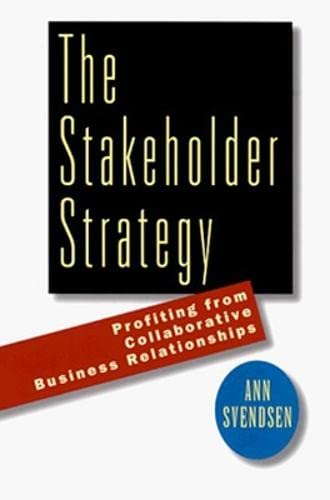
In The Stakeholder Strategy, sociologist Ann Svendsen presents an effective and practical step-by-step guide that companies can use to forge a network of powerful and profitable collaborative stakeholder relationships.
While some forward-thinking corporations have tried limited collaborative approaches-focusing on one stakeholder group at a time-few have taken a comprehensive and strategic approach to building relationships with all of their stakeholders, notes Svendsen. And, while considerable commitment to the idea of stakeholder collaboration exists, there is a lack of knowledge and understanding about how to develop these relationships. The Stakeholder Strategy is the first book to show business leaders and managers how to establish and maintain positive, mutually beneficial stakeholder relationships. Based on a synthesis of ideas from community relations, corporate philanthropy, stakeholder management, organizational change, sustainability, and the corporate social responsibility literature, it offers an integrated framework, as well as the practical tools for developing new kinds of collaborative relationships.
Svendsen uses easy-to-grasp concepts from everyday life, such as the process we go through in finding a mate or developing a long-term friendship, to illustrate these relationship-building strategies. She lays out the steps a company should take to create a collaboration-friendly organization: establishing a social mission, values, and ethical guidelines; assessing corporate readiness for collaboration; and making changes in communication, information and reward systems to support internal and external collaboration. Featuring case study examples from companies in North America and Europe who are working to build collaborative relationships with their stakeholders, The Stakeholder Strategy is the first book to provide a detailed explanation of how to conduct stakeholder audits and social audits so that companines can evaluate their relationship-building success and keep on track.
Die Inhaltsangabe kann sich auf eine andere Ausgabe dieses Titels beziehen.
Über die Autorin bzw. den Autor
Ann Svendsen is currently a senior partner with CoreRelation Consulting in Vancouver, Canada, where her clients include resource and utility companies, regional and provincial governments, and financial institutions. For the past twenty years, Svendsen has worked as a consulting sociologist, helping companies and government agencies identify, understand, and work effectively with their internal and external stakeholders. She is the author of The Stakeholder Strategy and has been an adjunct professor at Boston College Centre for Community Relations, Australia Centre for Corporate Citizenship and Simon Fraser University's Centre for Sustainable Community Development.
Auszug. © Genehmigter Nachdruck. Alle Rechte vorbehalten.
Why Build Collaborative Stakeholder Relationships?
To the extent the firm is able to recognize its interdependence, reflect upon the ethical standards appropriate to the situation, and react in a timely and responsive manner, it possesses a valuable, rare and nonsubstitutable strategic resource.
—Reginald Litz, 1996
Companies across North America are taking seriously the notion that as paradoxical as it seems, one way to succeed in a highly competitive globalized economy is to cooperate. In an economy where companies need to persuade investors to hold their stock, employees to work cooperatively with others, customers to buy a broader array of their products and services, and contractors to maintain strong supply chains, collaborative stakeholder relationships are key.
Every company, whether large or small, has a unique set of stakeholders—most often including investors, employees, customers, suppliers, and communities. The term “stakeholders” refers to individuals or groups who can affect or are affected by a corporation’s activities.
For most companies today, stakeholder relationships can have a significant impact on the bottom line. While companies could once manufacture an image and reputation through advertising and other media-based campaigns, in today’s networked world, reputation depends on establishing the trust of key stakeholders. The pursuit of financial success at the expense of employees, the environment, local communities, or workers in a subcontractor’s factory halfway around the globe is not only socially irresponsible but can result in shareholder losses rather than gains.2
A growing number of business leaders are acknowledging the power of long-term, positive stakeholder relationships. One such business leader is John Browne, CEO of British Petroleum. In a recent Harvard Business Review article (September/October 1997), he talked about the importance of building mutually beneficial stakeholder relationships. He said, “You can’t create an enduring business by viewing relationships as a bazaar activity—in which I try to get the best of you and you of me—or in which you pass off as much risk as you can to the other guy. Rather, we must view relationships as a coming together that allows us to do something no other two parties could do—something that makes the pie bigger and is to your advantage and to my advantage.”1
This is not to say that building stronger relationships with employees, customers, investors, suppliers, and communities is a panacea for all situations or all companies. Nor is building a network of reciprocal relationships simple. In most companies, competitive pressures keep all eyes focused on the short term, making it extremely difficult to bring long-term issues to the forefront. Traditional accounting systems based on financial measures of performance make it difficult to assess the impact of intangibles like relationships or reputation. And collaboration means letting go of control, which is always difficult for corporate managers schooled in the art of competition. However, despite these barriers, for many companies, stakeholder relationships do offer enormous untapped potential. For some, stakeholder relationships may even be a source of competitive advantage.
Stakeholder Collaboration versus Stakeholder Management
The theory of stakeholder management taught in most business schools today focuses on the mechanisms by which organizations understand and respond to the demands of their stakeholders. Theorists have argued that stakeholder relationships can be managed using techniques such as issue analysis, consultation, strategic communications, and formal contracts or agreements. Managers are seen as having the power to direct and control interactions between a corporation and its stakeholders.
The main purpose of stakeholder management is seen to be buffering the organization from the negative impacts of stakeholder activities. The job of a public affairs or community relations manager, for instance, is to anticipate how the company’s activities will affect public stakeholders and minimize negative reactions by instituting “damage control.”3
Within this more traditional perspective, responsibilities for various stakeholder groups are assigned to separate divisions. The marketing department deals with customer relations, the human resource department deals with employees, the public affairs department deals with the media, the community relations department deals with local organizations, and the purchasing department handles contracts with suppliers. The relationships that develop between managers and stakeholders are shaped by the interests and values of the department managers rather than by the corporation’s values and goals.
This “stakeholder management” approach has arisen out of the belief that corporations need to take steps to defend themselves from the demands of stakeholders. Part of the role of managers has been to act as a referee, deftly and diplomatically mediating between stakeholder demands and expectations in order to preserve goodwill toward the company, avoid public relations fiascoes, and maintain cost competitiveness.
Building Stakeholder Relationships
A collaborative approach to building stakeholder relationships, on the other hand, sees stakeholder relationships as being reciprocal, evolving, and mutually defined. The manager is not separate from the stakeholder relationship but is part of it. Thus the idea of “managing” relationships is not only untenable but is viewed as being counterproductive for both the corporation and its stakeholders in the long run.2
A collaborative model also assumes that stakeholder relationships can be a source of opportunity and competitive advantage. Relationships can increase an organization’s stability in a turbulent environment, enhance its control over changing circumstances, and expand its capacity rather than diminish it.
There are significant advantages to taking a more integrated, company-wide approach to identifying and building strategically important stakeholder relationships. In addition to increasing organizational effectiveness and consistency of response, this kind of holistic approach also allows an organization to build on the synergies that occur when positive relationships with one stakeholder group, such as a local community, start to have a beneficial impact on another stakeholder group, such as customers.4
This book presents an integrated strategy for building a network of collaborative stakeholder relationships based on a fundamental shift in management philosophy and attention. A singular focus on the needs and interests of stockholders is replaced by a focus on understanding and balancing the interests of all of a company’s key stakeholders. Through positive long-term relationships, companies identify “win-win-win” opportunities that serve the corporation as well as stakeholders and society.
The stakeholder strategy is based on the view that companies and society are interdependent. Therefore, business prosperity is linked to the well-being of local and global communities and all of a corporation’s other key stakeholders, including employees, suppliers, and the natural environment. Within this context, relationships with stakeholders are as essential to a company’s survival as air or water is to a human being’s survival.
A company’s relationship-building strategy is therefore seen as being inextricably linked to its mission, values, and goals. Given the strategic value assigned to the relationship-building function, employees are expected to act in concert with the corporation’s social mission and...
„Über diesen Titel“ kann sich auf eine andere Ausgabe dieses Titels beziehen.
Suchergebnisse für The Stakeholder Strategy: Profiting from Collaborative...

Beispielbild für diese ISBN
The Stakeholder Strategy: Profiting from Collaborative Business Relationships
Verlag:
Berrett-Koehler Publishers, 1998
ISBN 10: 1576750477
ISBN 13: 9781576750476
Gebraucht
Hardcover
Anbieter: World of Books (was SecondSale), Montgomery, IL, USA
Verkäuferbewertung 5 von 5 Sternen

Zustand: Good. Item in good condition and has highlighting/writing on text. Used texts may not contain supplemental items such as CDs, info-trac etc. Bestandsnummer des Verkäufers 00107286657
Gebraucht kaufen
EUR 4,01
Versand gratis
Versand innerhalb von USA
Versand innerhalb von USA
Anzahl: 1 verfügbar
Beispielbild für diese ISBN
The Stakeholder Strategy: Profiting from Collaborative Business Relationships
Verlag:
Berrett-Koehler Publishers, 1998
ISBN 10: 1576750477
ISBN 13: 9781576750476
Gebraucht
Hardcover
Anbieter: World of Books (was SecondSale), Montgomery, IL, USA
Verkäuferbewertung 5 von 5 Sternen
Zustand: Very Good. Item in very good condition! Textbooks may not include supplemental items i.e. CDs, access codes etc. Bestandsnummer des Verkäufers 00088315533
Gebraucht kaufen
EUR 4,01
Versand gratis
Versand innerhalb von USA
Versand innerhalb von USA
Anzahl: 1 verfügbar
Foto des Verkäufers
The Stakeholder Strategy: Profiting from Collaborative Business Relationships
Verlag:
Berrett-Koehler Publishers, 1998
ISBN 10: 1576750477
ISBN 13: 9781576750476
Gebraucht
Hardcover
Anbieter: Zoom Books Company, Lynden, WA, USA
Verkäuferbewertung 5 von 5 Sternen
Zustand: very_good. Book is in very good condition and may include minimal underlining highlighting. The book can also include "From the library of" labels. May not contain miscellaneous items toys, dvds, etc. . We offer 100% money back guarantee and 24 7 customer service. Bestandsnummer des Verkäufers ZBV.1576750477.VG
Gebraucht kaufen
EUR 4,02
Versand gratis
Versand innerhalb von USA
Versand innerhalb von USA
Anzahl: 1 verfügbar
Beispielbild für diese ISBN
The Stakeholder Strategy : Profiting from Collaborative Business Relationships
Verlag:
Berrett-Koehler Publishers, Incorporated, 1998
ISBN 10: 1576750477
ISBN 13: 9781576750476
Gebraucht
Hardcover
Anbieter: Better World Books, Mishawaka, IN, USA
Verkäuferbewertung 5 von 5 Sternen
Zustand: Good. Former library copy. Pages intact with minimal writing/highlighting. The binding may be loose and creased. Dust jackets/supplements are not included. Includes library markings. Stock photo provided. Product includes identifying sticker. Better World Books: Buy Books. Do Good. Bestandsnummer des Verkäufers GRP77136612
Gebraucht kaufen
EUR 6,67
Versand gratis
Versand innerhalb von USA
Versand innerhalb von USA
Anzahl: 1 verfügbar
Beispielbild für diese ISBN
The Stakeholder Strategy : Profiting from Collaborative Business Relationships
Verlag:
Berrett-Koehler Publishers, Incorporated, 1998
ISBN 10: 1576750477
ISBN 13: 9781576750476
Gebraucht
Hardcover
Anbieter: Better World Books, Mishawaka, IN, USA
Verkäuferbewertung 5 von 5 Sternen
Zustand: Very Good. Pages intact with possible writing/highlighting. Binding strong with minor wear. Dust jackets/supplements may not be included. Stock photo provided. Product includes identifying sticker. Better World Books: Buy Books. Do Good. Bestandsnummer des Verkäufers 7896899-6
Gebraucht kaufen
EUR 6,67
Versand gratis
Versand innerhalb von USA
Versand innerhalb von USA
Anzahl: 1 verfügbar
Beispielbild für diese ISBN
The Stakeholder Strategy : Profiting from Collaborative Business Relationships
Verlag:
Berrett-Koehler Publishers, Incorporated, 1998
ISBN 10: 1576750477
ISBN 13: 9781576750476
Gebraucht
Hardcover
Anbieter: Better World Books, Mishawaka, IN, USA
Verkäuferbewertung 5 von 5 Sternen
Zustand: Good. Pages intact with minimal writing/highlighting. The binding may be loose and creased. Dust jackets/supplements are not included. Stock photo provided. Product includes identifying sticker. Better World Books: Buy Books. Do Good. Bestandsnummer des Verkäufers 9446025-75
Gebraucht kaufen
EUR 6,67
Versand gratis
Versand innerhalb von USA
Versand innerhalb von USA
Anzahl: 1 verfügbar
Beispielbild für diese ISBN
The Stakeholder Strategy: Profiting from Collaborative Business Relationships
Verlag:
Berrett-Koehler Publishers, 1998
ISBN 10: 1576750477
ISBN 13: 9781576750476
Gebraucht
Hardcover
Anbieter: ThriftBooks-Atlanta, AUSTELL, GA, USA
Verkäuferbewertung 5 von 5 Sternen
Hardcover. Zustand: As New. No Jacket. Pages are clean and are not marred by notes or folds of any kind. ~ ThriftBooks: Read More, Spend Less. Bestandsnummer des Verkäufers G1576750477I2N00
Gebraucht kaufen
EUR 11,85
Versand gratis
Versand innerhalb von USA
Versand innerhalb von USA
Anzahl: 1 verfügbar
Beispielbild für diese ISBN
The Stakeholder Strategy: Profiting from Collaborative Business Relationships (AGENCY/DISTRIBUTED)
Verlag:
Berrett-Koehler Publishers, 1998
ISBN 10: 1576750477
ISBN 13: 9781576750476
Gebraucht
Hardcover
Anbieter: WorldofBooks, Goring-By-Sea, WS, Vereinigtes Königreich
Verkäuferbewertung 5 von 5 Sternen
Hardback. Zustand: Very Good. The book has been read, but is in excellent condition. Pages are intact and not marred by notes or highlighting. The spine remains undamaged. Bestandsnummer des Verkäufers GOR004939444
Gebraucht kaufen
EUR 7,38
EUR 6,56 Versand
Versand von Vereinigtes Königreich nach USA
Versand von Vereinigtes Königreich nach USA
Anzahl: 1 verfügbar
Beispielbild für diese ISBN
STAKEHOLDER STRATEGY (cl)
Anbieter: INDOO, Avenel, NJ, USA
Verkäuferbewertung 5 von 5 Sternen
Zustand: As New. Unread copy in mint condition. Bestandsnummer des Verkäufers RH9781576750476
Gebraucht kaufen
EUR 21,87
Versand gratis
Versand innerhalb von USA
Versand innerhalb von USA
Anzahl: Mehr als 20 verfügbar
Beispielbild für diese ISBN
STAKEHOLDER STRATEGY (cl)
Anbieter: INDOO, Avenel, NJ, USA
Verkäuferbewertung 5 von 5 Sternen
Zustand: New. Bestandsnummer des Verkäufers 9781576750476
Neu kaufen
EUR 21,92
Versand gratis
Versand innerhalb von USA
Versand innerhalb von USA
Anzahl: Mehr als 20 verfügbar