
Verwandte Artikel zu Future Search: An Action Guide to Finding Common Ground...
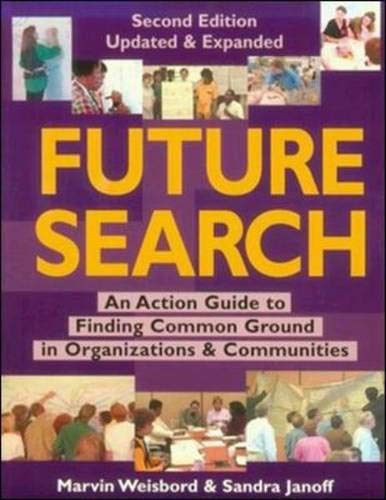
Future Search: An Action Guide to Finding Common Ground in Organizations and Communities - Softcover
Inhaltsangabe
This book explains how future search conferences -- where people with a stake in an organization gather to generate creative strategies -- can be most effective.
Die Inhaltsangabe kann sich auf eine andere Ausgabe dieses Titels beziehen.
Über die Autorin bzw. den Autor
Marvin Weisbord, an international consultant for more than forty years, is the author of Organizational Diagnosis and Productive Workplaces Revisited and editor and coauthor of Discovering Common Ground.
Sandra Janoff, consultant and psychologist, works with Fortune 500 companies, small businesses, communities, and nonprofits on whole systems transformation.
Auszug. © Genehmigter Nachdruck. Alle Rechte vorbehalten.
Introduction
First let us summarize 30 years of experience. The major Benefit of Future Search is transforming a system’s capability for action. You can do that in a few days when you observe our principles. We believe we can save you considerable trial and error if you take advantage of our experience. A bit of management history may help you appreciate why Future Search came into being.
Productive Workplaces (Weisbord, 1987) described how planning methods evolved on two axes: the “who,” from experts to everybody; and the “what,” from problem-solving to whole-systems improvement. A century ago, as the industrial revolution picked up steam, expert problem-solving (e.g., “scientific management”) became the gold standard, surviving to this day as a tarnished relic. after group dynamics was discovered, many adopted participative management when they found how hard it was to implement an expert’s solutions. When “systems thinking” hit the work world in the 1960s, experts rose to new heights, solving—on paper—whole systems of problems at once. By the 1980s it became clear that for progress in a speeded-up world of increasing diversity, nothing less would do than “getting everybody improving whole systems.” This became a central tenet of what people now call “large-group interventions” (see “Learning Curve”).
Productive Workplaces proposed that only “everybody improving whole systems” would prove satisfying in a fast-changing world—satisfying, that is, if you believe that economic results need not be compromised to achieve dignity, meaning, and community. For us Future Search is a learning laboratory for “getting everybody improving whole systems.” The enthusiastic response to this concept—letters, phone calls, requests for help—led to Discovering Common Ground (Weisbord et al., 1992), a work that sought to uncover the principles and the practices common to Effective large-group planning.
Planning methods have evolved on two axes: the “who,” from experts to everybody; and the “what,” from problem-solving to whole-systems improvement.
From Productive Workplaces Revisited (Weisbord, 2004). Used by permission.
We wrote the first detailed description of the FS method in the 1995 edition of this book. In the 2000 edition, we presented the evolving FS model, our experiments with tasks and techniques, and examples from many cultures, where, contrary to conventional wisdom, people were able to get long-lasting action from a single meeting. We also provided a philosophical rationale for “hands-off” facilitating, later elaborated in Don’t Just Do Something, Stand There! (Weisbord and Janoff, 2007).
Changes to the Third Edition
This Third Edition, based on input from dozens of FSN members, contains 10 new chapters and five chapters rewritten to reflect new learning. We now tell the FS story with greater confidence, more-diverse examples, and clear-eyed comments from pioneers in cultures everywhere.
Specifically, we have revised the text in the following ways:
Updated the design with subtle refinements that simplify the flow and improve the output (Chapter 5 and Appendix A)
Added new cases based on our own and colleagues’ recent experiences in diverse cultures and sectors (Chapter 1)
Documented the “ripple Effect” of Future Search by showing results sustained in various sectors over many years (Chapter 2)
Offered specific guidance for FS sponsors, steering committees, participants, funders, and facilitators (Chapter 6)
Noted several examples of the economic Benefits of Future Search (Chapter 7)
Added more advice on planning and the use of virtual technologies (Chapters 8 and 9)
Preserved the emphasis on our core philosophy and theory of facilitating (Chapters 10 and 11)
Described FS variations and integration with other methods (Chapter 12)
Incorporated many more examples of how to sustain action with effective follow-up (Chapter 13)
Interviewed leaders around the world to discover what Future Search means to them (Chapter 14)
Surveyed research and evaluation studies for formal evidence of what works (Chapter 15)
Introduced provocative thoughts on why Future Search has crossed so many cultural boundaries (Epilogue)
What Makes Future Search Different?
Future Searches enable organizations and communities to learn more together than any one person can discover alone. Bringing the “whole system into the room” makes feasible a shared encounter with complexity and uncertainty leading to clarity, hope, and action. The key word is shared. When we explore common ground with others, we release creative energy, leading to projects that all value and none can do alone.
Future Search, even three days’ worth, is time efficient. People need not master abstract concepts to do good planning. They need only show up and use the skills, experience, and motivation they already have. We are seeking what people already want to do and never dreamed they could. Rarely do people encounter these key conditions for action all at once. Every meeting thereafter becomes more productive.
When to Hold a Future Search
People use Future Search for three main purposes:
To create a shared vision and action plan for an organization, network, or community
To enable all stakeholders to act on common ground and take responsibility for their own plans
To help people implement an existing vision that they have not acted on together
A Short Overview
The FS design depends on sticking to a set of reliable “conditions for success.” These start with four core principles that are the focus of Chapters 3 and 4:
“Whole system in the room”
Global context for local action
Focus on future and common ground, not problems and conflicts
Self-management and responsibility for action
We advocate full attendance, healthy meeting conditions, working across three days instead of doing it all in two, and public commitments for follow-up.
Participant Terminology
We use the following terms to describe parties involved in Future Searches:
Sponsors: those from an organization, community, or coalition who initiate a Future Search
Steering committee (or planning group): those selected by a sponsor to help frame the task, select the stakeholders, manage the logistics, and plan for follow-up
Stakeholders: participants from diverse backgrounds considered by sponsors to be essential to the success of the Future Search
Funders: those who invest in projects and programs related to the purpose of the Future Search
Facilitators (also FS managers or consultants): experienced professionals who plan and manage Future Searches in collaboration with sponsors.
Structure
A Future Search typically involves 60 to 100 people who share a common purpose. We do five activities of two to four hours each, 16 to 20 hours in total, spread over three days: review the past, explore the present, create desired future scenarios, discover common ground, and make action plans.
Mixed groups—each a cross-section of the whole—work on the past and the future. Stakeholder groups whose members have a shared perspective work together on the present. Everybody validates the common ground. Action planning employs both stakeholder and...
„Über diesen Titel“ kann sich auf eine andere Ausgabe dieses Titels beziehen.
Suchergebnisse für Future Search: An Action Guide to Finding Common Ground...

Beispielbild für diese ISBN
Future Search
Verlag:
Berrett-Koehler Publishers, 2000
ISBN 10: 1576750817
ISBN 13: 9781576750810
Gebraucht
Softcover
Anbieter: World of Books (was SecondSale), Montgomery, IL, USA
Verkäuferbewertung 5 von 5 Sternen

Zustand: Good. Item in good condition. Textbooks may not include supplemental items i.e. CDs, access codes etc. Bestandsnummer des Verkäufers 00106979498
Gebraucht kaufen
EUR 3,41
Versand gratis
Versand innerhalb von USA
Versand innerhalb von USA
Anzahl: 2 verfügbar
Foto des Verkäufers
Future Search
Verlag:
Berrett-Koehler Publishers, 2000
ISBN 10: 1576750817
ISBN 13: 9781576750810
Gebraucht
Softcover
Anbieter: Greenworld Books, Arlington, TX, USA
Verkäuferbewertung 5 von 5 Sternen
Zustand: very_good. Fast Free Shipping â" Very Good condition book with a firm cover and clean pages. Shows normal use and some light wear or limited notes markings. A solid, nice copy to enjoy. Bestandsnummer des Verkäufers GWV.1576750817.VG
Gebraucht kaufen
EUR 4,64
Versand gratis
Versand innerhalb von USA
Versand innerhalb von USA
Anzahl: 1 verfügbar
Beispielbild für diese ISBN
Future Search
Verlag:
Berrett-Koehler Publishers (edition Subsequent), 2000
ISBN 10: 1576750817
ISBN 13: 9781576750810
Gebraucht
Paperback
Anbieter: BooksRun, Philadelphia, PA, USA
Verkäuferbewertung 5 von 5 Sternen
Paperback. Zustand: Very Good. Subsequent. It's a well-cared-for item that has seen limited use. The item may show minor signs of wear. All the text is legible, with all pages included. It may have slight markings and/or highlighting. Bestandsnummer des Verkäufers 1576750817-11-1
Gebraucht kaufen
EUR 4,88
Versand gratis
Versand innerhalb von USA
Versand innerhalb von USA
Anzahl: 1 verfügbar
Beispielbild für diese ISBN
Future Search
Verlag:
Berrett-Koehler Publishers, 2000
ISBN 10: 1576750817
ISBN 13: 9781576750810
Gebraucht
Paperback
Anbieter: ThriftBooks-Atlanta, AUSTELL, GA, USA
Verkäuferbewertung 5 von 5 Sternen
Paperback. Zustand: Very Good. No Jacket. May have limited writing in cover pages. Pages are unmarked. ~ ThriftBooks: Read More, Spend Less. Bestandsnummer des Verkäufers G1576750817I4N00
Gebraucht kaufen
EUR 5,99
Versand gratis
Versand innerhalb von USA
Versand innerhalb von USA
Anzahl: 1 verfügbar
Foto des Verkäufers
Future Search
Verlag:
Berrett-Koehler Publishers, 2000
ISBN 10: 1576750817
ISBN 13: 9781576750810
Gebraucht
Softcover
Anbieter: -OnTimeBooks-, Phoenix, AZ, USA
Verkäuferbewertung 5 von 5 Sternen
Zustand: very_good. Gently read. May have name of previous ownership, or ex-library edition. Binding tight; spine straight and smooth, with no creasing; covers clean and crisp. Minimal signs of handling or shelving. 100% GUARANTEE! Shipped with delivery confirmation, if you're not satisfied with purchase please return item! Ships USPS Media Mail. Bestandsnummer des Verkäufers OTV.1576750817.VG
Gebraucht kaufen
EUR 6,19
Versand gratis
Versand innerhalb von USA
Versand innerhalb von USA
Anzahl: 1 verfügbar
Beispielbild für diese ISBN
Future Search
Verlag:
Berrett-Koehler Publishers, 2000
ISBN 10: 1576750817
ISBN 13: 9781576750810
Gebraucht
Softcover
Anbieter: Wonder Book, Frederick, MD, USA
Verkäuferbewertung 5 von 5 Sternen
Zustand: Very Good. Very Good condition. 2nd edition. A copy that may have a few cosmetic defects. May also contain light spine creasing or a few markings such as an owner's name, short gifter's inscription or light stamp. Bestandsnummer des Verkäufers K06W-00745
Gebraucht kaufen
EUR 6,32
Versand gratis
Versand innerhalb von USA
Versand innerhalb von USA
Anzahl: 1 verfügbar
Beispielbild für diese ISBN
Future Search : An Action Guide to Finding Common Ground in Organizations and Communities
Verlag:
Berrett-Koehler Publishers, Incorporated, 2000
ISBN 10: 1576750817
ISBN 13: 9781576750810
Gebraucht
Softcover
Anbieter: Better World Books, Mishawaka, IN, USA
Verkäuferbewertung 5 von 5 Sternen
Zustand: Good. 2nd. Pages intact with minimal writing/highlighting. The binding may be loose and creased. Dust jackets/supplements are not included. Stock photo provided. Product includes identifying sticker. Better World Books: Buy Books. Do Good. Bestandsnummer des Verkäufers 8174866-6
Gebraucht kaufen
EUR 6,46
Versand gratis
Versand innerhalb von USA
Versand innerhalb von USA
Anzahl: 2 verfügbar
Beispielbild für diese ISBN
Future Search
Verlag:
Berrett-Koehler Publishers, 2000
ISBN 10: 1576750817
ISBN 13: 9781576750810
Gebraucht
Paperback
Anbieter: Midtown Scholar Bookstore, Harrisburg, PA, USA
Verkäuferbewertung 5 von 5 Sternen
Paperback. Zustand: Acceptable. Writing/underlining. Acceptable - This is a significantly damaged book. It should be considered a reading copy only. Please order this book only if you are interested in the content and not the condition. May be ex-library. Standard-sized. Bestandsnummer des Verkäufers M1576750817Z4
Gebraucht kaufen
EUR 2,39
EUR 5,27 Versand
Versand innerhalb von USA
Versand innerhalb von USA
Anzahl: 1 verfügbar
Beispielbild für diese ISBN
Future Search: An Action Guide to Finding Common Ground in Organizations and Communities
Anbieter: AwesomeBooks, Wallingford, Vereinigtes Königreich
Verkäuferbewertung 5 von 5 Sternen
Paperback. Zustand: Very Good. Future Search: An Action Guide to Finding Common Ground in Organizations and Communities This book is in very good condition and will be shipped within 24 hours of ordering. The cover may have some limited signs of wear but the pages are clean, intact and the spine remains undamaged. This book has clearly been well maintained and looked after thus far. Money back guarantee if you are not satisfied. See all our books here, order more than 1 book and get discounted shipping. Bestandsnummer des Verkäufers 7719-9781576750810
Gebraucht kaufen
EUR 4,37
EUR 4,79 Versand
Versand von Vereinigtes Königreich nach USA
Versand von Vereinigtes Königreich nach USA
Anzahl: 2 verfügbar
Beispielbild für diese ISBN
Future Search
Verlag:
Berrett-Koehler Publishers, 2000
ISBN 10: 1576750817
ISBN 13: 9781576750810
Gebraucht
paperback
Anbieter: HPB-Emerald, Dallas, TX, USA
Verkäuferbewertung 5 von 5 Sternen
paperback. Zustand: Very Good. Connecting readers with great books since 1972! Used books may not include companion materials, and may have some shelf wear or limited writing. We ship orders daily and Customer Service is our top priority! Bestandsnummer des Verkäufers S_430946535
Gebraucht kaufen
EUR 6,33
EUR 3,29 Versand
Versand innerhalb von USA
Versand innerhalb von USA
Anzahl: 1 verfügbar