
Verwandte Artikel zu Action Inquiry: The Secret of Timely and Transforming...
Inhaltsangabe
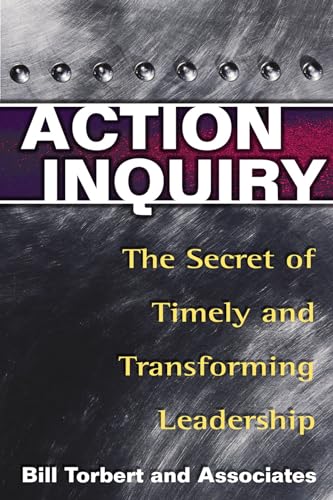
A fresh approach to learning leadership in the midst of action. This highly accessible process takes each of us beyond muddling through daily dilemmas to exercising transforming power at key moments and more timely action in general.
Bill Torbert and Associates lead you through more and more sophisticated “action-logics”—strategies for analyzing the world and reacting to it—until you can practice action inquiry continually.
Speaking to everyone from new managers to CEOs to world leaders, real-life stories of leadership and organizational transformations show how action inquiry increases personal integrity, relational mutuality, company profitability, and long-term organizational and environmental sustainability.
Die Inhaltsangabe kann sich auf eine andere Ausgabe dieses Titels beziehen.
Über die Autorin bzw. den Autor
Bill Torbert is professor of management at the Carroll School of Management at Boston College, former graduate dean and director of the Ph.D. Program in organizational transformation and a consultant to such organizations as Gillette, Pricewaterhouse-Coopers, Volvo, Lego, Pilgrim Health Care, Danforth Foundation, and the National Security Agency, He is the author of numerous books, including Learning from Experience and Managing the Corporate Dream.
Dalmar Fisher teaches organizational communication, interpersonal effectiveness, and teambuilding at Boston College. His research and writing is aimed at improving managers’ interpersonal skills. Books he has authored and coauthored include Communication in Organizations, Autonomy in Organizational Life, and Personal and Organizational Transformations through Action Inquiry. He has long enjoyed running, from the 400-meter race at Northwestern to marathons with the 60+ age group to more leisurely jogging in recent years. After both running at and graduating from Northwestern, he received an MBA from Boston College and a DBA from Harvard Business School. His wife of 33 years is Laura; children are Deirdre, Nathaniel, and Naomi; and grandchildren are Sarah, Caitlin, and Ocean.
Auszug. © Genehmigter Nachdruck. Alle Rechte vorbehalten.
ONE
Fundamentals of Action Inquiry
By “action inquiry,” we mean a kind of behavior that is simultaneously productive and self-assessing. Action inquiry is behavior that does several things at once. It listens into the developing situation. It accomplishes whatever tasks appear to have priority. And it invites a revisioning of the task (and of our own action!) if necessary. Action inquiry is always a timely discipline to exercise because its purpose is always in part to discover, whether coldly and precisely or warmly and stumblingly, what action is timely.
These sentences are easy enough to read and to write, and they make action inquiry seem obviously worthwhile. When don’t you want to act in a timely fashion? Yet action inquiry is also the hardest thing in the world to do on a continuing basis (at least so it feels to some of us who’ve been working and playing with it for three or four decades). The difficulty arises partly because of the unusual degrees of awareness of the present situation that high quality action inquiry requires. The difficulty arises partly because of the many different and potentially conflicting political pressures and standards of timeliness that may be at play in a given situation. And the difficulty arises partly because of how hard it is to develop a taste for making ourselves vulnerable to change at the very moment when we are also trying to get something done.
A small example of action inquiry may seem ridiculously simple. Here is a company president speaking by phone to her special assistant:
“I’m assuming you are handling the Jones contract. Let me know if you need assistance.”
The president makes her assumption explicit and advocates that the special assistant seek her support, if necessary, to assure the job gets done. The assistant may say, “What? I’ve never heard of the Jones contract.” Or, “I thought Paul was taking care of that.” Or whatever the truth is, if it is incongruent with the president’s explicitly stated assumption and offer of assistance. Many of the day-to-day frustrations of work life can be avoided by such brief assumption-testing action inquiries.14
But even such obvious types of checking and inquiry as this president displays are rare in business, professional, and familial conversations. Consider the recent simulated operating room study of medical residents receiving training on how to avoid errors (Rudolph 2003). This study shows that in over 4,000 comments by the lead physician during simulated operating crises, only three combined some direction about what to attend to with an inquiry about what the assistant was learning. This small number occurred in spite of the fact that half of these young doctors were trained in a specific method for inquiring in the midst of action only minutes before the simulation. Yet their much more deeply internalized need to appear independent, competent, and knowledgeable interfered with showing the vulnerability necessary to learn the data that can prevent error (as a number of them acknowledged in postscenario interviews).
A shift in awareness is needed, a shift to a kind of awareness that shows us the opportunity to make a comment like the president’s. This kind of awareness transcends the sort of implicit self-image that prevents medical residents from seeking colleagues’ help in the operating room and instead attends responsively to the real need both the patient and we have for help. What is this awareness? How can we gain access to it in a timely way?
The Underwater Pipeline Project Manager
For some clues, let’s listen in as Steve Thompson, a highly competent and well-paid manager, reconstructs a confrontation with his boss, Ron Cedrick. Steve’s team is laying underwater pipeline when a storm begins to blow around their North Sea platform.
British National Oil Company had contracted with Ron Cedrick to construct and install its “single anchor leg mooring system” that can fill oil tankers at sea, eliminating the need for hundreds of miles of pipeline from the offshore oil fields. The initial underwater construction had been completed in a picturesque and protected Norwegian fjord. But we were now saturation diving for 8- to 12-hour periods from aboard a 600-foot derrick ship in the February North Sea, which can be unpredictably violent.15
The most critical part of this dangerous procedure is the launch and recovery of the six-man bell through the “interface”—the wave-affected first 25 feet below the ocean surface. Rough seas have separated more than one diving bell from its winch. When this happens, there is little hope of returning the divers alive.
It was my first job as project manager, so it was of particular importance to me that the crew was doing an outstanding job and Cedrick was extremely pleased with our performance. Famously aloof, Cedrick wore a shiny gold metal hard hat. And, no matter how difficult, his projects always came in ahead of schedule.
The bell had just gone into the water for an anticipated 12-hour run when the wind changed direction and was coming at us from the same direction as the moderate swell, just as it does before it really blows. I alerted the shift supervisor to keep an eye on the weather and went up to the bridge for a look at the most recent forecast and facsimile, which confirmed my suspicions.
Just then, Cedrick came up to me, “I personally appreciate the fine job you and your boys are doing and I know it’ll continue. I know the weather’s getting up a bit, but we have to complete the flowline connection today to stay ahead, so we need to keep that bell in the water as long as we can before we let a little ole weather shut us down. I’ve seen the respect those boys have for you and I know they’ll do what you ask.”
“Yes, sir” I responded confidently. What was going on inside me at that moment sounded different, though. The moment I reviewed the weather on the bridge, I became tense with fear. I was afraid I wouldn’t have the strength of character to shut down the operation in the face of my overwhelming desire to succeed objectively and in Cedrick’s eyes. I was also afraid I would have to deceive my people into thinking that pushing our operating limits was justified.
The outcome was all too predictable. I kept the bell in the water too long. The weather blew a gale. The recovery of the bell through 20-foot seas was perilous. I compromised the safety of the divers and set a poor precedent for the permissible operating parameters. I received no satisfaction from the major bonus Cedrick gave me for “pulling it off”—we did complete the flowline connection. Inside me, the awareness that I had manipulated and jeopardized the safety of my fellow workers galled my illusion that I was an honest, ethical man.16
After the emergency was over and the mission successfully accomplished, Steve Thompson could simply have congratulated himself for getting the job done in the face of significant obstacles and for winning the praise of his superior. Instead, his awareness was alert and vulnerable in a way that revealed a serious weakness of character to him that few have the strength of character to face. He became aware of a serious incongruity between his espoused or proclaimed values and his actual actions.
We were led into the Steve Thompson story by two questions about the kind of awareness associated with action inquiry. What is this kind of awareness that transcends all our implicit self-images that cramp awareness and prevent us from acting with integrity, mutuality, justice, and inquiry? And how can this kind of awareness be...
„Über diesen Titel“ kann sich auf eine andere Ausgabe dieses Titels beziehen.
Suchergebnisse für Action Inquiry: The Secret of Timely and Transforming...

Foto des Verkäufers
Action Inquiry: The Secret of Timely and Transforming Leadership
Verlag:
Berrett-Koehler Publishers, 2004
ISBN 10: 157675264X
ISBN 13: 9781576752647
Gebraucht
Softcover
Anbieter: Zoom Books East, Glendale Heights, IL, USA
Verkäuferbewertung 5 von 5 Sternen

Zustand: good. Book is in good condition and may include underlining highlighting and minimal wear. The book can also include "From the library of" labels. May not contain miscellaneous items toys, dvds, etc. . We offer 100% money back guarantee and 24 7 customer service. Bestandsnummer des Verkäufers ZEV.157675264X.G
Gebraucht kaufen
EUR 5,18
Versand gratis
Versand innerhalb von USA
Versand innerhalb von USA
Anzahl: 1 verfügbar
Beispielbild für diese ISBN
Action Inquiry: The Secret of Timely and Transforming Leadership
Verlag:
Berrett-Koehler Publishers, 2004
ISBN 10: 157675264X
ISBN 13: 9781576752647
Gebraucht
Softcover
Anbieter: World of Books (was SecondSale), Montgomery, IL, USA
Verkäuferbewertung 5 von 5 Sternen
Zustand: Good. Item in good condition. Textbooks may not include supplemental items i.e. CDs, access codes etc. Bestandsnummer des Verkäufers 00097801642
Gebraucht kaufen
EUR 5,49
Versand gratis
Versand innerhalb von USA
Versand innerhalb von USA
Anzahl: 5 verfügbar
Foto des Verkäufers
Action Inquiry: The Secret of Timely and Transforming Leadership
Verlag:
Berrett-Koehler Publishers, 2004
ISBN 10: 157675264X
ISBN 13: 9781576752647
Gebraucht
Softcover
Anbieter: Dream Books Co., Denver, CO, USA
Verkäuferbewertung 5 von 5 Sternen
Zustand: acceptable. This copy has clearly been enjoyedâ"expect noticeable shelf wear and some minor creases to the cover. Binding is strong, and all pages are legible. May contain previous library markings or stamps. Bestandsnummer des Verkäufers DBV.157675264X.A
Gebraucht kaufen
EUR 5,79
Versand gratis
Versand innerhalb von USA
Versand innerhalb von USA
Anzahl: 1 verfügbar
Beispielbild für diese ISBN
Action Inquiry: The Secret of Timely and Transforming Leadership
Verlag:
Berrett-Koehler Publishers (edition Illustrated), 2004
ISBN 10: 157675264X
ISBN 13: 9781576752647
Gebraucht
Paperback
Anbieter: BooksRun, Philadelphia, PA, USA
Verkäuferbewertung 5 von 5 Sternen
Paperback. Zustand: Very Good. Illustrated. It's a well-cared-for item that has seen limited use. The item may show minor signs of wear. All the text is legible, with all pages included. It may have slight markings and/or highlighting. Bestandsnummer des Verkäufers 157675264X-11-1
Gebraucht kaufen
EUR 5,83
Versand gratis
Versand innerhalb von USA
Versand innerhalb von USA
Anzahl: 1 verfügbar
Beispielbild für diese ISBN
Action Inquiry: The Secret of Timely and Transforming Leadership
Verlag:
Berrett-Koehler Publishers, 2004
ISBN 10: 157675264X
ISBN 13: 9781576752647
Gebraucht
Paperback
Anbieter: HPB Inc., Dallas, TX, USA
Verkäuferbewertung 5 von 5 Sternen
Paperback. Zustand: Very Good. Connecting readers with great books since 1972! Used books may not include companion materials, and may have some shelf wear or limited writing. We ship orders daily and Customer Service is our top priority! Bestandsnummer des Verkäufers S_475855733
Gebraucht kaufen
EUR 2,73
EUR 3,28 Versand
Versand innerhalb von USA
Versand innerhalb von USA
Anzahl: 1 verfügbar
Beispielbild für diese ISBN
Action Inquiry : The Secret of Timely and Transforming Leadership
Verlag:
Berrett-Koehler Publishers, Incorporated, 2004
ISBN 10: 157675264X
ISBN 13: 9781576752647
Gebraucht
Softcover
Anbieter: Better World Books: West, Reno, NV, USA
Verkäuferbewertung 5 von 5 Sternen
Zustand: Very Good. Former library copy. Pages intact with possible writing/highlighting. Binding strong with minor wear. Dust jackets/supplements may not be included. Includes library markings. Stock photo provided. Product includes identifying sticker. Better World Books: Buy Books. Do Good. Bestandsnummer des Verkäufers 8711674-6
Gebraucht kaufen
EUR 6,05
Versand gratis
Versand innerhalb von USA
Versand innerhalb von USA
Anzahl: 1 verfügbar
Beispielbild für diese ISBN
Action Inquiry : The Secret of Timely and Transforming Leadership
Verlag:
Berrett-Koehler Publishers, Incorporated, 2004
ISBN 10: 157675264X
ISBN 13: 9781576752647
Gebraucht
Softcover
Anbieter: Better World Books, Mishawaka, IN, USA
Verkäuferbewertung 5 von 5 Sternen
Zustand: Good. Pages intact with minimal writing/highlighting. The binding may be loose and creased. Dust jackets/supplements are not included. Stock photo provided. Product includes identifying sticker. Better World Books: Buy Books. Do Good. Bestandsnummer des Verkäufers 4549835-6
Gebraucht kaufen
EUR 6,05
Versand gratis
Versand innerhalb von USA
Versand innerhalb von USA
Anzahl: 1 verfügbar
Beispielbild für diese ISBN
Action Inquiry: The Secret of Timely and Transforming Leadership
Verlag:
Berrett-Koehler Publishers, 2004
ISBN 10: 157675264X
ISBN 13: 9781576752647
Gebraucht
Paperback
Anbieter: HPB-Diamond, Dallas, TX, USA
Verkäuferbewertung 5 von 5 Sternen
Paperback. Zustand: Very Good. Connecting readers with great books since 1972! Used books may not include companion materials, and may have some shelf wear or limited writing. We ship orders daily and Customer Service is our top priority! Bestandsnummer des Verkäufers S_470126171
Gebraucht kaufen
EUR 3,50
EUR 3,28 Versand
Versand innerhalb von USA
Versand innerhalb von USA
Anzahl: 1 verfügbar
Beispielbild für diese ISBN
Action Inquiry: The Secret of Timely and Transforming Leadership
Verlag:
Berrett-Koehler Publishers, 2004
ISBN 10: 157675264X
ISBN 13: 9781576752647
Gebraucht
Paperback
Anbieter: HPB-Emerald, Dallas, TX, USA
Verkäuferbewertung 5 von 5 Sternen
Paperback. Zustand: Very Good. Connecting readers with great books since 1972! Used books may not include companion materials, and may have some shelf wear or limited writing. We ship orders daily and Customer Service is our top priority! Bestandsnummer des Verkäufers S_483153588
Gebraucht kaufen
EUR 3,59
EUR 3,28 Versand
Versand innerhalb von USA
Versand innerhalb von USA
Anzahl: 1 verfügbar
Beispielbild für diese ISBN
Action Inquiry: The Secret of Timely and Transforming Leadership
Verlag:
Berrett-Koehler Publishers, 2004
ISBN 10: 157675264X
ISBN 13: 9781576752647
Gebraucht
Paperback
Anbieter: ThriftBooks-Reno, Reno, NV, USA
Verkäuferbewertung 5 von 5 Sternen
Paperback. Zustand: Good. No Jacket. Pages can have notes/highlighting. Spine may show signs of wear. ~ ThriftBooks: Read More, Spend Less. Bestandsnummer des Verkäufers G157675264XI3N00
Gebraucht kaufen
EUR 7,08
Versand gratis
Versand innerhalb von USA
Versand innerhalb von USA
Anzahl: 1 verfügbar