
Verwandte Artikel zu Cracking the Code: How to Win Hearts, Change Minds,...
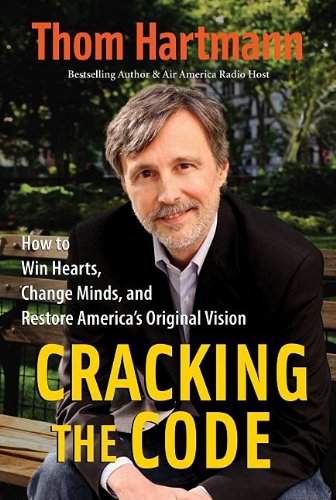
Cracking the Code: How to Win Hearts, Change Minds, and Restore America's Original Vision - Hardcover
Inhaltsangabe
Millions of working Americans talk, act, and vote as if their economic interests match those of the megawealthy, the multinational corporations, and the politicians who do their bidding. How did this happen? Bestselling author Thom Hartmann says it’s because the apologists of the Right have become masters of the subtle and largely subconscious aspects of political communication. It’s not an escalation in Iraq, it’s a surge; it’s not the inheritance tax, it’s the death tax; it’s not drilling for oil, it’s exploring for energy.
Conservatives didn’t intuit the path to persuasive messaging—they learned these techniques. There is no reason why progressives can’t learn them too. In Cracking the Code, Hartmann shows you how. Drawing on his background as a psychotherapist and advertising executive as well as a nationally syndicated Air America radio host, he breaks down the science and technology of effective communication so you can apply it to your own efforts to counter right-wing disinformation.
As Hartmann explains, political persuasion is as much about biology as ideology, about knowing how the brain processes information and how that influences the way people perceive messages, make decisions, and form a worldview. Throughout the book, he shows you precisely how to master this technology—how to crack the communications code—providing examples dating from the time of the Founding Fathers to the present day.
Die Inhaltsangabe kann sich auf eine andere Ausgabe dieses Titels beziehen.
Über die Autorin bzw. den Autor
Thom Hartmann is the host of a nationally syndicated Air America radio program. A four-time Project Censored award winner, he is the bestselling author of more than nineteen books, including Screwed: The Undeclared War Against the Middle Class—and What We Can Do About It, The Last Hours of Ancient Sunlight, and Unequal Protection: The Rise of Corporate Dominance and the Theft of Human Rights.
Auszug. © Genehmigter Nachdruck. Alle Rechte vorbehalten.
TALKING THE TALK
Communication leads to community, that is, to
understanding, intimacy, and mutual valuing.
— ROLLO MAY
My wife, Louise, and I live atop 30 feet of water, 100 feet from shore, in a houseboat on a river in Portland, Oregon. One day I stepped out our back door onto the floating deck that serves as our backyard and found myself confronting a very upset Canada goose. He bobbed his head up and down, lifted his wings to make his body look larger and more intimidating, and ran straight at me, hissing and trying to nip at me.
Observing this behavior my comedian friend Swami Beyond-ananda (Steve Bhaerman), who was visiting us that week, named the bird Goosalini.
I had no idea why this psycho goose was attacking, but there was no mistaking what Goosalini was trying to communicate: Stay inside that house and don’t come out! I got the message, but I didn’t stay inside. Instead, every time I went out to water the plants on my deck, I brought a broom with me to fight off Goosalini.
I found out what was going on a week later, when I learned from my neighbor that a female goose had settled on her back deck, just a few feet from our own, and was sitting on a nest. I realized that Goosalini must have been the proud papa, protecting his territory, and I stopped swatting at him with my broom.
Goosalini has a lot to tell us about communicative strategies. Even though he was just doing what a gander does when he wants a predator to leave—draw attention to himself and away from his mate, attack first and ask questions later—he was able to communicate the “go away” part of his message to me pretty well. We all communicate all the time, even when we don’t give much thought to what we are saying or how we are saying it.
Because Goosalini was unable to use what we would call rational powers of persuasion, he communicated by going straight for the more primitive parts of my brain—the parts we shared as human and goose, the center of our gut feelings. The first time Goosalini attacked, I backed off because he was successful in communicating an intent to harm me, which caused me to feel fear, that most primal and visceral of human emotions.
The first key to unlocking the communication code is to understand that when we communicate, feeling comes first. Emotions will always trump intellect, at least in the short term.
This emotive form of communication, however, ultimately didn’t get Goosalini the response he wanted. On its own the attack wasn’t very persuasive. Instead of shooing me away, Goosalini got me angry.
Effective communicators know how to get the response they want because they understand how to tailor a message to the person who’s listening. They know the second key to unlocking the communication code: the meaning of a communication is the response you get.
Because Goosalini couldn’t tell me his story, I had to imagine his story for myself. The first story I came up with was that he was simply a psycho goose, trying to hurt me for no reason I could understand. The second story that I came up with—after talking to my neighbor—was a story of a dad protecting his soon-to-be-hatched goslings. Both stories accurately described what was happening, but the stories led to very different endings. The psycho goose made me angry; the dad goose made me feel protective of Goosalini himself.
In this book I call such stories “maps,” and the world the stories describe as “the territory.” The third key to unlocking the communication code is: the map is not the territory. Each story captures a different piece of reality; no one story captures all of it. The key to effective communication is to find the best story to use to convey your understanding of the world to the greatest number of people.
In politics we tell each other stories all the time. If you think about it, politics is really nothing more than a set of stories.
The United States of America began as a story that the Founders and the Framers told about a society that could live in harmony around the principles of life, liberty, and the pursuit of happiness. This country was held together after the Great Depression and through a war by a story told by Franklin D. Roosevelt, which he called the New Deal.
Ronald Reagan told a very different story—one we are still in—that he called the “free market” story. In Reagan’s story our corporate CEOs should run our society instead of our elected representatives because, as Reagan pointed out (and believed), “The best minds are not in government. If any were, business would hire them away.”
Most of the stories we hear in the media today are scary. We are told to be afraid because the world is a bad place and people are untrustworthy. Every goose is a Goosalini—without understanding why.
These scary stories are profitable to our infotainment industry and to the politicians who are typically allied with the barons of the infotainment industry.
There is a different story, however, in which every Goosalini is a proud papa. It is a story of a world that is interconnected and of people who are fundamentally good. This is the traditional American liberal story, which has been told and understood since the first telling of it during the Enlightenment by thinkers like Jean Jacques Rousseau, John Locke, and Thomas Jefferson. It’s the story that reaches directly back to the founding of this country.
My aim with this book is to give you the tools to tell the liberal story—and tell it well. I will show you how the process of communication is coded—actually hardwired into our brains—and help you crack that code to become a brilliant communicator.
First, though, there are a few concepts it’s important to master.
Everybody wants the best outcomes, and their behavior reflects the best tools they have to achieve those outcomes.
Another way of saying this is that people always make what they think are the best choices given the circumstances and the tools they have. All behavior has, at its root, the goal of a positive outcome.
As a practical statement, this means that conservatives and liberals are both working toward the best world possible.
In 2007 I broadcast my radio program live from the Conservative Political Action Conference in Washington, D.C. Three hours a day for four days, I had one conservative after another on my show, debating the issues of the day with me. As I was the only liberal in a hotel filled with more than 4,000 conservatives, most felt pretty comfortable, and we were often able to meet on a human-to-human level.
One particularly poignant moment came after I’d debated health care with a prominent conservative ideologue, who honestly and strongly believed that if there were absolutely no government interference in the “private marketplace of health care” whatsoever—no Food and Drug Administration (FDA); no pure-drug laws; no regulation of hospitals, doctors, or HMOs; no Medicare or Medicaid—all the “imbalances” in the system would be removed and everybody would end up with access to health care. Our debate was spirited, fast paced, and at times loud. Listeners may have even thought he was occasionally angry with me.
When we were finished and the radio network had gone to the news at the top of the hour and the microphones were turned off, he leaned across the table and said to me, in a soft and friendly voice, as if he didn’t want his fellows around to hear: “You know, Thom, you and I want the same things. We both want our children to live in a world at peace. We both want everybody to be healthy and to be...
„Über diesen Titel“ kann sich auf eine andere Ausgabe dieses Titels beziehen.
Suchergebnisse für Cracking the Code: How to Win Hearts, Change Minds,...

Beispielbild für diese ISBN
Cracking the Code: How to Win HEarts, Change Minds, and Restore America's Original Vision
Verlag:
Berrett-Koehler Publishers, 2007
ISBN 10: 1576754588
ISBN 13: 9781576754580
Gebraucht
Hardcover
Anbieter: World of Books (was SecondSale), Montgomery, IL, USA
Verkäuferbewertung 5 von 5 Sternen

Zustand: Very Good. Item in very good condition! Textbooks may not include supplemental items i.e. CDs, access codes etc. Bestandsnummer des Verkäufers 00086710277
Gebraucht kaufen
EUR 5,29
Versand gratis
Versand innerhalb von USA
Versand innerhalb von USA
Anzahl: 4 verfügbar
Beispielbild für diese ISBN
Cracking the Code: How to Win HEarts, Change Minds, and Restore America's Original Vision
Verlag:
Berrett-Koehler Publishers, 2007
ISBN 10: 1576754588
ISBN 13: 9781576754580
Gebraucht
Hardcover
Anbieter: World of Books (was SecondSale), Montgomery, IL, USA
Verkäuferbewertung 5 von 5 Sternen
Zustand: Good. Item in good condition. Textbooks may not include supplemental items i.e. CDs, access codes etc. Bestandsnummer des Verkäufers 00109735511
Gebraucht kaufen
EUR 5,29
Versand gratis
Versand innerhalb von USA
Versand innerhalb von USA
Anzahl: 1 verfügbar
Beispielbild für diese ISBN
Cracking the Code: How to Win HEarts, Change Minds, and Restore America's Original Vision
Verlag:
Berrett-Koehler Publishers (edition Reprint), 2007
ISBN 10: 1576754588
ISBN 13: 9781576754580
Gebraucht
Hardcover
Anbieter: BooksRun, Philadelphia, PA, USA
Verkäuferbewertung 5 von 5 Sternen
Hardcover. Zustand: Very Good. Reprint. With dust jacket. It's a well-cared-for item that has seen limited use. The item may show minor signs of wear. All the text is legible, with all pages included. It may have slight markings and/or highlighting. Bestandsnummer des Verkäufers 1576754588-11-1-29
Gebraucht kaufen
EUR 5,30
Versand gratis
Versand innerhalb von USA
Versand innerhalb von USA
Anzahl: 1 verfügbar
Foto des Verkäufers
Cracking the Code: How to Win HEarts, Change Minds, and Restore America's Original Vision
Verlag:
Berrett-Koehler Publishers, 2007
ISBN 10: 1576754588
ISBN 13: 9781576754580
Gebraucht
Hardcover
Anbieter: -OnTimeBooks-, Phoenix, AZ, USA
Verkäuferbewertung 5 von 5 Sternen
Zustand: very_good. Gently read. May have name of previous ownership, or ex-library edition. Binding tight; spine straight and smooth, with no creasing; covers clean and crisp. Minimal signs of handling or shelving. 100% GUARANTEE! Shipped with delivery confirmation, if you're not satisfied with purchase please return item! Ships USPS Media Mail. Bestandsnummer des Verkäufers OTV.1576754588.VG
Gebraucht kaufen
EUR 6,14
Versand gratis
Versand innerhalb von USA
Versand innerhalb von USA
Anzahl: 1 verfügbar
Beispielbild für diese ISBN
Cracking the Code: How to Win HEarts, Change Minds, and Restore America's Original Vision
Verlag:
Berrett-Koehler Publishers, 2007
ISBN 10: 1576754588
ISBN 13: 9781576754580
Gebraucht
Hardcover
Anbieter: ThriftBooks-Atlanta, AUSTELL, GA, USA
Verkäuferbewertung 5 von 5 Sternen
Hardcover. Zustand: As New. No Jacket. Pages are clean and are not marred by notes or folds of any kind. ~ ThriftBooks: Read More, Spend Less. Bestandsnummer des Verkäufers G1576754588I2N00
Gebraucht kaufen
EUR 6,24
Versand gratis
Versand innerhalb von USA
Versand innerhalb von USA
Anzahl: 1 verfügbar
Beispielbild für diese ISBN
Cracking the Code: How to Win HEarts, Change Minds, and Restore America's Original Vision
Verlag:
Berrett-Koehler Publishers, 2007
ISBN 10: 1576754588
ISBN 13: 9781576754580
Gebraucht
Hardcover
Anbieter: ThriftBooks-Phoenix, Phoenix, AZ, USA
Verkäuferbewertung 5 von 5 Sternen
Hardcover. Zustand: Very Good. No Jacket. May have limited writing in cover pages. Pages are unmarked. ~ ThriftBooks: Read More, Spend Less. Bestandsnummer des Verkäufers G1576754588I4N00
Gebraucht kaufen
EUR 6,24
Versand gratis
Versand innerhalb von USA
Versand innerhalb von USA
Anzahl: 1 verfügbar
Beispielbild für diese ISBN
Cracking the Code: How to Win HEarts, Change Minds, and Restore America's Original Vision
Verlag:
Berrett-Koehler Publishers, 2007
ISBN 10: 1576754588
ISBN 13: 9781576754580
Gebraucht
Hardcover
Anbieter: ThriftBooks-Atlanta, AUSTELL, GA, USA
Verkäuferbewertung 5 von 5 Sternen
Hardcover. Zustand: Very Good. No Jacket. May have limited writing in cover pages. Pages are unmarked. ~ ThriftBooks: Read More, Spend Less. Bestandsnummer des Verkäufers G1576754588I4N00
Gebraucht kaufen
EUR 6,24
Versand gratis
Versand innerhalb von USA
Versand innerhalb von USA
Anzahl: 1 verfügbar
Beispielbild für diese ISBN
Cracking the Code: How to Win HEarts, Change Minds, and Restore America's Original Vision
Verlag:
Berrett-Koehler Publishers, 2007
ISBN 10: 1576754588
ISBN 13: 9781576754580
Gebraucht
Hardcover
Anbieter: ThriftBooks-Dallas, Dallas, TX, USA
Verkäuferbewertung 5 von 5 Sternen
Hardcover. Zustand: Very Good. No Jacket. May have limited writing in cover pages. Pages are unmarked. ~ ThriftBooks: Read More, Spend Less. Bestandsnummer des Verkäufers G1576754588I4N00
Gebraucht kaufen
EUR 6,24
Versand gratis
Versand innerhalb von USA
Versand innerhalb von USA
Anzahl: 1 verfügbar
Beispielbild für diese ISBN
Cracking the Code: How to Win HEarts, Change Minds, and Restore America's Original Vision
Verlag:
Berrett-Koehler Publishers, 2007
ISBN 10: 1576754588
ISBN 13: 9781576754580
Gebraucht
Hardcover
Anbieter: Wonder Book, Frederick, MD, USA
Verkäuferbewertung 5 von 5 Sternen
Zustand: Very Good. Very Good condition. Very Good dust jacket. A copy that may have a few cosmetic defects. May also contain light spine creasing or a few markings such as an owner's name, short gifter's inscription or light stamp. Bestandsnummer des Verkäufers A06A-04295
Gebraucht kaufen
EUR 6,27
Versand gratis
Versand innerhalb von USA
Versand innerhalb von USA
Anzahl: 1 verfügbar
Beispielbild für diese ISBN
Cracking the Code: How to Win HEarts, Change Minds, and Restore America's Original Vision
Verlag:
Berrett-Koehler Publishers, 2007
ISBN 10: 1576754588
ISBN 13: 9781576754580
Gebraucht
Hardcover
Anbieter: Wonder Book, Frederick, MD, USA
Verkäuferbewertung 5 von 5 Sternen
Zustand: As New. Like New condition. Very Good dust jacket. A near perfect copy that may have very minor cosmetic defects. Bestandsnummer des Verkäufers M13D-01094
Gebraucht kaufen
EUR 6,27
Versand gratis
Versand innerhalb von USA
Versand innerhalb von USA
Anzahl: 1 verfügbar