
Verwandte Artikel zu Community: Restoring the Possible
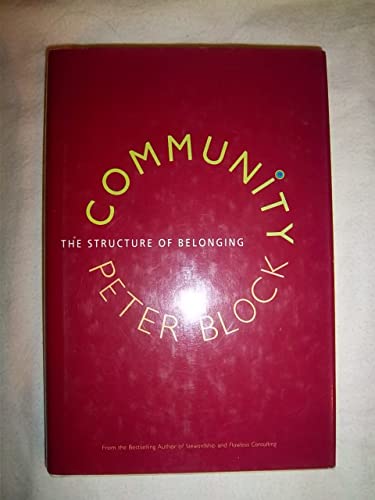
Inhaltsangabe
We need our neighbors and community to stay healthy, produce jobs, raise our children, and care for those on the margin. Institutions and professional services have reached their limit of their ability to help us.
The consumer society tells us that we are insufficient and that we must purchase what we need from specialists and systems outside the community. We have become consumers and clients, not citizens and neighbors. John McKnight and Peter Block show that we have the capacity to find real and sustainable satisfaction right in our neighborhood and community.
This book reports on voluntary, self-organizing structures that focus on gifts and value hospitality, the welcoming of strangers. It shows how to reweave our social fabric, especially in our neighborhoods. In this way we collectively have enough to create a future that works for all.
Die Inhaltsangabe kann sich auf eine andere Ausgabe dieses Titels beziehen.
Über die Autorin bzw. den Autor
Peter Block is a citizen of Cincinnati, Ohio. He is a partner in Designed Learning, a training company that offers workshops designed by Block to build the skills outlined in his books. He is the author of Flawless Consulting, Stewardship, The Empowered Manager, and The Answer to How Is Yes. He is the recipient of the American Society for Training and Development Award for Distinguished Contribution to Workplace Learning and Performance and the Association for Quality and Participation President’s Award. He is also a member of Training magazine’s HRD Hall of Fame.
Auszug. © Genehmigter Nachdruck. Alle Rechte vorbehalten.
The Fragmented Community and Its Transformation
The essential challenge is to transform the isolation and self-interest within our communities into connectedness and caring for the whole. The key is to identify how this transformation occurs. We begin by shifting our attention from the problems of community to the possibility of community. We also need to acknowledge that our wisdom about individual transformation is not enough when it comes to community transformation. So, one purpose here is to bring together our knowledge about the nature of collective transformation. A key insight in this pursuit is to accept the importance of social capital to the life of the community. This begins the effort to create a future distinct from the past.
• • •
The need to create a structure of belonging grows out of the isolated nature of our lives, our institutions, and our communities. The absence of belonging is so widespread that we might say we are living in an age of isolation, imitating the lament from early in the last century, when life was referred to as the age of anxiety. Ironically, we talk today of how small our world has become, with the shrinking effect of globalization, instant sharing of information, quick technology, workplaces that operate around the globe. Yet these do not necessarily create a sense of belonging. They provide connection, diverse information, an infinite range of opinion. But all this does not create the connection from which we can become grounded and experience the sense of safety that arises from a place where we are emotionally, spiritually, and psychologically a member.
Our isolation occurs because western culture, our individualistic narrative, the inward attention of our institutions and our professions, and the messages from our media all fragment us. We are broken into pieces.
One aspect of our fragmentation is the gaps between sectors of our cities and neighborhoods; businesses, schools, social service organizations, churches, government operate mostly in their own worlds. Each piece is working hard on its own purpose, but parallel effort added together does not make a community. Our communities are separated into silos; they are a collection of institutions and programs operating near one another but not overlapping or touching. This is important to understand because it is this dividedness that makes it so difficult to create a more positive or alternative future—especially in a culture that is much more interested in individuality and independence than in interdependence. The work is to overcome this fragmentation.
To create the sense that we are safe and among friends, especially those we have not yet met, is a particular challenge for our cities and rural towns. The dominant narrative about our cities is that they are unsafe and troubled. Those we label “homeless,” or “ex-offenders,” or “disabled,” or “at risk” are the most visible people who struggle with belonging, but isolation and apartness is also a wider condition of modern life. This is as true in our gated communities and suburbs as in our urban centers.
There is a particular isolation in the spaciousness and comfort of our suburbs. In these neighborhoods we needed to invent the “play date” for our children. Interaction among kids must be scheduled, much like a business meeting. On Tuesday, a mom must call another mom and ask, “Can Alex play with Phil on Thursday, at our house, say about 4? I will call if we are running late. The play date should last until roughly 5:45, to give both children time to freshen up for the family get-together at dinner.” A far cry from the day of kids walking home after school and casually seeing who they ran into.
The cost of our detachment and disconnection is not only our isolation, our loneliness, but also the fact that there are too many people in our communities whose gifts remain on the margin. Filling the need for belonging is not just a personal struggle for connection, but also a community problem, which is our primary concern in this book. The effects of the fragmentation of our communities show up in low voter turnout, the struggle to sustain volunteerism, and the large portion of the population who remain disengaged. The struggle is also the reality for the millions of people around the world who are part of today’s diaspora—the growing number of displaced people unable to return to their homeland, living and raising their children in a permanent state of transition.
Communities That Work for All
Community offers the promise of belonging and calls for us to acknowledge our interdependence. To belong is to act as an investor, owner, and creator of this place. To be welcome, even if we are strangers. As if we came to the right place and are affirmed for that choice.
To feel a sense of belonging is important because it will lead us from conversations about safety and comfort to other conversations, such as our relatedness and willingness to provide hospitality and generosity. Hospitality is the welcoming of strangers, and generosity is an offer with no expectation of return. These are two elements that we want to nurture as we work to create, strengthen, and restore our communities. This will not occur in a culture dominated by isolation, and its correlate, fear.
• • •
It is not my intent here to journalistically describe what healthy communities look like and where they exist. This is well documented. We have the success stories from Savannah, Boston, Chicago, Portland—all those places where community well-being has been on the rise over time. We have the pockets of authentic community in showcase organizational cultures such as Harley-Davidson and AES.
There is no need for more benchmarking of where the world is working. The reason is partly that we have already heard all the stories, and partly—and more important—that narratives of success give us hope and places to visit, but do not build our community. Social fabric and successful communities elsewhere cannot be imported. What works somewhere else ends up as simply another program here, which might be useful but does not shift the fundamentals that we are after.
What is needed is an exploration of the exact way authentic community occurs. How is it transformed? What fundamental shifts are involved? Too little is understood about the creation and transformation of a collective. I want to explore a way of thinking that creates an opening for authentic communities to exist and details what each of us can do to make that happen. The essence is to take a step forward in our thinking and design about the ways that people in communities come together to produce something new for themselves. By thinking in terms of a structure of belonging, we begin to build the capacity to transform our communities into ones that work for all.
The challenge is to think broadly enough to have a theory and methodology that have the power to make a difference, and yet be simple and clear enough to be accessible to anyone who wants to make that difference. We need ideas from a variety of places and disciplines to deal with the complexity of community. Then, acting as if these ideas are true, we must translate them into embarrassingly simple and concrete acts.
This means a shift in thinking that gives us clues about collective possibility. The shift in thinking is the focus of Chapters 1 through 7. Following that, we come to methodology, which many of you may consider the heart of the book. But without the shift in thinking, methodology becomes technique and practice becomes imitation.
• • •
One key perspective is that to create a more positive and connected future for our communities,...
„Über diesen Titel“ kann sich auf eine andere Ausgabe dieses Titels beziehen.
Suchergebnisse für Community: Restoring the Possible

Beispielbild für diese ISBN
Community
Verlag:
Berrett-Koehler Publishers, 2008
ISBN 10: 1576754871
ISBN 13: 9781576754870
Gebraucht
Hardcover
Anbieter: World of Books (was SecondSale), Montgomery, IL, USA
Verkäuferbewertung 5 von 5 Sternen

Zustand: Very Good. Item in very good condition! Textbooks may not include supplemental items i.e. CDs, access codes etc. Bestandsnummer des Verkäufers 00105733355
Gebraucht kaufen
EUR 3,84
Versand gratis
Versand innerhalb von USA
Versand innerhalb von USA
Anzahl: 2 verfügbar
Beispielbild für diese ISBN
Community
Anbieter: World of Books (was SecondSale), Montgomery, IL, USA
Verkäuferbewertung 5 von 5 Sternen
Hardback. Zustand: Good. This book is written to support those who care for the well-being of their community. It is for anyone who wants to be part of creating an organization, neighborhood, city, or country that works for all, and who has the faith and the energy to create such a place. I am one of those people. Whenever I am in a neighborhood or small town and see empty storefronts, watch people floating aimlessly on the sidewalks during school or working hours, pass by housing projects, or read about crime, poverty, or a poor environment in the places where our children and our brothers and sisters live, I am distressed and anguished. It has become impossible for me to ignore the fact that the world we are creating does not come close to fulfilling its promise. Along with this distress comes the knowledge that each of us, myself included, is participating in creating this world. If it is true that we are creating this world, then each of us has the power to heal its woundedness. This is not about guilt, it is about accountability. Citizens, in their capacity to come together and choose to be accountable, are our best shot at making a difference. This book is for all who are willing to take a leadership role that affirms the conviction that without a willingness to be accountable for our part in creating a strong and connected community, our desire to reduce suffering and increase happiness in the world becomes infinitely more difficult to fulfill. It is also based on the belief that in some way the vitality and connectedness of our communities will determine the strength of our democracy. Bestandsnummer des Verkäufers 00106572543
Gebraucht kaufen
EUR 3,84
Versand gratis
Versand innerhalb von USA
Versand innerhalb von USA
Anzahl: 4 verfügbar
Beispielbild für diese ISBN
Community
Verlag:
Berrett-Koehler Publishers, 2008
ISBN 10: 1576754871
ISBN 13: 9781576754870
Gebraucht
Hardcover
Anbieter: World of Books (was SecondSale), Montgomery, IL, USA
Verkäuferbewertung 5 von 5 Sternen
Zustand: Acceptable. Item in acceptable condition! Textbooks may not include supplemental items i.e. CDs, access codes etc. Bestandsnummer des Verkäufers 00109412550
Gebraucht kaufen
EUR 3,84
Versand gratis
Versand innerhalb von USA
Versand innerhalb von USA
Anzahl: 1 verfügbar
Beispielbild für diese ISBN
Community: The Structure of Belonging
Verlag:
Berrett-Koehler Publishers, 2008
ISBN 10: 1576754871
ISBN 13: 9781576754870
Gebraucht
Hardcover
Anbieter: Gulf Coast Books, Cypress, TX, USA
Verkäuferbewertung 5 von 5 Sternen
hardcover. Zustand: Good. Bestandsnummer des Verkäufers 1576754871-3-37367461
Gebraucht kaufen
EUR 3,85
Versand gratis
Versand innerhalb von USA
Versand innerhalb von USA
Anzahl: 1 verfügbar
Foto des Verkäufers
Community: The Structure of Belonging
Verlag:
Berrett-Koehler Publishers, 2008
ISBN 10: 1576754871
ISBN 13: 9781576754870
Gebraucht
Hardcover
Anbieter: Greenworld Books, Arlington, TX, USA
Verkäuferbewertung 5 von 5 Sternen
Zustand: good. Fast Free Shipping â" Good condition. It may show normal signs of use, such as light writing, highlighting, or library markings, but all pages are intact and the book is fully readable. A solid, complete copy that's ready to enjoy. Bestandsnummer des Verkäufers GWV.1576754871.G
Gebraucht kaufen
EUR 4,70
Versand gratis
Versand innerhalb von USA
Versand innerhalb von USA
Anzahl: 1 verfügbar
Beispielbild für diese ISBN
Community: The Structure of Belonging
Verlag:
Berrett-Koehler Publishers, 2008
ISBN 10: 1576754871
ISBN 13: 9781576754870
Gebraucht
Hardcover
Anbieter: Once Upon A Time Books, Siloam Springs, AR, USA
Verkäuferbewertung 4 von 5 Sternen

hardcover. Zustand: Good. This is a used book in good condition and may show some signs of use or wear . This is a used book in good condition and may show some signs of use or wear . Bestandsnummer des Verkäufers mon0003569537
Gebraucht kaufen
EUR 1,95
EUR 3,53 Versand
Versand innerhalb von USA
Versand innerhalb von USA
Anzahl: 1 verfügbar
Beispielbild für diese ISBN
Community
Anbieter: World of Books Inc, Montgomery, IL, USA
Verkäuferbewertung 4 von 5 Sternen
Hardback. Zustand: Good. This book is written to support those who care for the well-being of their community. It is for anyone who wants to be part of creating an organization, neighborhood, city, or country that works for all, and who has the faith and the energy to create such a place. I am one of those people. Whenever I am in a neighborhood or small town and see empty storefronts, watch people floating aimlessly on the sidewalks during school or working hours, pass by housing projects, or read about crime, poverty, or a poor environment in the places where our children and our brothers and sisters live, I am distressed and anguished. It has become impossible for me to ignore the fact that the world we are creating does not come close to fulfilling its promise. Along with this distress comes the knowledge that each of us, myself included, is participating in creating this world. If it is true that we are creating this world, then each of us has the power to heal its woundedness. This is not about guilt, it is about accountability. Citizens, in their capacity to come together and choose to be accountable, are our best shot at making a difference. This book is for all who are willing to take a leadership role that affirms the conviction that without a willingness to be accountable for our part in creating a strong and connected community, our desire to reduce suffering and increase happiness in the world becomes infinitely more difficult to fulfill. It is also based on the belief that in some way the vitality and connectedness of our communities will determine the strength of our democracy. Bestandsnummer des Verkäufers CIN1576754871G
Gebraucht kaufen
EUR 5,68
Versand gratis
Versand innerhalb von USA
Versand innerhalb von USA
Anzahl: 4 verfügbar
Beispielbild für diese ISBN
Community
Anbieter: World of Books Inc, Montgomery, IL, USA
Verkäuferbewertung 4 von 5 Sternen
Hardback. Zustand: Very Good. This book is written to support those who care for the well-being of their community. It is for anyone who wants to be part of creating an organization, neighborhood, city, or country that works for all, and who has the faith and the energy to create such a place. I am one of those people. Whenever I am in a neighborhood or small town and see empty storefronts, watch people floating aimlessly on the sidewalks during school or working hours, pass by housing projects, or read about crime, poverty, or a poor environment in the places where our children and our brothers and sisters live, I am distressed and anguished. It has become impossible for me to ignore the fact that the world we are creating does not come close to fulfilling its promise. Along with this distress comes the knowledge that each of us, myself included, is participating in creating this world. If it is true that we are creating this world, then each of us has the power to heal its woundedness. This is not about guilt, it is about accountability. Citizens, in their capacity to come together and choose to be accountable, are our best shot at making a difference. This book is for all who are willing to take a leadership role that affirms the conviction that without a willingness to be accountable for our part in creating a strong and connected community, our desire to reduce suffering and increase happiness in the world becomes infinitely more difficult to fulfill. It is also based on the belief that in some way the vitality and connectedness of our communities will determine the strength of our democracy. Bestandsnummer des Verkäufers CIN1576754871VG
Gebraucht kaufen
EUR 5,68
Versand gratis
Versand innerhalb von USA
Versand innerhalb von USA
Anzahl: 2 verfügbar
Beispielbild für diese ISBN
Community: The Structure of Belonging
Verlag:
Berrett-Koehler Publishers, 2008
ISBN 10: 1576754871
ISBN 13: 9781576754870
Gebraucht
Hardcover
Anbieter: HPB Inc., Dallas, TX, USA
Verkäuferbewertung 5 von 5 Sternen
Hardcover. Zustand: Very Good. Connecting readers with great books since 1972! Used books may not include companion materials, and may have some shelf wear or limited writing. We ship orders daily and Customer Service is our top priority! Bestandsnummer des Verkäufers S_443134464
Gebraucht kaufen
EUR 2,39
EUR 3,35 Versand
Versand innerhalb von USA
Versand innerhalb von USA
Anzahl: 1 verfügbar
Beispielbild für diese ISBN
Community: The Structure of Belonging
Verlag:
Berrett-Koehler Publishers, 2008
ISBN 10: 1576754871
ISBN 13: 9781576754870
Gebraucht
Hardcover
Anbieter: HPB-Red, Dallas, TX, USA
Verkäuferbewertung 5 von 5 Sternen
hardcover. Zustand: Very Good. Connecting readers with great books since 1972! Used textbooks may not include companion materials such as access codes, etc. May have some wear or limited writing/highlighting. We ship orders daily and Customer Service is our top priority! Bestandsnummer des Verkäufers S_450926924
Gebraucht kaufen
EUR 2,76
EUR 3,35 Versand
Versand innerhalb von USA
Versand innerhalb von USA
Anzahl: 1 verfügbar