
Verwandte Artikel zu Wave Rider: Leadership for High Performance in a Self-Organi...
Inhaltsangabe
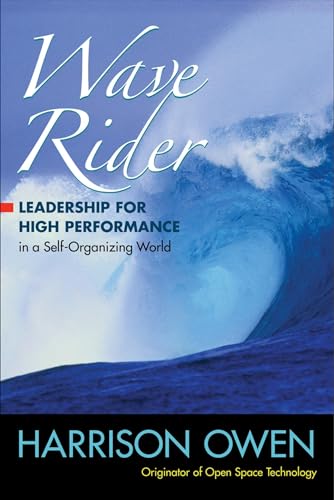
What began forty years ago as a journey of exploration into the interplay between chaos, order, and the creative process culminates in this capstone work of Harrison Owen’s pioneering career. From the creator of Open Space Technology (OST), Wave Rider shows how to apply the fundamental principles of OST to the day-to-day management and leadership of organizations. Owen lays out eight concrete steps for aligning ourselves with the driving power behind OST’s immense success: the primal force of self-organization. We can’t control it, but we can work with it—we can ride the wave.
Die Inhaltsangabe kann sich auf eine andere Ausgabe dieses Titels beziehen.
Über die Autorin bzw. den Autor
Harrison Owen is president of H. H. Owen and Company. His aca- demic background and training centered on the nature and function of myth, ritual, and culture. In the mid-1960s, he left academe to work with a variety of organizations, including small West African villages, urban community organizations (both in the United States and in Africa), the Peace Corps, regional medical programs, the U.S. National Institutes of Health, and the U. S. Veterans Administration. Along the way, he discovered that his study of myth, ritual, and culture had direct application to these social systems. In 1977, he created H. H. Owen and Company in order to explore the culture of organizations in transfor- mation as a theorist and practicing consultant. Harrison convened the First International Symposium on Organization Transformation and is the originator of Open Space Technology. He is the author of Open Space Technology: The Users Guide; Spirit: Transformation and Development in Organiza- tion; Leadership Is; Riding the Tiger; The Millennium Organization; Tales from Open Space; and Expanding Our Now: The Story of Open Space Technology.
Auszug. © Genehmigter Nachdruck. Alle Rechte vorbehalten.
Introduction Wave Rider
Wave Riders are curious people possessed of an innate capacity to go with the flow, constantly seizing upon opportunity when others see no possibility or even disaster. Their level of performance is consistently high, and projects are often completed in breathtakingly short periods of time, with a degree of excellence that may seem unbelievable. Not always, not in every instance——but with a regularity that sets them apart, but never alone. Together with their fellows, Wave Riders create the critical community bonds, essential for productive activity. And they bring a special gift——Leadership. Their passion and responsibility for a cause inspire others to make common cause. Not by domination and control, but through invitation and appreciation, the efforts of many coalesce as one.
Saying that Wave Riders go with the flow is not to say that they have a light regard for planning, logic, and hard work. In fact the Wave Rider may be a fanatic for planning, logical to a fault, and a total workaholic. But what sets them apart is that they also possess a clear understanding of the limitations of all three: planning, logic, and hard work. For them the Plan is the map and not the territory. Necessary, useful, but never to be confused with the facts on the ground, and certainly never to be given preeminence.
Likewise with logic. Good and useful for sure, but when the daily course of experience appears to behave in an illogical fashion, usually referred to as counterintuitive, the Wave Rider will understand that there are multiple “logics,” and it may well be that the one employed is simply inappropriate to the situation. A classic case of this phenomenon comes from the world of physics at the point where quantum mechanics made its appearance. Traditional Newtonian physicists were logical to a fault, perceiving the elegant coherence in the cosmos to be an exquisite clockworks. However, as the world of subatomic physics became the object of study, the traditional logic faltered. And those who were crafting the emerging quantum physics used the sense of illogic to advance their work. Werner Heisenberg, the originator of the Uncertainty Principle, is said to have remarked, “Your theory is crazy, but not crazy enough to be true.”2
On the subject of work——Wave Riders do indeed work very hard. They are often sticklers for detail and devote amazing amounts of time and energy to enterprises for which they have a genuine passion. When they care, they care deeply, and the effect of this caring is a devotion to their cause that others may find disturbing.
But there is another aspect to a Wave Rider’s relation to work that many will find strange. On occasion, all of their busy doing simply stops. The task lists are put away, the goals and objectives are all placed on hold. The Wave Rider is content to be there in that present moment. An outside observer might legitimately conclude that the Wave Rider has given up, but the truth is rather different. She or he has simply let go. Not to be confused with a fatalistic withdrawal from life——this letting go has a very different quality. The commitment to the original passionate concern remains unshaken, and if anything, is deepened and intensified. Rather than fatalism, there is profound awareness and trust in the deep forces which drive toward completion and fulfillment. And of equal importance is a recognition that any “doing” in the sense of organizing, managing, forcing——will not only be ineffective, but may well be counterproductive.3
Wave Riders may be found in all times and places. Some will be remembered as major historical characters, the names of others will never be recorded in the pages of history. Gandhi, for example, confounded the British Empire not only with his tireless efforts and articulate strategy (plans), but also, and perhaps more importantly, with his presence and capacity to simply be there in the present moment, apparently doing nothing. Dee Hock comes from a very different environment, the corporate world. As the founder of VISA International, Dee Hock surely did a lot, but he also well understood the need to let go and simply be there. Not the controlling/directing chief executive, but rather the appreciator of an evolving organic entity which has become one of the largest global corporations——and over which he had no control.
Wave Riders are not limited to global or corporate heros. The mother of a growing family, shepherding her brood toward adulthood, will ride the waves of her complex and confusing world——multi-tasking we call it. To be sure, she has plans and tasks in abundance, to-do lists without end. But at the end of the day, and indeed on every day, she will be remembered not so much for what she did, which may be truly awesome, but rather for the power of her singular presence.4
Wave Riders show up on the shop floor and the executive suite, athletic fields, and the halls of government. They appear at every level and station in life, but never are they to be confused with the great man version of The Leader, even though some may bear the most exalted of titles. The power of their presence comes from a very different place. It is not bestowed as a divine right, nor is it claimed in a decisive act of control. It is a power that comes from powerlessness and the full recognition that they will never be in control. They do not command; they invite. They do not envision themselves at the apex of a hierarchy but rather in a circle with their peers and colleagues. The source of their power comes from their own unique passion linked to responsibility which attracts others to join a common venture. A venture which is at once productive and personally fulfilling for those who care to join. Wave Riders are leaders who enable individuals and organizations to fulfill their potential——with distinction.
Needed: More Wave Riders
Wave Riders have been with us always, usually unnoticed, or if noticed then treated as a curious exception to the rule. And indeed it often seemed that they were playing by very different rules. There was doubtless a time when we could afford to smile sympathetically at the behavior of the Wave Riders in our midst. When good things happened (the difficult was handled with dispatch, and the impossible achieved with a little more time), we could scratch our heads and wonder at the fabulous run of luck which the Wave Rider obviously enjoyed. It would never occur to us that there might actually be a method in their madness. In fact such thoughts could not occur to us if only because virtually all of our training and experience told us otherwise. Wave Riders were clearly the exception, and we all knew the proper way to do business, whatever that business might be. The critical point was to seize and maintain control in the manner of the Great Man Leader. Only then could good and useful things happen. Or so many of us thought.5
The times have changed. The anomalous behavior of the Wave Rider holds a critical clue to new ways of surviving, and indeed thriving, in our chaotic world, enabling all of us to achieve levels of excellence and high performance previously unknown.
The search for high performance has typically been a major concern of businesses and other organizations in their quest for efficiency and effectiveness. However, the stakes have risen dramatically. Achieving optimum levels of human performance is no longer just an issue of organizational effectiveness, but now a matter of global survival. The list of threatening possibilities is virtually without end: climate change, nuclear disaster, pandemics of various sorts, to name a few. Any one of these, taken by itself, would constitute a real problem, but everything is...
„Über diesen Titel“ kann sich auf eine andere Ausgabe dieses Titels beziehen.
Suchergebnisse für Wave Rider: Leadership for High Performance in a Self-Organi...

Beispielbild für diese ISBN
Wave Rider: Leadership for High Performance in a Self-Organizing World
Verlag:
Berrett-Koehler Publishers, 2008
ISBN 10: 1576756173
ISBN 13: 9781576756171
Gebraucht
Softcover
Anbieter: World of Books (was SecondSale), Montgomery, IL, USA
Verkäuferbewertung 5 von 5 Sternen

Zustand: Very Good. Item in very good condition! Textbooks may not include supplemental items i.e. CDs, access codes etc. Bestandsnummer des Verkäufers 00110157881
Gebraucht kaufen
EUR 5,10
Versand gratis
Versand innerhalb von USA
Versand innerhalb von USA
Anzahl: 1 verfügbar
Beispielbild für diese ISBN
Wave Rider: Leadership for High Performance in a Self-Organizing World
Verlag:
Berrett-Koehler Publishers, 2008
ISBN 10: 1576756173
ISBN 13: 9781576756171
Gebraucht
Softcover
Anbieter: World of Books (was SecondSale), Montgomery, IL, USA
Verkäuferbewertung 5 von 5 Sternen
Zustand: Good. Item in good condition and has highlighting/writing on text. Used texts may not contain supplemental items such as CDs, info-trac etc. Bestandsnummer des Verkäufers 00102623216
Gebraucht kaufen
EUR 5,10
Versand gratis
Versand innerhalb von USA
Versand innerhalb von USA
Anzahl: 1 verfügbar
Beispielbild für diese ISBN
Wave Rider: Leadership for High Performance in a Self-Organizing World
Verlag:
Berrett-Koehler Publishers (edition ), 2008
ISBN 10: 1576756173
ISBN 13: 9781576756171
Gebraucht
Paperback
Anbieter: BooksRun, Philadelphia, PA, USA
Verkäuferbewertung 5 von 5 Sternen
Paperback. Zustand: Fair. The item might be beaten up but readable. May contain markings or highlighting, as well as stains, bent corners, or any other major defect, but the text is not obscured in any way. Bestandsnummer des Verkäufers 1576756173-7-1
Gebraucht kaufen
EUR 5,11
Versand gratis
Versand innerhalb von USA
Versand innerhalb von USA
Anzahl: 1 verfügbar
Beispielbild für diese ISBN
Wave Rider: Leadership for High Performance in a Self-Organizing World
Verlag:
Berrett-Koehler Publishers, 2008
ISBN 10: 1576756173
ISBN 13: 9781576756171
Gebraucht
Paperback
Anbieter: ThriftBooks-Atlanta, AUSTELL, GA, USA
Verkäuferbewertung 5 von 5 Sternen
Paperback. Zustand: Good. No Jacket. Pages can have notes/highlighting. Spine may show signs of wear. ~ ThriftBooks: Read More, Spend Less. Bestandsnummer des Verkäufers G1576756173I3N00
Gebraucht kaufen
EUR 6,19
Versand gratis
Versand innerhalb von USA
Versand innerhalb von USA
Anzahl: 1 verfügbar
Beispielbild für diese ISBN
Wave Rider: Leadership for High Performance in a Self-Organizing World
Verlag:
Berrett-Koehler Publishers, 2008
ISBN 10: 1576756173
ISBN 13: 9781576756171
Gebraucht
Paperback
Anbieter: ThriftBooks-Dallas, Dallas, TX, USA
Verkäuferbewertung 5 von 5 Sternen
Paperback. Zustand: Very Good. No Jacket. Former library book; May have limited writing in cover pages. Pages are unmarked. ~ ThriftBooks: Read More, Spend Less. Bestandsnummer des Verkäufers G1576756173I4N10
Gebraucht kaufen
EUR 6,19
Versand gratis
Versand innerhalb von USA
Versand innerhalb von USA
Anzahl: 1 verfügbar
Beispielbild für diese ISBN
Wave Rider: Leadership for High Performance in a Self-Organizing World
Anbieter: World of Books Inc, Montgomery, IL, USA
Verkäuferbewertung 4 von 5 Sternen

Paperback. Zustand: Very Good. Wave Rider is about leveraging the power of self-organization for high performance in all sizes and types of organizations. Harrison Owen the originator of the internationally popular Open Space Technology organizational change method, shows that self-organization is the most powerful force in organizations but a force that is often muffled by well meaning yet constricting management and leadership practices. Using his unique and interesting folksy writing style he reveals that self-organization is the magic behind the immense success of Open Space Technology, and he applies the principles of Open Space Technology to day-to-day management and leadership (not just to meetings and change programs, which is where open space technology has previously been most used). Bestandsnummer des Verkäufers CIN1576756173VG
Gebraucht kaufen
EUR 6,94
Versand gratis
Versand innerhalb von USA
Versand innerhalb von USA
Anzahl: 1 verfügbar
Beispielbild für diese ISBN
Wave Rider: Leadership for High Performance in a Self-Organizing World
Anbieter: World of Books Inc, Montgomery, IL, USA
Verkäuferbewertung 4 von 5 Sternen
Paperback. Zustand: Good. Wave Rider is about leveraging the power of self-organization for high performance in all sizes and types of organizations. Harrison Owen the originator of the internationally popular Open Space Technology organizational change method, shows that self-organization is the most powerful force in organizations but a force that is often muffled by well meaning yet constricting management and leadership practices. Using his unique and interesting folksy writing style he reveals that self-organization is the magic behind the immense success of Open Space Technology, and he applies the principles of Open Space Technology to day-to-day management and leadership (not just to meetings and change programs, which is where open space technology has previously been most used). Bestandsnummer des Verkäufers CIN1576756173G
Gebraucht kaufen
EUR 6,94
Versand gratis
Versand innerhalb von USA
Versand innerhalb von USA
Anzahl: 1 verfügbar
Beispielbild für diese ISBN
Wave Rider: Leadership for High Performance in a Self-Organizing World
Verlag:
Berrett-Koehler Publishers, 2008
ISBN 10: 1576756173
ISBN 13: 9781576756171
Gebraucht
paperback
Anbieter: HPB-Ruby, Dallas, TX, USA
Verkäuferbewertung 5 von 5 Sternen
paperback. Zustand: Very Good. Connecting readers with great books since 1972! Used books may not include companion materials, and may have some shelf wear or limited writing. We ship orders daily and Customer Service is our top priority! Bestandsnummer des Verkäufers S_461374403
Gebraucht kaufen
EUR 5,75
EUR 3,35 Versand
Versand innerhalb von USA
Versand innerhalb von USA
Anzahl: 1 verfügbar
Beispielbild für diese ISBN
Wave Rider : Leadership for High Performance in a Self-Organizing World
Verlag:
Berrett-Koehler Publishers, Incorporated, 2008
ISBN 10: 1576756173
ISBN 13: 9781576756171
Gebraucht
Softcover
Anbieter: Better World Books, Mishawaka, IN, USA
Verkäuferbewertung 5 von 5 Sternen
Zustand: Very Good. Pages intact with possible writing/highlighting. Binding strong with minor wear. Dust jackets/supplements may not be included. Stock photo provided. Product includes identifying sticker. Better World Books: Buy Books. Do Good. Bestandsnummer des Verkäufers 8712181-6
Gebraucht kaufen
EUR 10,12
Versand gratis
Versand innerhalb von USA
Versand innerhalb von USA
Anzahl: 1 verfügbar
Beispielbild für diese ISBN
Wave Rider : Leadership for High Performance in a Self-Organizing World
Verlag:
Berrett-Koehler Publishers, Incorporated, 2008
ISBN 10: 1576756173
ISBN 13: 9781576756171
Gebraucht
Softcover
Anbieter: Better World Books, Mishawaka, IN, USA
Verkäuferbewertung 5 von 5 Sternen
Zustand: Good. Pages intact with minimal writing/highlighting. The binding may be loose and creased. Dust jackets/supplements are not included. Stock photo provided. Product includes identifying sticker. Better World Books: Buy Books. Do Good. Bestandsnummer des Verkäufers 15247837-20
Gebraucht kaufen
EUR 10,12
Versand gratis
Versand innerhalb von USA
Versand innerhalb von USA
Anzahl: 1 verfügbar