
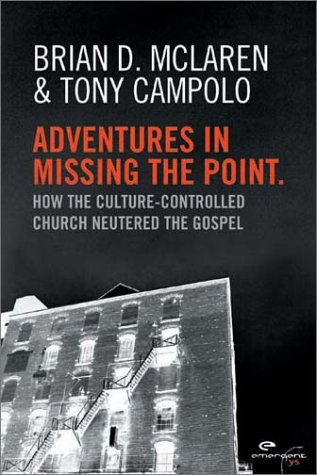
Adventures in Missing the Point: How the Culture-Controlled Church Neutered the Gospel (Emergent Ys) - Hardcover
Inhaltsangabe
Are you missing the point?
Do you ever look at how the Christian faith is being lived out in the early 21st century and wonder if, somehow, we’re missing the point? It’s easy to rely on what we’ve been told to believe or what is widely accepted by the Christian community. But if we took an honest look at our beliefs and truly questioned them and their origin, where would we find ourselves?
Best-selling authors Brian McLaren and Tony Campolo invite you to do just that. Join them on an adventure—one that is about discovering our misguided conclusions about the Christian faith. In Adventures in Missing the Point, the authors take turns addressing such topics as:
· Missing the Point of Salvation
· Missing the Point of the Bible
· Missing the Point on Postmodernism
· Missing the Point of Worship
· Missing the Point on Women in Church Leadership
Die Inhaltsangabe kann sich auf eine andere Ausgabe dieses Titels beziehen.
Über die Autorin bzw. den Autor
BRIAN D. MCLAREN is senior pastor of Cedar Ridge Community Church in suburban Washington, D.C. He’s a noted thinker and speaker on the church and postmodernism, and the author of many books, including A New Kind of Christian and More Ready Than You Realize. He’s one of the founders of Emergent.
TONY CAMPOLO has long been a gadfly to evangelicalism, one of our own who is able to help us see our weaknesses from within the camp. He is professor emeritus of sociology at Eastern College. A media commentator on religious, social, and political matters, he is also the author of dozens of books, including Revolution and Renewal, Let Me Tell You a Story, and 20 Hot Potatoes Christians Are Afraid to Touch.
Rezensionen
Liberal evangelicals McLaren and Campolo share chapters on topics related to, as the three section titles indicate, "God" (religious philosophy), "World" (society), and "Soul" (personal spirituality). In each chapter, one man offers his perspective on a topic, and the other briefly concurs, dissents, or differs. Never is there sharp disagreement, since McLaren and Campolo always agree that too many evangelicals miss the Christian point involved in the topic under discussion. For instance, on evangelism McLaren opines that most people don't know how to evangelize, so he offers some do's and don'ts; Campolo endorses this advice but regrets McLaren's failure to emphasize that the most important element in evangelizing is personal testimony. Such a thumbnail description may make the dialogue seem drier than it really is, and on such subjects as the kingdom of God, prophecy, homosexuality, women and ordination, sin, worship, doubt, and truth, McLaren and Campolo's exchanges are so compelling that anyone interested in contemporary American Christianity might profitably take them to heart for their own reflections on the issues. Ray Olson
Copyright © American Library Association. All rights reserved
Many Christians, argue McLaren and Campolo, have missed-and keep missing-the point of the very Gospel they are called to proclaim. They mistake the Bible for a simple answer book. They mistake salvation for political liberation or celestial fire insurance. They mistake worship for feelings of personal intimacy. But the emerging postmodern culture provides an opportunity and an impetus for the church to revisit some of these topics and discover again what the Gospel is all about. In this volume, McLaren (A New Kind of Christian) teams up with Campolo (20 Hot Potatoes Christians Are Afraid to Touch) to opine and stimulate thought and discussion among their conservative colleagues. They take turns writing chapters about a variety of topics that are sometimes mundane (sin, culture, seminary) and sometimes more controversial (homosexuality, the Bible). Not every chapter includes an actual "missed point," and several contain straw men. Sometimes a favorable uptick on the accessibility meter is matched by a corresponding downturn in the one measuring theological depth. Still, the book offers much sharp insight, is solidly biblical and is helpfully illustrated by stories-it's easy to see why both authors are sought-after preachers. The writing is lively, and the back-and-forth between Campolo and McLaren is often quite interesting. They aren't afraid to disagree with each other, which encourages the reader to think a bit harder about being a Christian today-which is probably the point.
Copyright 2003 Reed Business Information, Inc.
„Über diesen Titel“ kann sich auf eine andere Ausgabe dieses Titels beziehen.

