
Verwandte Artikel zu Yod Book: Including a Complete Discussion of Unaspected...
Inhaltsangabe
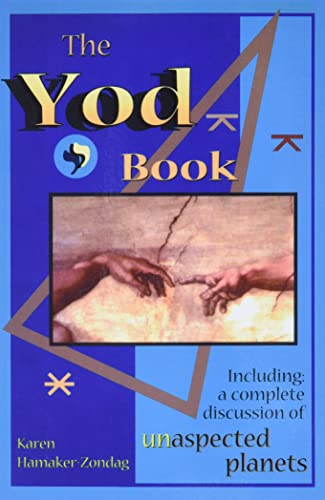
A yod is formed when two planets that are sextile also form an inconjunct to another planet. These planets are in different signs and modes and are deeply significant, for they usually symbolize patterns in families that have lasted for generations. This is what HamakerZondag discovered when she started to research the inconjunct aspect as it related to a yod. Also included in this book is a complete discussion of how the energies of unaspected planets, and planets in duet (that only aspect each other) are expressed in a person's birth chart. HamakerZondag says that people with a yod are often insecure, or have trouble expressing themselves, and there is an emphasis on stalemates or unusual situations. She analyzes the background and places it in a broader perspective, including how she works with elements, modes, orbs, and other astrological factors when interpreting this aspect. All in all, this is one of the most exciting books on aspect interpretation published in recent years!
Included are great case histories: you have a chance to examine the Monica Lewinsky, Linda Tripp, Kenneth Starr, Bill Clinton scenario and see it with new eyes. And Princess Diana, Prince Charles, and Prince William are not without these family patterns. The stories are profound. These aspects work in the lives of people who change the world, people who have lived the unpopular position of stalemate, delay, and social change indicated by the presence of a yod in their natal chart, by transit, or by progression. She uses the examples of Gandhi, Vaclav Havel, Khomeini, Solzhenitsyn, Willy Brandt, C. G. Jung, Jim Jones, and others. To help you work with your own clients, HamakerZondag brings in the charts of her personal clients and explains them in depth.
When you've read this book, you'll want to check out the charts of everyone you know!
Die Inhaltsangabe kann sich auf eine andere Ausgabe dieses Titels beziehen.
Über die Autorin bzw. den Autor
Karen Hamaker-Zondag is the author of fifteen books, including The Twelfth House and Tarot as a Way of Life. She is a recipient of the 1998 Regulus Award for Education from the UAC, founder two schools: Stichting Achernar, an astrological school; and Stichting Odrerir, a school of Jungian Psychology. With her husband Hans, in 1990, she started Symbolon, a successful quarterly astrological journal. Karen lives near Amsterdam with her husband and two children.
Auszug. © Genehmigter Nachdruck. Alle Rechte vorbehalten.
The Yod Book
Including a complete discussion of unaspected planets
By Karen Hamaker-ZondagSamuel Weiser, Inc.
Copyright © 1998 Karen Hamaker-Zondag
All rights reserved.
ISBN: 978-1-57863-163-6All rights reserved.
Contents
| Preface | |
| 1. What Is a Yod?—Technical Background of the Yod Configuration | |
| 2. Unaspected Planets | |
| 3. Family Themes and the Generation Problem | |
| 4. Effects of Yods and Unaspected Planets | |
| 5. Interpreting Yod Configurations | |
| 6. Interpreting Unaspected Planets and Duets | |
| 7. The Shadow and Evil | |
| 8. Unaspected Planets and Temporary Yods by Progression and Transit | |
| 9. How Should We Deal with Yods and Unaspected Planets? | |
| 10. Yods and Unaspected Planets in the Astrology of Relationships | |
| 11. Yods, a Duet, and Unaspected Planets | |
| 12. Yods and Unaspected Planets in Action | |
| 13. Life and Death | |
| 14. Yods and a Duet in C. G. Jung's Childhood | |
| 15. Case Files of Yods and Unaspected Planets | |
| 16. Gemma—Your Own Form within the Generational Theme | |
| 17. Living with a Number of Yods—Esther's Experience | |
| 18. In Conclusion | |
| Bibliography | |
| Index | |
| About the Author |
CHAPTER 1
What Is a Yod?—Technical Background of the Yod Configuration
A yod is an aspect configuration where one planet (MC, Ascendant, or a planet)forms an inconjunct with two other zodiacal points, while these two planets forma sextile between them. In a yod either the MC or the Ascendant can participate,but because we don't draw aspects between the MC and the Ascendant, they cannever be involved in a single yod at the same time. [Jod comes from the Hebrewword [TEXT NOT REPRODUCIBLE IN ASCII] 'jod' = hand.]
Astrology recognizes a number of different aspects that form a "closed"configuration; for instance, we recognize the grand trine (whose points connectthree signs of a single element), or the grand cross (or square), whose pointsconnect the four signs of a single mode, and so on. The direction theinterpretation of any aspect configuration takes is determined, for one, by themeaning of the kinds of aspects involved, and by the planets involved. More isgoing on though. In order to understand thoroughly what aspects are all about,aspect configurations in general, and the yod in particular, we will sidestep abit and look at other astrological rules and interpretive factors so we canbring these together later on at a deeper level in discussing the yodconfiguration.
Aspects
Technically speaking, an aspect is an angle a planet forms in relation toanother in the sky, as seen from Earth. There are countless possible angles, buthistory has taught us that particular angles exhibit a clear effect and othersdo so less or not at all. After Kepler, classification according to so-calledmajor and minor aspects was recognized; the major aspects were traditionally theconjunction (0°), sextile (60°), square (90°), trine (120°), and opposition(180°). These are all angles divisible by 30, the number of degrees comprising awhole sign. At that time, aspects were considered exclusively with reference tosign. The only two aspects missing from this list of major aspects that are alsodivisible by 30 are the semi-sextile (30°) and the inconjunct (150°). These usedto be minor aspects.
By combining music and numerology with the concept of astrological aspects,Kepler created many new aspects. He was familiar with the inconjunct (alsocalled a quincunx), but also made totally new ones. Because Kepler came up withquite a few aspects whose angles were no longer divisible by 30, the problemarose, for instance, that you could get a quintile (72°) between the signs Ariesand Cancer (i.e., a planet at 29° Aries, and the other 72° further at 11°Cancer), but also one between Aries and Gemini (i.e., a planet at 2° Aries, andthe other 72° further at 14° Gemini). He gave aspects their own meaning based onmusic and numerology, and the angles that belong to the aspects were, fromKepler's time on, pretty much considered from a strictly mathematical point ofview, rather than from the sign where the planets were placed. This meantchanging the traditional manner of reading the chart, where a planet wasinseparably linked to its sign and where the sign was of considerable importancewhen thinking of aspects. In the old days, as Greek sources report (think ofPtolemy), it was even the case that aspects were not seen as having an orb, butonly used as "whole-sign" aspects.
For example: every planet in Aries, regardless of the degree was considered tobe sextile to every planet in Aquarius, again regardless of the degree in whichthat planet was located. The reason for this was that Aries and Aquarius aresextile, and any planets located in these signs, because of their background,will also have a sextile-tendency to each other.
However, if you ignore the background sign when interpreting aspects, you willarrive at very strange combinations and encounter conflicting readings. Forexample: if you only look at the angle (the distance in degrees) as amathematical given, then you'll see the 120° angle (with an orb, of course)between 29° Aries and 1° Virgo as a trine because the aspect is 122°, and fallswithin the effective range due to the allowed orb. However, the planets involvednever work on their own; they are also colored by the sign in which they areplaced.
Although Mercury always remains Mercury as such (representing such things as ourway of talking, combining facts, and thinking), it will inevitably exhibititself differently and express itself differently in Aries than it will inTaurus. So when interpreting an aspect, we can't just say that Mercury is inthis or that aspect, but must first describe Mercury in greater detail inconnection with its sign.
Let's say that in our example, we have Mercury at 29° Aries and the Moon at 1°Virgo. What are these planets doing? Mercury in Aries will talk and think inthe way of fire—rapidly and in broad terms. This is a Mercury that wants to takethe world by storm, sees countless possibilities, smells adventure, and in thisway combines facts and comes up with ideas. This Mercury will almost stumbleover words when speaking, which he does enthusiastically, at full throttle, andwith zeal. He might even blurt out all kinds of things. Details and the concretematerial world are completely lost sight of. But not Moon in Virgo. This Moonwill feel the most comfortable if it can direct itself at concrete reality, atwhat is tangible and can be experienced by the senses—at that which offerssecurity. This Moon in Virgo has the most trouble with the insecurity ofadventure and chasing after countless still intangible possibilities. A Moon inVirgo feels safe if it can calmly weigh things mentally and act cautiously. Infact, it is totally different and, with respect to feelings, even in conflictwith Mercury in Aries. What are the implications for the trine without referenceto sign?
A trine is always described as a harmonious and flexible connection between twoplanets that...
„Über diesen Titel“ kann sich auf eine andere Ausgabe dieses Titels beziehen.
Suchergebnisse für Yod Book: Including a Complete Discussion of Unaspected...

Beispielbild für diese ISBN
Yod Book: Including a Complete Discussion of Unaspected Planets
Anbieter: World of Books (was SecondSale), Montgomery, IL, USA
Verkäuferbewertung 5 von 5 Sternen

Paperback. Zustand: Good. A yod is formed when two planets that are sextile also form an inconjunct to another planet. These planets are in different signs and modes and are deeply significant, for they usually symbolize patterns in families that have lasted for generations. This is what HamakerZondag discovered when she started to research the inconjunct aspect as it related to a yod. Also included in this book is a complete discussion of how the energies of unaspected planets, and planets in duet (that only aspect each other) are expressed in a person's birth chart. HamakerZondag says that people with a yod are often insecure, or have trouble expressing themselves, and there is an emphasis on stalemates or unusual situations. She analyzes the background and places it in a broader perspective, including how she works with elements, modes, orbs, and other astrological factors when interpreting this aspect. All in all, this is one of the most exciting books on aspect interpretation published in recent years! Included are great case histories: you have a chance to examine the Monica Lewinsky, Linda Tripp, Kenneth Starr, Bill Clinton scenario and see it with new eyes. And Princess Diana, Prince Charles, and Prince William are not without these family patterns. The stories are profound. These aspects work in the lives of people who change the world, people who have lived the unpopular position of stalemate, delay, and social change indicated by the presence of a yod in their natal chart, by transit, or by progression. She uses the examples of Gandhi, Vaclav Havel, Khomeini, Solzhenitsyn, Willy Brandt, C. G. Jung, Jim Jones, and others. To help you work with your own clients, HamakerZondag brings in the charts of her personal clients and explains them in depth. When you've read this book, you'll want to check out the charts of everyone you know! Bestandsnummer des Verkäufers 00108877894
Gebraucht kaufen
EUR 6,61
Versand gratis
Versand innerhalb von USA
Versand innerhalb von USA
Anzahl: 1 verfügbar
Beispielbild für diese ISBN
The Yod Book: Including a Complete Discussion of Unaspected Planets
Anbieter: Wonder Book, Frederick, MD, USA
Verkäuferbewertung 5 von 5 Sternen
Zustand: Very Good. Very Good condition. A copy that may have a few cosmetic defects. May also contain light spine creasing or a few markings such as an owner's name, short gifter's inscription or light stamp. Bestandsnummer des Verkäufers K12R-00705
Gebraucht kaufen
EUR 6,62
Versand gratis
Versand innerhalb von USA
Versand innerhalb von USA
Anzahl: 1 verfügbar
Beispielbild für diese ISBN
Yod Book: Including a Complete Discussion of Unaspected Planets
Anbieter: World of Books Inc, Montgomery, IL, USA
Verkäuferbewertung 4 von 5 Sternen

Paperback. Zustand: Good. A yod is formed when two planets that are sextile also form an inconjunct to another planet. These planets are in different signs and modes and are deeply significant, for they usually symbolize patterns in families that have lasted for generations. This is what HamakerZondag discovered when she started to research the inconjunct aspect as it related to a yod. Also included in this book is a complete discussion of how the energies of unaspected planets, and planets in duet (that only aspect each other) are expressed in a person's birth chart. HamakerZondag says that people with a yod are often insecure, or have trouble expressing themselves, and there is an emphasis on stalemates or unusual situations. She analyzes the background and places it in a broader perspective, including how she works with elements, modes, orbs, and other astrological factors when interpreting this aspect. All in all, this is one of the most exciting books on aspect interpretation published in recent years! Included are great case histories: you have a chance to examine the Monica Lewinsky, Linda Tripp, Kenneth Starr, Bill Clinton scenario and see it with new eyes. And Princess Diana, Prince Charles, and Prince William are not without these family patterns. The stories are profound. These aspects work in the lives of people who change the world, people who have lived the unpopular position of stalemate, delay, and social change indicated by the presence of a yod in their natal chart, by transit, or by progression. She uses the examples of Gandhi, Vaclav Havel, Khomeini, Solzhenitsyn, Willy Brandt, C. G. Jung, Jim Jones, and others. To help you work with your own clients, HamakerZondag brings in the charts of her personal clients and explains them in depth. When you've read this book, you'll want to check out the charts of everyone you know! Bestandsnummer des Verkäufers CIN1578631637G
Gebraucht kaufen
EUR 8,45
Versand gratis
Versand innerhalb von USA
Versand innerhalb von USA
Anzahl: 1 verfügbar
Beispielbild für diese ISBN
The Yod Book: Including a Complete Discussion of Unaspected Planets
Anbieter: HPB Inc., Dallas, TX, USA
Verkäuferbewertung 5 von 5 Sternen
Paperback. Zustand: Very Good. Connecting readers with great books since 1972! Used books may not include companion materials, and may have some shelf wear or limited writing. We ship orders daily and Customer Service is our top priority! Bestandsnummer des Verkäufers S_474723637
Gebraucht kaufen
EUR 5,74
EUR 3,35 Versand
Versand innerhalb von USA
Versand innerhalb von USA
Anzahl: 1 verfügbar
Beispielbild für diese ISBN
The Yod Book: Including a Complete Discussion of Unaspected Planets
Anbieter: HPB-Emerald, Dallas, TX, USA
Verkäuferbewertung 5 von 5 Sternen
Paperback. Zustand: Very Good. Connecting readers with great books since 1972! Used books may not include companion materials, and may have some shelf wear or limited writing. We ship orders daily and Customer Service is our top priority! Bestandsnummer des Verkäufers S_483269485
Gebraucht kaufen
EUR 9,18
EUR 3,35 Versand
Versand innerhalb von USA
Versand innerhalb von USA
Anzahl: 1 verfügbar
Foto des Verkäufers
The Yod Book: Including a Complete Discussion of Unaspected Planets
Verlag:
Weiser Books, 2000
ISBN 10: 1578631637
ISBN 13: 9781578631636
Gebraucht
Soft cover
Erstausgabe
Anbieter: Snowden's Books, Santa Fe, NM, USA
Verkäuferbewertung 5 von 5 Sternen
Soft cover. Zustand: Very Good. 1st Edition. Original paperback in very good condition. Light reading wear - publisher barcode sticker on rear cover. Solid and bright. gc5. Bestandsnummer des Verkäufers ABE-1749844078298
Gebraucht kaufen
EUR 10,16
EUR 4,45 Versand
Versand innerhalb von USA
Versand innerhalb von USA
Anzahl: 1 verfügbar
Beispielbild für diese ISBN
The Yod Book: Including a Complete Discussion of Unaspected Planets
Anbieter: Affordable Collectibles, Columbia, MO, USA
Verkäuferbewertung 5 von 5 Sternen
Paperback. Zustand: Very Good. No marks. Minimal use or wear. Bestandsnummer des Verkäufers 25070115
Gebraucht kaufen
EUR 14,66
EUR 3,57 Versand
Versand innerhalb von USA
Versand innerhalb von USA
Anzahl: 1 verfügbar
Beispielbild für diese ISBN
The Yod Book: Including a Complete Discussion of Unaspected Planets
Verlag:
Weiser Books, 2000
ISBN 10: 1578631637
ISBN 13: 9781578631636
Gebraucht
Soft cover
Erstausgabe
Anbieter: Jt,s junk box, Newcastle, STAFF, Vereinigtes Königreich
Verkäuferbewertung 5 von 5 Sternen
Soft cover. Zustand: Good. 1st Edition. good condition. Bestandsnummer des Verkäufers ABE-1782086664515
Gebraucht kaufen
EUR 12,17
EUR 7,09 Versand
Versand von Vereinigtes Königreich nach USA
Versand von Vereinigtes Königreich nach USA
Anzahl: 1 verfügbar
Beispielbild für diese ISBN
The Yod Book: Including a Complete Discussion of Unaspected Planets
Anbieter: Books From California, Simi Valley, CA, USA
Verkäuferbewertung 4 von 5 Sternen
Paperback. Zustand: Fine. Bestandsnummer des Verkäufers mon0003378839
Gebraucht kaufen
EUR 15,69
EUR 4,45 Versand
Versand innerhalb von USA
Versand innerhalb von USA
Anzahl: 3 verfügbar
Foto des Verkäufers
Yod Book : Including a Complete Discussion of Unaspected Planets
Anbieter: GreatBookPrices, Columbia, MD, USA
Verkäuferbewertung 5 von 5 Sternen
Zustand: As New. Unread book in perfect condition. Bestandsnummer des Verkäufers 544269
Gebraucht kaufen
EUR 22,12
EUR 2,36 Versand
Versand innerhalb von USA
Versand innerhalb von USA
Anzahl: Mehr als 20 verfügbar