
Verwandte Artikel zu Introduction To Rubrics: An Assessment Tool To Save...
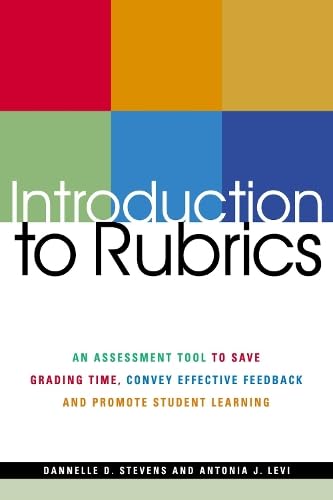
Introduction To Rubrics: An Assessment Tool To Save Grading Time, Convey Effective Feedback And Promote Student Learning - Hardcover
Inhaltsangabe
“Anyone struggling with the new landscape of direct assessment of student learning demanded by accreditors and employers will find this new and expanded edition of Introduction to Rubrics to be exactly what they need. Based upon their extensive experience, and drawing on a wide variety of examples of rubric use by faculty across institutions and disciplines, the authors clearly and insightfully present the value of rubrics, the process of developing rubrics and using them, and their usefulness for faculty, and for improving student learning. A 'must' read for anyone seriously interested in student learning enhancement.”? Terrell Rhodes,Vice President for the Office of Quality, Curriculum and Assessment, Association of American Colleges and Universities
"A rubric, the authors emphasize, is a tool. And their book itself is a wonderful tool for exploring how to use rubrics as tools. For a long time, I have been recommending the first edition to faculty in workshops I lead. I can recommend this second edition with even greater enthusiasm, because it does so much more, and does it so intelligently.
The authors offer advice about all the surrounding situations and problems that may accompany rubrics: how to get students involved in rubrics, how to use rubrics with TAs, how to collaborate with other faculty in constructing common rubrics, and how to use rubrics that someone else has constructed. The book focuses on rubrics but offers a great deal of advice about good teaching, good collaboration, and good assessment. In short, this book is a great tool."? From the Foreword by Barbara E. Walvoord,Professor Emerita, University of Notre Dame, and author of Effective Grading
This new edition retains the appeal, clarity and practicality that made the first so successful, and continues to provide a fundamental introduction to the principles and purposes of rubrics, with guidance on how to construct them, use them to align course content to learning outcomes, and apply them in a wide variety of courses, and to all forms of assignment.
Reflecting developments since publication of the first edition, the authors have extended coverage to include:
• Expanded discussion on use of rubrics for grading
• Grading on-line with rubrics
• Wider coverage of rubric types (e.g., holistic, rating scales)
• Rubric construction in student affairs
• Pros and cons of working with "ready-made" rubrics
• Using rubrics to improve your teaching, and for SoTL
• Use of rubrics in program assessment (case study)
• Application of rubrics in the arts, for study abroad, service learning and students’ independent learning
• Up-dated literature review
Die Inhaltsangabe kann sich auf eine andere Ausgabe dieses Titels beziehen.
Über die Autorin bzw. den Autor
Dannelle D. Stevens is a tenured professor in the Department of Curriculum and Instruction at Portland State University in Oregon where she has been since 1994. Her roots, however, are in the public school classroom where she taught middle school and high school social studies, language arts, and special education for 14 years across four school districts and three states. She received her master's from the University of Utah in 1983, and a doctorate in educational psychology from Michigan State in 1991. Before coming to PSU she taught at Whitman College in Walla Walla, Washington. Whether the topic is rubrics, journal writing, action research or academic writing, her work centers on how adults reflect on what they do and, then, act on those reflections. One of Dr. Stevens' underlying assumptions is that cognitive, social and emotional development does not end with the teenage years but continues through the lifetime. Besides over 75 conference presentations, she has written three books, all designed to impact development of her fellow faculty and their students. Her first book, co-edited with Joanne Cooper, Tenure in the Sacred Grove: Issues and Strategies for Women and Minorities, (SUNY Press, 2002), was written to help faculty women and minorities negotiate the path to tenure. Introduction to Rubrics, now in its second edition, and co-authored with Antonia J. Levi, and Journal Keeping, co-authored with Joanne Cooper, are both published by Stylus Publishing. In addition to teaching classes, she has taken on leadership positions in the department and campus-wide. In the Curriculum and Instruction Department, Dr. Stevens leads teacher licensure cohorts and coordinates the MA/MS program for experienced teachers. For the university at large, she works within the Center for Academic Excellence as faculty-in-residence for assessment. She is chair of the Institutional Assessment Council.
Antonia J. Levi is a professor of Japanese history and popular culture who taught for many years in Portland (Oregon) State University's University Studies Program, an innovative common core experience for Freshmen that created and utilizes many of the methodologies found in Introduction to Rubrics. Now retired, she serves part-time as a mentor and curriculum developer in Simon Fraser University's South Bank Writer's Program in British Columbia (Canada) where she is working on expanding the use of rubrics for creative writers. She has over thirty years of active classroom experience, and has worked on numerous projects from creating portfolios for seamless transitions to increasing opportunities for overseas studies programs. Her experience with rubrics in the classroom has contributed to these programs as well.
Barbara E. Walvoord is a Professor Emerita at the University of Notre Dame, Indiana. She is the author of numerous books, including Effective Grading: A Tool for Learning and Assessment with V. J. Anderson, and Assessment Clear and Simple: A Practical Guide for Institutions, Departments, and General Education
„Über diesen Titel“ kann sich auf eine andere Ausgabe dieses Titels beziehen.
Suchergebnisse für Introduction To Rubrics: An Assessment Tool To Save...

Beispielbild für diese ISBN
Introduction to Rubrics : An Assessment Tool to Save Grading Time, Convey Effective Feedback and Promote Student Learning
Anbieter: Better World Books, Mishawaka, IN, USA
Verkäuferbewertung 5 von 5 Sternen

Zustand: Good. Former library copy. Pages intact with minimal writing/highlighting. The binding may be loose and creased. Dust jackets/supplements are not included. Includes library markings. Stock photo provided. Product includes identifying sticker. Better World Books: Buy Books. Do Good. Bestandsnummer des Verkäufers 3759440-6
Gebraucht kaufen
EUR 22,82
Versand gratis
Versand innerhalb von USA
Versand innerhalb von USA
Anzahl: 1 verfügbar