
Verwandte Artikel zu Win the Fat War Cookbook: 175 Family-Style Recipes...
Inhaltsangabe
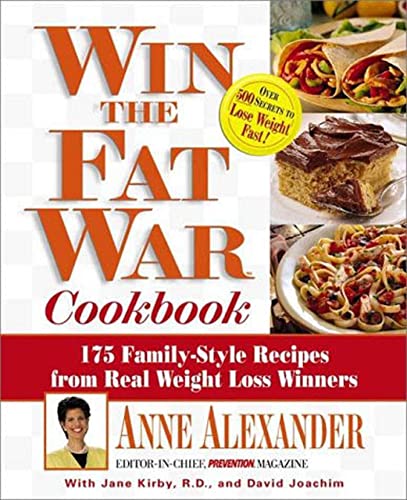
A collection of 175 low-fat family-style recipes includes blueberry pecan pancakes, orange almond chicken, and much, much more, accompanied by practical advice from some of the nation's leading weight-loss experts. 25,000 first printing.
Die Inhaltsangabe kann sich auf eine andere Ausgabe dieses Titels beziehen.
Auszug. © Genehmigter Nachdruck. Alle Rechte vorbehalten.
@CTG:Wisdom from the Winners
@ICRTF:You've heard the heartbreaking statistics: "Ninety-five percent of
people who lose weight will gain it back." It's enough to make you exchange
your scale for a frequent buyer's card at the plus-size store.
@RTF:Don't believe it. Plenty of people lose weight and keep it off. And
you can, too. That's worth repeating.
@RTF:Plenty of people lose weight and keep it off. And you can, too. <$>
@RTF:But what about that 95 percent failure rate? That's a widely quoted
statistic that comes from a study of only 100 people at a nutrition clinic
at New York Hospital in the 1950s. It does not represent the real world of
today, where lots of people lose weight and keep it off on their own. Our
evidence: Thousands of weight-loss winners are coming out and speaking up.
The innovative National Weight Control Registry at the University of
Pittsburgh School of Medicine has identified the largest group of weight-
loss winners ever recorded, and they have lots of good advice to share. We
also interviewed dozens of successful dieters. They're people just like
you. Some lost weight on their own. Some joined weight-loss programs. Some
had to lose weight for health reasons. Others wanted to make a better
impression at their high school reunions. And a few had simply had enough
of being overweight.
@A:Break the Rules
@RTF:The patterns of success that we saw in our interviews were the same as
those at the National Weight Control Registry. And they weren't what you
might expect. The registry has tracked more than 2,000 people who have lost
at least 30 £ds and kept it off for at least 1 year. Amazingly, the
average loss for those in the registry is about 65 £ds, and they have
maintained it for more than 6 years. What these people told us flies in the
face of conventional weight-loss wisdom. Consider these myth-busting
truths.
@RTF:It's never too late. <$>Being heavy as a child doesn't sentence you
to a life as an overweight adult. At the registry, 46 percent of the
participants said that they were overweight as children at age 11 or
younger. Twenty-five percent first became heavy between ages 12 and 18.
Only 28 percent became overweight as adults. That means most of these
weight-loss winners overcame a lifetime of being overweight.
@RTF:Forget your "ideal" weight. <$>Ideal weight is just that: an ideal.
The fact is that most people who consider themselves successful at
maintaining a weight loss drop only about half the £ds that they'd hoped
to drop. Weight-loss researcher Thomas Wadden, Ph.D., proves the point. He
and his colleagues asked 60 overweight women (their average weight was
about 218 £ds) to write down three different numbers: their ideal "goal"
weight, weight loss that they considered "acceptable," and weight loss that
they saw as "disappointing." Most set their ideal weights about 72 £ds
less than their current weights (an average ideal of 146 £ds). The
average "acceptable" weight loss was about 55 £ds (which would put them
at an average of 163 £ds). A loss of only 38 £ds was considered
"disappointing" (an average weight of 180).
@RTF:After 6 months of dieting, exercising, and behavior modification, plus
6 months of maintenance, the average weight loss sustained by these women
was only 36 £ds. Two £ds less<$> than their "disappointing" weight
loss. The good news? All were absolutely thrilled with their new weight.
Even though they hadn't reached the loss that they initially called
"disappointing," they felt better physically and emotionally than they had
ever expected.
@RTF:A weight loss of only 10 percent of your current weight is enough to
bring down high blood pressure, lower cholesterol and triglycerides
(substances that can put you at risk for heart disease), and improve your
overall medical health. And that translates into feeling better instantly.
So reach for a reasonable goal weight, not an ideal. That's exactly what
Susan Cursi did. Susan is 5 feet 5 inches tall and now weighs 130 £ds.
She lost 50 £ds and has kept it off for 5 years. But she had to get real
first. "I realized that I may never be as skinny as I was in high school.
But when I lost just 25 to 30 £ds, I felt so much better."
@RTF:Keep trying. <$>Contrary to rumors, yo-yo dieting (or continually
losing weight and gaining it back) does not lower your chances of ever
losing weight permanently. The research that started that rumor was done on
rats, not humans. Even so, it caused some weight-loss "experts" to think
that it might be healthier to stay heavy than to continue trying to lose
weight. Nothing could be further from the truth. A national task force was
organized to do a comprehensive survey of 43 human studies on the subject
(known among doctors as "weight cycling"). Guess what they concluded?
Repeat dieting does not increase body fat, make future weight-loss attempts
more difficult, or permanently lower metabolic rate (the rate at which your
body burns calories).
@RTF:Proof positive: Nearly all the weight-loss winners (91 percent) in the
National Weight Control Registry are veteran dieters. And these folks lost
an average of 60 £ds and kept it off for 10 years. The people we
interviewed had similar dieting patterns. So what triggered the lasting
success? Among other things, they all said that this time, they were going
to make long-term behavior changes. They more closely watched what they
ate, and they exercised more.
@RTF:Adrienne Jacobson dieted for years. She tried everything: weight-loss
pills, liquid diet products, even starvation. Finally, she found a
registered dietitian who designed an eating plan based on her
lifestyle<\m>a diet that she could stick with for the long haul. She met
with her dietitian once a week for positive reinforcement and fine tuning.
She has maintained a loss of 36 £ds for 3 ;1/2 years.
@RTF:Mark Ballard dropped an amazing 125 £ds<\m>but not the first time
he tried. "My first weight-loss attempt was a fast that I did in high
school. From there, I moved on: Weight Watchers, the Cambridge System, Slim
Fast, Nutri/System, Cabbage Soup." Mark eventually found that a sensible
low-fat eating plan and exercise worked for him. If you've tried before, it
couldn't hurt to try again. This time could be different.
@RTF:Ignore your family's weight history. <$>Genetics tell you only that
you have a tendency to be overweight. Your genes do not predict your
ability to lose weight. "I saw pictures of my grandmothers, great-
grandmothers, and great-great-grandmothers, and they were all overweight
and short like I am. My mother was only about 5 feet tall, and she was also
overweight," says Jean Ross. Despite her family's weight history, Jean
dropped 35 £ds and went from a size 22 to a size 12. How about the
weight-loss winners at the registry? Forty-six percent reported having at
least one parent who was overweight.
@RTF:Trust your instincts. <$>People told us that one of the keys to
permanent weight loss was getting triggered by something deep inside,
coming to a turning point, an incident or time in their lives that made
them say, "This...
„Über diesen Titel“ kann sich auf eine andere Ausgabe dieses Titels beziehen.
Suchergebnisse für Win the Fat War Cookbook: 175 Family-Style Recipes...

Beispielbild für diese ISBN
Win the Fat War Cookbook
Anbieter: World of Books (was SecondSale), Montgomery, IL, USA
Verkäuferbewertung 5 von 5 Sternen

Zustand: Good. Item in good condition. Textbooks may not include supplemental items i.e. CDs, access codes etc. Bestandsnummer des Verkäufers 00103623958
Gebraucht kaufen
EUR 7,02
Versand gratis
Versand innerhalb von USA
Versand innerhalb von USA
Anzahl: 1 verfügbar
Beispielbild für diese ISBN
The Win the Fat War Cookbook
Anbieter: Wonder Book, Frederick, MD, USA
Verkäuferbewertung 5 von 5 Sternen
Zustand: Very Good. Very Good condition. Good dust jacket. A copy that may have a few cosmetic defects. May also contain light spine creasing or a few markings such as an owner's name, short gifter's inscription or light stamp. Bestandsnummer des Verkäufers P04D-01671
Gebraucht kaufen
EUR 7,04
Versand gratis
Versand innerhalb von USA
Versand innerhalb von USA
Anzahl: 1 verfügbar
Beispielbild für diese ISBN
Win the Fat War : 175 Family Style Recipes from Real Weight-Loss Winners
Verlag:
Rodale Press, Incorporated, 2001
ISBN 10: 1579543634
ISBN 13: 9781579543631
Gebraucht
Hardcover
Anbieter: Better World Books, Mishawaka, IN, USA
Verkäuferbewertung 5 von 5 Sternen
Zustand: Good. Pages intact with minimal writing/highlighting. The binding may be loose and creased. Dust jackets/supplements are not included. Stock photo provided. Product includes identifying sticker. Better World Books: Buy Books. Do Good. Bestandsnummer des Verkäufers 55502693-6
Gebraucht kaufen
EUR 7,21
Versand gratis
Versand innerhalb von USA
Versand innerhalb von USA
Anzahl: 1 verfügbar
Beispielbild für diese ISBN
The Win the Fat War Cookbook
Anbieter: HPB-Emerald, Dallas, TX, USA
Verkäuferbewertung 5 von 5 Sternen
hardcover. Zustand: Very Good. Connecting readers with great books since 1972! Used books may not include companion materials, and may have some shelf wear or limited writing. We ship orders daily and Customer Service is our top priority! Bestandsnummer des Verkäufers S_466611562
Gebraucht kaufen
EUR 5,60
EUR 3,27 Versand
Versand innerhalb von USA
Versand innerhalb von USA
Anzahl: 1 verfügbar
Beispielbild für diese ISBN
The Win the Fat War Cookbook
Anbieter: HPB-Diamond, Dallas, TX, USA
Verkäuferbewertung 5 von 5 Sternen
hardcover. Zustand: Very Good. Connecting readers with great books since 1972! Used books may not include companion materials, and may have some shelf wear or limited writing. We ship orders daily and Customer Service is our top priority! Bestandsnummer des Verkäufers S_472743576
Gebraucht kaufen
EUR 7,28
EUR 3,27 Versand
Versand innerhalb von USA
Versand innerhalb von USA
Anzahl: 1 verfügbar
Beispielbild für diese ISBN
Win the Fat War Cookbook
Verlag:
Rodale, New York, 2001
ISBN 10: 1579543634
ISBN 13: 9781579543631
Gebraucht
Hardcover
Erstausgabe
Anbieter: gearbooks, The Bronx, NY, USA
Verkäuferbewertung 5 von 5 Sternen
Hardcover. Zustand: Very Good. Zustand des Schutzumschlags: Very Good. Carol Angstadt (Jacket Design) (illustrator). Copyright 2001. 357 pp. Solidly bound copy and dj with moderate external wear, crisp pages and clean text. Bestandsnummer des Verkäufers 2iDi0003
Gebraucht kaufen
EUR 14,35
EUR 5,65 Versand
Versand innerhalb von USA
Versand innerhalb von USA
Anzahl: 1 verfügbar