
Inhaltsangabe
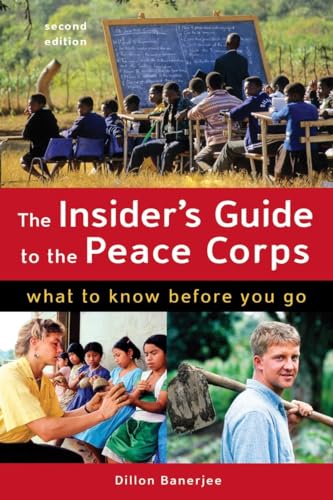
So, you want to join the Peace Corps . . . If you are interested in joining the Peace Corps, you probably have questions that run the gamut from "What is the application process like?" to "Is the Peace Corps effective as a development agency?" In this updated second edition, former Peace Corps volunteer Dillon Banerjee shares candid facts and insights about the experience in a practical question-and-answer format. With input from recently returned volunteers who served across the globe, this thorough guide presents valuable information including: • What Peace Corps recruiters look for in your application• Items you should--and shouldn't---pack for your two-year trip• Useful gadgets and technology that help volunteers stay connected from far away• Real answers to personal questions about culture shock, safety, dating, homesickness, and more Whether you're thinking of joining or have already been accepted and are preparing to leave, The Insider's Guide to the Peace Corps will help equip you for the unique challenges and rewards of the volunteer experience, regardless of your program area or country assignment. It's essential reading for anyone interested in "the toughest job you'll ever love."
Die Inhaltsangabe kann sich auf eine andere Ausgabe dieses Titels beziehen.
Über die Autorin bzw. den Autor
DILLON BANERJEE served as an agroforestry volunteer in the Peace Corps from 1994 to 1996 in Belo, Cameroon. He currently works as a U.S. diplomat in Lisbon, Portugal, where he is the director of the American Embassy's International Trade program.
THE AUTHOR SCOOP
Read any good books lately?
I was on a roll a while back with books like Blindness, Bel Canto, Life of Pi, Perfume, and The Road. I just started The Friends of the Earth by T.C. Boyle and am hopeful.
What was the hardest thing about writing a book?
Having it edited. After laboring for endless hours over the manuscript, my initial reaction to recommended changes was usually denial. Nothing could be changed because it was so obviously perfect. Between my wife and the top-notch editors at Ten Speed, however, I came to accept that too many cooks can't spoil the broth when it comes to polishing a book manuscript. Revisions usually translate to improvements.
What's the first concert you ever attended?
Tenth grade, Siouxsie and the Banshees at Warner Theater in Washington, DC. I had my black jeans, black sneakers, and black concert-T on, but felt like a preppie as I watched grown men in ballroom gowns scaling the stage speakers and jumping into the crowd below.
Know any good jokes?
My five-year-old son loves to tell this knock-knock joke:
Knock knock
Who's there?
Nobody.
Nobody who?
…(silence)…
Don't know why, but it still kind of cracks me up.
What's the farthest you've ever traveled?
My second assignment in the Foreign Service was to Moscow, Russia, where I served as a Commercial Officer at the Embassy for two years. About halfway through my tour, I was asked to lead a business delegation to the capital city in Siberia – Novosibirsk. Russia is an enormous country with 11 time zones; it's shorter to fly from Moscow to Boston than Moscow to Vladivostok (in the far east). My flight to Novosibirsk carried me over vast expanses of nothingness, and when I landed, I spammed friends and family in the States with SMS's just to tell them that I was in Siberia. In truth, Novosibirsk is a nice town with over a million people, replete with a metro system, opera house, cafes, university, and a huge manmade lake (the Ob Sea). Still, it felt way off the beaten path.
Auszug. © Genehmigter Nachdruck. Alle Rechte vorbehalten.
1 What is the application process like? How long does it take? The application process can be arduous and seemingly endless. The Peace Corps receives over two hundred thousand inquiries each year from people interested in applying. Tens of thousands of those people submit applications, and only a fraction is eventually accepted. Besides the fact that the Peace Corps is a government agency--which, by definition, means it can be slow and bureaucratic--the sheer number of applicants combined with the excruciating detail each must provide on the application forms make it easy to understand why the review process can last up to a year. The Peace Corps tells potential recruits that three personality traits are invaluable during the application process: persistence, patience, and a sense of humor. Persistence is required because, try as they may, the Peace Corps does not always review every application and forward every file in a timely manner. Every so often you'll need to prod and encourage them to keep the process moving. I knew an applicant who, after submitting his completed application, sat back and waited to hear from the Peace Corps. He never followed up with calls; he never thought to check on the status of his application. After almost six months of waiting, he received a letter notifying him that his application had been deemed "inactive." Apparently, having never heard from him, his recruiter assumed he had lost interest in joining. Patience is a virtue for Peace Corps applicants simply because, even if you are persistent and hound the office with weekly calls, the entire process may take anywhere from four to twelve months. Why does it take so long? Because there are several steps one must take to navigate successfully through the system. In a nutshell, they are: 1. Filling out the application. This is no easy feat, though it has been made a bit less cumbersome now that the entire process can be completed online. From Peace Corps' official website (www.peacecorps.gov), you can create an account that allows you to access the application and complete it in stages at your convenience. You can also track your progress so you know where you are in the process at any given time. That said, the application still consists of seventeen distinct sections ranging from queries on personal and legal information to military status, language skills, and employment history. The Peace Corps demands an account of every relevant course, internship, summer job, and hobby that may qualify you for one of their programs. You must provide three references (one professional, one personal, and one from a volunteer work supervisor) and write two five hundred-word essays (detailing your motivation to apply, and any past cross-cultural experiences). The Office of Personnel Management (OPM) estimates that the Peace Corps application should take approximately eight hours to complete. In reality, expect to be filling in the blanks for days, if not weeks, due to the amount and depth of information requested. If you are unable to access or complete the forms online, you can request that Peace Corps send you hard copies so you can put pen to paper. 2. Passing an interview. Once your application has been reviewed, the Peace Corps determines whether or not you "fit" into any of their program areas. If you do, you will be called into the nearest Peace Corps office for an interview with a recruiter. If you are unable to attend in person, the interview may be conducted over the phone. This step of the process is a major screening tool for the Peace Corps. It is their forum for evaluating your level of commitment, maturity, and experience, and it is your golden opportunity to sell yourself, your skills, and your ambition. During the interview, expect to be grilled on your reasons for wanting to join, your expectations, your hopes and fears, your strengths and weaknesses, and your preferences with regard to the Peace Corps' geographic and program areas. They may also ask you whether or not you are dating anyone seriously--a red flag to help them identify volunteers who may quit before their two-year commitments are fulfilled (see questions 59 and 60 for more on early termination [ET]). You should treat the interview as you would any other job interview. Be professional, confident, assertive, and prepared. Many applicants assume they can wear shorts and a T-shirt, or show up without preparation since it's an interview for the Peace Corps. Recruiters will be turned off by that. They are not looking for applicants who come across as extremely liberal or laid-back; they're looking for the best-qualified applicants among thousands of competitors. 3. Securing a nomination. Assuming the interview goes well, your recruiter will "nominate" you for one of the Peace Corps' programs. Possibilities include education, youth outreach, community development, business development, environment, agriculture, health, HIV/AIDS, and information technology. For a complete description of Peace Corps programs, refer to appendix C. If you aren't slotted for a program that interests you, this would be the time to speak with your recruiter about revisiting your qualifications as they may relate to other programs. You'll also be told the region of the world in which you will most likely serve, the language requirements for that region, and your approximate date of departure. On the one hand, receiving such information boosts your morale and provides exciting news for friends and family. On the other hand, once the initial impact wears off, impatience and frustration tend to grow. You'll quickly realize how much of the picture is still missing. You won't know the exact country assignment, the actual date of departure, the specific language(s) you'll be learning, or the details of the projects you will be working on. This is usually the stage that applicants find the most trying. 4. Physical and legal screening. Step 4 is when you undergo a thorough medical, dental, and legal review, while the Peace Corps checks on all of your references and validates the information provided on your application. The physical, dental, and eye exams can all be conducted by your regular doctors; costs are reimbursed by the Peace Corps. Legal clearances include an FBI background check and a closer look at issues related to financial obligations or debts, dependents, and marital status. During this stage, your recruiter will also keep his or her eyes peeled for specific openings that suit your qualifications. Timing is everything at this point. If your medical exams go off without a hitch, hound the office to ensure that Peace Corps nurses review your file in a timely manner. Call your recruiter frequently to follow the progress of your background and reference check, and inquire about his or her efforts to place your name in an available and appropriate volunteer slot. 5. Receiving an invitation. The last stage of the application process is receiving the coveted "invitation" for a specific program, in a specific country, leaving on a specific day. You will be invited, for example, to teach English as a second language in Niger, leaving August 3. You'll have only ten days to accept the invitation, so do some quick research and some serious soul-searching to be sure that you are committed and willing to go. If you have doubts about the country to which you've been assigned--perhaps it's predominantly French-speaking, Muslim, and urban, whereas you had your hopes set on Spanish-speaking, animist, and rural--you may want to inquire about other possibilities. Be sure, though, that your doubts are substantial and reasonable, not impulsive or superficial, and communicate them clearly to your recruiter. If you bow out of your initial invitation because you've heard the food stinks and the beaches are dirty, you're likely not to receive...
„Über diesen Titel“ kann sich auf eine andere Ausgabe dieses Titels beziehen.
Suchergebnisse für The Insider's Guide to the Peace Corps: What to...

Beispielbild für diese ISBN
The Insider's Guide to the Peace Corps : What to Know Before You Go
Verlag:
Potter/Ten Speed/Harmony/Rodale, 2009
ISBN 10: 1580089704
ISBN 13: 9781580089708
Gebraucht
Softcover
Anbieter: Better World Books: West, Reno, NV, USA
Verkäuferbewertung 5 von 5 Sternen

Zustand: Very Good. 2nd. Pages intact with possible writing/highlighting. Binding strong with minor wear. Dust jackets/supplements may not be included. Stock photo provided. Product includes identifying sticker. Better World Books: Buy Books. Do Good. Bestandsnummer des Verkäufers 5294234-75
Gebraucht kaufen
EUR 5,89
Versand gratis
Versand innerhalb von USA
Versand innerhalb von USA
Anzahl: 1 verfügbar
Beispielbild für diese ISBN
The Insider's Guide to the Peace Corps : What to Know Before You Go
Verlag:
Potter/Ten Speed/Harmony/Rodale, 2009
ISBN 10: 1580089704
ISBN 13: 9781580089708
Gebraucht
Softcover
Anbieter: Better World Books, Mishawaka, IN, USA
Verkäuferbewertung 5 von 5 Sternen
Zustand: Good. 2nd. Former library copy. Pages intact with minimal writing/highlighting. The binding may be loose and creased. Dust jackets/supplements are not included. Includes library markings. Stock photo provided. Product includes identifying sticker. Better World Books: Buy Books. Do Good. Bestandsnummer des Verkäufers GRP94259549
Gebraucht kaufen
EUR 5,89
Versand gratis
Versand innerhalb von USA
Versand innerhalb von USA
Anzahl: 2 verfügbar
Beispielbild für diese ISBN
The Insider's Guide to the Peace Corps: What to Know Before You Go
Verlag:
Clarkson Potter/Ten Speed, 2009
ISBN 10: 1580089704
ISBN 13: 9781580089708
Gebraucht
Softcover
Anbieter: Wonder Book, Frederick, MD, USA
Verkäuferbewertung 5 von 5 Sternen
Zustand: Very Good. Very Good condition. A copy that may have a few cosmetic defects. May also contain light spine creasing or a few markings such as an owner's name, short gifter's inscription or light stamp. Bestandsnummer des Verkäufers L13A-02061
Gebraucht kaufen
EUR 6,85
Versand gratis
Versand innerhalb von USA
Versand innerhalb von USA
Anzahl: 1 verfügbar
Beispielbild für diese ISBN
The Insider's Guide to the Peace Corps: What to Know Before You Go
Verlag:
Clarkson Potter/Ten Speed, 2009
ISBN 10: 1580089704
ISBN 13: 9781580089708
Gebraucht
Softcover
Anbieter: Wonder Book, Frederick, MD, USA
Verkäuferbewertung 5 von 5 Sternen
Zustand: As New. Like New condition. A near perfect copy that may have very minor cosmetic defects. Bestandsnummer des Verkäufers L19B-04683
Gebraucht kaufen
EUR 6,85
Versand gratis
Versand innerhalb von USA
Versand innerhalb von USA
Anzahl: 1 verfügbar
Foto des Verkäufers
The Insider's Guide to the Peace Corps: What to Know Before You Go
Verlag:
Clarkson Potter/Ten Speed, 2009
ISBN 10: 1580089704
ISBN 13: 9781580089708
Gebraucht
Softcover
Anbieter: Goodwill Books, Hillsboro, OR, USA
Verkäuferbewertung 5 von 5 Sternen
Zustand: acceptable. Fairly worn, but readable and intact. If applicable: Dust jacket, disc or access code may not be included. Bestandsnummer des Verkäufers GICWV.1580089704.A
Gebraucht kaufen
EUR 4,04
EUR 3,49 Versand
Versand innerhalb von USA
Versand innerhalb von USA
Anzahl: 1 verfügbar
Beispielbild für diese ISBN
The Insider's Guide to the Peace Corps: What to Know Before You Go
Anbieter: ThriftBooks-Atlanta, AUSTELL, GA, USA
Verkäuferbewertung 5 von 5 Sternen
Paperback. Zustand: Very Good. No Jacket. May have limited writing in cover pages. Pages are unmarked. ~ ThriftBooks: Read More, Spend Less. Bestandsnummer des Verkäufers G1580089704I4N00
Gebraucht kaufen
EUR 7,64
Versand gratis
Versand innerhalb von USA
Versand innerhalb von USA
Anzahl: 1 verfügbar
Beispielbild für diese ISBN
The Insider's Guide to the Peace Corps: What to Know Before You Go
Anbieter: ThriftBooks-Dallas, Dallas, TX, USA
Verkäuferbewertung 5 von 5 Sternen
Paperback. Zustand: As New. No Jacket. Pages are clean and are not marred by notes or folds of any kind. ~ ThriftBooks: Read More, Spend Less. Bestandsnummer des Verkäufers G1580089704I2N00
Gebraucht kaufen
EUR 7,64
Versand gratis
Versand innerhalb von USA
Versand innerhalb von USA
Anzahl: 1 verfügbar
Beispielbild für diese ISBN
The Insider's Guide to the Peace Corps: What to Know Before You Go
Anbieter: ThriftBooks-Atlanta, AUSTELL, GA, USA
Verkäuferbewertung 5 von 5 Sternen
Paperback. Zustand: Very Good. No Jacket. Former library book; May have limited writing in cover pages. Pages are unmarked. ~ ThriftBooks: Read More, Spend Less. Bestandsnummer des Verkäufers G1580089704I4N10
Gebraucht kaufen
EUR 7,64
Versand gratis
Versand innerhalb von USA
Versand innerhalb von USA
Anzahl: 1 verfügbar
Beispielbild für diese ISBN
The Insider's Guide to the Peace Corps: What to Know Before You Go
Anbieter: Foggypaws, Sonoma, CA, USA
Verkäuferbewertung 5 von 5 Sternen
Paperback. Zustand: Good. Paperback in good to very good condition. All inside pages are in great shape. Minor shelf wear to the cover. Ex library. Bestandsnummer des Verkäufers mon0000036473
Gebraucht kaufen
EUR 3,97
EUR 7,00 Versand
Versand innerhalb von USA
Versand innerhalb von USA
Anzahl: 1 verfügbar
Beispielbild für diese ISBN
The Insider's Guide to the Peace Corps: What to Know Before You Go
Verlag:
Clarkson Potter/Ten Speed, 2009
ISBN 10: 1580089704
ISBN 13: 9781580089708
Gebraucht
paperback
Anbieter: HPB-Emerald, Dallas, TX, USA
Verkäuferbewertung 5 von 5 Sternen
paperback. Zustand: Very Good. Connecting readers with great books since 1972! Used books may not include companion materials, and may have some shelf wear or limited writing. We ship orders daily and Customer Service is our top priority! Bestandsnummer des Verkäufers S_476580441
Gebraucht kaufen
EUR 8,56
EUR 3,28 Versand
Versand innerhalb von USA
Versand innerhalb von USA
Anzahl: 1 verfügbar