
Verwandte Artikel zu The Ballets Russes and the Art of Design
Inhaltsangabe
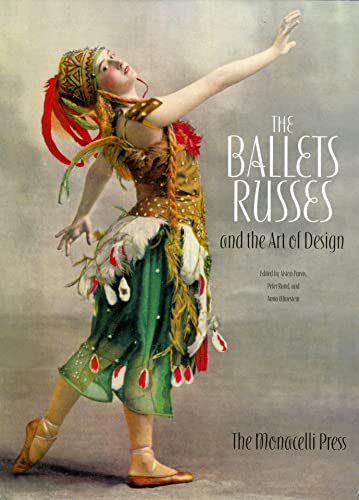
The Ballets Russes was a phenomenon of the early twentieth century, permeating daily life wherever the company traveled and leaving a lasting impact on dance, theater, and the visual arts. Sergei Diaghilev, impresario from 1909 until his death in 1929, fused the most avant-garde, groundbreaking movements in dance, choreography, art, design, and costume into unique and stunning productions. The work was exciting, and always new, and it stretched the limits of the possible in art. The color, form, and material in costume and set design astonished audiences, transforming every corner of Western culture in the twentieth century. Fashion and decor designers and visual artists in particular―including Coco Chanel, Natalia Goncharova, Mikhail Larionov, Léon Bakst, and Pablo Picasso―found inspiration in the Ballets Russes. Designers and artists moved past old boundaries and created costumes and set designs for these extravagant productions, bridging the gaps between tangible and abstract artistic genres. The Ballets Russes and the Art of Design explores these revolutionary icons and ideas, illuminating Sergei Diaghilev's profound revitalization of the arts, which continues to influence us today. Ten essays by internationally recognized experts and 200 color and black-and-white illustrations―many from private collections and never-before-published―discuss a broad range of topics, including set and costume designs, graphic design and poster art, photographs and postcards, Diaghilev's presence in the media, and private and museum collections of Ballets Russes treasures.
Die Inhaltsangabe kann sich auf eine andere Ausgabe dieses Titels beziehen.
Über die Autorin bzw. den Autor
Alston Purvis, chair of the department of graphic design, College of Fine Arts, Boston University, has written numerous books, including Type: A Visual History of Typefaces and Graphic Styles, Vol. 1, Dutch Graphic Design: A Century of Innovation, and Meggs' History of Graphic Design.
Peter Rand teaches writing at the College of Communication, Boston University, and is the author of numerous works of fiction and nonfiction, including Firestorm and China Hands.
Anna Winestein is a historian and scholar of Russian culture working on her doctoral dissertation at Oxford University.
Auszug. © Genehmigter Nachdruck. Alle Rechte vorbehalten.
From: Introduction by Peter Rand
The show's the thing, to paraphrase Shakespeare. Sergei Diaghilev, the Ballets Russes impresario, was a showman, vulgar though it may seem to say so. Only a master of show business of a very high order could have harnessed the genius of great artists and fused elements of the fine arts to stage works for the musical theater with such professional success for two decades. Diaghilev in some respects created the model for twentieth-century impresarios like Florenz Ziegfield, Billy Rose, and Mike Todd. He possessed a genius for publicity. He was able to hold his own among bankers and theater people. He knew his particular audience, and he knew how to keep them entertained.
Diaghilev stands alone, however, among those showmen who came before and those who followed because he was a provocateur, a passionate aesthete with a radical mission to show an audience, as with a mirror, works that would disturb its self-image and incite it to think in new ways about art. Painting and the art of the new formed the foundations of the Ballets Russes mission, which grew to include musical composition and dance. For Diaghilev, show business was the means to an end. He never sacrificed his mission to the demands of the box office.
The Ballets Russes product was conceived and refined, aesthetically and ideologically, over two decades before Diaghilev launched his first season in 1909, in the World of Art workshop. This was the informal club of young men who, under the inspired guidance of Alexandre Benois, used to meet regularly in Saint Petersburg. Diaghilev was a vital force in this group, which claimed Léon Bakst as an early confederate. Diaghilev was an ambitious proponent of its ideas, but it must be said that the Ballets Russes was the product of a collective mission to assert new values in Russian painting and, in the new century, to introduce to the Paris salons a peculiarly Russian contribution to painting of the new century in Europe.
. . .
He set forth with the confidence of someone who knows exactly what he needs to do. Victory was a foregone conclusion. He understood the members of his audience better than they knew him, and this was his power. He did not want to turn them to stone. He'd done that in Saint Petersburg. He wanted to excite them and show them a spectacle that would arouse them and break some taboos. He used the rhythms of Russian music, classical ballet performance with new choreography, and vibrant design to awaken archetypal drives, long repressed, that ranged from eros to thanatos. He did so with spectacles that demanded absolute perfection and integrity in every aspect of the various disciplines employed.
From this beginning, under the command of Diaghilev, the Ballets Russes matured over twenty years into a theater of experiment in the relationship between form, image, and content in dance. These showpieces continued to shock, and they continued to reflect a world of bewildering change. Great works came into being under the command of Diaghilev. To make this happen, he played to a capitalist gallery that was always prepared to be bored. He solved the problem by creating the new. He led his troupe through a world war, across the ocean, and from one country to another.
Diaghilev showed his audience how to imagine the future. That future is with us, now. As you behold the images on these pages, and read the thoughtful commentaries that elucidate aspects of the Ballets Russes, you may find a kind of inspiration of your own reflected here for the time in which we now live. Such is the gift, however fragmentary, that the Ballets Russes continues to supply.
„Über diesen Titel“ kann sich auf eine andere Ausgabe dieses Titels beziehen.
Suchergebnisse für The Ballets Russes and the Art of Design

Foto des Verkäufers
The Ballets Russes and the Art of Design
Verlag:
The Monacelli Press, 2009
ISBN 10: 1580932541
ISBN 13: 9781580932547
Gebraucht
Hardcover
Erstausgabe
Anbieter: Lavendier Books, Foster, RI, USA
Verkäuferbewertung 5 von 5 Sternen

hardcover. Zustand: Very Good. First Edition. The Monacelli Press; New York, 2009. Hardcover. First Edition. A Very Good, blue cloth binding with white lettering on front board and spine, binding sturdy and intact, some rubbing along board and spine edges, mild scattered foxing top text block edge, in a Very Good, some handling/scuff marks to panels, bit of edge/corner wear, Dust wrapper. A nice, clean and unmarked copy. 4to[quarto or approx. 11.5 x 13.5 inches], 208pp., contributors, donors, indexed, acknowledgements, color and b&w illustrations. We pack securely and ship daily with delivery confirmation on every book. The picture on the listing page is of the actual book for sale. Additional Scan(s) are available for any item, please inquire.Please note: Oversized books/sets MAY require additional postage then what is quoted for 2.2lb book. Bestandsnummer des Verkäufers SKU1045637
Gebraucht kaufen
EUR 52,90
EUR 5,99 Versand
Versand innerhalb von USA
Versand innerhalb von USA
Anzahl: 1 verfügbar
Foto des Verkäufers
THE BALLETS RUSSES AND THE ART OF DESIGN
Verlag:
The Monacelli Press, New York, 2009
ISBN 10: 1580932541
ISBN 13: 9781580932547
Gebraucht
Hardcover
Erstausgabe
Anbieter: Lost Horizon Bookstore, Santa Barbara, CA, USA
Verkäuferbewertung 5 von 5 Sternen
Hard cover. Zustand: Fine. Zustand des Schutzumschlags: Fine. First edition. 13'' x 9 1/2''. 208pp. With ten essays by internationally recognized experts and 200 color and black-and-white illustrations. Bestandsnummer des Verkäufers 57629
Gebraucht kaufen
EUR 52,90
EUR 5,99 Versand
Versand innerhalb von USA
Versand innerhalb von USA
Anzahl: 1 verfügbar
Beispielbild für diese ISBN
The Ballets Russes and the Art of Design
Verlag:
The Monacelli Press, 2009
ISBN 10: 1580932541
ISBN 13: 9781580932547
Gebraucht
Hardcover
Erstausgabe
Anbieter: Widney Manor Books, Solihull, MIDLA, Vereinigtes Königreich
Verkäuferbewertung 5 von 5 Sternen
Hardcover. Zustand: Good. Zustand des Schutzumschlags: Good. 1st Edition. Book and dust jacket in good condition. 208pp with colour illustrations. Bestandsnummer des Verkäufers 040137
Gebraucht kaufen
EUR 234,74
EUR 23,38 Versand
Versand von Vereinigtes Königreich nach USA
Versand von Vereinigtes Königreich nach USA
Anzahl: 1 verfügbar
Beispielbild für diese ISBN
The Ballets Russes and the Art of Design
Anbieter: GoldBooks, Denver, CO, USA
Verkäuferbewertung 5 von 5 Sternen
Hardcover. Zustand: new. New Copy. Customer Service Guaranteed. Bestandsnummer des Verkäufers 75R58_39_1580932541
Neu kaufen
EUR 304,49
EUR 4,71 Versand
Versand innerhalb von USA
Versand innerhalb von USA
Anzahl: 1 verfügbar