Inhaltsangabe
"The church must be distinct from the world to reach the world."
- From Chapter 1
"But you are a chosen race, a royal priesthood, a holy nation, a people for [God's] own possession, that you may proclaim the excellencies of him who called you out of darkness into his marvelous light" (1 Peter 2:9, ESV).
Holy and dedicated to declaring the excellencies of God-this is the church, or is it? Can we really call the church holy?
- A minority of those who claim to be born again say they believe in moral absolutes (Source: Barna Research).
- One third of evangelicals between the ages of 18 and 35 have no problem with unmarried men and women living together (Source: Evangelical Alliance).
Evangelical Christianity is becoming increasingly worldly. Materialism, hedonism, violence, sexual misconduct, pluralism, and divorce are becoming as common within the church as without. As a result the church is losing its distinct identity as a people set apart to reach the world.
In this book, R. Kent Hughes builds a case for godliness in the church-a case that echoes the biblical call to holiness. The church can reach the world only if it keeps itself from being ensnared by the world. Hughes is not simply urging Christians to say no to worldliness-he is calling the church to say yes to Christ and to his call to reach our lost world.
Die Inhaltsangabe kann sich auf eine andere Ausgabe dieses Titels beziehen.
Über die Autorin bzw. den Autor
R. Kent Hughes (DMin, Trinity Evangelical Divinity School) is senior pastor emeritus of College Church in Wheaton, Illinois, and former professor of practical theology at Westminster Theological Seminary in Philadelphia, Pennsylvania. Hughes is also a founder of the Charles Simeon Trust, which conducts expository preaching conferences throughout North America and worldwide. He serves as the series editor for the Preaching the Word commentary series and is the author or coauthor of many books. He and his wife, Barbara, live in Spokane, Washington, and have four children and an ever-increasing number of grandchildren.
Auszug. © Genehmigter Nachdruck. Alle Rechte vorbehalten.
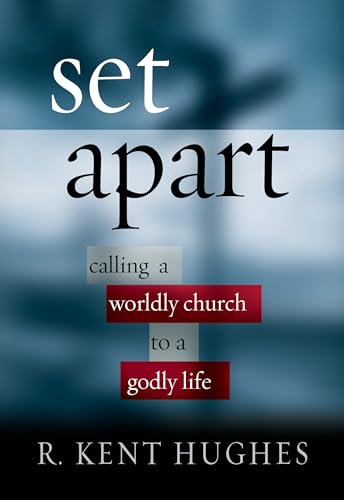
Set Apart
Calling a Worldly Church to a Godly Life
By R. Kent HughesGood News Publishers
Copyright © 2003 R. Kent Hughes
All rights reserved.
ISBN: 978-1-58134-491-2All rights reserved.
Contents
Acknowledgments,
Preface,
1 Set Apart to Save,
2 Set Apart to Save: Materialism,
3 Set Apart to Save: Hedonism,
4 Set Apart to Save: Viewing Sensuality,
5 Set Apart to Save: Violence and Voyeurism,
6 Set Apart to Save: Sexual Conduct,
7 Set Apart to Save: Modesty,
8 Set Apart to Save: Pluralism,
9 Set Apart to Save: Marriage,
10 Set Apart to Save: Church and the Lord's Day,
11 Set Apart to Save: The Unending Yes,
Appendix I: The Gospel-Old and New,
Appendix II: Internet Safety,
Scripture Index,
General Index,
CHAPTER 1
Set Apart to Save
"Now therefore, if you will indeed obey my voice and keep my covenant, you shall be my treasured possession among all peoples, for all the earth is mine; and you shall be to me a kingdom of priests and a holy nation. These are the words that you shall speak to the people of Israel."
EXODUS 19:5-6
As you come to him, a living stone rejected by men but in the sight of God chosen and precious, you yourselves like living stones are being built up as a spiritual house, to be a holy priesthood, to offer spiritual sacrifices acceptable to God through Jesus Christ.
1 PETER 2:4-5
If we had only the story of Lot's life as it is told in the book of Genesis, we would never have imagined that Lot was a true believer. But Second Peter 2 tells us three times that this conflicted, compromised man was "righteous" — and more, that he was "distressed" and tormented by life in Sodom. Peter's carefully crafted description of Lot is this: "... righteous Lot, greatly distressed by the sensual conduct of the wicked (for as that righteous man lived among them day after day, he was tormenting his righteous soul over their lawless deeds that he saw and heard) ..." (vv. 7-8). Ironically, though Lot was revolted by Sodom, Sodom was in his soul. It is possible, then, for a believer to be distressed by the world while willfully clinging to the world.
There is every evidence that righteous Lot was of no benefit whatsoever to the inhabitants of Sodom. Though he lived in Sodom for years and was prominent in its gates, and therefore would have had many opportunities to influence his friends, Lot utterly disappointed. When judgment fell on Sodom, not one righteous person could be found outside his family. No acquaintances, no neighbors, not one of his servants had come to know the Lord. His plea with the Sodomites in front of his door was dismissed by them out of hand. Lot lacked gravitas; his words carried no weight.
Even more tragically, Lot's life did nothing to point his family and relatives to heaven. None of his family or friends feared God. When he urged his then future sons-in-law to flee the cities' destruction, they thought he was "jesting." Lot's words had no substance because he was so insubstantial. Additionally Lot's lifestyle had done nothing to loosen the culture's grip on his wife. She left her heart in Sodom and therefore couldn't resist turning around — to her destruction. The very woman who bore his children, who was on most intimate terms with him, who knew the contours of his soul, saw nothing in him or in his faith to point her from earth to heaven.
It is also evident that Lot's life choices had promoted his daughters' absorbing of the spirit of Sodom into their souls. Deception, of course, was a way of life in Sodom. And Lot was part of it. But his deception was spiritually charged and therefore domestically lethal. Inwardly he was "greatly distressed by the sensual conduct of the wicked" and "was tormenting his righteous soul," says Peter; but outwardly he said little or nothing because he had become a prominent man in town. Forthrightness, anything approaching a witness, would have jeopardized his standing. Lot had mastered the craft of turning a blind eye and deaf ear to the social and sexual abuses of Sodom. He didn't practice them. He didn't approve of them. He loathed them. But he didn't speak out against them. Blasphemies and filthy speech were met by Lot's easy politic smile and careful deflection.
His daughters saw his accommodating character that so deftly masked what he really thought. Lot the survivor was a master. His girls could not forget that he had offered them to appease the inflamed men of Sodom in his infamous betrayal of fatherly duty. So when the successive father-daughter seductions took place, his girls used the craft he had bequeathed to them. It was his wine, his deceit, his betrayal mixed together and served in a dark cup in the depths of the cave. His daughters' dishonor of him was brilliant, because with cruel irony he himself carried out the shameful act he had first suggested to the men of Sodom. Lot had effectively sown Sodom into his daughters' souls.
Lot's folly was this: Though the worldliness of Sodom vexed his righteous soul, he lived as close to the world as he could, hanging on to it for dear life until the bitter end. And the result was that though God judged all of Sodom except Lot and his daughters, Sodom was reborn in their very lives. We see, then, that it is possible for believing people like us who are truly distressed by the course of this world to live lives that are so profoundly influenced by culture that Sodom is reborn in the lives of those we love the most.
Fair warnings. The enticements to yield to this syndrome and become indistinct from culture have never been more powerful than they are right now because of our prosperity, cyber-options, and the powers of the media. I sense that these are crucial days culturally and spiritually. And I am not alone. Those who poll religious interests — including George Gallup, Barna Research, the Princeton Religion Research Center, and ChristianityToday.com — indicate that evangelical Christianity is becoming increasingly worldly, and that it is ever more becoming a mere mirror of secular culture.
The September 2001 issue of Emerging Trends, published by the Princeton Religion Research Center, bears the headline "Religion Is Gaining Ground, But Morality Is Losing Ground." Positively it notes that adult weekly church attendance has increased from 38 percent in 1996 to 44 percent in 2000 — up 6 percent in four years. The same is true of teenaged students, only higher, from 42 percent to 53 percent, an increase of 11 percent in four years. There is also an uptrend in adult Bible reading (weekly or two or three times weekly), from 18 percent in 1982 to 26 percent in 2000. Yet at the same time one Gallup Poll indicates that 78 percent say that our moral values are "somewhat weak" or "very weak" and that morals are in decline.
This is corroborated by a study by the Evangelical Alliance (the British counterpart to the National Association of Evangelicals), which found that one third of evangelicals between the ages of eighteen and thirty-five say they have no problem with unmarried men and women living together. One Christian college president here in the U.S. confided to a Christianity Today editor that the most perplexing puzzle he and his staff were facing regarding their present student body was that student leaders were outspoken in their Christian commitment and yet living with a girlfriend or boyfriend — and not seeing a disconnect. Significantly, Barna Research listed the following as one of the most discouraging findings of 2000: "Born again adults are more likely to experience a divorce than are non-born again adults (27% vs. 24%)."
In the same issue it was noted that a minority of born-again adults (44 percent) and an even smaller proportion of born-again teenagers (9 percent) are certain of the existence of absolute moral truth. George Barna's recent book Boiling Point categorically states that moral anarchy has arrived and rules our culture, and that we are now in a state of spiritual anarchy. The implication is that some ominous times are ahead for a church that dares to insist that there is absolute truth. This isn't helped by the biblical ignorance that afflicts so many young Christians in the upcoming generation, 40 percent of whom hold the view that Jesus Christ committed sins!
All of this together — the ignorance, the spiritual anarchy, the growing acceptance of relativism among Christians, divorce rates that exceed those of secular culture, the rise of cohabitation among professing Christians, the increase of worldliness in the church despite growing attendance and Bible reading — suggests that the church is becoming indistinct from the world — worldly. And more, the failure of its increasing numbers to make a difference in the world shouts of compromise. Indeed, what we see now may be an Indian summer, the last gasp of the warm, sunny days before a long, dark spiritual winter.
Who can deny Robert Gundry's assertion that the evangelical enterprise has become worldly, that materialism grips the church, that pleasure-seeking dominates us, that evangelicals watch sensuality and violence like everyone else, that immodesty is de jure, that voyeurism and pornography and sexual laxity and divorce are on the rise, and that we, like Lot, could find that Sodom has been born anew in our own homes. God help us if while decrying sin, we are sprinting headlong after it.
We must lay this to heart: A worldly church cannot and will not reach the world. The church must be distinct from the world to reach the world. We must set ourselves apart to God if we hope to reach the world. In a word, the only hope for us and the lost world is a holy church.
GOD'S PLAN: A PEOPLE SET APART (DISTINCT) FROM THE WORLD TO REACH THE WORLD
From the onset God's plan for reaching the world has been to create a people distinct from the world who would then minister to and reach the world.
God's plan: Israel. This was God's global plan for his chosen people as first told to Abraham: "And I will make of you a great nation, and I will bless you ... and in you all the families of the earth shall be blessed" (Genesis 12:2-3; cf. 18:18).
A kingdom of priests. As Israel became a nation during the four centuries that followed their captivity in Egypt, the manner of their becoming a blessing was unclear. But after the Exodus and before Israel's entry into the Promised Land, God made it very clear to Moses as he gave them the Ten Commandments: "You yourselves have seen what I did to the Egyptians, and how I bore you on eagles' wings and brought you to myself. Now therefore, if you will indeed obey my voice and keep my covenant, you shall be my treasured possession among all peoples, for all the earth is mine; and you shall be to me a kingdom of priests and a holy nation" (Exodus 19:4-6). As a kingdom of priests they would then offer sacrifices and intercede for the whole world. What a stupendous designation — a kingdom of priests — every Israelite a priest to the Gentile nations!
A holy people. The key, the secret, behind Israel's worldwide ministry was to be their holiness (or set-apartness) as a holy nation. The parallel version of their commission at Mount Sinai in Deuteronomy says, "For you are a people holy to the LORD your God. The LORD your God has chosen you to be a people for his treasured possession" (Deuteronomy 7:6). Holiness is essential to God's nature; it is not so much an attribute of God as it is the very foundation of his being. Holiness denotes the separateness or otherness of God from all his creation. God is set apart from all that is unclean or evil.
The holiness of God was to be the example and motivation for God's people to be set apart as holy, that they might reach the world. This is a great theme in the book of Leviticus, which repeatedly highlights the fact that they must be distinct from and holier than the nations around them:
"For I am the LORD who brought you up out of the land of Egypt to be your God. You shall therefore be holy, for I am holy."
— LEVITICUS 11:45
And the LORD spoke to Moses, saying, "Speak to all the congregation of the people of Israel and say to them, You shall be holy, for I the LORD your God am holy."
— LEVITICUS 19:1-2
"Consecrate yourselves, therefore, and be holy, for I am the LORD your God. Keep my statutes and do them; I am the LORD who sanctifies you."
— LEVITICUS 20:7-8
"You shall be holy to me, for I the LORD am holy and have separated you from the peoples, that you should be mine."
— LEVITICUS 20:26
The sum of their call was that they be separated to God and consecrated to serve him in holiness. This is where their power lay. Israel's distinctiveness was to leverage them for ministry to a sinful world.
A light to the Gentiles. Isaiah repeatedly refers to Israel as a light for the Gentiles. The context of those declarations is the servant songs in which the servant is sometimes corporate Israel and sometimes an individual servant, prophesying the Messiah, the ultimate light to the Gentiles (see 42:6; 49:1-6; cf. 60:1). But national Israel, set apart as holy, was in its time to be a beacon to the dark Gentile world.
But Israel never reached its potential. Aaron's golden calf shows how miserably Israel could fail in becoming a nation holy to the Lord (cf. Exodus 32 — 34). Likewise, the failed attempt to enter Canaan was due to Israel's faithlessness and fears (cf. Numbers 13 — 14). Israel's repeated lapses into idolatry as recorded in Judges, the sins of the latter prophets, and the many failures of the people all testify to their descent from holiness, despite glowing exceptions. Israel never achieved its potential as a kingdom of priests and a light to the Gentiles.
Someday, as Zechariah says:
"Many peoples and strong nations shall come to seek the LORD of hosts in Jerusalem and to entreat the favor of the LORD. Thus says the LORD of hosts: In those days ten men from the nations of every tongue shall take hold of the robe of a Jew, saying, 'Let us go with you, for we have heard that God is with you.'"
— ZECHARIAH 8:22-23
But that did not happen with national Israel. It yet awaits a future fulfillment in the last days.
God's plan: Jesus. When Jesus came, he succeeded where Israel had failed. As the ultimate seed of Abraham, Jesus is true Israel (cf. Galatians 3:16). He was called out of Egypt as was the nation of Israel (cf. Matthew 2:15). As true Israel, he succeeded in resisting Satan's wilderness temptations, whereas corporate Israel had failed (cf. Matthew 4:1-11; Luke 4:1-13). Jesus was at once set apart as holy to God the Father, a great high priest and a light to the Gentiles.
Holy: Jesus was the Holy One of God (cf. Mark 1:24; John 6:69). He had set himself apart as holy, praying on the very night of his death, "And for their sake I consecrate myself, that they also may be sanctified in truth" (John 17:19). Holiness was the province of Jesus' soul.
Priest: At his ascension Jesus became a high priest in the order of Melchizedek who eternally and tirelessly intercedes for his people (Hebrews 7).
Light: After Jesus' birth, when his parents brought him to the temple, aged Simeon swept up Jesus in his arms and sang:
"Lord, now you are letting your servant depart in peace, according to your word; for my eyes have seen your salvation that you have prepared in the presence of all peoples, a light for revelation to the Gentiles, and for glory to your people Israel."
— LUKE 2:29-32
Thirty-three years later in the same temple, Jesus declared, "I am the light of the world. Whoever follows me will not walk in darkness, but will have the light of life" (John 8:12).
God's plan: the church. Today the threefold responsibility that was corporate Israel's — and that of Jesus, the true Israel — falls to the church. The apostle Peter, in chapter 2 of his first letter, refers to Exodus 19:6 (where Israel had been first called to be a kingdom of priests) by telling believers that they themselves are now a holy priesthood: "As you come to him, a living stone rejected by men but in the sight of God chosen and precious, you yourselves like living stones are being built up as a spiritual house, to be a holy priesthood, to offer spiritual sacrifices acceptable to God through Jesus Christ" (1 Peter 2:4-5). Again, "But you are a chosen race, a royal priesthood, a holy nation, a people for his own possession, that you may proclaim the excellencies of him who called you out of darkness into his marvelous light" (v. 9). We are all to declare that Christ is the light of the world, both Jews and Gentiles.
As to our holiness, the Scriptures declare that we are both "sanctified in Christ Jesus, called to be saints [holy]" (1 Corinthians 1:2). This verse contains the indicative of what we are ("sanctified," i.e., holy) and the imperative of what we are to be ("saints [or holy]," i.e., sanctified). Thus we are holy and must become holy!
We are sanctified (set apart as holy) because Jesus is "our righteousness and sanctification and redemption" (1 Corinthians 1:30). Fifty-six times the New Testament designates believers as saints (holy ones). The common compliment, "she's a real saint," referring to a woman's goodness, is nice but uninformed. All believers are real saints (cf. Romans 1:7; 1 Corinthians 1:2; 2 Corinthians 1:1; Ephesians 1:1; Philippians 1:1; Colossians 1:2).
(Continues...)
Excerpted from Set Apart by R. Kent Hughes. Copyright © 2003 R. Kent Hughes. Excerpted by permission of Good News Publishers.
All rights reserved. No part of this excerpt may be reproduced or reprinted without permission in writing from the publisher.
Excerpts are provided by Dial-A-Book Inc. solely for the personal use of visitors to this web site.
„Über diesen Titel“ kann sich auf eine andere Ausgabe dieses Titels beziehen.
Suchergebnisse für Set Apart: Calling a Worldly Church to a Godly Life

Beispielbild für diese ISBN
Set Apart: Calling a Worldly C
Anbieter: World of Books (was SecondSale), Montgomery, IL, USA
Verkäuferbewertung 5 von 5 Sternen

Zustand: Very Good. Item in very good condition! Textbooks may not include supplemental items i.e. CDs, access codes etc. Bestandsnummer des Verkäufers 00077812374
Beispielbild für diese ISBN
Set Apart: Calling a Worldly Church to a Godly Life
Anbieter: Orion Tech, Kingwood, TX, USA
Verkäuferbewertung 5 von 5 Sternen
paperback. Zustand: Good. Bestandsnummer des Verkäufers 1581344910-3-34948406
Beispielbild für diese ISBN
Set Apart: Calling a Worldly Church to a Godly Life
Anbieter: Your Online Bookstore, Houston, TX, USA
Verkäuferbewertung 5 von 5 Sternen
paperback. Zustand: Good. Bestandsnummer des Verkäufers 1581344910-3-31093932
Beispielbild für diese ISBN
Set Apart: Calling a Worldly Church to a Godly Life
Anbieter: Jenson Books Inc, Logan, UT, USA
Verkäuferbewertung 5 von 5 Sternen
paperback. Zustand: Acceptable. The item is showing use from the previous owner but works perfectly. Signs of previous ownership which could include: tears, scuffing, notes, excessive highlighting, gift inscriptions, slight water damage, a missing dust jacket, and library markings. Bestandsnummer des Verkäufers 4BQGBJ011VCM
Beispielbild für diese ISBN
Set Apart: Calling a Worldly Church to a Godly Life
Anbieter: Jenson Books Inc, Logan, UT, USA
Verkäuferbewertung 5 von 5 Sternen
paperback. Zustand: Good. The item is in good condition and works perfectly, however it is showing some signs of previous ownership which could include: small tears, scuffing, notes, highlighting, gift inscriptions, and library markings. Bestandsnummer des Verkäufers 4BQGBJ0129JB
Foto des Verkäufers
Set Apart: Calling a Worldly Church to a Godly Life
Anbieter: ZBK Books, Carlstadt, NJ, USA
Verkäuferbewertung 5 von 5 Sternen
Zustand: acceptable. Fast & Free Shipping â" A well-used but reliable copy with all text fully readable. Pages and cover remain intact, though wear such as notes, highlighting, bends, or library marks may be present. Supplemental items like CDs or access codes may not be included. Bestandsnummer des Verkäufers ZWV.1581344910.A
Foto des Verkäufers
Set Apart: Calling a Worldly Church to a Godly Life
Anbieter: Greenworld Books, Arlington, TX, USA
Verkäuferbewertung 5 von 5 Sternen
Zustand: good. Fast Free Shipping â" Good condition book with a firm cover and clean, readable pages. Shows normal use, including some light wear or limited notes highlighting, yet remains a dependable copy overall. Supplemental items like CDs or access codes may not be included. Bestandsnummer des Verkäufers GWV.1581344910.G
Foto des Verkäufers
Set Apart: Calling a Worldly Church to a Godly Life
Anbieter: Goodwill, Brooklyn Park, MN, USA
Verkäuferbewertung 5 von 5 Sternen
Zustand: very_good. Cover Case has some rubbing and edgewear. Access codes, CD's, slipcovers and other accessories may not be included. Bestandsnummer des Verkäufers 2Y6ZRZ000FIA_ns
Foto des Verkäufers
Set Apart: Calling a Worldly Church to a Godly Life
Anbieter: Goodwill of Colorado, COLORADO SPRINGS, CO, USA
Verkäuferbewertung 5 von 5 Sternen
Zustand: good. This item is in overall good condition. Covers and dust jackets are intact but may have minor wear including slight curls or bends to corners as well as cosmetic blemishes including stickers. Pages are intact but may have minor highlighting writing. Binding is intact; however, spine may have slight wear overall. Digital codes may not be included and have not been tested to be redeemable and or active. Minor shelf wear overall. Please note that all items are donated goods and are in used condition. Orders shipped Monday through Friday! Your purchase helps put people to work and learn life skills to reach their full potential. Orders shipped Monday through Friday. Your purchase helps put people to work and learn life skills to reach their full potential. Thank you! Bestandsnummer des Verkäufers 466SUS003EF2
Beispielbild für diese ISBN
Set Apart: Calling a Worldly Church to a Godly Life
Anbieter: Wonder Book, Frederick, MD, USA
Verkäuferbewertung 5 von 5 Sternen
Zustand: Good. Good condition. A copy that has been read but remains intact. May contain markings such as bookplates, stamps, limited notes and highlighting, or a few light stains. Bundled media such as CDs, DVDs, floppy disks or access codes may not be included. Bestandsnummer des Verkäufers X11C-01292