
Verwandte Artikel zu How to Talk to Your Child About Sex: It's Best...
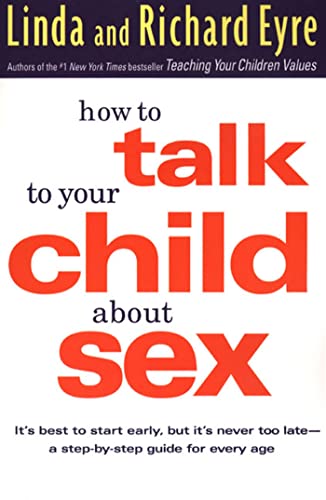
How to Talk to Your Child About Sex: It's Best to Start Early, but It's Never Too Late : A Step-By-Step Guide for Every Age - Softcover
Inhaltsangabe
Linda and Richard Eyre stress that it's never too soon-or too late-to start discussing sex and values with your children, and they've got proven strategies to make it easier. For parents who want to go beyond the birds and the bees talk, How to Talk to Your Child About Sex provides thoughtful, clear, specific guidance on when and, most important, how to help children begin to learn and understand sex, love, and commitment from the most positive viewpoint possible.
Preliminary "as needed" talks with three-to eight-year-olds
The age eight Big Talk
Follow-up talks with eight-to thirteen-year-olds
Behavior discussions and guidelines with eleven-to sixteen-year-olds
Discussions of perspective and personal standards with fifteen-to nineteen-year-olds
Die Inhaltsangabe kann sich auf eine andere Ausgabe dieses Titels beziehen.
Über die Autorin bzw. den Autor
Linda and Richard Eyre live with their family in Washington, D.C.; Salt Lake City, Utah; and Jackson Hole, Wyoming. The mission statement of their nonprofit foundation EYREALM is "Popularize Parenting, Validate Values, and Bolster Balance." They are hard at work on their next book, Turning the Hearts: Re-Value-ing the American Family.
Auszug. © Genehmigter Nachdruck. Alle Rechte vorbehalten.
How To Talk To Your Child About Sex
it's best to start early, but it's never too late — a step-by-step guide for every age
By Linda Eyre, Richard EyreSt. Martin's Press
Copyright © 1998 Linda and Richard Eyre
All rights reserved.
ISBN: 978-1-58238-057-5All rights reserved.
Contents
PREFACE,
INTRODUCTION: What Parents Face Today,
1 Preliminary "As Needed" Talks with Three- to Eight-Year-Olds,
2 The Age Eight "Big Talk",
3 Follow-up Talks with Eight- to Thirteen-Year-Olds,
4 Behavior Discussions with Eleven- to Sixteen-Year-Olds,
5 Discussions of Perspective and Personal Standards with Fifteen- to Nineteen-Year-Olds,
AFTERWORD: Why Parents and Families Are the Answer,
FINDING A SUPPORT GROUP,
ABOUT THE AUTHORS,
CHAPTER 1
Preliminary "As Needed" Talks with Three- to Eight-Year-Olds
* * *
This section outlines discussions to have with preschool and early elementary age children in preparation for the "big talk." The suggested dialogues deal with the physical body, awe and wonder in nature and the physical world, family commitment, loyalty and love, and "modesty" based on respect. Ideas and instruction are given on how to answer younger children's simple questions without going beyond the questions.
* * *
Answering Questions Without Going Beyond Them
A mother told us a funny (but point-making) story. Her five-year-old son came up to her one evening at home and said, "Mom, where did I come from?" She thought of trying to detour or escape the question somehow, but there was no ready excuse. The two of them were alone at home that night, and she figured that if her son was asking, she'd better summon up her courage and tell him.
They sat down in the living room, and the mother launched into it, not too smoothly and feeling a little embarrassed, but giving it her best shot. The little boy's eyes got wider and wider as he listened without a word, just nodding his head slightly whenever his mother said, "Do you understand that?" and shaking his head slowly whenever she said, "Did you know that?" When she was finished, she said, "Does that answer your question?"
The little fellow squirmed around and said, "Well ... I just meant ... you know ... where did we come from? Like before we moved here last year. I forgot the name of our other town."
While usually not as dramatically as in this story, it is easy to tell very young children too much. The best policy, until they are seven or eight, is just to respond to their questions, their real questions, with simple answers, always deferring detail to later and using the interchange as a way to build a positive anticipation for when they turn eight.
So if a five-year-old says, "Where do babies come from?" say, "Sometimes when a mommy and daddy love each other, it helps make a baby." If he says, "But how?" say, "It's like a miracle, a wonderful, unbelievable magic. When you're eight, we'll tell you about it."
If your belief or faith supports it, an even better answer might be "Babies are a gift from our Heavenly Father. He puts them into our families." If there is a persisting "But how?" say, "Well, it happens in a really wonderful, awesome way, and when you turn eight, we'll tell you about it."
Then change the subject unless you detect that the child is troubled or worried or has heard something that is causing him to persist. If this is the case, probe. Find out what he has heard or what has happened. If it's just a word or term he's heard that he doesn't understand, give your best explanation and say, "That's one thing we'll talk about when you're eight." If he has heard a joke or an off-color story about sex, you may want to say, "Some people joke around or say weird things about stuff they don't understand. But don't worry, we'll tell you all about it when you're eight. And believe me, it is wonderful and really cool!"
Appreciation for Bodies
A healthy attitude about sex starts with how a child feels about his own body. At a very young age children become aware of their bodies and what they can do. In fact, studies have shown that over 80 percent of what we learn about our physical bodies is learned in the first eighteen months of life. We see this when watching our four-month-old grandchild realize that the thing attached to the end of his arm can be used to move things that are in front of him and that he can see a different view by pushing off with one leg and one arm while balancing with the other two appendages to make the magnificent effort to turn his whole body over! Babies learn more about how to manage their physical bodies in that short time than they will for the rest of their lifetime.
As children grow, they often maintain their childlike spontaneous delight in the interesting things that are happening around them, but without our help they don't fully understand the marvelous miracle that is called their body. They take for granted that they can see their mother's face and hear cars racing by as they mutilate a piece of bread while sitting in their car seat.
We've seen how older preschoolers continued to find awe and wonder in their bodies while observing thousands of kids go through our Joy Schools (a series of do-it-yourself preschool lesson plans designed for three-, four-, and five-year-olds), especially the unit called "The Joy of the Body." This preschool curriculum, based on Teaching Your Children Joy, is an alternative to pushy, early academic approaches. Included are hundreds of creative ways to help young children appreciate the magic of their bodies, from dancing in the leaves to classical music to taping their thumbs to the rest of their hands for a short time to help them appreciate how valuable their thumbs are. Kids revel in appreciating all that their body can do.
As children grow older, their basic attitude about their body and how it functions becomes part of their reference for how they feel about using their bodies as an adult to show love and to feel joy in a physical sexual relationship. Learning how the body can conceive and produce a child fits their framework of the joyful, miraculous nature of the body.
In dealing with young children, every available opportunity should be taken to point out how lucky we are to be able to see the beauties of the season, to hear creative and inspirational music, to taste different and unique combinations of food (a couple of our children would not call this a joy), to touch a baby's cheek or a kitten's soft fur, and especially to feel the love that we have for the others in our family. The list of things to point out and be grateful for is endless. The more a child can appreciate his own body as a preschooler, the better foundation he will have for feeling positive about the greatest of all physical miracles.
Awe and Wonder in Nature
I (Linda) think our appreciation for nature peaked during our first year of graduate school in Boston. I was working long, hard hours and coming home with just enough energy to make a dinner, prepare a lesson plan for the next day, and drop into bed beside Richard, who was working day and night on his assignments for the Harvard Business School, where he was slogging his way toward a degree. Newly married and with a brand-new baby, we were woefully poor, and the only form of recreation we could afford was to observe nature. We sat by the Charles River and watched the crews go by, stroking in unison through water so calm that it looked as if they were gliding through unset Jell-O. By October we...
„Über diesen Titel“ kann sich auf eine andere Ausgabe dieses Titels beziehen.
Suchergebnisse für How to Talk to Your Child About Sex: It's Best...

Beispielbild für diese ISBN
How to Talk to Your Child about Sex: It's Best to Start Early, but it's Never Too Late : a Step-by-Step Guide for Every Age
Anbieter: World of Books (was SecondSale), Montgomery, IL, USA
Verkäuferbewertung 5 von 5 Sternen

Paperback. Zustand: Good. Linda and Richard Eyre stress that it's never too soon-or too late-to start discussing sex and values with your children, and they've got proven strategies to make it easier. For parents who want to go beyond the birds and the bees talk, How to Talk to Your Child About Sex provides thoughtful, clear, specific guidance on when and, most important, how to help children begin to learn and understand sex, love, and commitment from the most positive viewpoint possible. Preliminary "as needed" talks with three-to eight-year-olds The age eight Big Talk Follow-up talks with eight-to thirteen-year-olds Behavior discussions and guidelines with eleven-to sixteen-year-olds Discussions of perspective and personal standards with fifteen-to nineteen-year-olds. Bestandsnummer des Verkäufers 00085943327
Gebraucht kaufen
EUR 3,88
Versand gratis
Versand innerhalb von USA
Versand innerhalb von USA
Anzahl: Mehr als 20 verfügbar
Beispielbild für diese ISBN
How to Talk to Your Child about Sex: It's Best to Start Early, but it's Never Too Late : a Step-by-Step Guide for Every Age
Anbieter: World of Books (was SecondSale), Montgomery, IL, USA
Verkäuferbewertung 5 von 5 Sternen
Paperback. Zustand: Fair. Linda and Richard Eyre stress that it's never too soon-or too late-to start discussing sex and values with your children, and they've got proven strategies to make it easier. For parents who want to go beyond the birds and the bees talk, How to Talk to Your Child About Sex provides thoughtful, clear, specific guidance on when and, most important, how to help children begin to learn and understand sex, love, and commitment from the most positive viewpoint possible. Preliminary "as needed" talks with three-to eight-year-olds The age eight Big Talk Follow-up talks with eight-to thirteen-year-olds Behavior discussions and guidelines with eleven-to sixteen-year-olds Discussions of perspective and personal standards with fifteen-to nineteen-year-olds. Bestandsnummer des Verkäufers 00068491479
Gebraucht kaufen
EUR 3,88
Versand gratis
Versand innerhalb von USA
Versand innerhalb von USA
Anzahl: 2 verfügbar
Beispielbild für diese ISBN
How to Talk to Your Child about Sex: It's Best to Start Early, but it's Never Too Late : a Step-by-Step Guide for Every Age
Anbieter: World of Books (was SecondSale), Montgomery, IL, USA
Verkäuferbewertung 5 von 5 Sternen
Paperback. Zustand: Very Good. Linda and Richard Eyre stress that it's never too soon-or too late-to start discussing sex and values with your children, and they've got proven strategies to make it easier. For parents who want to go beyond the birds and the bees talk, How to Talk to Your Child About Sex provides thoughtful, clear, specific guidance on when and, most important, how to help children begin to learn and understand sex, love, and commitment from the most positive viewpoint possible. Preliminary "as needed" talks with three-to eight-year-olds The age eight Big Talk Follow-up talks with eight-to thirteen-year-olds Behavior discussions and guidelines with eleven-to sixteen-year-olds Discussions of perspective and personal standards with fifteen-to nineteen-year-olds. Bestandsnummer des Verkäufers 00099145258
Gebraucht kaufen
EUR 3,88
Versand gratis
Versand innerhalb von USA
Versand innerhalb von USA
Anzahl: 9 verfügbar
Beispielbild für diese ISBN
How to Talk to Your Child About Sex
Anbieter: Orion Tech, Kingwood, TX, USA
Verkäuferbewertung 5 von 5 Sternen
Paperback. Zustand: Fair. Bestandsnummer des Verkäufers 1582380570-4-25443729
Gebraucht kaufen
EUR 3,89
Versand gratis
Versand innerhalb von USA
Versand innerhalb von USA
Anzahl: 1 verfügbar
Beispielbild für diese ISBN
How to Talk to Your Child About Sex
Anbieter: Your Online Bookstore, Houston, TX, USA
Verkäuferbewertung 5 von 5 Sternen
Paperback. Zustand: Very Good. Bestandsnummer des Verkäufers 1582380570-2-21469141
Gebraucht kaufen
EUR 3,89
Versand gratis
Versand innerhalb von USA
Versand innerhalb von USA
Anzahl: 1 verfügbar
Beispielbild für diese ISBN
How to Talk to Your Child About Sex: It's Best to Start Early, but It's Never Too Late -- A Step-by-Step Guide for Every Age
Anbieter: Gulf Coast Books, Cypress, TX, USA
Verkäuferbewertung 5 von 5 Sternen
paperback. Zustand: Very Good. Bestandsnummer des Verkäufers 1582380570-2-34001898
Gebraucht kaufen
EUR 3,89
Versand gratis
Versand innerhalb von USA
Versand innerhalb von USA
Anzahl: 1 verfügbar
Foto des Verkäufers
How to Talk to Your Child About Sex: It's Best to Start Early, but It's Never Too Late -- A Step-by-Step Guide for Every Age
Anbieter: Zoom Books Company, Lynden, WA, USA
Verkäuferbewertung 5 von 5 Sternen
Zustand: very_good. Book is in very good condition and may include minimal underlining highlighting. The book can also include "From the library of" labels. May not contain miscellaneous items toys, dvds, etc. . We offer 100% money back guarantee and 24 7 customer service. Bestandsnummer des Verkäufers ZBV.1582380570.VG
Gebraucht kaufen
EUR 4,08
Versand gratis
Versand innerhalb von USA
Versand innerhalb von USA
Anzahl: 1 verfügbar
Foto des Verkäufers
How to Talk to Your Child About Sex: It's Best to Start Early, but It's Never Too Late -- A Step-by-Step Guide for Every Age
Anbieter: Greenworld Books, Arlington, TX, USA
Verkäuferbewertung 5 von 5 Sternen
Zustand: very_good. Fast Free Shipping â" Very Good condition book with a firm cover and clean pages. Shows normal use and some light wear or limited notes markings. A solid, nice copy to enjoy. Bestandsnummer des Verkäufers GWV.1582380570.VG
Gebraucht kaufen
EUR 4,99
Versand gratis
Versand innerhalb von USA
Versand innerhalb von USA
Anzahl: 5 verfügbar
Foto des Verkäufers
How to Talk to Your Child About Sex: It's Best to Start Early, but It's Never Too Late -- A Step-by-Step Guide for Every Age
Anbieter: Greenworld Books, Arlington, TX, USA
Verkäuferbewertung 5 von 5 Sternen
Zustand: good. Fast Free Shipping â" Good condition. It may show normal signs of use, such as light writing, highlighting, or library markings, but all pages are intact and the book is fully readable. A solid, complete copy that's ready to enjoy. Bestandsnummer des Verkäufers GWV.1582380570.G
Gebraucht kaufen
EUR 4,99
Versand gratis
Versand innerhalb von USA
Versand innerhalb von USA
Anzahl: 10 verfügbar
Foto des Verkäufers
How to Talk to Your Child About Sex: It's Best to Start Early, but It's Never Too Late -- A Step-by-Step Guide for Every Age
Anbieter: Greenworld Books, Arlington, TX, USA
Verkäuferbewertung 5 von 5 Sternen
Zustand: acceptable. Fast Free Shipping â" A well-loved copy with text fully readable and cover pages intact. May display wear such as writing, highlighting, bends, folds or library marks. Still a complete and usable book. Bestandsnummer des Verkäufers GWV.1582380570.A
Gebraucht kaufen
EUR 4,99
Versand gratis
Versand innerhalb von USA
Versand innerhalb von USA
Anzahl: 1 verfügbar