
Verwandte Artikel zu Life Is a Miracle: An Essay Against Modern Superstition
Inhaltsangabe
“[A] scathing assessment . . . Berry shows that Wilson's much–celebrated, controversial pleas in Consilience to unify all branches of knowledge is nothing more than a fatuous subordination of religion, art, and everything else that is good to science . . . Berry is one of the most perceptive critics of American society writing today.” —The Washington Post
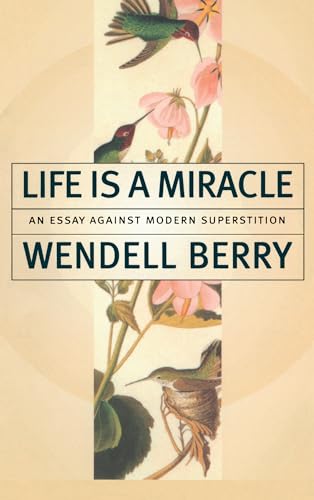
In Life Is a Miracle, the devotion of science to the quantitative and reductionist world is measured against the mysterious, qualitative suggestions of religion and art. Berry sees life as the collision of these separate forces, but without all three in the mix we are left at sea in the world.
Die Inhaltsangabe kann sich auf eine andere Ausgabe dieses Titels beziehen.
Über die Autorin bzw. den Autor
WENDELL BERRY is the author of fifty books of poetry, fiction, and essays. He was recently awarded the Cleanth Brooks Medal for Lifetime Achievement by the Fellowship of Southern Writers and the Louis Bromfield Society Award. For over forty years he has lived and farmed with his wife, Tanya, in Kentucky.
Auszug. © Genehmigter Nachdruck. Alle Rechte vorbehalten.
Life is a Miracle
An Essay Against Modern SuperstitionBy Wendell BerryCounterpoint Press
Copyright © 2001 Wendell BerryAll right reserved.
ISBN: 9781582431413
Chapter One
Ignorance
The expressed dissatisfaction of some scientists with the dangerousoversimplifications of commercialized science has encouragedme to hope that this dissatisfaction will run its full course.These scientists, I hope, will not stop with some attempt at a merelytheoretical or technical "correction," but will press on toward anew, or a renewed, propriety in the study and the use of the livingworld.
No such change is foreseeable in the terms of the presently dominantmechanical explanations of things. Such a change is imaginableonly if we are willing to risk an unfashionable recourse to ourcultural tradition. Human hope may always have resided in ourability, in time of need, to return to our cultural landmarks andreorient ourselves.
One of the principle landmarks of the course of my own life isShakespeare's tragedy of King Lear. Over the last forty-five years Ihave returned to King Lear many times. Among the effects of thatplay?on me, and I think on anybody who reads it closely?is therecognition that in all our attempts to renew or correct ourselves,to shake off despair and have hope, our starting place is always andonly our experience. We can begin (and we must always be beginning)only where our history has so far brought us, with what wehave done.
Lately my thoughts about the inevitably commercial geneticmanipulations already in effect or contemplated have sent me backto King Lear again. The whole play is about kindness, both in theusual sense, and in the sense of truth-to-kind, naturalness, or knowingthe limits of our specifically human nature. But this issue isdealt with most explicitly in an episode of the subplot, in which theEarl of Gloucester is recalled from despair so that he may die in hisfull humanity.
The old earl has been blinded in retribution for his loyalty tothe king, and in this fate he sees a kind of justice for, as he says, "Istumbled when I saw" (King Lear, The Pelican Shakespeare, IV, i,19). He, like Lear, is guilty of hubris or presumption, of treating lifeas knowable, predictable, and within his control. He has falselyaccused and driven away his loyal son, Edgar. Exiled and undersentence of death, Edgar has disguised himself as a madman andbeggar. He becomes, in that role, the guide of his blinded father,who asks to be led to Dover where he intends to kill himself byleaping off a cliff. Edgar's task is to save his father from despair, andhe succeeds, for Gloucester dies at last "'Twixt two extremes ofpassion, joy and grief ..." (V, iii, 199). He dies, that is, within theproper bounds of the human estate. Edgar does not want his fatherto give up on life. To give up on life is to pass beyond the possibilityof change or redemption. And so he does not lead his fatherto the cliff's verge, but only tells him he has done so. Gloucesterrenounces the world, blesses Edgar, his supposedly absent son,and, according to the stage direction, "Falls forward and swoons"(IV, vi, 41).
When he returns to consciousness, Edgar now speaks to him inthe guise of a passer-by at the bottom of the cliff, from which hepretends to have seen Gloucester fall. Here he assumes explicitlythe role of spiritual guide to his father.
Gloucester, dismayed to find himself still alive, attempts to refusehelp: "Away, and let me die" (IV, vi, 48).
And then Edgar, after an interval of several lines in which herepresents himself as a stranger, speaks the filial (and fatherly) lineabout which my thoughts have gathered:
Thy life's a miracle. Speak yet again.
(IV, vi, 55)
This is the line that calls Gloucester back?out of hubris, andthe damage and despair that invariably follow?into the properlysubordinated human life of grief and joy, where change and redemptionare possible.
The power of that line read in the welter of innovation and speculationof the bioengineers will no doubt be obvious. One immediatelyrecognizes that suicide is not the only way to give up on life.We know that creatures and kinds of creatures can be killed, deliberatelyor inadvertently. And most farmers know that any creaturethat is sold has in a sense been given up on; there is a big differencebetween selling this year's lamb crop, which is, as such, all that itcan be, and selling the breeding flock or the farm, which hold theimmanence of a limitless promise.
* * *
A little harder to compass is the danger that we can give up on lifealso by presuming to "understand" it?that is by reducing it to theterms of our understanding and by treating it as predictable ormechanical. The most radical influence of reductive science hasbeen the virtually universal adoption of the idea that the world, itscreatures, and all the parts of its creatures are machines?that is,that there is no difference between creature and artifice, birth andmanufacture, thought and computation. Our language, wherever itis used, is now almost invariably conditioned by the assumptionthat fleshly bodies are machines full of mechanisms, fully compatiblewith the mechanisms of medicine, industry, and commerce;and that minds are computers fully compatible with electronictechnology.
This may have begun as a metaphor, but in the language as it isused (and as it affects industrial practice) it has evolved from metaphorthrough equation to identification. And this usage institutionalizesthe human wish, or the sin of wishing, that life might be,or might be made to be, predictable.
I have read of Werner Heisenberg's principle that "Wheneverone treats living organisms as physiochemical systems they mustnecessarily behave as such." I am not competent to have an opinionabout the truth of that. I do feel able to say that whenever one treatsliving organisms as machines they must necessarily be perceived tobehave as such. And I can see that the proposition is reversible:Whenever one perceives living organisms as machines they mustnecessarily be treated as such. William Blake made the same pointearlier in this age of reduction and affliction:
What seems to Be, Is, To those to whom
It seems to Be, & is productive of the most dreadful
Consequences to those to whom it seems to Be ...
(Blake, Complete Writings, Oxford, 1966, p. 663)
For quite a while it has been possible for a free and thoughtfulperson to see that to treat life as mechanical or predictable orunderstandable is to reduce it. Now, almost suddenly, it is becomingclear that to reduce life to the scope of our understanding (whatever"model" we use) is inevitably to enslave it, make property of it,and put it up for sale.
This is to give up on life, to carry it beyond change and redemption,and to increase the proximity of despair.
Cloning?to use the most obvious example?is not a way toimprove sheep. On the contrary, it is a way to stall the sheep's lineageand make it unimprovable. No true breeder could consent to it,for...
„Über diesen Titel“ kann sich auf eine andere Ausgabe dieses Titels beziehen.
Weitere beliebte Ausgaben desselben Titels

Suchergebnisse für Life Is a Miracle: An Essay Against Modern Superstition

Foto des Verkäufers
Life Is a Miracle: An Essay Against Modern Superstition
Anbieter: Austin Goodwill 1101, Austin, TX, USA
Verkäuferbewertung 5 von 5 Sternen

Zustand: acceptable. Book shows noticeable wear from use. May include writing, highlighting, or other markings, but not excessive. Cover or edges may have visible wear. The book remains complete and fully readable. Bestandsnummer des Verkäufers CTXV.1582431418.A
Gebraucht kaufen
EUR 4,84
EUR 2,86 Versand
Versand innerhalb von USA
Versand innerhalb von USA
Anzahl: 1 verfügbar
Beispielbild für diese ISBN
Life Is a Miracle An Essay Aga
Anbieter: World of Books (was SecondSale), Montgomery, IL, USA
Verkäuferbewertung 5 von 5 Sternen
Zustand: Very Good. Item in very good condition! Textbooks may not include supplemental items i.e. CDs, access codes etc. Bestandsnummer des Verkäufers 00106820426
Gebraucht kaufen
EUR 7,79
Versand gratis
Versand innerhalb von USA
Versand innerhalb von USA
Anzahl: 1 verfügbar
Beispielbild für diese ISBN
Life Is a Miracle An Essay Aga
Anbieter: World of Books (was SecondSale), Montgomery, IL, USA
Verkäuferbewertung 5 von 5 Sternen
Zustand: Good. Item in good condition. Textbooks may not include supplemental items i.e. CDs, access codes etc. Bestandsnummer des Verkäufers 00106742898
Gebraucht kaufen
EUR 7,79
Versand gratis
Versand innerhalb von USA
Versand innerhalb von USA
Anzahl: 1 verfügbar
Beispielbild für diese ISBN
Life Is a Miracle: An Essay Against Modern Superstition
Anbieter: HPB-Diamond, Dallas, TX, USA
Verkäuferbewertung 5 von 5 Sternen
Paperback. Zustand: Very Good. Connecting readers with great books since 1972! Used books may not include companion materials, and may have some shelf wear or limited writing. We ship orders daily and Customer Service is our top priority! Bestandsnummer des Verkäufers S_475670853
Gebraucht kaufen
EUR 5,35
EUR 3,25 Versand
Versand innerhalb von USA
Versand innerhalb von USA
Anzahl: 1 verfügbar
Beispielbild für diese ISBN
Life Is a Miracle: An Essay Against Modern Superstition
Anbieter: HPB-Ruby, Dallas, TX, USA
Verkäuferbewertung 5 von 5 Sternen
Paperback. Zustand: Very Good. Connecting readers with great books since 1972! Used books may not include companion materials, and may have some shelf wear or limited writing. We ship orders daily and Customer Service is our top priority! Bestandsnummer des Verkäufers S_475415257
Gebraucht kaufen
EUR 5,35
EUR 3,25 Versand
Versand innerhalb von USA
Versand innerhalb von USA
Anzahl: 1 verfügbar
Foto des Verkäufers
Life Is a Miracle: An Essay Against Modern Superstition
Anbieter: Goodwill, Brooklyn Park, MN, USA
Verkäuferbewertung 4 von 5 Sternen

Zustand: good. All pages and cover are intact including the dust cover, if applicable . Spine may show signs of wear. Pages may include limited notes and highlighting. May include "From the library of" labels. Shrink wrap, dust covers, or boxed set case may be missing. Item may be missing bundled media. Bestandsnummer des Verkäufers MINV.1582431418.G
Gebraucht kaufen
EUR 5,16
EUR 3,46 Versand
Versand innerhalb von USA
Versand innerhalb von USA
Anzahl: 1 verfügbar
Beispielbild für diese ISBN
Life Is a Miracle: An Essay Against Modern Superstition
Anbieter: Half Price Books Inc., Dallas, TX, USA
Verkäuferbewertung 5 von 5 Sternen
Paperback. Zustand: Very Good. Connecting readers with great books since 1972! Used books may not include companion materials, and may have some shelf wear or limited writing. We ship orders daily and Customer Service is our top priority! Bestandsnummer des Verkäufers S_478313972
Gebraucht kaufen
EUR 6,68
EUR 3,03 Versand
Versand innerhalb von USA
Versand innerhalb von USA
Anzahl: 1 verfügbar
Beispielbild für diese ISBN
Life Is a Miracle: An Essay Against Modern Superstition
Anbieter: HPB Inc., Dallas, TX, USA
Verkäuferbewertung 5 von 5 Sternen
Paperback. Zustand: Very Good. Connecting readers with great books since 1972! Used books may not include companion materials, and may have some shelf wear or limited writing. We ship orders daily and Customer Service is our top priority! Bestandsnummer des Verkäufers S_477692390
Gebraucht kaufen
EUR 6,68
EUR 3,25 Versand
Versand innerhalb von USA
Versand innerhalb von USA
Anzahl: 1 verfügbar
Beispielbild für diese ISBN
Life Is a Miracle: An Essay Against Modern Superstition
Anbieter: HPB-Emerald, Dallas, TX, USA
Verkäuferbewertung 5 von 5 Sternen
Paperback. Zustand: Very Good. Connecting readers with great books since 1972! Used books may not include companion materials, and may have some shelf wear or limited writing. We ship orders daily and Customer Service is our top priority! Bestandsnummer des Verkäufers S_475693091
Gebraucht kaufen
EUR 6,68
EUR 3,25 Versand
Versand innerhalb von USA
Versand innerhalb von USA
Anzahl: 1 verfügbar
Foto des Verkäufers
Life Is a Miracle : An Essay Against Modern Superstition
Anbieter: GreatBookPrices, Columbia, MD, USA
Verkäuferbewertung 5 von 5 Sternen
Zustand: New. Bestandsnummer des Verkäufers 548245-n
Neu kaufen
EUR 10,61
EUR 2,29 Versand
Versand innerhalb von USA
Versand innerhalb von USA
Anzahl: 15 verfügbar