
Verwandte Artikel zu Advanced Guide to PHP on IBM i
Inhaltsangabe
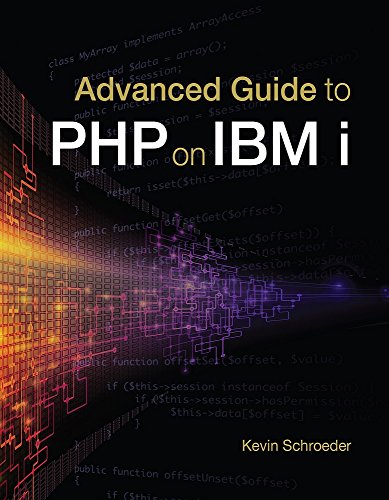
Working through many of the concepts and skills needed by intermediate and advanced PHP developers, this book is specifically designed to help good PHP developers become indispensable ones. Topics include debugging, test-driven development, web-based development, advanced object-oriented programming, and web security, and the book also takes an in-depth look at the new PHP Toolkit for IBM i provided by Zend Technologies. Upon completion of this book, readers will be able to use its principles as a basis for architecting complex applications, building web services according to the best standards currently available, significantly reducing the time spent discovering and fixing errors in code, designing architectures that are testable and predictable, building secure applications by protecting against most known attacks, and avoiding and preparing for common performance issues.
Die Inhaltsangabe kann sich auf eine andere Ausgabe dieses Titels beziehen.
Über die Autorin bzw. den Autor
Kevin Schroeder is the technical manager for education and consulting for MagentoU and a former technical consultant for Zend Technologies. He is the author of You Want to Do What with PHP? and the coauthor of The IBM i Programmer&;s Guide to PHP. He lives in Frisco, Texas.
Auszug. © Genehmigter Nachdruck. Alle Rechte vorbehalten.
Advanced Guide to PHP on IBM i
By Kevin SchroederMC Press
Copyright © 2014 Kevin Schroeder
All rights reserved.
ISBN: 978-1-58347-384-9All rights reserved.
Contents
Chapter 1: A Re-Introduction to Basic Concepts,
Chapter 2: Design Patterns,
Chapter 3: Standard PHP Library,
Chapter 4: Debugging Basics,
Chapter 5: Security,
Chapter 6: Working with the Browser,
Chapter 7: Test-Driven Development,
Chapter 8: Web Service Basics,
Chapter 9: Using the Toolkit,
Chapter 10: Performance Considerations,
CHAPTER 1
A Re-Introduction to Basic Concepts
We will start this section with a (very) quick re-introduction to the basic concepts of object-oriented programming (OOP).
Classes and Objects
When it comes to OOP, the most basic discernible concept is the class. The class is the foundation of everything that follows it. You cannot have an object without a class. An interface is largely pointless without a class. Abstract classes refuse to instantiate. Sometimes that class might simply be a definition that says an object of said type can exist, and other times it can be part of a much larger grouping of functionality.
As a general starting point, think about a class as the definition of a reference in an application to a real thing. Although, in practice, objects rarely are accurate representations of a thing, it is a good starting place for your understanding. It is much the same as in real life.
Consider from within the world of biology, which has many different taxonomic groups, such as Plants, Fungi, and Animals. You can break down these groups into even more distinct categories; for example, you can sort the Animal group into Fish, Birds, and Mammals, and then divide the Mammals group into yet more distinct categories like People, Dogs, and Kittens. These are examples of classes. They are definitions of what could be. An object is when you give form to that definition. You do not just have a person, but you have a "Kevin" or a "Bob." An individual can be likened to an object, whereas taxa can be likened to classes. It is the relationship of definition to instance.
When defining a class, you can define three general types of things: properties, methods, and constants. Let's look at an example that encapsulates about 80 percent of what you will be using when working with OOP:
[PROGRAM LISTING NOT REPRODUCIBLE IN ASCII]
Properties
Think of a property as a variable attached to an instance of a class. It will contain only data and no logic. In this case, you have two properties: $name and $breed.
Methods
Methods are the class version of a function. A method is basically a function that is tied to a class, and where you will implement any logic in the class.
In this example, you have two methods: setName() and setBreed(). The setBreed() method contains a little logic that allows only defined breeds to be set for the instance's $breed property. By setting the $breed property as private (we will look at what that means in a bit), you ensure that the only way to set that property is by calling the setBreed() method.
Constants
Classes can contain data that is consistent, or constant, across multiple instances of a class. This technique is often used as a means to introduce defined predictability. In the previous example, you would not be allowed to enter just any breed; instead, you must enter one that the class has defined as valid. And one of the easiest ways of doing that is by providing the constant name rather than a defined value.
The following code shows how you might be tempted to set a breed:
$macy = new Dog();
$macy -> setName('Macy');
$macy -> setBreed('Corgi');
But go back and look at how you defined the constant representing a Corgi. Notice the difference? The code example here uses an uppercase "c," whereas the class definition is all lower case. So by providing the string value, you might have accidentally introduced inconsistency into your data.
However, when you use the constant, you are saying, this dog is a Corgi, according to my definition. And by doing so, you reduce the risk of accidental mistypes on the keyboard and provide a much more predictable use case:
$macy = new Dog();
$macy -> setName('Macy');
$macy -> setBreed(Dog::BREED_CORGI);
Context
Context is the nature of our interaction with a definition. When you interact with static context, you are working with the class itself. Any logic can be executed from any class instance, can affect other instances, or might not be related to an instance of that class at all. To some degree, we can liken it to procedural functionality within a class structure. This is not entirely true, but it's accurate enough for a base definition. If working from within the object context, you are interacting not with the class, but with the instance of that class.
Two important keywords to know are self and $this. Because self refers to the class definition, it is somewhat global in its scope — not global like a global variable, but simply globally accessible. You can define the static context as a property (self::$breeds) or as a method (self::addBreed($breed)).
However, you can use the self keyword only when you are working within the class definition itself. If you are working within the global context or calling from within another class, you must specify the class name to call it:
Dog::addBreed('beagle');
When working in the object context, you generally use the keyword $this. It is a reserved variable name that simply refers to the current object instance. So if you have two instances of the Dog class — one for Macy and another for Sasha — calling setName() sets the property for the individual instance, which means that $this->name will have a different value depending on the instance of the object that you are working from within.
Visibility
When working in OOP, you have three levels of visibility: public, protected, and private, as Table 1.1 shows.
Abstract Classes
Sometimes a class can have some functionality defined in it, but not enough to let it instantiate. Or it has additional functionality that will diverge at further levels of taxonomic completeness. For example, fish can share certain commonalities such as fins, scales, and cold-bloodedness. But if you were to add gills to that list, you would be wrong. Some fish (called the lungfish) have lungs. So although you can define the Fish class to a certain extent, you cannot include the breathing mechanism because it can be completely different based on the type of fish.
Therefore, you need to define the Fish class as abstract and add functionality in later implementations:
[PROGRAM LISTING NOT REPRODUCIBLE IN ASCII]
Then when you later define Fish, you can include the breathing mechanism (e.g., gills for trout and lungs for lungfish).
Interface Definition
If classes are the definition of an instance, as "human" is to an individual, then interfaces are the expectations. But unlike classes, interfaces do not contain implementation details. That is because an object frequently needs only to know that something exists, not how it exists. And often that something might be an item that is not instantiated within the class itself but is injected from the outside. When that happens, the outside item might include a wild range of functionality that...
„Über diesen Titel“ kann sich auf eine andere Ausgabe dieses Titels beziehen.
Weitere beliebte Ausgaben desselben Titels

Suchergebnisse für Advanced Guide to PHP on IBM i

Beispielbild für diese ISBN
Advanced Guide to PHP on IBM i
Anbieter: HPB-Red, Dallas, TX, USA
Verkäuferbewertung 5 von 5 Sternen

paperback. Zustand: Good. Connecting readers with great books since 1972! Used textbooks may not include companion materials such as access codes, etc. May have some wear or writing/highlighting. We ship orders daily and Customer Service is our top priority! Bestandsnummer des Verkäufers S_472198649
Gebraucht kaufen
EUR 8,96
EUR 3,25 Versand
Versand innerhalb von USA
Versand innerhalb von USA
Anzahl: 1 verfügbar
Beispielbild für diese ISBN
Advanced Guide to PHP on IBM i
Anbieter: Meadowland Media, Fayetteville, AR, USA
Verkäuferbewertung 4 von 5 Sternen

paperback. iT'S NEW!!!! Ships same or next. Bestandsnummer des Verkäufers K125-111325-S-115
Gebraucht kaufen
EUR 17,63
EUR 3,46 Versand
Versand innerhalb von USA
Versand innerhalb von USA
Anzahl: 1 verfügbar
Beispielbild für diese ISBN
Advanced Guide to Php on IBM I
Anbieter: Revaluation Books, Exeter, Vereinigtes Königreich
Verkäuferbewertung 5 von 5 Sternen
Paperback. Zustand: Brand New. 1st edition. 336 pages. 9.00x7.00x1.00 inches. In Stock. Bestandsnummer des Verkäufers 158347384X
Neu kaufen
EUR 30,87
EUR 14,62 Versand
Versand von Vereinigtes Königreich nach USA
Versand von Vereinigtes Königreich nach USA
Anzahl: 1 verfügbar
Beispielbild für diese ISBN
Advanced Guide to PHP on IBM i
Anbieter: Your Online Bookstore, Houston, TX, USA
Verkäuferbewertung 5 von 5 Sternen
Paperback. Zustand: New. Bestandsnummer des Verkäufers 158347384X-11-23227587
Beispielbild für diese ISBN
Advanced Guide to PHP on IBM i Format: Paperback
Anbieter: INDOO, Avenel, NJ, USA
Verkäuferbewertung 5 von 5 Sternen
Zustand: New. Brand New. Bestandsnummer des Verkäufers 9781583473849
Neu kaufen
EUR 50,09
Versand gratis
Versand innerhalb von USA
Versand innerhalb von USA
Anzahl: Mehr als 20 verfügbar
Beispielbild für diese ISBN
Advanced Guide to PHP on IBM i
Anbieter: GreatBookPrices, Columbia, MD, USA
Verkäuferbewertung 5 von 5 Sternen
Zustand: New. Bestandsnummer des Verkäufers 20154601-n
Neu kaufen
EUR 53,69
EUR 2,29 Versand
Versand innerhalb von USA
Versand innerhalb von USA
Anzahl: Mehr als 20 verfügbar
Foto des Verkäufers
Advanced Guide to PHP on IBM i
Anbieter: Rarewaves USA, OSWEGO, IL, USA
Verkäuferbewertung 5 von 5 Sternen
Paperback. Zustand: New. Working through many of the concepts and skills needed by intermediate and advanced PHP developers, this book is specifically designed to help good PHP developers become indispensable ones. Topics include debugging, test-driven development, web-based development, advanced object-oriented programming, and web security, and the book also takes an in-depth look at the new PHP Toolkit for IBM i provided by Zend Technologies. Upon completion of this book, readers will be able to use its principles as a basis for architecting complex applications, building web services according to the best standards currently available, significantly reducing the time spent discovering and fixing errors in code, designing architectures that are testable and predictable, building secure applications by protecting against most known attacks, and avoiding and preparing for common performance issues. Bestandsnummer des Verkäufers LU-9781583473849
Neu kaufen
EUR 56,06
Versand gratis
Versand innerhalb von USA
Versand innerhalb von USA
Anzahl: Mehr als 20 verfügbar
Beispielbild für diese ISBN
Advanced Guide to PHP on IBM i (Paperback)
Anbieter: Grand Eagle Retail, Bensenville, IL, USA
Verkäuferbewertung 5 von 5 Sternen
Paperback. Zustand: new. Paperback. Working through many of the concepts and skills needed by intermediate and advanced PHP developers, this book is specifically designed to help good PHP developers become indispensable ones. Topics include debugging, test-driven development, web-based development, advanced object-oriented programming, and web security, and the book also takes an in-depth look at the new PHP Toolkit for IBM i provided by Zend Technologies. Upon completion of this book, readers will be able to use its principles as a basis for architecting complex applications, building web services according to the best standards currently available, significantly reducing the time spent discovering and fixing errors in code, designing architectures that are testable and predictable, building secure applications by protecting against most known attacks, and avoiding and preparing for common performance issues. Shipping may be from multiple locations in the US or from the UK, depending on stock availability. Bestandsnummer des Verkäufers 9781583473849
Beispielbild für diese ISBN
Advanced Guide to PHP on IBM i
Anbieter: GreatBookPrices, Columbia, MD, USA
Verkäuferbewertung 5 von 5 Sternen
Zustand: As New. Unread book in perfect condition. Bestandsnummer des Verkäufers 20154601
Gebraucht kaufen
EUR 61,11
EUR 2,29 Versand
Versand innerhalb von USA
Versand innerhalb von USA
Anzahl: Mehr als 20 verfügbar
Foto des Verkäufers
Advanced Guide to PHP on IBM i
Anbieter: Rarewaves.com USA, London, LONDO, Vereinigtes Königreich
Verkäuferbewertung 5 von 5 Sternen
Paperback. Zustand: New. Working through many of the concepts and skills needed by intermediate and advanced PHP developers, this book is specifically designed to help good PHP developers become indispensable ones. Topics include debugging, test-driven development, web-based development, advanced object-oriented programming, and web security, and the book also takes an in-depth look at the new PHP Toolkit for IBM i provided by Zend Technologies. Upon completion of this book, readers will be able to use its principles as a basis for architecting complex applications, building web services according to the best standards currently available, significantly reducing the time spent discovering and fixing errors in code, designing architectures that are testable and predictable, building secure applications by protecting against most known attacks, and avoiding and preparing for common performance issues. Bestandsnummer des Verkäufers LU-9781583473849
Neu kaufen
EUR 70,29
Versand gratis
Versand von Vereinigtes Königreich nach USA
Versand von Vereinigtes Königreich nach USA
Anzahl: Mehr als 20 verfügbar