
Verwandte Artikel zu DB2 11 for z/OS Database Administration: Certification...
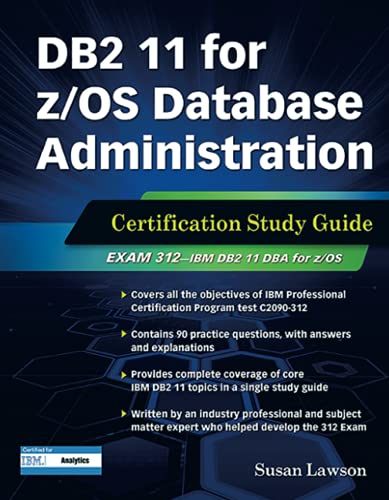
DB2 11 for z/OS Database Administration: Certification Study Guide (DB2 DBA Certification) - Softcover
Inhaltsangabe
Written primarily for database administrators who work on z/OS and who are taking the IBM DB2 11 for z/OS Database Administration certification exam (Exam 312), this resource also appeals to those who simply want to master the skills needed to be an effective database administrator of z/OS mainframes. This study guide is designed to provide those seeking certification with an intense overview of DB2 11 for z/OS and all topics covered on the exam. Sample questions are provided at the end of each chapter, along with answers and explanations.
Die Inhaltsangabe kann sich auf eine andere Ausgabe dieses Titels beziehen.
Über die Autorin bzw. den Autor
Susan Lawson is an internationally recognized consultant, author, and lecturer with a background in system and database administration. She is an IBM GOLD Consultant for DB2 and z, an IBM Champion, and a Subject Matter Expert for several IBM DB2 for z/OS Certification exams.
Auszug. © Genehmigter Nachdruck. Alle Rechte vorbehalten.
DB2 11 for z/OS Database Administration
Certification Study Guide (Exam 312)
By Susan LawsonMC Press
Copyright © 2016 Susan Lawson
All rights reserved.
ISBN: 978-1-58347-397-9All rights reserved.
Contents
Introduction: IBM DB2 11 DBA for z/OS Certification Review Guide — Exam 312,
1: DB2 for z/OS Introduction,
2: Database Design and Implementation,
3: Applications and Database Functionality,
4: Environment Management,
5: Data Management,
6: Performance and Tuning,
Index,
CHAPTER 1
DB2 for z/OS Introduction
This chapter introduces the DB2 z/OS environment and its various components. Later chapters will further discuss all topics, providing additional details about each one. Topics presented here will be covered on the 312 exam in various questions. The questions at the end of this chapter provide an example of the types of questions that will be asked about different areas of DB2's environment, such as address spaces, attachment facilities, SQL, commands, and utilities.
To start this introduction, let us first get an overview of the z/OS architecture on which DB2 is built, and then examine DB2 and how it is designed and constructed to be one of the industry's leading database management systems.
z/Architecture and the z/OS Operating System
With z/OS and the IBM System z10®, System z9® 109, zSeries 890, and zSeries 990 systems, you get an architecture that provides qualities of service that are critical for e-business. As a highly secure, scalable, and open operating system, z/OS offers high performance that supports a diverse application execution environment. The tight integration that DB2 has with the System z architecture and the z/OS environment creates a synergy that allows DB2 to exploit advanced z/OS functions.
The z/OS operating system is based on 64-bit z/Architecture. The robustness of z/OS powers the most advanced features of the IBM System z10 and IBM System z9technology as well as the IBM eServer™ zSeries 990 (z990), 890 (z890), and servers, enabling management of unpredictable business workloads.
DB2 benefits tremendously from z/Architecture. The architecture of DB2 for z/OS exploits the key z/Architecture feature: 64-bit virtual addressing support. With 64-bit z/Architecture, DB2 gains an immediate scalability advantage.
The following z/Architecture features benefit DB2:
• 64-bit storage
» Increased capacity of central memory from 2 GB to 16 exabytes eliminates most storage constraints. Also, 64-bit storage allows for 16 exabytes of virtual address space, a huge step in the continuing evolution of increased virtual storage. In addition to improving DB2 performance, 64-bit storage improves availability and scalability, and it simplifies storage management.
• High-speed communication
» HiperSockets™ enable high-speed TCP/IP communication across partitions of the same System z server, for example, between Linux on System z and DB2 for z/OS.
• Dynamic workload management
» The z/OS Workload Manager (WLM) provides solutions for managing distribution, balancing workloads, and distributing resources to competing workloads. With z/OS workload management, you get the combined cooperation of various subsystems (CICS, IMS/ESA®, JES, APPC, TSO/E, z/OS UNIX System Services, DDF, DB2, LSFM, and Internet Connection Server). The Intelligent Resource Director (IRD) allows you to group logical partitions that are resident on the same physical server, and in the same sysplex, into an LPAR cluster. This gives WLM the ability to manage resources across the entire cluster of logical partitions.
• Specialty engines
» With special processors, such as the System z Integrated Information Processor (zIIP), DB2 achieves higher degrees of query parallelism and higher levels of transaction throughput. The zIIP improves resource optimization and lowers the cost of eligible workloads, enhancing the role of the mainframe as the data hub of the enterprise.
In addition to the benefits of z/Architecture, DB2 takes advantage of many other z/OS operating system features:
• High security
» For decades, z/OS and its predecessors have provided robust security. Security features deliver privacy for users, applications, and data, as well as protect the integrity and isolation of running processes. Current security functions have evolved to include comprehensive network and transaction security that operates with many other operating systems. Enhancements to the z/OS Security Server provide improved security options, such as multilevel security. The System z environment offers highly secure cryptographic functions and provides improved Secure Sockets Layer (SSL) performance.
• Open software technologies
» The z/OS operating system supports the latest open software technologies, including Enterprise JavaBeans, XML, and Unicode.
• Cluster technology
» The z/OS Parallel Sysplex provides cluster technology that achieves availability 24 hours a day, 7 days a week. Cluster technology also provides the capability for horizontal growth. Horizontal growth solves the problems of performance overheads and system management issues that you typically encounter when combining multiple machines to access the same database. With horizontal growth, more scalability can be achieved; systems can grow beyond the confines of a single machine while the database remains intact.
• Solid-state drives
» Solid-state drives (SSDs) are more reliable, consume less power, and generate less heat than traditional hard-disk drives (HDDs). SSDs can also improve the performance of online transaction processing. SSDs are especially efficient at performing random access requests, and they provide greater throughput than HDDs. Some IBM System Storage® series allow a combination of HDDs and SSDs.
• Parallel Access Volume
» IBM Enterprise Storage Server® (ESS) exploits the Parallel Access Volume (PAV) and Multiple Allegiance features of z/OS and supports up to 256 I/Os per logical disk volume. A single z/OS host can issue I/Os in parallel to the same logical volume, and different hosts can issue I/Os to a shared volume in parallel.
• HyperPAV
» HyperPAV is available on some IBM System Storage series. HyperPAV helps applications to achieve equal or greater I/O performance than the original PAV feature, but uses fewer z/OS resources.
• Adaptive multi-stream prefetching
» Adaptive multi-stream prefetching (AMP) is a sequential prefetching algorithm that resolves cache pollution and prefetch waste for a cache that multiple sequential request streams share. AMP works well to manage caches efficiently across a wide variety of workloads and cache sizes.
• Cache optimization
» DB2 code and control structures are adapted to reduce cache misses.
• MIDAW
» The System z environment also supports the Modified Indirect Data Address Word (MIDAW) facility, which improves channel utilization and throughput and can potentially reduce I/O response times.
• FICON® channels
» These channels offer significant performance benefits for transaction workloads. FICON features, such as a rapid data transfer rate (4 GB per second), also result in faster table scans and improved utility performance.
• High performance FICON
» High Performance FICON (zHPF)...
„Über diesen Titel“ kann sich auf eine andere Ausgabe dieses Titels beziehen.
Suchergebnisse für DB2 11 for z/OS Database Administration: Certification...

Beispielbild für diese ISBN
DB2 11 for z/OS Database Administration: Certification Study Guide (DB2 DBA Certification)
Anbieter: HPB-Red, Dallas, TX, USA
Verkäuferbewertung 5 von 5 Sternen

Paperback. Zustand: Good. Connecting readers with great books since 1972! Used textbooks may not include companion materials such as access codes, etc. May have some wear or writing/highlighting. We ship orders daily and Customer Service is our top priority! Bestandsnummer des Verkäufers S_355983267
Gebraucht kaufen
EUR 19,45
EUR 3,33 Versand
Versand innerhalb von USA
Versand innerhalb von USA
Anzahl: 1 verfügbar
Foto des Verkäufers
DB2 11 for Z/Os Database Administration : Certification Study Guide
Anbieter: GreatBookPrices, Columbia, MD, USA
Verkäuferbewertung 5 von 5 Sternen
Zustand: New. Bestandsnummer des Verkäufers 26600291-n
Neu kaufen
EUR 73,55
EUR 2,35 Versand
Versand innerhalb von USA
Versand innerhalb von USA
Anzahl: Mehr als 20 verfügbar
Beispielbild für diese ISBN
DB2 11 for z/OS Database Administration: Certification Study Guide (DB2 DBA Certification)
Anbieter: California Books, Miami, FL, USA
Verkäuferbewertung 5 von 5 Sternen
Zustand: New. Bestandsnummer des Verkäufers I-9781583473979
Neu kaufen
EUR 75,97
Versand gratis
Versand innerhalb von USA
Versand innerhalb von USA
Anzahl: Mehr als 20 verfügbar
Beispielbild für diese ISBN
DB2 11 for z/OS Database Administration
Anbieter: PBShop.store UK, Fairford, GLOS, Vereinigtes Königreich
Verkäuferbewertung 5 von 5 Sternen
PAP. Zustand: New. New Book. Shipped from UK. Established seller since 2000. Bestandsnummer des Verkäufers L2-9781583473979
Neu kaufen
EUR 80,18
EUR 6,91 Versand
Versand von Vereinigtes Königreich nach USA
Versand von Vereinigtes Königreich nach USA
Anzahl: Mehr als 20 verfügbar
Foto des Verkäufers
DB2 11 for Z/Os Database Administration : Certification Study Guide
Anbieter: GreatBookPricesUK, Woodford Green, Vereinigtes Königreich
Verkäuferbewertung 5 von 5 Sternen
Zustand: New. Bestandsnummer des Verkäufers 26600291-n
Neu kaufen
EUR 80,17
EUR 17,65 Versand
Versand von Vereinigtes Königreich nach USA
Versand von Vereinigtes Königreich nach USA
Anzahl: Mehr als 20 verfügbar
Beispielbild für diese ISBN
DB2 11 for z/OS Database Administration: Certification Study Guide (DB2 DBA Certification)
Anbieter: Chiron Media, Wallingford, Vereinigtes Königreich
Verkäuferbewertung 5 von 5 Sternen
Paperback. Zustand: New. Bestandsnummer des Verkäufers 6666-ING-9781583473979
Neu kaufen
EUR 80,79
EUR 18,23 Versand
Versand von Vereinigtes Königreich nach USA
Versand von Vereinigtes Königreich nach USA
Anzahl: Mehr als 20 verfügbar
Foto des Verkäufers
DB2 11 for Z/OS Database Administration
Print-on-DemandAnbieter: BuchWeltWeit Ludwig Meier e.K., Bergisch Gladbach, Deutschland
Verkäuferbewertung 5 von 5 Sternen
Taschenbuch. Zustand: Neu. This item is printed on demand - it takes 3-4 days longer - Neuware -Written primarily for database administrators who work on z/OS and who are taking the IBM DB2 11 for z/OS Database Administration certification exam (Exam 312), this resource also appeals to those who simply want to master the skills needed to be an effective database administrator of z/OS mainframes. This study guide is designed to provide those seeking certification with an intense overview of DB2 11 for z/OS and all topics covered on the exam. Sample questions are provided at the end of each chapter, along with answers and explanations. 600 pp. Englisch. Bestandsnummer des Verkäufers 9781583473979
Neu kaufen
EUR 83,50
EUR 23,00 Versand
Versand von Deutschland nach USA
Versand von Deutschland nach USA
Anzahl: 2 verfügbar
Beispielbild für diese ISBN
DB2 11 for z/OS Database Administration: Certification Study Guide (DB2 DBA Certification)
Anbieter: Ria Christie Collections, Uxbridge, Vereinigtes Königreich
Verkäuferbewertung 5 von 5 Sternen
Zustand: New. In English. Bestandsnummer des Verkäufers ria9781583473979_new
Neu kaufen
EUR 91,38
EUR 17,58 Versand
Versand von Vereinigtes Königreich nach USA
Versand von Vereinigtes Königreich nach USA
Anzahl: Mehr als 20 verfügbar
Beispielbild für diese ISBN
DB2 11 for z/OS Database Administration: Certification Study Guide
Anbieter: Kennys Bookshop and Art Galleries Ltd., Galway, GY, Irland
Verkäuferbewertung 5 von 5 Sternen
Zustand: New. Num Pages: 600 pages. BIC Classification: UNA; UYA. Category: (G) General (US: Trade). Dimension: 182 x 303 x 40. Weight in Grams: 942. . 2016. Study Guide. Paperback. . . . . Bestandsnummer des Verkäufers V9781583473979
Neu kaufen
EUR 110,20
EUR 9,50 Versand
Versand von Irland nach USA
Versand von Irland nach USA
Anzahl: Mehr als 20 verfügbar
Beispielbild für diese ISBN
DB2 11 for z/OS Database Administration: Certification Study Guide (DB2 Dba Certification)
Print-on-DemandAnbieter: Majestic Books, Hounslow, Vereinigtes Königreich
Verkäuferbewertung 4 von 5 Sternen

Zustand: New. Print on Demand pp. 672. Bestandsnummer des Verkäufers 371277831
Neu kaufen
EUR 119,29
EUR 7,65 Versand
Versand von Vereinigtes Königreich nach USA
Versand von Vereinigtes Königreich nach USA
Anzahl: 4 verfügbar