
Verwandte Artikel zu IBM Mainframe Security: Beyond the Basics—A...
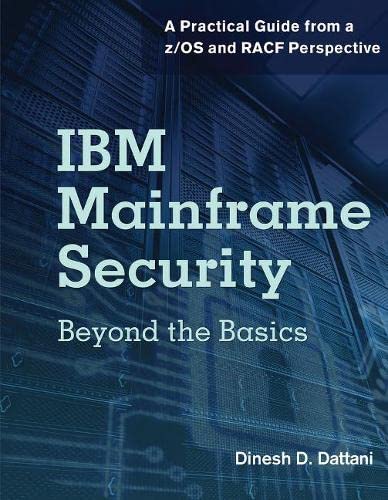
IBM Mainframe Security: Beyond the Basics—A Practical Guide from a z/OS and RACF Perspective (Ebl-Schweitzer) - Softcover
Inhaltsangabe
Rather than rehashing basic information—such as command syntax—already available in other publications, this book focuses on important security and audit issues, business best practices, and compliance, discussing the important issues in IBM mainframe security. Mainframes are the backbone of most large IT organizations; security cannot be left to chance. With very little training available to the younger crowd, and older, more experienced personnel retiring or close to retiring, there is a need in mainframe security skills at the senior level. Based on real-life experiences, issues, and solutions to mainframe security from the author’s three decades of practical experience as a mainframe security practitioner, this book fulfills that need.
Die Inhaltsangabe kann sich auf eine andere Ausgabe dieses Titels beziehen.
Über die Autorin bzw. den Autor
Dinesh D. Dattani is a mainframe security consultant and the president of Triple-D Mainframe Services Ltd. He has more than 30 years of mainframe security experience at a number of companies in North America, and his consulting career spans diverse industries and sectors, including banking, telecom, automotive, insurance, energy, government, and service providers. He is the author of nearly 60 articles on mainframe security, including the IBM white paper "Best Practices for System z Security: Mainframe Security Matters--Thinking Outside the Box." He lives in Toronto.
Auszug. © Genehmigter Nachdruck. Alle Rechte vorbehalten.
IBM Mainframe Security: Beyond the Basics
A Practical Guide from a z/OS and RACF Perspective
By Dinesh D. DattaniMC Press
Copyright © 2013 Dinesh D. Dattani
All rights reserved.
ISBN: 978-1-58347-828-8All rights reserved.
Contents
Introduction,
PART ONE: SECURING BUSINESS DATA,
Chapter 1: How the Mainframe Provides Security,
Chapter 2: RACF Special Privileges,
Chapter 3: The Data Security Monitor (DSMON),
Chapter 4: Security Event Logging and Auditing,
Chapter 5: The Global Access Checking (GAC) Table,
Chapter 6: Understanding the FACILITY Class,
Chapter 7: The Benefits of the SEARCH Command,
Chapter 8: WARNING Mode and Its Implications,
Chapter 9: Understanding z/OS UNIX Security,
Chapter 10: The Benefits of RACF Commands in Batch Mode,
Chapter 11: Security Administration: Beyond the Basics,
PART TWO: SECURING THE z/OS OPERATING SYSTEM,
Chapter 12: APF-Authorized Libraries,
Chapter 13: The System Management Facility (SMF),
Chapter 14: Operating System Data Sets,
Chapter 15: RACF Databases,
Chapter 16: RACF Exits,
Chapter 17: System Exits,
Chapter 18: Started Procedures,
Chapter 19: Tape Bypass Label Processing (BLP),
Chapter 20: The SYS1.UADS Data Set,
Chapter 21: The System Display and Search Facility (SDSF),
Chapter 22: The Program Properties Table (PPT),
Chapter 23: Special-Use Programs,
PART THREE: SECURITY INFRASTRUCTURE MATTERS,
Chapter 24: Application and Batch ID Security,
Chapter 25: Security Architecture,
Chapter 26: The RACF Unload Database,
Chapter 27: Increasing Your Productivity,
Chapter 28: Security Compliance,
Chapter 29: Security Best Practices,
Chapter 30: Security Add-On Products,
Epilogue,
Index,
CHAPTER 1
How the Mainframe Provides Security
Any farmer will tell you, only a fool lets a fox guard the henhouse door. — Proverb
One way to implement mainframe security is to let all applications running on the system manage their own security. However, that would be akin to allowing foxes to guard the henhouse. Instead, the mainframe operating system is entrusted with providing security for all users and applications sharing the computer. Being an independent entity, the operating system has no vested interest in compromising the data.
A key integrity feature of the z/OS mainframe operating system is that all programs doing work are kept apart from each other. In other words, one program cannot see what the other is doing. This segregation is implemented via a feature called address spaces, whereby each entity in the mainframe is allocated an address space and cannot look into other address spaces.
Thus, the very foundation of the operating system provides data integrity, as shown in Figure 1.1.
While the operating system provides basic integrity, it uses an "external" security product to do all other security checking.
When we talk about an external security product, we mean it is external to the "core" operating system. However, the security product is still part of the operating system. The security checking has been externalized from the core operating system to enable competing security products to provide mainframe security.
There are three main mainframe security products: IBM's Resource Access Control Facility, or RACF, and ACF2 and Top Secret, both from CA Technologies (formerly Computer Associates International). We will use RACF throughout this book.
The operating system intercepts all authentication and validation requests. It then passes along these requests to RACF, which in turn makes its decision based on information in its security database. In this sense, the operating system is strictly a gatekeeper or go-between; it does not actively make decisions to allow or fail the security requests.
One can think of the operating system as having subcontracted all installation-specific security checking to RACF.
How RACF Does Access Checking
When RACF receives a request for access checking, it decides to grant or deny the request based on information residing in the RACF database. RACF checking for an access request is quite involved. There are of course the "access lists" in RACF profiles that specify who has access, but that's not all. Several other factors influence RACF's decision-making process. In addition to access lists, following are the main factors RACF considers before deciding whether to grant or deny access:
1. Universal access — The "universal access" (UACC) specified in the profile is above and beyond what is in the access lists. For example, if the value is READ and a user ID is not in the access list, then the user ID gets at least READ access.
2. General access — If the profile has an entry of * (an asterisk) in its access list, all user IDs have access that is specified for *. There is a subtle difference between this general access and universal access. This is covered in chapter 11, "Security Administration: Beyond the Basics."
3. Operations privilege — If a user has the OPERATIONS privilege, the user might get access because of that fact. This is discussed in detail in chapter 2, "RACF Special Privileges."
4. Global Access Checking (GAC) table — The GAC table can grant access before the pertaining profile is even checked. This is discussed in detail in chapter 5, "The Global Access Checking (GAC) Table."
5. RACF exits — RACF exits can override all access definitions in the RACF database. This is discussed in detail in chapter 16, "RACF Exits."
The RACF Access Checking Diagram
The diagram in Figure 1.2 is a simplified version of RACF authorization checking. It covers the main areas, but it does not go into the details of seldom-used cases. Let's use the diagram to understand how RACF works, by taking Quiz 1.1.
CHAPTER 2RACF Special Privileges
In this business you don't even trust yourself. — Former colleague
RACF has provisions for users to have special privileges. The three main special privileges are OPERATIONS, SPECIAL, and AUDITOR.
These three privileges come in two flavors: group-level and system-wide. A group-level privilege is only applicable to one RACF group, and the privilege applies only to users and resources that fall within the scope of the specified group. A system-wide privilege does not have this limitation — it applies to all resources, and to all users.
Note that the following are not discussed in this chapter:
• The UNIX® SUPERUSER privilege. For information about this privilege, refer to chapter 9, "Understanding z/OS UNIX Security."
• Special privileges available in optional system components such as DB2®, CICS®, and IMS®.
The OPERATIONS privilege allows the user to read, write, create, and delete most of the installation's data.
The SPECIAL privilege allows the user to define and administer security profiles and user IDs, and to set RACF global options through the SETROPTS command in the RACF database. It does not allow the ability to manipulate any data, although users with this privilege can do that in a roundabout way, by adding themselves to the appropriate access lists of profiles.
The AUDITOR privilege allows the holder to display all profiles in the RACF database.
In addition, your...
„Über diesen Titel“ kann sich auf eine andere Ausgabe dieses Titels beziehen.
Suchergebnisse für IBM Mainframe Security: Beyond the Basics—A...

Beispielbild für diese ISBN
IBM Mainframe Security: Beyond the BasicsùA Practical Guide from a z/OS and RACF Perspective (Ebl-Schweitzer)
Anbieter: Lakeside Books, Benton Harbor, MI, USA
Verkäuferbewertung 5 von 5 Sternen

Zustand: New. Brand New! Not Overstocks or Low Quality Book Club Editions! Direct From the Publisher! We're not a giant, faceless warehouse organization! We're a small town bookstore that loves books and loves it's customers! Buy from Lakeside Books! Bestandsnummer des Verkäufers OTF-9781583478288
Neu kaufen
EUR 42,35
EUR 3,57 Versand
Versand innerhalb von USA
Versand innerhalb von USA
Anzahl: Mehr als 20 verfügbar
Foto des Verkäufers
IBM Mainframe Security : Beyond the Basics: A Practical Guide from a z/OS and RACF Perspective
Anbieter: GreatBookPrices, Columbia, MD, USA
Verkäuferbewertung 5 von 5 Sternen
Zustand: New. Bestandsnummer des Verkäufers 20111124-n
Neu kaufen
EUR 43,59
EUR 2,36 Versand
Versand innerhalb von USA
Versand innerhalb von USA
Anzahl: 4 verfügbar
Foto des Verkäufers
IBM Mainframe Security: Beyond the Basics-A Practical Guide from A Z/OS and Racf Perspective (Paperback or Softback)
Verlag:
MC Press 9/30/2013, 2013
ISBN 10: 1583478280
ISBN 13: 9781583478288
Neu
Paperback or Softback
Anbieter: BargainBookStores, Grand Rapids, MI, USA
Verkäuferbewertung 5 von 5 Sternen
Paperback or Softback. Zustand: New. IBM Mainframe Security: Beyond the Basics-A Practical Guide from A Z/OS and Racf Perspective. Book. Bestandsnummer des Verkäufers BBS-9781583478288
Beispielbild für diese ISBN
IBM Mainframe Security : Beyond the Basics: A Practical Guide from a z/OS and RACF Perspective
Anbieter: GreatBookPrices, Columbia, MD, USA
Verkäuferbewertung 5 von 5 Sternen
Zustand: As New. Unread book in perfect condition. Bestandsnummer des Verkäufers 20111124
Gebraucht kaufen
EUR 49,35
EUR 2,36 Versand
Versand innerhalb von USA
Versand innerhalb von USA
Anzahl: 4 verfügbar
Beispielbild für diese ISBN
IBM Mainframe Security: Beyond the Basics?A Practical Guide from a z/OS and RACF Perspective (Ebl-Schweitzer)
Anbieter: California Books, Miami, FL, USA
Verkäuferbewertung 5 von 5 Sternen
Zustand: New. Bestandsnummer des Verkäufers I-9781583478288
Neu kaufen
EUR 52,54
EUR 2,68 Versand
Versand innerhalb von USA
Versand innerhalb von USA
Anzahl: Mehr als 20 verfügbar
Beispielbild für diese ISBN
IBM Mainframe Security: Beyond the Basics - A Practical Guide from a z/OS and RACF Perspective
Anbieter: Chiron Media, Wallingford, Vereinigtes Königreich
Verkäuferbewertung 5 von 5 Sternen
Paperback. Zustand: New. Brand new book, sourced directly from publisher. Dispatch time is 7-8 days from our warehouse. Book will be sent in robust, secure packaging to ensure it reaches you securely. Bestandsnummer des Verkäufers 6666-ING-9781583478288
Neu kaufen
EUR 53,66
EUR 5,96 Versand
Versand von Vereinigtes Königreich nach USA
Versand von Vereinigtes Königreich nach USA
Anzahl: 20 verfügbar
Beispielbild für diese ISBN
IBM Mainframe Security
Print-on-DemandAnbieter: PBShop.store UK, Fairford, GLOS, Vereinigtes Königreich
Verkäuferbewertung 5 von 5 Sternen
PAP. Zustand: New. New Book. Delivered from our UK warehouse in 4 to 14 business days. THIS BOOK IS PRINTED ON DEMAND. Established seller since 2000. Bestandsnummer des Verkäufers L0-9781583478288
Neu kaufen
EUR 55,37
EUR 4,97 Versand
Versand von Vereinigtes Königreich nach USA
Versand von Vereinigtes Königreich nach USA
Anzahl: Mehr als 20 verfügbar
Foto des Verkäufers
IBM Mainframe Security : Beyond the Basics: A Practical Guide from a z/OS and RACF Perspective
Anbieter: GreatBookPricesUK, Woodford Green, Vereinigtes Königreich
Verkäuferbewertung 5 von 5 Sternen
Zustand: As New. Unread book in perfect condition. Bestandsnummer des Verkäufers 20111124
Gebraucht kaufen
EUR 54,54
EUR 17,91 Versand
Versand von Vereinigtes Königreich nach USA
Versand von Vereinigtes Königreich nach USA
Anzahl: Mehr als 20 verfügbar
Foto des Verkäufers
IBM Mainframe Security : Beyond the Basics: A Practical Guide from a z/OS and RACF Perspective
Anbieter: GreatBookPricesUK, Woodford Green, Vereinigtes Königreich
Verkäuferbewertung 5 von 5 Sternen
Zustand: New. Bestandsnummer des Verkäufers 20111124-n
Neu kaufen
EUR 55,35
EUR 17,91 Versand
Versand von Vereinigtes Königreich nach USA
Versand von Vereinigtes Königreich nach USA
Anzahl: Mehr als 20 verfügbar
Beispielbild für diese ISBN
IBM Mainframe Security: Beyond the Basics?A Practical Guide from a z/OS and RACF Perspective (Ebl-Schweitzer)
Anbieter: Ria Christie Collections, Uxbridge, Vereinigtes Königreich
Verkäuferbewertung 5 von 5 Sternen
Zustand: New. In English. Bestandsnummer des Verkäufers ria9781583478288_new
Neu kaufen
EUR 63,62
EUR 13,48 Versand
Versand von Vereinigtes Königreich nach USA
Versand von Vereinigtes Königreich nach USA
Anzahl: Mehr als 20 verfügbar