
Verwandte Artikel zu Drawing on the Right Side of the Brain: The Definitive,...
Inhaltsangabe
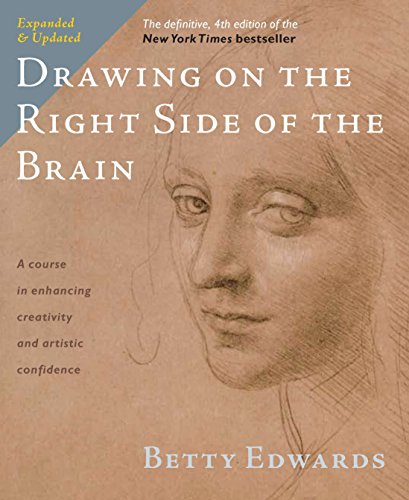
A revised edition of the classic bestselling how to draw book. A life-changing book, this fully revised and updated edition of Drawing on the Right Side of the Brain is destined to inspire generations of readers and artists to come.
Translated into more than seventeen languages, Drawing on the Right Side of the Brain is the world's most widely used instructional drawing book. Whether you are drawing as a professional artist, as an artist in training, or as a hobby, this book will give you greater confidence in your ability and deepen your artistic perception, as well as foster a new appreciation of the world around you. This revised/updated fourth edition includes:
• a new introduction;
• crucial updates based on recent research on the brain's plasticity and the enormous value of learning new skills/ utilizing the right hemisphere of the brain;
• new focus on how the ability to draw on the strengths of the right hemisphere can serve as an antidote to the increasing left-brain emphasis in American life-the worship of all that is linear, analytic, digital, etc.;
• an informative section that addresses recent research linking early childhood "scribbling" to later language development and the importance of parental encouragement of this activity;
• and new reproductions of master drawings throughout
Die Inhaltsangabe kann sich auf eine andere Ausgabe dieses Titels beziehen.
Über die Autorin bzw. den Autor
Betty Edwards speaks regularly at universities, art schools, and companies. Now retired from her position as professor emeritus of art at California State University in Long Beach, Edwards received her doctorate from UCLA in art, education, and the psychology of perception. Dr. Edwards has been profiled on the Today show and in Time, among other magazines and newspapers. She lives in California.
Auszug. © Genehmigter Nachdruck. Alle Rechte vorbehalten.
Introduction
Drawing used to be a civilized thing to do, like reading and writing. It was taught in elementary schools. It was democratic. It was a boon to happiness.
—Michael Kimmelman
For more than thirty years, Drawing on the Right Side of the Brain has been a work in progress. Since the original publication in 1979, I have revised the book three times, with each revision about a decade apart: the ?rst in 1989, the second, 1999, and now a third, 2012 version. In each revision, my main purpose has been to incorporate instructional improvements that my group of teachers and I had gleaned from continuously teaching drawing over the intervening years, as well as bringing up-to-date ideas and information from education and neuroscience that relate to drawing. As you will see in this new version, much of the original material remains, as it has passed the test of time, while I continue to re?ne the lessons and clarify instructions. In addition, I make some new points about emergent right-brain signi?cance and the astonishing, relatively new science called neuroplasticity. I make a case for my life’s goal, the possibility that public schools will once again teach drawing, not only as a civilized thing to do and a boon to happiness, but also as perceptual training for improving creative thinking.
The power of perception
Many of my readers have intuitively understood that this book is not only about learning to draw, and it is certainly not about Art with a capital A. The true subject is perception. Yes, the lessons have helped many people attain the basic ability to draw, and that is a main purpose of the book. But the larger underlying purpose was always to bring right hemisphere functions into focus and to teach readers how to see in new ways, with hopes that they would discover how to transfer perceptual skills to thinking and problem solving. In education, this is called “transfer of learning,” which has always been regarded as di?cult to teach, and often teachers, myself included, hope that it will just happen. Transfer of learning, however, is best accomplished by direct teaching, and therefore, in Chapter 11 of this revised edition, I encourage that transfer by including some direct instruction on how perceptual skills, learned through drawing, can be used for thinking and problem solving in other ?elds.
The book’s drawing exercises are truly on a basic level, intended for a beginner in drawing. The course is designed for persons who cannot draw at all, who feel that they have no talent for drawing, and who believe that they probably can never learn to draw. Over the years, I have said many times that the lessons in this book are not on the level of art, but are rather more like learning how to read—more like the ABCs of reading: learning the alphabet, phonics, syllabi?cation, vocabulary, and so on. And just as learning basic reading is a vitally important goal, because the skills of reading transfer to every other kind of learning, from math and science to philosophy and astronomy, I believe that in time learning to draw will emerge as an equally vital skill, one that provides equally transferrable powers of perception to guide and promote insight into the meaning of visual and verbal information. I will even go out on a limb and say that we mistakenly may have been putting all our educational eggs into one basket only, while shortchanging other truly valuable capabilities of the human brain, namely perception, intuition, imagination, and creativity. Perhaps Albert Einstein put it best: “The intuitive mind is a sacred gift, and the rational mind is a faithful servant. We have created a society that honors the servant and has forgotten the gift.”
The hidden content
About six months after publication of the original book in 1979, I had the odd experience of suddenly realizing that the book I thought I had written contained another content of which I was unaware. That hidden content was something I didn’t know I knew: I had inadvertently de?ned the basic component skills of the global skill of drawing. I think part of the reason this content was hidden from me was the very nature of art education at the time, where beginning drawing classes focused on subject matter, such as “Still Life Drawing,” “Landscape Drawing,” or “Figure Drawing,” or on drawing mediums, such as charcoal, pencil, pen and ink, ink wash, or mixtures of mediums.
But my aim was di?erent: I needed to provide my readers with exercises that would cause a cognitive shift to the right hemisphere—a shift similar to that caused by Upside-Down Drawing: “tricking” the dominant left hemisphere into dropping out of the task. I settled on ?ve subskills that seemed to have the same e?ect, but at the time, I thought that there must be other basic skills—maybe dozens of them.
Then, months after the book had been published, in the midst of teaching a class, it hit me as an aha! that for learning to draw realistic images of observed subjects, the ?ve subskills were it—there weren’t more. I had inadvertently selected from the many aspects of drawing a few fundamental subskills that I thought might be closely aligned to the e?ect of Upside-Down Drawing. And the ?ve skills, I realized, were not drawing skills in the usual sense; they were rock-bottom, fundamental seeing skills: how to perceive edges, spaces, relationship, lights and shadows, and the gestalt. As with the ABCs of reading, these were the skills you had to have in order to draw any subject.
I was elated by this discovery. I discussed it at length with my colleagues and searched through old and new textbooks on drawing, but we did not ?nd any additional fundamental basic components of the global skill of basic realistic drawing—drawing one’s perceptions. With this discovery, it occurred to me that perhaps drawing could be quickly and easily taught and learned— not strung out over years and years, as was the current practice in art schools. My aim suddenly became “drawing for everyone,” not just for artists in training. Clearly, the basic ability to draw does not necessarily lead to the “?ne art” found in museums and galleries any more than the basic ability to read and write inevitably leads to literary greatness and published works of literature. But learning to draw was something I knew was valued by children and adults. Thus, my discovery led me in new directions, resulting in a 1989 revision of Drawing on the Right Side of the Brain, in which I focused on explaining my insight and proposing that individuals who had never been able to draw could learn to draw well very rapidly.
Subsequently, my colleagues and I developed a five-day workshop of forty hours of teaching and learning (eight hours a day for ?ve days), which proved to be surprisingly e?ective: students acquired quite high-level basic drawing skills in that brief time, and gained all the information they needed to go on making progress in drawing. Since drawing perceived subjects is always the same task, always requiring the ?ve basic component skills, they could proceed to any subject matter, learn to use any or all drawing mediums, and take the skill as far as they wished. They could also apply their new visual skills to thinking. The parallels to learning to read were becoming obvious.
Over the next decade, from 1989 to 1999, the connection of perceptual skills to general thinking, problem solving, and creativity became a more central focus for me, especially after publication of my 1986 book, Drawing on the Artist Within. In this
book, I proposed a “written” language for the right hemisphere:...
„Über diesen Titel“ kann sich auf eine andere Ausgabe dieses Titels beziehen.
Suchergebnisse für Drawing on the Right Side of the Brain: The Definitive,...

Beispielbild für diese ISBN
Drawing on the Right Side of the Brain: The Definitive, 4th Edition
Anbieter: World of Books (was SecondSale), Montgomery, IL, USA
Verkäuferbewertung 5 von 5 Sternen

Paperback. Zustand: Good. A revised edition of the classic bestselling how to draw book. A life-changing book, this fully revised and updated edition of Drawing on the Right Side of the Brain is destined to inspire generations of readers and artists to come. Translated into more than seventeen languages, Drawing on the Right Side of the Brain is the world's most widely used instructional drawing book. Whether you are drawing as a professional artist, as an artist in training, or as a hobby, this book will give you greater confidence in your ability and deepen your artistic perception, as well as foster a new appreciation of the world around you. This revised/updated fourth edition includes: * a new introduction; * crucial updates based on recent research on the brain's plasticity and the enormous value of learning new skills/ utilizing the right hemisphere of the brain; * new focus on how the ability to draw on the strengths of the right hemisphere can serve as an antidote to the increasing left-brain emphasis in American life-the worship of all that is linear, analytic, digital, etc.; * an informative section that addresses recent research linking early childhood "scribbling" to later language development and the importance of parental encouragement of this activity; * and new reproductions of master drawings throughout. Bestandsnummer des Verkäufers 00107840872
Gebraucht kaufen
EUR 4,62
Versand gratis
Versand innerhalb von USA
Versand innerhalb von USA
Anzahl: Mehr als 20 verfügbar
Beispielbild für diese ISBN
Drawing on the Right Side of the Brain: The Definitive, 4th Edition
Anbieter: World of Books (was SecondSale), Montgomery, IL, USA
Verkäuferbewertung 5 von 5 Sternen
Paperback. Zustand: Very Good. A revised edition of the classic bestselling how to draw book. A life-changing book, this fully revised and updated edition of Drawing on the Right Side of the Brain is destined to inspire generations of readers and artists to come. Translated into more than seventeen languages, Drawing on the Right Side of the Brain is the world's most widely used instructional drawing book. Whether you are drawing as a professional artist, as an artist in training, or as a hobby, this book will give you greater confidence in your ability and deepen your artistic perception, as well as foster a new appreciation of the world around you. This revised/updated fourth edition includes: * a new introduction; * crucial updates based on recent research on the brain's plasticity and the enormous value of learning new skills/ utilizing the right hemisphere of the brain; * new focus on how the ability to draw on the strengths of the right hemisphere can serve as an antidote to the increasing left-brain emphasis in American life-the worship of all that is linear, analytic, digital, etc.; * an informative section that addresses recent research linking early childhood "scribbling" to later language development and the importance of parental encouragement of this activity; * and new reproductions of master drawings throughout. Bestandsnummer des Verkäufers 00110705870
Gebraucht kaufen
EUR 4,62
Versand gratis
Versand innerhalb von USA
Versand innerhalb von USA
Anzahl: 6 verfügbar
Foto des Verkäufers
Drawing on the Right Side of the Brain: The Definitive, 4th Edition
Anbieter: Zoom Books East, Glendale Heights, IL, USA
Verkäuferbewertung 5 von 5 Sternen
Zustand: good. Book is in good condition and may include underlining highlighting and minimal wear. The book can also include "From the library of" labels. May not contain miscellaneous items toys, dvds, etc. . We offer 100% money back guarantee and 24 7 customer service. Bestandsnummer des Verkäufers ZEV.1585429201.G
Gebraucht kaufen
EUR 4,63
Versand gratis
Versand innerhalb von USA
Versand innerhalb von USA
Anzahl: 1 verfügbar
Foto des Verkäufers
Drawing on the Right Side of the Brain: The Definitive, 4th Edition
Anbieter: Bay State Book Company, North Smithfield, RI, USA
Verkäuferbewertung 5 von 5 Sternen
Zustand: very_good. Bestandsnummer des Verkäufers BSM.1FFR0
Gebraucht kaufen
EUR 5,25
Versand gratis
Versand innerhalb von USA
Versand innerhalb von USA
Anzahl: 1 verfügbar
Foto des Verkäufers
Drawing on the Right Side of the Brain: The Definitive, 4th Edition
Anbieter: Bay State Book Company, North Smithfield, RI, USA
Verkäuferbewertung 5 von 5 Sternen
Zustand: very_good. Bestandsnummer des Verkäufers BSM.1FFTW
Gebraucht kaufen
EUR 5,25
Versand gratis
Versand innerhalb von USA
Versand innerhalb von USA
Anzahl: 1 verfügbar
Beispielbild für diese ISBN
Drawing on the Right Side of the Brain
Anbieter: ThriftBooks-Phoenix, Phoenix, AZ, USA
Verkäuferbewertung 5 von 5 Sternen
Paperback. Zustand: Good. No Jacket. Pages can have notes/highlighting. Spine may show signs of wear. ~ ThriftBooks: Read More, Spend Less. Bestandsnummer des Verkäufers G1585429201I3N00
Gebraucht kaufen
EUR 6,10
Versand gratis
Versand innerhalb von USA
Versand innerhalb von USA
Anzahl: 1 verfügbar
Beispielbild für diese ISBN
Drawing on the Right Side of the Brain
Anbieter: ThriftBooks-Atlanta, AUSTELL, GA, USA
Verkäuferbewertung 5 von 5 Sternen
Paperback. Zustand: Fair. No Jacket. Former library book; Readable copy. Pages may have considerable notes/highlighting. ~ ThriftBooks: Read More, Spend Less. Bestandsnummer des Verkäufers G1585429201I5N10
Gebraucht kaufen
EUR 6,10
Versand gratis
Versand innerhalb von USA
Versand innerhalb von USA
Anzahl: 1 verfügbar
Beispielbild für diese ISBN
Drawing on the Right Side of the Brain
Anbieter: ThriftBooks-Reno, Reno, NV, USA
Verkäuferbewertung 5 von 5 Sternen
Paperback. Zustand: Good. No Jacket. Pages can have notes/highlighting. Spine may show signs of wear. ~ ThriftBooks: Read More, Spend Less. Bestandsnummer des Verkäufers G1585429201I3N00
Gebraucht kaufen
EUR 6,10
Versand gratis
Versand innerhalb von USA
Versand innerhalb von USA
Anzahl: 2 verfügbar
Beispielbild für diese ISBN
Drawing on the Right Side of the Brain
Anbieter: ThriftBooks-Dallas, Dallas, TX, USA
Verkäuferbewertung 5 von 5 Sternen
Paperback. Zustand: Good. No Jacket. Former library book; Pages can have notes/highlighting. Spine may show signs of wear. ~ ThriftBooks: Read More, Spend Less. Bestandsnummer des Verkäufers G1585429201I3N10
Gebraucht kaufen
EUR 6,10
Versand gratis
Versand innerhalb von USA
Versand innerhalb von USA
Anzahl: 1 verfügbar
Beispielbild für diese ISBN
Drawing on the Right Side of the Brain
Anbieter: ThriftBooks-Reno, Reno, NV, USA
Verkäuferbewertung 5 von 5 Sternen
Paperback. Zustand: As New. No Jacket. Pages are clean and are not marred by notes or folds of any kind. ~ ThriftBooks: Read More, Spend Less. Bestandsnummer des Verkäufers G1585429201I2N00
Gebraucht kaufen
EUR 6,10
Versand gratis
Versand innerhalb von USA
Versand innerhalb von USA
Anzahl: 1 verfügbar