
Verwandte Artikel zu The Heroic Garrison (The Alexander Sheridan Adventures)
Inhaltsangabe
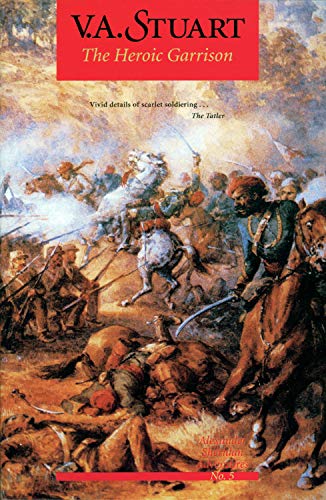
In this final volume of Stuart's Sheridan series, General Havelock's Moveable Column—a force of barely a thousand men—has finally fought its way through to the heroic garrison defending the Residency in Lucknow, only to be besieged themselves by the 60,000 mutinous sepoys in the city. They must hold firm until the relieving force reaches them. Meanwhile, Colonel Alex Sheridan volunteers for a dangerous mission, but is captured. He is soon called upon to fight a much more personal war: assassination of the very man who ordered the deaths of his wife and child!
Die Inhaltsangabe kann sich auf eine andere Ausgabe dieses Titels beziehen.
Über die Autorin bzw. den Autor
V. A. Stuart wrote several military fiction series and numerous other novels under various pseudonyms. Her settings span history and the globe, from the Napoleonic Wars of Europe to India under the British Raj. Born in 1914, she was in Burma with the British Fourteenth Army, became a lieutenant, and was decorated with the Burma Star and the Pacific Star.
Auszug. © Genehmigter Nachdruck. Alle Rechte vorbehalten.
The Heroic Garrison
The Alexander Sheridan Adventures, No. 5
By V. A. StuartMcBooks Press, Inc.
Copyright © 1975 V. A. Stuart
All rights reserved.
ISBN: 978-1-59013-030-8All rights reserved.
CHAPTER 1
It was barely light when the first small party of volunteers left the Lucknow Residency to make their way cautiously through the Terhee Kothee and Furhut Baksh Palaces and from there, along the river bank, to the position held by the rear-guard of Havelock's force in the Moti Mahal.
Alex Sheridan, leading his horse a little way behind the rest, was almost asleep on his feet, stumbling blindly on the rubble-strewn ground, still littered with the debris of the previous day's battle. He had snatched less than an hour's sleep after entering the beleaguered Bailey Guard gate in the wake of the gun-limber bearing Brigadier General James Neill's body, eaten a frugal meal and then — informed of a call for anyone familiar with Lucknow's geography to volunteer to assist in bringing in wounded — had answered the call. For what remained of the night, he had gone, with a surgeon named Greenhow and Lieutenant Johnson of the Irregular Cavalry and twenty of his sowars, as far as the Khas Bazaar, returning with wounded Highlanders and Sikhs slung across their saddles or clinging, limping, to their stirrupirons.
Lousada Barrow, commander of the Volunteer Cavalry, had also fared forth on a similar mission, along the street leading to the Paeen Bagh and — thanks to the prompt action of the commander of the Bailey Guard, Lieutenant Aitken, who had led a party of his defenders to secure the adjacent buildings — neither party had been fired on by the enemy. Indeed, Alex thought, rousing himself to look about him, the rebels were conspicuous by their continued absence, content, it appeared, to abandon both palaces at the river's edge and their walled enclosures to British occupation. Only ahead of them, in the neighborhood of the Moti Mahal three quarters of a mile away, were the Begum's guns in action ... and there, according to a report received from Colonel Campbell, of Her Majesty's 90th Light Infantry, who was in command, the position was one of considerable peril. The rear-guard, which consisted of a hundred men of his regiment, was surrounded and under continuous bombardment. Hampered by the column's baggage train and by its wounded — now numbering over two hundred, in doolies — and with one of Major Eyre's heavy guns jammed in a narrow passageway and out of action, Campbell stated that he could not advance, although he was so far holding his own. He had asked for reinforcements and, as a matter of urgency, for assistance to evacuate the wounded, many of whom were dying, due to the inability of his handful of surgeons to care for them adequately under such conditions.
The reinforcements — two companies of H.M.'s 5th Fusiliers, under Major Simmons, and a company of Jeremiah Brasyer's Sikhs — had been ordered out by General Outram, Alex was aware, before his own party had left the Residency, but they had been held up by the necessity to clear and occupy the Chutter Munzil garden before proceeding to their objective. When a young civil service officer, Bensley Thornhill — who was well acquainted with Lucknow's tortuous maze of streets and palace courtyards — had offered to guide a party along a path by the river bank, at the rear of the Chutter Munzil, and bring the wounded back by the same route, his offer had been accepted thankfully by General Havelock and agreed to by Sir James Outram.
Havelock's son Harry, deputy assistant adjutant-general to the Oudh Field Force, had been shot down after the attack on the Char Bagh bridge the day before and he was known to be among the wounded. The little general, despite his stoic efforts not to betray his personal feelings, was beside himself with anxiety on his son's account and Thornhill, who was related to the Havelocks by marriage, was eager to assuage his anxiety. His offer, however, had been confidently made and his route very carefully planned; it was evident to Alex, as the young civilian strode unhesitatingly ahead of his party of volunteers, that he knew the locale as well as he had claimed to know it.
"We're skirting the Chutter Munzil now," he called back softly. "Heads down and keep close to the wall, if you please."
Outside, under the towering wall of the palace, the shadows were deep and the path deserted. To their left, the River Goomti followed its winding course, its murky waters touched with a faint pink radiance as the new day dawned. On the far bank, the lights that had flickered through the darkness like fireflies went out, one by one, but, aside from this indication that the citizens of Lucknow were starting to wake, there was no sign of untoward activity on the part of the rebel troops. All their efforts were concentrated on the destruction of Colonel Campbell's hard-pressed rear-guard, the thunder of cannon and the crackle of musketry bearing witness to the ferocity of their assault.
A guard of Fusiliers, posted in a walled garden overlooking the river, challenged and brought the volunteer party to a halt. Thornhill gave the password of the day and one of the Fusiliers, gesturing ahead with his Minié rifle, told him that the main body of the reinforcements, under Major Simmons, had advanced through the king's stables and the godowns beyond, making for Martin's House. They were retracing the route by which the column had advanced yesterday, Alex's tired brain registered, but this time, seemingly, without meeting anything like yesterday's opposition.
"We'll keep close to the river," Bensley Thornhill said, as they moved forward again. "Until we're opposite Martin's House. Then we'll have to leg it across three hundred yards of dangerous ground, exposed to enemy fire. Perhaps, Colonel Sheridan, as you are mounted, you and your sowars could give us cover?"
"Certainly," Alex assented. He had two native cavalrymen with him, men who had accompanied him on one of his earlier sorties to bring in wounded from the Khas Bazaar area, and he glanced at them inquiringly, wondering if they had understood Thornhill's request, which had been made in English. He was about to repeat it in Hindustani when one of the sowars, who had a daffadar's stripes on his tattered uniform, gave vent to a startled exclamation.
"Sheridan Sahib ... you are Sheridan Sahib? Allah forgive me, I was not sure. In the darkness I did not see the sahib's face and, in truth, I believed you dead, Colonel Sahib — in Cawnpore, with all the others!" The man's voice shook and Alex checked his stride, to subject him to a puzzled scrutiny. The lined, dark face, with its graying beard was vaguely familiar and so was the voice but ... his tired eyes glimpsed the medals pinned to the ragged tunic. Ghuznee and the Sutlej campaign ... of course, it could be no one else! Pleasure and relief overcame his weariness and he turned, his hand extended.
"Ghulam Rasul — Daffadar Ghulam Rasul!"
"The same, Sahib." The old daffadar was beaming as he clasped the proffered hand.
"My wits are woolly from lack of sleep," Alex apologized. "I should have recognized you, daffadar-ji."
"We have all changed, Colonel Sahib." Ghulam Rasul gestured to Alex's scarred face. "You bear the scars of Cawnpore and I those of Lucknow."
"Have you been with the Lucknow garrison throughout the siege?" Alex asked him, resuming his slow, stumbling walk. Ghulam Rasul inclined his turbaned head.
"Ji-han ... since the day when the Colonel Sahib sent...
„Über diesen Titel“ kann sich auf eine andere Ausgabe dieses Titels beziehen.
Weitere beliebte Ausgaben desselben Titels

Suchergebnisse für The Heroic Garrison (The Alexander Sheridan Adventures)

Beispielbild für diese ISBN
The Heroic Garrison (Volume 5) (Alexander Sheridan Adventures, 5)
Anbieter: Gulf Coast Books, Cypress, TX, USA
Verkäuferbewertung 5 von 5 Sternen

paperback. Zustand: Very Good. Bestandsnummer des Verkäufers 1590130308-2-36432813
Gebraucht kaufen
EUR 4,71
Versand gratis
Versand innerhalb von USA
Versand innerhalb von USA
Anzahl: 1 verfügbar
Beispielbild für diese ISBN
The Heroic Garrison (Alexander Sheridan Novels)
Verlag:
McBooks Press (edition First Edition), 2003
ISBN 10: 1590130308
ISBN 13: 9781590130308
Gebraucht
Paperback
Erstausgabe
Anbieter: BooksRun, Philadelphia, PA, USA
Verkäuferbewertung 5 von 5 Sternen
Paperback. Zustand: Very Good. First Edition. It's a well-cared-for item that has seen limited use. The item may show minor signs of wear. All the text is legible, with all pages included. It may have slight markings and/or highlighting. Bestandsnummer des Verkäufers 1590130308-8-1
Gebraucht kaufen
EUR 4,85
Versand gratis
Versand innerhalb von USA
Versand innerhalb von USA
Anzahl: 1 verfügbar
Beispielbild für diese ISBN
The Heroic Garrison (Alexander Sheridan Adventures)
Anbieter: World of Books (was SecondSale), Montgomery, IL, USA
Verkäuferbewertung 5 von 5 Sternen
Zustand: Good. Item in good condition. Textbooks may not include supplemental items i.e. CDs, access codes etc. Bestandsnummer des Verkäufers 00105600723
Gebraucht kaufen
EUR 5,35
Versand gratis
Versand innerhalb von USA
Versand innerhalb von USA
Anzahl: 1 verfügbar
Beispielbild für diese ISBN
The Heroic Garrison
Anbieter: ThriftBooks-Atlanta, AUSTELL, GA, USA
Verkäuferbewertung 5 von 5 Sternen
Paperback. Zustand: Good. No Jacket. Pages can have notes/highlighting. Spine may show signs of wear. ~ ThriftBooks: Read More, Spend Less. Bestandsnummer des Verkäufers G1590130308I3N00
Gebraucht kaufen
EUR 5,84
Versand gratis
Versand innerhalb von USA
Versand innerhalb von USA
Anzahl: 1 verfügbar
Beispielbild für diese ISBN
The Heroic Garrison (Alexander Sheridan Novels)
Verlag:
McBooks Press, 2003
ISBN 10: 1590130308
ISBN 13: 9781590130308
Gebraucht
paperback
Erstausgabe
Anbieter: The Maryland Book Bank, Baltimore, MD, USA
Verkäuferbewertung 5 von 5 Sternen
paperback. Zustand: Very Good. First Edition. Used - Very Good. Bestandsnummer des Verkäufers 13-J-2-0251
Gebraucht kaufen
EUR 2,26
EUR 4,07 Versand
Versand innerhalb von USA
Versand innerhalb von USA
Anzahl: 1 verfügbar
Foto des Verkäufers
The Heroic Garrison (Alexander Sheridan Novels)
Anbieter: Southampton Books, Sag Harbor, NY, USA
Verkäuferbewertung 5 von 5 Sternen
Paperback. Zustand: Like New. FIRST THUS. First Edition Thus, First Printing. Not price-clipped. Published by McBooks Press, 2003. Octavo. Paperback. Book is like new. 100% positive feedback. 30 day money back guarantee. NEXT DAY SHIPPING! Excellent customer service. Please email with any questions. All books packed carefully and ship with free delivery confirmation/tracking. All books come with free bookmarks. Ships from Sag Harbor, New York. Bestandsnummer des Verkäufers 428910
Gebraucht kaufen
EUR 8,93
EUR 4,33 Versand
Versand innerhalb von USA
Versand innerhalb von USA
Anzahl: 1 verfügbar
Foto des Verkäufers
Heroic Garrison
Anbieter: GreatBookPrices, Columbia, MD, USA
Verkäuferbewertung 5 von 5 Sternen
Zustand: As New. Unread book in perfect condition. Bestandsnummer des Verkäufers 952913
Gebraucht kaufen
EUR 11,02
EUR 2,29 Versand
Versand innerhalb von USA
Versand innerhalb von USA
Anzahl: Mehr als 20 verfügbar
Beispielbild für diese ISBN
Heroic Garrison
Anbieter: GreatBookPrices, Columbia, MD, USA
Verkäuferbewertung 5 von 5 Sternen
Zustand: New. Bestandsnummer des Verkäufers 952913-n
Neu kaufen
EUR 11,65
EUR 2,29 Versand
Versand innerhalb von USA
Versand innerhalb von USA
Anzahl: Mehr als 20 verfügbar
Foto des Verkäufers
The Heroic Garrison
Anbieter: Rarewaves.com USA, London, LONDO, Vereinigtes Königreich
Verkäuferbewertung 5 von 5 Sternen
Paperback. Zustand: New. General Havelock's Moveable Column-a force of barely a thousand men--has fought its way through to the heroic garrison defending the Residency in Lucknow. They must hold firm until the relieving force reaches them. Colonel Alex sheridan volunteers for a dangerous mission, but is captured. He is soon called upon to fight a much more personal war-assassination of the very man who ordered the deaths of his wife and child! Bestandsnummer des Verkäufers LU-9781590130308
Neu kaufen
EUR 14,02
Versand gratis
Versand von Vereinigtes Königreich nach USA
Versand von Vereinigtes Königreich nach USA
Anzahl: 10 verfügbar
Foto des Verkäufers
The Heroic Garrison
Verlag:
McBooks Press,, Ithaca, New York, U.S.A., 2003
ISBN 10: 1590130308
ISBN 13: 9781590130308
Gebraucht
Large Soft Cover
Anbieter: HERB RIESSEN-RARE BOOKS, Costa Mesa, CA, USA
Verkäuferbewertung 5 von 5 Sternen
Large Soft Cover. Zustand: Fine. First McBooks Paperback, 1st Print. Bestandsnummer des Verkäufers 9757
Gebraucht kaufen
EUR 8,80
EUR 5,64 Versand
Versand innerhalb von USA
Versand innerhalb von USA
Anzahl: 1 verfügbar