
Verwandte Artikel zu The Top 10 Myths about Evolution
Inhaltsangabe
Though the United States is the world leader in science and technology, many of its citizens display a shocking ignorance regarding basic scientific facts. Recent surveys have revealed that only about half of Americans realize that humans have never lived side by side with dinosaurs, and about the same number reject the idea that humans developed from earlier species of animals. This lack of knowledge in the face of overwhelming scientific evidence for evolution springs from a number of negative influences in contemporary society: poor secondary education in some regions of the country, misinformation in the mass media, and deliberate obfuscation by supporters of Creationism and Intelligent Design.
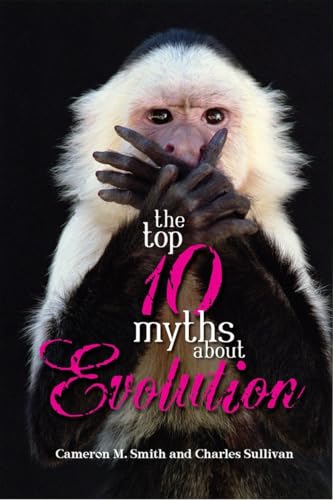
In this concise, accessible, "myth-buster’s handbook," educators Cameron M. Smith and Charles Sullivan clearly dispel the ten most common myths about evolution, which continue to mislead average Americans. Using a refreshing, jargon-free style, they set the record straight on claims that evolution is "just a theory," that Darwinian explanations of life undercut morality, that Intelligent Design is a legitimate alternative to conventional science, that humans come from chimpanzees, and six other popular but erroneous notions.
Smith and Sullivan’s reader-friendly, solidly researched text will serve as an important tool, both for teachers and laypersons seeking accurate information about evolution.
Die Inhaltsangabe kann sich auf eine andere Ausgabe dieses Titels beziehen.
Über die Autorin bzw. den Autor
Cameron M. Smith, Ph.D. (Portland, OR) is an adjunct faculty associate at Portland State University’s department of anthropology and a popular science writer who has published articles in Scientific American MIND, Archaeology, Playboy, Spaceflight, Skeptical Inquirer, The Writer, and other publications.
Charles Sullivan (Portland, OR) has graduate degrees in philosophy and English and is an adjunct faculty member in Portland Community College's writing department. He has published articles with Cameron M. Smith in Playboy, Skeptical Inquirer, and The Writer.
Auszug. © Genehmigter Nachdruck. Alle Rechte vorbehalten.
The Top 10 Myths about Evolution
By Cameron M. Smith Charles SullivanPrometheus Books
Copyright © 2007 Cameron M. Smith and Charles SullivanAll right reserved.
ISBN: 978-1-59102-479-8
Contents
Acknowledgments................................................7Introduction...................................................9Myth One Survival of the Fittest...............................13Myth Two It's Just a Theory....................................25Myth Three The Ladder of Progress..............................43Myth Four The Missing Link.....................................59Myth Five Evolution Is Random..................................75Myth Six People Come from Monkeys..............................87Myth Seven Nature's Perfect Balance............................107Myth Eight Creationism Disproves Evolution.....................123Myth Nine Intelligent Design Is Science........................135Myth Ten Evolution Is Immoral..................................151Afterword......................................................167Bibliography...................................................169Index..........................................................183
Chapter One
Survival of the Fittest
"Survival of the fittest" is the most commonly used phrase drafted into everyday speech from the theory of evolution. Flipping through television channels, we see a lion bearing down on a gazelle, a boxer pummeling his opponent, bighorn sheep clashing horns: we nod and smugly think, "There, see? Survival of the fittest; the order of nature." And it seems clear enough: for all we can tell, the strong do survive. It would be crazy to think otherwise, considering what we've learned about the natural world from mass media.
But mass media, of course, is about drama and unfolding stories, and every dramatist knows that without conflict, you have no story. And so the natural world has been dressed up as a vast and violent landscape of competition-the ultimate reality show, where real blood can be shed. Can the antelope corner tighter than the lion? Can the species survive? Will the "balance of nature" be upset? Television has taken Tennyson to heart, portraying nature as "red in tooth and claw," a world of savage predation, where survival of the fittest is the primary law.
This is all very exciting, but it's a vision of the natural world focused almost entirely on dramatic competition. If we shift our focus, though, it's clear that there's an entire world of plant and animal relationships that aren't dominated by violent competition. For example, aside from the obvious eating of prey by predators, most animals generally leave each other alone, particularly if they're after different kinds of food. And of course there's symbiosis, in which species interactions are mutually beneficial. Nevertheless, on tonight's Animal Planet schedule, we have plenty of shows on big, scary, ferocious animals (polar bears, lions, and spitting cobras), while only one herbivore is getting airtime-the poor old wildebeest. And what about plants? Their lack of bloody teeth and claws might account for the lack of a "Plant Planet" channel.
Clearly, the popular focus on competition has led to a portrayal of nature as a metaphorical battlefield, where all that matters is your ability to wage war, outstrip your opponent, and beat down your immediate peers: the "survival of the fittest." But, as usual, nature is far too complex to be reduced to this absolute, bumper-sticker slogan. Let's see if we can clear up the confusion caused by the survival of the fittest myth, starting with Darwin himself.
What Did Darwin Mean by "Survival of the Fittest"?
We know how popular culture portrays survival of the fittest, but what did Darwin himself have to say about it? In 1872 he wrote: "[The] preservation of favourable individual differences and variations, and the destruction of those which are injurious, I have called Natural Selection, or the Survival of the Fittest."
So, according to Darwin himself, "survival of the fittest" and "natural selection" are basically the same thing-both phrases tell us that in any population, those individuals with characteristics well suited to their environment tend to be preserved, while those less well suited tend to die off. What's most important is that Darwin doesn't specify anything here about the characteristics we often casually associate with the idea that only the strong survive, such as brute force. In fact, Darwin doesn't mention any specific characteristics (like bulging muscles, sharp teeth, or a keen sense for smelling blood) equating to fitness. That should raise the first red flag when people speak casually about survival of the fittest, because we can immediately ask, fittest in what sense or fittest in what environment? Clearly, no single ability or physical characteristic makes any life-form "fit" in every environment.
For example, the long-finned eel is expert at snapping up dragonfly larvae, snails, and small fish that live in New Zealand's lakes, and it's in these lakes where they grow fat (up to eighty pounds) and happy, with few predators. They're kings of their cool, clear-water environment. But before they can grow fat and happy, they have to survive a perilous migration from their birthplace in the Pacific Ocean, and that often requires them to squirm across dry land; most make it, but dry spells occasionally strand armies of them in sticky mudflats. Slightly less rainfall than average can make carcasses of these would-be kings.
Humans, it's often thought, are immune to the rigors of nature -the "selective pressures" that any life-form must endure to survive-because we've mastered living in so many environments. But newborns can't walk or crawl, have no teeth or claws, and can only really eat breast milk, so actually there are many selective pressures that can quickly kill our offspring. At birth, in fact, we're among the most helpless of animals, entirely dependent on our parents. Our specialty as a species isn't brawn but brain.
Obviously, then, we need to refine our concept of the survival of the fittest. It's pretty clear what "survival" refers to. For the individual, it means staying alive. For a species, it means that enough individuals stay alive long enough to have offspring, and perhaps long enough to care for those offspring. The problem here is the word fittest. Fittest, of course, means the most fit, so let's examine the concept of fitness itself.
Fitness
What is fitness? From the perspective of population genetics, fitness is basically the statistical likelihood that you'll have offspring, a cosmic wager on your genetic prospects as an individual. Fitness isn't any single physical characteristic of an organism, like musculature or tooth size; it's a measure of an individual's reproductive potential, whether that individual is bat, buffalo, or bamboo.
While population geneticists calculate theoretical fitness for lab studies, calculating that exact probability for any individual in the real world would take a bank of supercomputers going full-tilt, 24/7. Why? Because the probability that you'll have offspring can be affected by so many factors-each called a selective pressure-that your fitness score is constantly changing. An individual's fitness fluctuates so much that no bookie would dare wager on it, and that's because no bookie, or supercomputer, could ever estimate the range and the effects of selective agents that modify your fitness score from...
„Über diesen Titel“ kann sich auf eine andere Ausgabe dieses Titels beziehen.
Suchergebnisse für The Top 10 Myths about Evolution

Beispielbild für diese ISBN
The Top 10 Myths About Evolution
Anbieter: World of Books (was SecondSale), Montgomery, IL, USA
Verkäuferbewertung 5 von 5 Sternen

Zustand: Very Good. Item in very good condition! Textbooks may not include supplemental items i.e. CDs, access codes etc. Bestandsnummer des Verkäufers 00099567441
Gebraucht kaufen
EUR 5,72
Versand gratis
Versand innerhalb von USA
Versand innerhalb von USA
Anzahl: 2 verfügbar
Beispielbild für diese ISBN
Top 10 Myths about Evolution
Verlag:
The Globe Pequot Publishing Group, Inc., 2006
ISBN 10: 159102479X
ISBN 13: 9781591024798
Gebraucht
Softcover
Anbieter: Better World Books: West, Reno, NV, USA
Verkäuferbewertung 5 von 5 Sternen
Zustand: Good. Pages intact with minimal writing/highlighting. The binding may be loose and creased. Dust jackets/supplements are not included. Stock photo provided. Product includes identifying sticker. Better World Books: Buy Books. Do Good. Bestandsnummer des Verkäufers 8842967-75
Gebraucht kaufen
EUR 6,04
Versand gratis
Versand innerhalb von USA
Versand innerhalb von USA
Anzahl: 1 verfügbar
Beispielbild für diese ISBN
Top 10 Myths about Evolution
Verlag:
The Globe Pequot Publishing Group, Inc., 2006
ISBN 10: 159102479X
ISBN 13: 9781591024798
Gebraucht
Softcover
Anbieter: Better World Books, Mishawaka, IN, USA
Verkäuferbewertung 5 von 5 Sternen
Zustand: Very Good. Former library copy. Pages intact with possible writing/highlighting. Binding strong with minor wear. Dust jackets/supplements may not be included. Includes library markings. Stock photo provided. Product includes identifying sticker. Better World Books: Buy Books. Do Good. Bestandsnummer des Verkäufers GRP95483956
Gebraucht kaufen
EUR 6,04
Versand gratis
Versand innerhalb von USA
Versand innerhalb von USA
Anzahl: 1 verfügbar
Beispielbild für diese ISBN
The Top 10 Myths about Evolution
Anbieter: ThriftBooks-Dallas, Dallas, TX, USA
Verkäuferbewertung 5 von 5 Sternen
Paperback. Zustand: As New. No Jacket. Pages are clean and are not marred by notes or folds of any kind. ~ ThriftBooks: Read More, Spend Less. Bestandsnummer des Verkäufers G159102479XI2N00
Gebraucht kaufen
EUR 6,19
Versand gratis
Versand innerhalb von USA
Versand innerhalb von USA
Anzahl: 1 verfügbar
Beispielbild für diese ISBN
The Top 10 Myths About Evolution
Anbieter: The Book Cellar, LLC, Nashua, NH, USA
Verkäuferbewertung 4 von 5 Sternen

paperback. Zustand: Very Good. Ex-Library copy with some moderate shelf wear. A portion of your purchase of this book will be donated to non-profit organizations.Over 1,000,000 satisfied customers since 1997! Choose expedited shipping (if available) for much faster delivery. Delivery confirmation on all US orders. Bestandsnummer des Verkäufers 10865344
Gebraucht kaufen
EUR 3,27
EUR 3,48 Versand
Versand innerhalb von USA
Versand innerhalb von USA
Anzahl: 1 verfügbar
Foto des Verkäufers
The Top 10 Myths about Evolution
Anbieter: clickgoodwillbooks, Indianapolis, IN, USA
Verkäuferbewertung 4 von 5 Sternen
Zustand: acceptable. Used - Acceptable: All pages and the cover are intact, but shrink wrap, dust covers, or boxed set case may be missing. Pages may include limited notes, highlighting, or minor water damage but the text is readable. Item may be missing bundled media. Bestandsnummer des Verkäufers CSIV.159102479X.A
Gebraucht kaufen
EUR 3,59
EUR 3,48 Versand
Versand innerhalb von USA
Versand innerhalb von USA
Anzahl: 1 verfügbar
Beispielbild für diese ISBN
The Top 10 Myths About Evolution
Anbieter: Drew, Hutchinson, KS, USA
Verkäuferbewertung 5 von 5 Sternen
paperback. Zustand: VeryGood. Bestandsnummer des Verkäufers 58WRD90000FU
Gebraucht kaufen
EUR 7,17
Versand gratis
Versand innerhalb von USA
Versand innerhalb von USA
Anzahl: 1 verfügbar
Beispielbild für diese ISBN
The Top 10 Myths about Evolution
Anbieter: World of Books Inc, Montgomery, IL, USA
Verkäuferbewertung 2 von 5 Sternen

Paperback. Zustand: Very Good. Though the United States is the world leader in science and technology, many of its citizens display a shocking ignorance regarding basic scientific facts. Surveys have revealed that only about half of Americans realise that humans have never lived side by side with dinosaurs. This book dispels ten common myths about evolution. Bestandsnummer des Verkäufers CIN159102479XVG
Gebraucht kaufen
EUR 7,51
Versand gratis
Versand innerhalb von USA
Versand innerhalb von USA
Anzahl: 2 verfügbar
Beispielbild für diese ISBN
The Top 10 Myths about Evolution
Anbieter: HPB-Diamond, Dallas, TX, USA
Verkäuferbewertung 5 von 5 Sternen
paperback. Zustand: Very Good. Connecting readers with great books since 1972! Used books may not include companion materials, and may have some shelf wear or limited writing. We ship orders daily and Customer Service is our top priority! Bestandsnummer des Verkäufers S_475191456
Gebraucht kaufen
EUR 4,96
EUR 3,27 Versand
Versand innerhalb von USA
Versand innerhalb von USA
Anzahl: 1 verfügbar
Beispielbild für diese ISBN
The Top 10 Myths About Evolution
Anbieter: Webster's Bookstore Cafe, Inc., State College, PA, USA
Verkäuferbewertung 5 von 5 Sternen
Paperback. Zustand: Very Good. Light shelf wear. Else clean and tight. Bestandsnummer des Verkäufers mon0000116528
Gebraucht kaufen
EUR 4,48
EUR 4,78 Versand
Versand innerhalb von USA
Versand innerhalb von USA
Anzahl: 1 verfügbar