
Verwandte Artikel zu The End of Absence: Reclaiming What We’ve Lost...
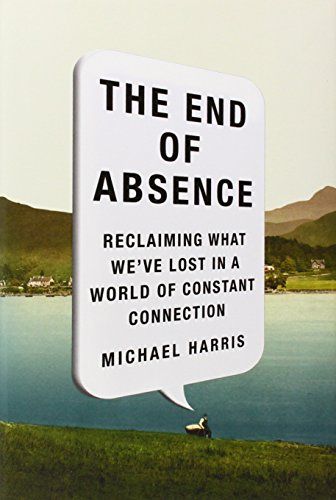
Inhaltsangabe
Soon enough, nobody will remember life before the Internet. What does this unavoidable fact mean?
For future generations, it won't mean anything very obvious. They will be so immersed in online life that questions about the Internet's basic purpose or meaning will vanish.
But those of us who have lived both with and without the crowded connectivity of online life have a rare opportunity. We can still recognize the difference between Before and After. We catch ourselves idly reaching for our phones at the bus stop. Or we notice how, mid-conversation, a fumbling friend dives into the perfect recall of Google.
In this eloquent and thought-provoking book, Michael Harris argues that amid all the changes we're experiencing, the most interesting is the one that future generations will find hardest to grasp. That is the end of absence-the loss of lack. The daydreaming silences in our lives are filled; the burning solitudes are extinguished. There's no true "free time" when you carry a smartphone. Today's rarest commodity is the chance to be alone with your own thoughts.
Die Inhaltsangabe kann sich auf eine andere Ausgabe dieses Titels beziehen.
Über die Autorin bzw. den Autor
Michael Harris is an award-winning journalist, and a contributing editor at Western Living and Vancouver magazines. He lives in Toronto, Canada.
Auszug. © Genehmigter Nachdruck. Alle Rechte vorbehalten.
PROLOGUE
This Can Show You Everything
1996—Malaysia
THE settlement called Batu Lima sat deep in the tropical forests of eastern Malaysia, about three miles from the closest real village. Its one-room houses, largely abandoned or dismantled by the time our story begins, stood on stilts, with floors of bamboo. One family was left—made up of Siandim Gunda, Jimi Sinting, and their twelve children. One daughter, Linda Jimi, was fourteen years old and ready to leave.
There was a box with four little legs in their house, and in the box was a black-and-white television. There was no electricity (Linda was tasked with gathering firewood for the kitchen stove each day), but on special occasions, Linda’s father would take the car battery that powered the TV into the village and have it charged. Then Linda could watch Sesame Street, which was senseless but wonderful, with its American children and Muppets prattling in confounding English, playing out their deeply foreign antics.
Big Bird was yellow, Linda learned. The village children had electricity and color televisions; they would brag about their colors. Linda said, “I know,” and told the other children that her family had colors, too.
Sesame Street was baffling, but Linda’s family believed intrinsically in spirits and ghosts, so the apparitions that flashed on the television screen could be folded into a larger trust in magic, in brushes with the unknowable.
Besides, more magical by far was the komburongoh that Linda’s grandmother Sukat wielded. Linda never touched the sacred object herself, for fear of angering the spirits and growing sick—but she could look across the hut at the thing in her grandmother’s hands, a tight bundle of teeth taken from several animals, knotted together with a collection of small bones. Sukat, who could handle the komburongoh with impunity, had access to the spirit of an ancestor, and she could call upon the spirit for help when attempting to heal members of the Dusun tribe.
Once, before the village was abandoned, Linda watched her grandmother work her magic over a child who’d been stricken with fever. This was only a small ritual, so Sukat hadn’t bothered to dress in the full garb of a bobolian (high priestess)—she’d worn an ordinary sarong and a long-sleeved blouse. Sukat had moved her komburongoh over the sickly child’s head, shaking her bundle of teeth for five full minutes while the infant sweated beneath. Sukat had told the spirit to undo this child’s illness, and the spirit had asked for a sacrifice—a chicken or a few cups of rice.
Sukat’s healing powers were meant to be passed on to her daughter—Linda’s mother—but Sukat died too early, and then, like many Malaysians, Linda’s mother converted to Catholicism. When the family finally left Batu Lima and moved to town, Linda’s mother left behind Sukat’s mystical equipment.
Linda, too, was taking steps away from that miniature settlement, away from the mythical past of Malaysia. She wanted something more, though she couldn’t say what “more” might look like. At eighteen, she ran away from home and moved to the city of Sabah (a relative metropolis with its two thousand people). There she worked at a KFC restaurant (much the same setup as the American version, though minus the American pay). She saved her meager wages for months before purchasing a mobile phone, which became precious to her. She wanted badly to enter the modern world, to live, at last, in the full glow of the world’s future. Eventually, Linda worked her way up to the far “classier” Little Italy restaurant in Kota Kinabalu. The pay was the same, but at least tourists dined there, which meant Linda could practice her English.
Tourists like Nate, a Canadian who’d just graduated from college and was backpacking around the region. “Come hang out in Singapore with me,” he offered.
“Sure,” said Linda, and she went a little farther afield. The couple had their affair and Nate left for home, promising to return in the fall. Linda hoped, rather than believed, that the promise would be fulfilled. And when Nate did return, eventually inviting Linda to come live on the other side of the world, in Vancouver, she might well have undergone severe culture shock. The Canadian city was almost a letdown, though, since Linda had assumed that every city in North America looked like the city she’d seen, in black and white, on Sesame Street.
• • • • •
A few years and many miles later, Linda returned to Malaysia. Now she was a soon-to-be Canadian, lugging a laptop to her mother’s home. She patched into the Internet through a shaky dial-up connection and managed to introduce her mother to the wonder that is Google.
“This can show you everything,” she told her mother. Videos of celebrities flashed across the laptop’s screen. “Here, I’ll show you where I live in Canada.” A few taps later, the laptop’s screen was displaying a map of the world and Linda proceeded to zoom into Canada, into British Columbia, into Vancouver, into the city’s east side, and finally into the block where she lived with Nate. “There,” she said to her mother, pointing. “That’s where I live. That’s my home.” Her mother didn’t understand at first, and Linda continued to wave at the screen. “This can show you everything.”
“It can show me everything?” her mother asked, now leaning in, full of wonder.
“Everything. What do you want to see?”
The answer came through tears: “Show me my mother in the afterlife.”
PART 1
------------------------------
Gathering
We think we have discovered a grotto that is stored with bewildering treasure; we come back to the light of day, and the gems we have brought are false—mere pieces of glass—and yet does the treasure shine on, unceasingly, in the darkness.
—Maurice Maeterlinck
CHAPTER 1
This Kills That
Technology is neither good nor bad, nor is it neutral.
—Melvin Kranzberg
SOON enough, nobody will remember life before the Internet. What does this unavoidable fact mean?
For those billions who come next, of course, it won’t mean anything very obvious. Our online technologies, taken as a whole, will have become a kind of foundational myth—a story people are barely conscious of, something natural and, therefore, unnoticed. Just as previous generations were charmed by televisions until their sets were left always on, murmuring as consolingly as the radios before them, future generations will be so immersed in the Internet that questions about its basic purpose or meaning will have faded from notice. Something tremendous will be missing from their lives—a mind-set that their ancestors took entirely for granted—but they will hardly be able to notice its disappearance. Nor can we blame them.
However, we have in this brief historical moment, this moment in between two modes of being, a very rare opportunity. For those of us who have lived both with and without the vast, crowded connectivity the Internet provides, these are the few days when we can still notice the difference between Before and After.
This is the moment. Our awareness of this singular position pops up every now and again. We catch ourselves idly reaching for our phones at the bus stop. Or we notice how, midconversation, a fumbling friend dives into the perfect recall of Google. We can still catch ourselves. We say,...
„Über diesen Titel“ kann sich auf eine andere Ausgabe dieses Titels beziehen.
Suchergebnisse für The End of Absence: Reclaiming What We’ve Lost...

Beispielbild für diese ISBN
The End of Absence: Reclaiming
Anbieter: World of Books (was SecondSale), Montgomery, IL, USA
Verkäuferbewertung 5 von 5 Sternen

Zustand: Good. Good condition ex-library book with usual library markings and stickers. Bestandsnummer des Verkäufers 00100377814
Gebraucht kaufen
EUR 4,83
Versand gratis
Versand innerhalb von USA
Versand innerhalb von USA
Anzahl: 2 verfügbar
Beispielbild für diese ISBN
The End of Absence: Reclaiming
Anbieter: World of Books (was SecondSale), Montgomery, IL, USA
Verkäuferbewertung 5 von 5 Sternen
Zustand: Very Good. Item in very good condition! Textbooks may not include supplemental items i.e. CDs, access codes etc. Bestandsnummer des Verkäufers 00105725803
Gebraucht kaufen
EUR 4,83
Versand gratis
Versand innerhalb von USA
Versand innerhalb von USA
Anzahl: 3 verfügbar
Beispielbild für diese ISBN
The End of Absence: Reclaiming
Anbieter: World of Books (was SecondSale), Montgomery, IL, USA
Verkäuferbewertung 5 von 5 Sternen
Zustand: Acceptable. Item in acceptable condition! Textbooks may not include supplemental items i.e. CDs, access codes etc. Bestandsnummer des Verkäufers 00107976285
Gebraucht kaufen
EUR 4,83
Versand gratis
Versand innerhalb von USA
Versand innerhalb von USA
Anzahl: 2 verfügbar
Foto des Verkäufers
The End of Absence: Reclaiming What We've Lost in a World of Constant Connection
Anbieter: Greenworld Books, Arlington, TX, USA
Verkäuferbewertung 5 von 5 Sternen
Zustand: good. Fast Free Shipping â" Good condition. It may show normal signs of use, such as light writing, highlighting, or library markings, but all pages are intact and the book is fully readable. A solid, complete copy that's ready to enjoy. Bestandsnummer des Verkäufers GWV.1591846935.G
Gebraucht kaufen
EUR 4,84
Versand gratis
Versand innerhalb von USA
Versand innerhalb von USA
Anzahl: 2 verfügbar
Beispielbild für diese ISBN
The End of Absence: Reclaiming What We've Lost in a World of Constant Connection
Anbieter: MatSamstore, Chantilly, VA, USA
Verkäuferbewertung 4 von 5 Sternen

Zustand: Good. Bestandsnummer des Verkäufers 10-22-2025_MG_1.5M_H0000PKF
Gebraucht kaufen
EUR 5,24
Versand gratis
Versand innerhalb von USA
Versand innerhalb von USA
Anzahl: 1 verfügbar
Beispielbild für diese ISBN
The End of Absence: Reclaiming What We've Lost in a World of Constant Connection
Anbieter: BooksRun, Philadelphia, PA, USA
Verkäuferbewertung 5 von 5 Sternen
Hardcover. Zustand: Fair. With dust jacket. The item might be beaten up but readable. May contain markings or highlighting, as well as stains, bent corners, or any other major defect, but the text is not obscured in any way. Bestandsnummer des Verkäufers 1591846935-7-1-29
Gebraucht kaufen
EUR 5,38
Versand gratis
Versand innerhalb von USA
Versand innerhalb von USA
Anzahl: 1 verfügbar
Beispielbild für diese ISBN
The End of Absence: Reclaiming What We've Lost in a World of Constant Connection
Anbieter: ThriftBooks-Reno, Reno, NV, USA
Verkäuferbewertung 5 von 5 Sternen
Hardcover. Zustand: Very Good. No Jacket. May have limited writing in cover pages. Pages are unmarked. ~ ThriftBooks: Read More, Spend Less. Bestandsnummer des Verkäufers G1591846935I4N00
Gebraucht kaufen
EUR 6,65
Versand gratis
Versand innerhalb von USA
Versand innerhalb von USA
Anzahl: 1 verfügbar
Beispielbild für diese ISBN
The End of Absence: Reclaiming What We've Lost in a World of Constant Connection
Anbieter: ThriftBooks-Reno, Reno, NV, USA
Verkäuferbewertung 5 von 5 Sternen
Hardcover. Zustand: Very Good. No Jacket. Former library book; May have limited writing in cover pages. Pages are unmarked. ~ ThriftBooks: Read More, Spend Less. Bestandsnummer des Verkäufers G1591846935I4N10
Gebraucht kaufen
EUR 6,65
Versand gratis
Versand innerhalb von USA
Versand innerhalb von USA
Anzahl: 1 verfügbar
Beispielbild für diese ISBN
The End of Absence: Reclaiming What We've Lost in a World of Constant Connection
Anbieter: ThriftBooks-Dallas, Dallas, TX, USA
Verkäuferbewertung 5 von 5 Sternen
Hardcover. Zustand: Very Good. No Jacket. Missing dust jacket; May have limited writing in cover pages. Pages are unmarked. ~ ThriftBooks: Read More, Spend Less. Bestandsnummer des Verkäufers G1591846935I4N01
Gebraucht kaufen
EUR 6,65
Versand gratis
Versand innerhalb von USA
Versand innerhalb von USA
Anzahl: 1 verfügbar
Beispielbild für diese ISBN
The End of Absence: Reclaiming What We've Lost in a World of Constant Connection
Anbieter: ThriftBooks-Dallas, Dallas, TX, USA
Verkäuferbewertung 5 von 5 Sternen
Hardcover. Zustand: Very Good. No Jacket. May have limited writing in cover pages. Pages are unmarked. ~ ThriftBooks: Read More, Spend Less. Bestandsnummer des Verkäufers G1591846935I4N00
Gebraucht kaufen
EUR 6,65
Versand gratis
Versand innerhalb von USA
Versand innerhalb von USA
Anzahl: 1 verfügbar