
Verwandte Artikel zu The Voynich Manuscript: The Mysterious Code That Has...
The Voynich Manuscript: The Mysterious Code That Has Defied Interpretation for Centuries - Softcover
Inhaltsangabe
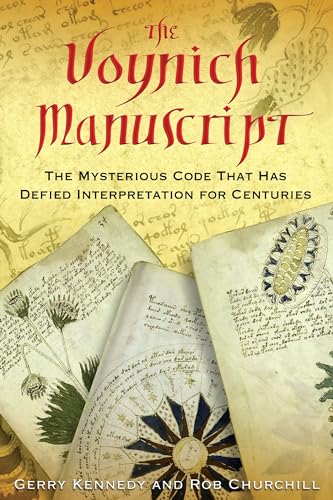
An examination of the many theories surrounding this enigmatic text, apparently written in code
• Reveals the connections between this work and the Cathars, Roger Bacon, and John Dee
• Explains the cryptanalysis methods used in attempts to break the code
• Includes color images from the manuscript juxtaposed with other medieval writings
Since its discovery by Wilfrid Voynich in an Italian monastery in 1912, the Voynich Manuscript has baffled scholars and cryptanalysists with its unidentifiable script and bizarre illustrations. Written in an unknown language or an as yet undecipherable code, this medieval manuscript contains hundreds of illustrations of unknown plants, cosmological charts, and inexplicable scenes of naked “nymphs” bathing in a green liquid that some interpret as a symbolic depiction of human reproduction and the joining of the soul with the body.
Gerry Kennedy and Rob Churchill explore the mystery surrounding the Voynich Manuscript, examining the many existing theories about the possible authors of this work and the information it may contain. They trace the speculative history of the manuscript and reveal those who may be connected to it, including Roger Bacon, John Dee, and the Cathars. With the possibility that it may be a lost alchemical text or other esoteric work, this manuscript remains one of the most intriguing yet enigmatic documents ever to have come to light.
Gerry Kennedy is a freelance writer and has produced a number of BBC Radio 4 programs, including one on the Voynich Manuscript in 2001. Rob Churchill is a professional writer who has written scripts for many production companies, including the BBC and Thames Television. Both authors were consultants for the BBC/Mentorn Films documentary The Voynich Mystery. They live in London.
Die Inhaltsangabe kann sich auf eine andere Ausgabe dieses Titels beziehen.
Über die Autorinnen und Autoren
Gerry Kennedy is a freelance writer and has produced a number of BBC Radio 4 programs, including one on the Voynich Manuscript in 2001. He served as a consultant for the BBC/Mentorn Films documentary The Voynich Mystery. He lives in London.
Rob Churchill is a professional writer who has written scripts for many production companies, including the BBC and Thames Television. He served as a consultant for the BBC/Mentorn Films documentary The Voynich Mystery. He lives in London.
Von der hinteren Coverseite
ANCIENT MYSTERIES
Since its discovery by Wilfrid Voynich in an Italian monastery in 1912, the Voynich Manuscript has baffled scholars and cryptanalysts with its unidentifiable script and bizarre illustrations. Written in an unknown language or an as-yet undecipherable code, this medieval manuscript contains hundreds of illustrations of unknown plants, cosmological charts, and inexplicable scenes of naked nymphs bathing in a green liquid that some interpret as a symbolic depiction of human reproduction and the joining of the soul with the body.
Gerry Kennedy and Rob Churchill explore the mystery surrounding the Voynich Manuscript, examining the many existing theories about the possible authors of this work and the information it may contain. They trace the speculative history of the manuscript and reveal those who may be connected to it, including Roger Bacon, John Dee, Edward Kelley, and the Cathars. With the possibility that it may be a lost alchemical text or other esoteric work, this manuscript remains one of the most intriguing yet enigmatic documents ever to have come to light.
Gerry Kennedy is a freelance writer and has produced a number of BBC Radio 4 programs, including one on the Voynich Manuscript in 2001. Rob Churchill is a professional writer who has written scripts for many production companies, including the BBC and Thames Television. Both authors were consultants for the BBC/Mentorn Films documentary The Voynich Mystery. They live in London.
Auszug. © Genehmigter Nachdruck. Alle Rechte vorbehalten.
from Chapter 6
A Garden of Unearthly Delights
Gerry Kennedy once again takes up the story of his visit to Yale.
The realisation of a fantasy is proverbially fraught; the long-sought-after has a habit of failing to live up to the dream, and, to make things worse, is subject to the fickle vagaries of a first impression. In July 2001, having travelled up from the Big Apple to Yale University to inspect the fabled Voynich manuscript, I was hoping to gain a clear and calm overview of its delights that up until then had been supplied remotely by a computer screen.
Initially, the sheer privilege of being granted an audience with the volume was excitement enough; I had never before sat reverentially in front of any book, let alone a medieval tome. But somewhere at the back of my mind I possessed images of such rarities, of exotic embellishments to first-line letters or the stylised perspectives of scenes and figures that unfolded as part of a recognisable story. Regardless of one’s acquaintance with ancient volumes, Mary D’Imperio was right to state that the Voynich manuscript stands ‘totally apart’ from other ‘remotely comparable documents’.
Each page (or folio, as I learned to term them, recto facing, verso on the other side) that librarian Ellen Cordes turned, as we progressed through the various sections, revealed fresh wonders for which I had no reference points of any kind. The collection of plants seemed gaspingly surreal, the naked nymphs, whether splashing in ponds or disported on starwheels, sensually whimsical, the medicine jars voluptuously oriental. I struggled to find something of the everyday in it, but felt, like others, that some coherent meaning would emerge if only I looked long and hard enough.
The session lasted about forty-five minutes. This inadequacy was compounded by the aloofness of my bibliographic minder. I attempted to ask a few unprobing questions about how often the volume was shown and to whom, only to be met with complete silence. The ‘look don’t touch’ treatment may have been understandable, but the ‘seen and not heard’ addendum was an unnecessary stricture, turning me from a would-be suitor into a Voynich voyeur. Not only did the book itself seem unreal but the whole context in which I viewed it. Most people, for example, on a visit to savour New York, city of gleaming skyscrapers, would be well advised to take in a bird’s-eye panorama from the top of the Empire State--rather than merely ride its cavernous avenues in a taxi. It was like sightseeing New York on a video played within the taxi.
I exited the revolving doors of the Beinecke Library, carrying a $40 unsatisfactory photocopy of the whole Voynich, feeling as dizzy as if I had spent the last three-quarters of an hour trapped in its portal’s clutches. I wasn’t sure what I had seen except for some document of star-status, clearly so rare and precious that it required the attendant services of a strict bodyguard. Fortunately I had arranged an interview that followed shortly after with another starstruck admirer, whose open enthusiasm reminded me that I was not alone in my infatuation. Phillip Marshall, a postgraduate student in biology at Yale, had seen the manuscript, and as a biologist had naturally concentrated his scientific attention on the large section devoted to plants. We discussed some of the possible identifications he had made. Outside the Beinecke glass box I found it soothing to think that it might be possible to temper a possibly irrational personal attraction with some kind of rational analysis.
Marshall has spent a good deal of time trying to make sense of the illustrations, but like others has met with scant success. If it is extraordinary that the manuscript has resisted decipherment by the most pre-eminent cryptographers of the twentieth century, it is even more so that the copious drawings have not really provided a solid basis to our understanding of it. Codes and ciphers perhaps belong to a specialist realm of study; one would expect concrete images to be more amenable to interpretation. It may turn out that the Voynich script hides a large quantity of written gibberish, but the illustrations do not seem to represent the visual equivalent of mere scrawl or doodling. The strange fact, agreed by many commentators, is that there does appear to be some overall sense of intention behind them, a tentative thematic link.
The illustrations described in chapter 1 divide fairly readily into sections, suggesting a systematic purpose rather than a random rambling. Voynich analysts differ over the precise boundaries of these sections but in general concur that these fall into the herbal, astronomical, astrological or cosmological, balneological (or bathing), and a pharmacopoeia section, including a list of ‘recipes’. We shall view the illustrations utilising these useful headings but perhaps more importantly try to put them in an overarching thematic context.
At a general level the Voynich manuscript’s illustrations evince creative and positive life-generating natural forces, whether relating to the heavens or earth. There are few antagonistic images--no blood, lightning, monsters or mythical beasts that haunted the medieval imagination. There is none of the conflict or destructive tendencies that might be generated pictorially where human interaction and social institutions are concerned. For a medieval document it is surprising that there are almost no references to organised religion or the trappings of secular power, or more mundanely to everyday objects--tools, furniture, means of transport, and so on--that might point historically to a way of life. This creates a sense of otherworldliness and timelessness enhanced by zodiacal drawings of suns, stars, moons and ‘cosmic’ phenomena. Yet this in turn is brought down to earth by the apparent purity, youth and innocence of the naked bathing women undergoing perhaps some esoteric aquatic medical treatment associated with the benefit of the many depicted plants. Are we looking perhaps at some kind of magical herbal treatise that holds contentious secrets for the eyes of only a few?
„Über diesen Titel“ kann sich auf eine andere Ausgabe dieses Titels beziehen.
Suchergebnisse für The Voynich Manuscript: The Mysterious Code That Has...

Beispielbild für diese ISBN
The Voynich Manuscript: The Mysterious Code That Has Defied Interpretation for Centuries
Verlag:
Inner Traditions International, 2006
ISBN 10: 1594771294
ISBN 13: 9781594771293
Gebraucht
Paperback
Anbieter: World of Books (was SecondSale), Montgomery, IL, USA
Verkäuferbewertung 5 von 5 Sternen

Paperback. Zustand: Good. An examination of the many theories surrounding this enigmatic text, apparently written in code Reveals the connections between this work and the Cathars, Roger Bacon, and John Dee Explains the cryptanalysis methods used in attempts to break the code Includes color images from the manuscript juxtaposed with other medieval writings Since its discovery by Wilfrid Voynich in an Italian monastery in 1912, the Voynich Manuscript has baffled scholars and cryptanalysists with its unidentifiable script and bizarre illustrations. Written in an unknown language or an as yet undecipherable code, this medieval manuscript contains hundreds of illustrations of unknown plants, cosmological charts, and inexplicable scenes of naked nymphs bathing in a green liquid that some interpret as a symbolic depiction of human reproduction and the joining of the soul with the body. Gerry Kennedy and Rob Churchill explore the mystery surrounding the Voynich Manuscript, examining the many existing theories about the possible authors of this work and the information it may contain. They trace the speculative history of the manuscript and reveal those who may be connected to it, including Roger Bacon, John Dee, and the Cathars. With the possibility that it may be a lost alchemical text or other esoteric work, this manuscript remains one of the most intriguing yet enigmatic documents ever to have come to light. Gerry Kennedy is a freelance writer and has produced a number of BC Radio 4 programs, including one on the Voynich Manuscript in 2001. Rob Churchill is a professional writer who has written scripts for many production companies, including the BC and Thames Television. Both authors were consultants for the BC/Mentorn Films documentary The Voynich Mystery. They live in London. Bestandsnummer des Verkäufers 00110950427
Gebraucht kaufen
EUR 11,61
Versand gratis
Versand innerhalb von USA
Versand innerhalb von USA
Anzahl: 2 verfügbar
Foto des Verkäufers
The Voynich Manuscript: The Mysterious Code That Has Defied Interpretation for Centuries
Anbieter: -OnTimeBooks-, Phoenix, AZ, USA
Verkäuferbewertung 5 von 5 Sternen
Zustand: very_good. Gently read. May have name of previous ownership, or ex-library edition. Binding tight; spine straight and smooth, with no creasing; covers clean and crisp. Minimal signs of handling or shelving. 100% GUARANTEE! Shipped with delivery confirmation, if you're not satisfied with purchase please return item! Ships USPS Media Mail. Bestandsnummer des Verkäufers OTV.1594771294.VG
Gebraucht kaufen
EUR 11,62
Versand gratis
Versand innerhalb von USA
Versand innerhalb von USA
Anzahl: 1 verfügbar
Beispielbild für diese ISBN
The Voynich Manuscript: The Mysterious Code That Has Defied Interpretation for Centuries
Anbieter: SVFOL Bookstore, Sierra Vista, AZ, USA
Verkäuferbewertung 4 von 5 Sternen

Paperback. Zustand: Fine. 3rd Edition, First North American. GOOD - Majority of pages are undamaged with minimal creasing and tearing. No pages are missing. VERY GOOD - Cover has very minimal wear and tear with no obvious damage. Bestandsnummer des Verkäufers mon-uln-1594771294
Gebraucht kaufen
EUR 7,71
EUR 5,21 Versand
Versand innerhalb von USA
Versand innerhalb von USA
Anzahl: 1 verfügbar
Beispielbild für diese ISBN
The Voynich Manuscript: The Mysterious Code That Has Defied Interpretation for Centuries
Verlag:
Inner Traditions International, 2006
ISBN 10: 1594771294
ISBN 13: 9781594771293
Gebraucht
Paperback
Anbieter: World of Books Inc, Montgomery, IL, USA
Verkäuferbewertung 4 von 5 Sternen
Paperback. Zustand: Good. An examination of the many theories surrounding this enigmatic text, apparently written in code Reveals the connections between this work and the Cathars, Roger Bacon, and John Dee Explains the cryptanalysis methods used in attempts to break the code Includes color images from the manuscript juxtaposed with other medieval writings Since its discovery by Wilfrid Voynich in an Italian monastery in 1912, the Voynich Manuscript has baffled scholars and cryptanalysists with its unidentifiable script and bizarre illustrations. Written in an unknown language or an as yet undecipherable code, this medieval manuscript contains hundreds of illustrations of unknown plants, cosmological charts, and inexplicable scenes of naked nymphs bathing in a green liquid that some interpret as a symbolic depiction of human reproduction and the joining of the soul with the body. Gerry Kennedy and Rob Churchill explore the mystery surrounding the Voynich Manuscript, examining the many existing theories about the possible authors of this work and the information it may contain. They trace the speculative history of the manuscript and reveal those who may be connected to it, including Roger Bacon, John Dee, and the Cathars. With the possibility that it may be a lost alchemical text or other esoteric work, this manuscript remains one of the most intriguing yet enigmatic documents ever to have come to light. Gerry Kennedy is a freelance writer and has produced a number of BC Radio 4 programs, including one on the Voynich Manuscript in 2001. Rob Churchill is a professional writer who has written scripts for many production companies, including the BC and Thames Television. Both authors were consultants for the BC/Mentorn Films documentary The Voynich Mystery. They live in London. Bestandsnummer des Verkäufers CIN1594771294G
Gebraucht kaufen
EUR 13,48
Versand gratis
Versand innerhalb von USA
Versand innerhalb von USA
Anzahl: 2 verfügbar
Beispielbild für diese ISBN
The Voynich Manuscript: The Mysterious Code That Has Defied Interpretation for Centuries
Verlag:
Inner Traditions, 2006
ISBN 10: 1594771294
ISBN 13: 9781594771293
Gebraucht
Soft cover
Erstausgabe
Anbieter: Martin Nevers- used & rare books, Oxford, FL, USA
Verkäuferbewertung 5 von 5 Sternen
Soft cover. Zustand: Very Good. 1st Edition. Pictorial front cover. Three sections of colored illustrations. A few pages of B/W illustrations scattered through the book. Light wear to corner tips. Photos of book on request. Bestandsnummer des Verkäufers 020075
Gebraucht kaufen
EUR 9,35
EUR 5,22 Versand
Versand innerhalb von USA
Versand innerhalb von USA
Anzahl: 1 verfügbar
Foto des Verkäufers
The Voynich Manuscript: The Mysterious Code That Has Defied Interpretation for Centuries
Anbieter: MERS Goodwill, Saint Louis, MO, USA
Verkäuferbewertung 5 von 5 Sternen
Zustand: good. Used - Good: All pages and cover are intact including the dust cover, if applicable . Spine may show signs of wear. Pages may include limited notes and highlighting. May include From the library of labels. Shrink wrap, dust covers, or boxed set case may be missing. Item may be missing bundled media. Any access codes or passwords originally included with the book may be expired, used or no longer valid. Image is stock photo and cover art edition may be different than pictured. Bestandsnummer des Verkäufers MERV.1594771294.G
Gebraucht kaufen
EUR 11,32
EUR 3,63 Versand
Versand innerhalb von USA
Versand innerhalb von USA
Anzahl: 1 verfügbar
Beispielbild für diese ISBN
The Voynich Manuscript: The Mysterious Code That Has Defied Interpretation for Centuries
Verlag:
Inner Traditions, Rochester, VT, 2006
ISBN 10: 1594771294
ISBN 13: 9781594771293
Neu
Soft cover
Anbieter: Veronica's Books, Gig Harbor, WA, USA
Verkäuferbewertung 5 von 5 Sternen
Soft cover. Zustand: New. Brand New Stock. 292pp. Book. Bestandsnummer des Verkäufers 026459
Neu kaufen
EUR 13,08
EUR 5,90 Versand
Versand innerhalb von USA
Versand innerhalb von USA
Anzahl: 1 verfügbar
Beispielbild für diese ISBN
The Voynich Manuscript: The Mysterious Code That Has Defied Interpretation for Centuries
Anbieter: INDOO, Avenel, NJ, USA
Verkäuferbewertung 5 von 5 Sternen
Zustand: New. Bestandsnummer des Verkäufers 9781594771293
Foto des Verkäufers
The Voynich Manuscript: The Mysterious Code That Has Defied Interpretation for Centuries
Verlag:
Inner Traditions, Rochester, VT, 2006
ISBN 10: 1594771294
ISBN 13: 9781594771293
Gebraucht
Softcover
Anbieter: Monroe Street Books, Middlebury, VT, USA
Verkäuferbewertung 4 von 5 Sternen
Zustand: Very Good. Zustand des Schutzumschlags: None. 392 pages. Softcover. Very minor wear, foxing to top of text block, otherwise clean and tight copy. Record # 2230724. Bestandsnummer des Verkäufers 2230724
Gebraucht kaufen
EUR 14,95
EUR 4,54 Versand
Versand innerhalb von USA
Versand innerhalb von USA
Anzahl: 1 verfügbar
Beispielbild für diese ISBN
The Voynich Manuscript: The Mysterious Code That Has Defied Interpretation for Centuries
Anbieter: Revaluation Books, Exeter, Vereinigtes Königreich
Verkäuferbewertung 5 von 5 Sternen
Paperback. Zustand: Brand New. 292 pages. 9.00x6.00x1.00 inches. In Stock. Bestandsnummer des Verkäufers 1594771294
Neu kaufen
EUR 41,92
EUR 14,99 Versand
Versand von Vereinigtes Königreich nach USA
Versand von Vereinigtes Königreich nach USA
Anzahl: 1 verfügbar